ExoMars Trace Gas Orbiter
ESA and Roscosmos · Multinational · Orbiter · 2016 · The long occupationOperating
Operating as of 3 September 2026: JPL Horizons returns live Mars-centred vectors for it, and raw ACS, NOMAD and FREND products run in ESA's public archive to 29 May 2026, the newest it holds.
TL;DR· 14 min read
The Trace Gas Orbiter was sent to settle the argument about methane on Mars, carrying spectrometers roughly a thousand times more sensitive than anything before it. It found none: an upper limit near 0.05 ppbv in 2019, tightened to 20 pptv in 2021, which sits against Curiosity's measurements inside Gale crater and has not been reconciled. It has meanwhile detected hydrogen chloride, mapped hydrogen in the top metre of soil and relayed for other agencies' rovers. It was still flying and filing data in 2026.
The Trace Gas Orbiter was sent to Mars to settle an argument. Several teams had reported methane in the Martian atmosphere, a gas that should not last there and that on Earth is mostly made by living things. TGO carried spectrometers roughly a thousand times more sensitive than anything that had looked before. It found nothing. That non-detection sits directly against Curiosity's measurements from inside Gale crater, and the two results have not been reconciled in the seven years since. Meanwhile TGO does the unglamorous work: mapping subsurface hydrogen, tracking how Mars leaks water, and relaying other agencies' rovers home.
- 20 pptvtightest published upper limit on Martian methane, ACS 2021, from 1.44 Mars years of occultations
- 98,000 kmapoapsis at capture, aerobraked down to a 400 km circle in about a year
- 2 of 4instruments built in Moscow, still filing data to ESA's archive in 2026
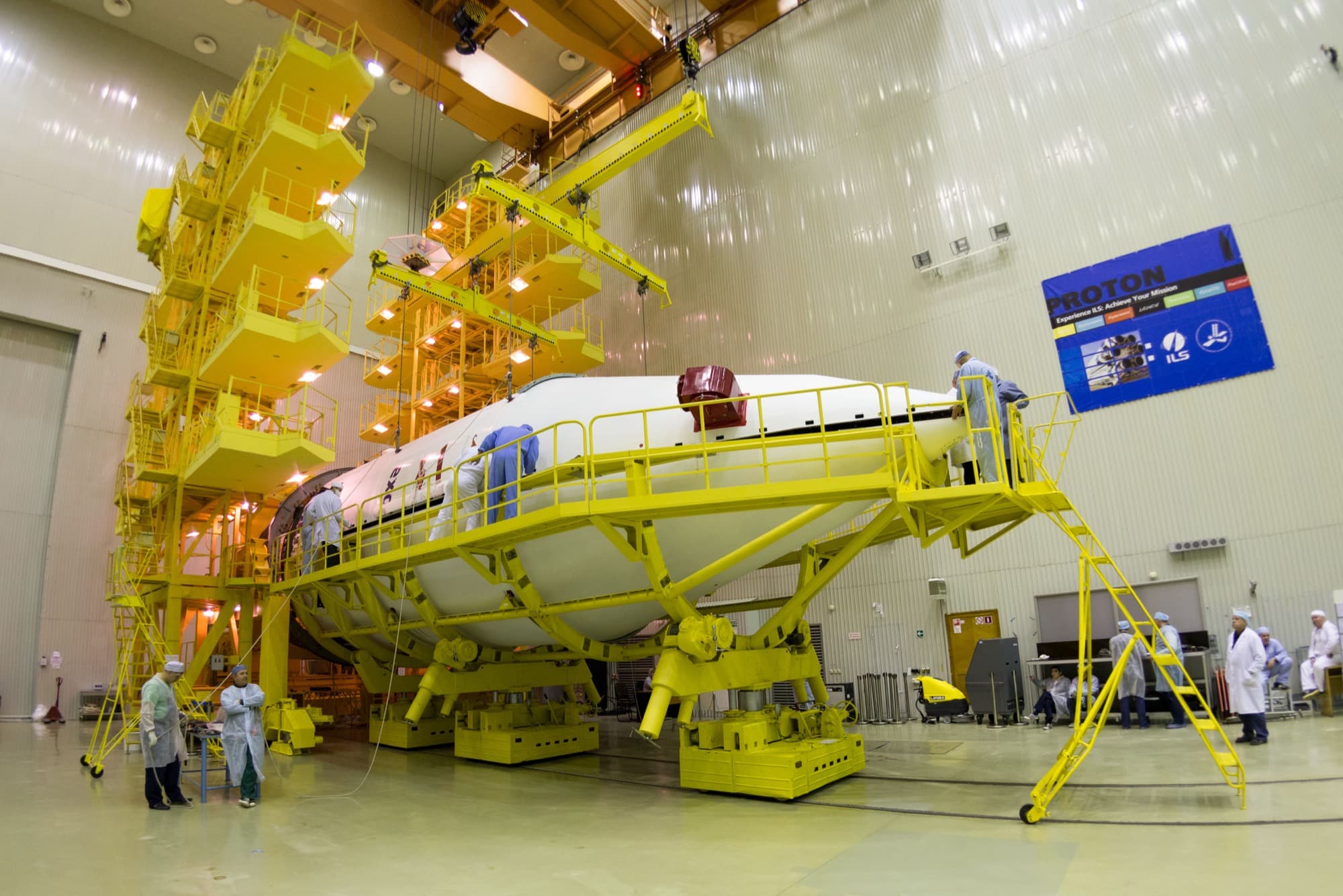
The Trace Gas Orbiter left Baikonur on 14 March 2016 at 09:31 UTC on a Proton-M, a Russian rocket carrying a spacecraft built by Thales Alenia Space, with the Schiaparelli demonstrator bolted to its side. It reached Mars on 19 October 2016 and burned its main engine for 139 minutes, from 13:05 to 15:24 UTC, shedding more than 1.5 km/s so the planet could catch it. That left it on a four-day ellipse of roughly 200 by 98,000 km, which is a captured orbit but not a useful one. Getting down to a working orbit took about eleven months of aerobraking, dipping into the top of the atmosphere and letting drag on the solar wings do what propellant would otherwise have had to. ESA announced aerobraking complete in February 2018, thruster firings closed the circle through April, and the main science mission began at the end of that month from a near-circular orbit roughly 400 km up, inclined 74 degrees, going round every two hours. Four instrument suites ride on it: NOMAD from the Royal Belgian Institute for Space Aeronomy, ACS and the FREND neutron telescope from the Space Research Institute in Moscow, and the CaSSIS camera from the University of Bern. NASA added a fifth box that is not a science instrument at all, the Electra relay and navigation radio. ESA's mission manager called it the heaviest orbiter ever sent to the Red Planet; ESA's own factsheet puts the orbiter alone at 3,732 kg, of which 113.8 kg is instruments.
Its reason for existing was methane. The gas should not survive long in the Martian atmosphere: ESA puts its predicted lifetime at about 300 years before ultraviolet light and photochemistry break it down. Anything present now must have been released recently, and on Earth the overwhelming majority of atmospheric methane comes from life. Mars Express reported about 10 ppbv from orbit in 2004. Ground-based telescopes reported both nothing and transient values up to about 45 ppbv. Curiosity, sitting in Gale crater since 2012, reported a rise to 7 plus or minus 2 ppbv in 2013 to 2014 and then a seasonally varying background that ESA summarises as about 0.2 to 0.7 ppbv. TGO was built with roughly three orders of magnitude more sensitivity than any of them, precisely to end the argument. Between April and August 2018 ACS and NOMAD stared through the Martian limb at sunrise and sunset, across both hemispheres, and found nothing. The upper limit published in Nature on 10 April 2019 was about 0.05 ppbv, with the single best limit of 0.012 ppbv at 3 km altitude. In 2021 a second campaign of 640 occultations spanning 1.44 Mars years pushed the annual mean of the smallest upper limits down to 20 pptv, which is 0.02 ppbv.
That is a genuine, unresolved scientific disagreement, and it is worth stating both sides properly rather than picking the answer that sounds tidier. TGO measures long slant paths through the atmosphere, mostly above about 3 km, in daylight. Curiosity measures air a metre above the floor of a crater, and since 2021 at night as well as by day. In 2021 Webster and colleagues reported two daytime Curiosity measurements averaging 0.05 plus or minus 0.22 ppbv, a non-detection consistent with TGO, against four nighttime measurements in the same season averaging 0.52 plus or minus 0.10 ppbv. Their proposal is micro-seepage that accumulates under the collapsed nocturnal boundary layer and is diluted by daytime mixing, which would let both instruments be right. Against that, Gillen, Rimmer and Catling reanalysed the Curiosity data in 2020 and found no statistically strong seasonal cycle. And in April 2025 Viscardy, Catling and Zahnle went further, arguing that the spectrometer's own foreoptics chamber routinely held methane three to four orders of magnitude above the levels reported from the sample cell, and that leaks of under 0.1 per cent of that reservoir would reproduce the published atmospheric numbers while staying invisible in housekeeping data. Nobody has yet demonstrated a chemical sink fast enough to destroy methane before it mixes globally, which is what Korablev said in 2019 would be required. As of September 2026 the question is open.
TGO has meanwhile done a great deal that has nothing to do with methane. In February 2021 the ACS and NOMAD teams reported hydrogen chloride at Mars, which ESA called the first halogen gas detected there; it appeared in both hemispheres simultaneously during the 2018 global dust storm and disappeared when the dust settled, pointing at salty dust reacting with atmospheric water rather than at volcanism. The same day, NOMAD results traced water vapour and semi-heavy water from near the surface to above 80 km, turning the deuterium-to-hydrogen ratio from a single column average into an altitude profile, and identified three episodes of accelerated water loss in a single Mars year. FREND, counting neutrons to find hydrogen in the top metre of soil, produced a map in 131 days that beat sixteen years of its predecessor on Mars Odyssey, and in December 2021 flagged an area in Candor Chaos about the size of the Netherlands where as much as 40 per cent of the near-surface material may be water. CaSSIS has supplied colour stereo imaging of everything from dust devils to slope streaks. And in February 2026 an ESA blog post described work using TGO, MRO and the Emirates Mars Mission to show that a single out-of-season regional dust storm in 2023 lifted water to 60 to 80 km and roughly 2.5 times the usual hydrogen escape.
The last thread is politics. TGO is formally an ESA-Roscosmos mission, and two of its four instruments were built in Moscow. When ESA's Council met on 16 and 17 March 2022 it acknowledged that the ExoMars rover cooperation with Roscosmos could not continue and mandated its suspension. That decision hit the rover. The orbiter was untouched. Rosalind Franklin lost its Russian descent module, its Russian landing platform and its Russian ISEM spectrometer, which has since been replaced by the UK-built Enfys; it was rebuilt around a US launch and a new European landing platform, and ESA's current factsheet gives its launch as 2028 on a Falcon Heavy. TGO simply kept flying. Raw products from ACS, NOMAD and FREND appear in ESA's public archive through 29 May 2026, the newest raw products it currently holds. ESA's SPICE repository carries a spacecraft clock correlation file whose last point is 25 August 2026 at 03:59:25 UTC, generated the following day, and flight-dynamics trajectory files running to 12 September 2026. JPL Horizons returned live Mars-centred vectors for the spacecraft on 3 September 2026, putting it about 3,789 km from the centre of Mars. On that evidence, and not on memory, TGO is working.
Mission facts
Launch
14 March 2016 at 09:31:42 UTC on a Proton-M with a Breeze-M upper stage from Baikonur Cosmodrome, with the Schiaparelli demonstrator attached. ESA's flight plan had Breeze-M releasing the pair onto the interplanetary trajectory at 20:13 UTC and first signal reaching ESOC via the Malindi ground station at about 21:28 UTC. All times in this entry are UTC unless marked otherwise.↗
Spacecraft
Built by Thales Alenia Space. ESA's factsheet gives 4,332 kg at launch for the whole stack, made up of the orbiter at 3,732 kg including 113.8 kg of science payload and Schiaparelli at 577 kg. Body about 3.5 by 2 by 2 m, solar arrays spanning 17.5 m tip to tip, about 2 kW of power. ESA's factsheet also records TGO's arrival as the second time ESA placed a spacecraft in orbit around Mars, after Mars Express.↗
Instruments
Four suites. NOMAD (Nadir and Occultation for MArs Discovery), two infrared channels and one ultraviolet, principal investigator Ann Carine Vandaele at the Royal Belgian Institute for Space Aeronomy. ACS (Atmospheric Chemistry Suite), three infrared spectrometer channels, PI Oleg Korablev at the Space Research Institute of the Russian Academy of Sciences, Moscow. FREND (Fine Resolution Epithermal Neutron Detector), a collimated neutron telescope, PI Igor Mitrofanov, same institute. CaSSIS (Colour and Stereo Surface Imaging System), built at the University of Bern; its instrument paper is led by Nicolas Thomas of Bern. NASA supplied a fifth box, the Electra relay radio.↗
Mars orbit insertion
19 October 2016. The main engine burned for 139 minutes, from 13:05 to 15:24 UTC, changing the spacecraft's velocity by more than 1.5 km/s and dropping it into a capture orbit. It was ESA's second successful Mars orbit insertion after Mars Express. The same spacecraft was simultaneously recording Schiaparelli's descent telemetry.↗
Aerobraking and the science orbit
The capture orbit was a four-day ellipse of roughly 200 by 98,000 km. TGO then aerobraked, using drag on its solar wings at the top of the atmosphere rather than propellant. ESA announced aerobraking complete in February 2018, while ESA's own factsheet writes the span as March 2017 to March 2018; additional thruster firings then closed the circle by the end of April. ESA describes the main science mission as beginning at the end of April 2018, from a near-circular orbit about 400 km up, inclined 74 degrees, period two hours. On the ESA page announcing that milestone, TGO mission manager Pia Mitschdoerfer calls it "the heaviest orbiter ever sent to the Red Planet"; we have not audited that claim against every previous Mars orbiter ourselves.↗
Relay role
The Electra proximity payload was provided by NASA. TGO relays for NASA surface assets and is the planned relay for ESA's Rosalind Franklin rover. Its first relay session with Perseverance opened at 02:07 CET on 19 February 2021, about four hours after that rover landed. TGO's operations manager Peter Schmitz described the normal cadence as one relay session per lander per day, with two extra sessions a day added for Perseverance.↗
The methane result, 2019
Korablev and colleagues, in Nature on 10 April 2019, reported ACS and NOMAD solar-occultation measurements from April to August 2018 and found no methane at any latitude in either hemisphere. The upper limit was about 0.05 parts per billion by volume, which they described as 10 to 100 times lower than previously reported positive detections. ESA's accompanying release adds that the single most precise limit, 0.012 ppbv, was reached at 3 km altitude.↗
The methane result, tightened
Montmessin and colleagues, in Astronomy and Astrophysics in 2021, used 640 ACS solar occultations covering 1.44 Mars years. Still nothing. In the clear northern summer they reached 1 sigma upper limits near 10 pptv, 20 pptv at 2 sigma, with an annual mean of the smallest upper limits of 20 pptv, that is 0.02 ppbv. Dust is the limiting factor: performance degrades near the equator and through southern spring and summer.↗
What Curiosity measured
The Tunable Laser Spectrometer in Curiosity's Sample Analysis at Mars suite reported a rise from below 1 to 7 plus or minus 2 ppbv across 2013 to 2014, published by Webster and colleagues in Science in 2015, then in Science in June 2018 a background varying seasonally, measured over five Earth years, close to three Mars years. ESA summarises that seasonal range as about 0.2 to 0.7 ppbv. These are in-situ measurements of air a metre or so above the floor of Gale crater; TGO's are line-of-sight column measurements through the limb, mostly above 3 km.↗
The day-night hypothesis
Webster and colleagues, in Astronomy and Astrophysics in 2021, reported two daytime TLS measurements averaging 0.05 plus or minus 0.22 ppbv, a non-detection, against four nighttime measurements in the same season averaging 0.52 plus or minus 0.10 ppbv. Their reading is that methane seeps out and stays trapped in the collapsed nocturnal boundary layer, then gets stirred away and diluted by day, which is when TGO looks. The same paper reports a June 2019 spike with a two-hour mean of 20.5 plus or minus 4 ppbv.↗
The statistical challenge
Gillen, Rimmer and Catling, in Icarus in 2020, reanalysed the Curiosity data and reported no evidence for a strong seasonal cycle of Martian methane, disputing the statistical validity of the 2018 claim rather than the detections themselves.↗
The instrument challenge, 2025
Viscardy, Catling and Zahnle, in the Journal of Geophysical Research: Planets on 13 April 2025, argued that TLS's own foreoptics chamber typically held methane 3 to 4 orders of magnitude above the levels reported in the sample cell, and that leaks smaller than 0.1 per cent of that reservoir would be enough to produce the reported atmospheric values while remaining invisible in housekeeping data. They also argued the retrieval method, averaging the three lines of the R3 triplet as if independent, understates the uncertainties. This challenges the Curiosity measurements. It is not a retraction by the Curiosity team.↗
Hydrogen chloride
In February 2021 ACS and NOMAD teams reported HCl in the Martian atmosphere, which ESA described as the first detection of a halogen gas there and the first new gas TGO had found. It appeared in both hemispheres at once during the 2018 global dust storm and vanished at the end of the dusty season. The proposed chemistry is salty dust lofted by wind reacting with atmospheric water, which argues against a volcanic source.↗
Water loss
NOMAD measurements published the same day tracked water vapour and semi-heavy water (HDO) from near the surface to above 80 km, giving the deuterium-to-hydrogen ratio as a function of altitude and season for the first time rather than as a column average. Once water is fully vapourised the enrichment settles near six times Earth's D/H across all reservoirs. Data from April 2018 to April 2019 showed three episodes of accelerated loss: the 2018 global dust storm, a regional storm in January 2019, and summer release from the south polar cap.↗
Subsurface water
FREND maps hydrogen in the top metre of soil by counting neutrons; drier ground emits more. In December 2021 Mitrofanov and colleagues reported an area in Candor Chaos, inside Valles Marineris and roughly the size of the Netherlands, where up to 40 per cent of the near-surface material appears to be water if the hydrogen is bound in water molecules. The dataset ran from May 2018 to February 2021. ESA had already noted in 2019 that 131 days of FREND data beat the resolution of 16 years from its predecessor on Mars Odyssey.↗
After the 2022 rupture
ESA's Council, meeting in Paris on 16 and 17 March 2022, acknowledged the impossibility of continuing the ExoMars rover cooperation with Roscosmos and mandated its suspension. That decision was about the rover mission. TGO was not part of it. TGO continued flying as a joint ESA-Roscosmos mission with its two Russian-built instruments, and raw ACS, NOMAD and FREND products in ESA's Planetary Science Archive run through 29 May 2026, the newest raw products the archive currently holds, and the newest raw science products from ACS and NOMAD cover 21 May 2026.↗
Mission timeline
- 14 Mar 2016Launch at 09:31:42 UTC on a Proton-M/Breeze-M from Baikonur, with Schiaparelli attached. ESA's plan had Breeze-M releasing the pair onto the Mars trajectory at 20:13 UTC and first signal reaching ESOC via Malindi about an hour later.
- 16 Oct 2016TGO releases the 577 kg Schiaparelli demonstrator at 14:42 UTC and raises its own trajectory so that, unlike its passenger, it will not hit the planet.
- 19 Oct 2016Mars orbit insertion: a 139-minute main-engine burn from 13:05 to 15:24 UTC sheds more than 1.5 km/s. TGO records Schiaparelli's descent telemetry at the same time, which is why the crash could later be reconstructed second by second.
- Mar 2017 to Feb 2018Aerobraking. TGO skims the top of the atmosphere for about a year, trading drag for propellant, dropping from a four-day 200 by 98,000 km ellipse toward its working orbit. ESA announces aerobraking complete in February 2018; its own factsheet writes the span as March 2017 to March 2018.
- Apr 2018Additional manoeuvres close the circle and, as ESA puts it, the main science mission begins at the end of April 2018, from a near-circular orbit about 400 km above Mars, inclined 74 degrees, period two hours. Two months later the planet stages a global dust storm, which TGO watches from the start.
- 10 Apr 2019First methane results published in Nature: no detection, upper limit about 0.05 ppbv from April to August 2018 data. ACS PI Oleg Korablev tells ESA the measurements suggest "a global absence of methane" and that reconciling them with Gale crater needs "a method that efficiently destroys methane close to the surface".
- 10 Feb 2021TGO reports hydrogen chloride, described by ESA as the first halogen gas found at Mars, alongside NOMAD's altitude-resolved D/H measurements and three episodes of accelerated water loss.
- 19 Feb 2021TGO opens its first relay session with NASA's Perseverance at 02:07 CET, about four hours after the rover lands in Jezero crater.
- 15 Dec 2021FREND reports a hydrogen-rich area in Candor Chaos, in Valles Marineris, roughly the size of the Netherlands, where as much as 40 per cent of the near-surface material may be water.
- 17 Mar 2022ESA's Council suspends cooperation with Roscosmos on the ExoMars rover after the invasion of Ukraine. TGO itself keeps flying, Russian instruments included.
- 13 Apr 2025Viscardy, Catling and Zahnle publish a challenge to the Curiosity methane detections themselves, arguing that undetectable leaks from the spectrometer's own methane-rich foreoptics chamber could account for them.
- 18 Aug 202625 August 2026 at 03:59:25 UTC: the last spacecraft clock correlation point in ESA's currently published SPICE kernel for TGO, generated the following day. Flight-dynamics orbit files in the same repository run to 12 September 2026.
A filled dot marks something that physically happened. A hollow one marks an announcement, a naming or a target.
In pictures
Tap a photo to enlarge.
Sources
- ESA, First results from the ExoMars Trace Gas Orbiter, 10 April 2019
- Korablev et al., No detection of methane on Mars from early ExoMars Trace Gas Orbiter observations, Nature 568, 517-520 (2019)
- Montmessin et al., A stringent upper limit of 20 pptv for methane on Mars, Astronomy and Astrophysics 650, A140 (2021)
- Webster et al., Day-night differences in Mars methane suggest nighttime containment at Gale crater, Astronomy and Astrophysics 650, A166 (2021)
- Gillen, Rimmer and Catling, Statistical analysis of Curiosity data shows no evidence for a strong seasonal cycle of martian methane, Icarus 336, 113407 (2020)
- Viscardy, Catling and Zahnle, Questioning the Reliability of Methane Detections on Mars by the Curiosity Rover, JGR Planets 130, e2024JE008441 (13 April 2025)
- ESA, ExoMars discovers new gas and traces water loss on Mars, 10 February 2021
- ESA, ExoMars discovers hidden water in Mars' Grand Canyon, 15 December 2021
- ESA, To Mars and back blog, An unusual dust storm reveals how Mars lost some of its water, 2 February 2026
- ESA press release, ExoMars suspended, 17 March 2022
- ESA SPICE Service kernel repository for ExoMars 2016, spacecraft clock kernels: em16_tgo_step_20260818.tsc
- JPL Horizons, live Mars-centred state vectors for ExoMars16 TGO (object -143), queried 23 August 2026
- Escudero-Jimenez et al., Upper limits of CH4 and OCS in the Martian atmosphere from NOMAD/TGO solar occultation, Icarus (online 29 December 2025)
- ESA Planetary Science Archive, ExoMars 2016 raw data trees for ACS, NOMAD and FREND
Facts on this page were verified on 3 September 2026. Where sources disagree, the disagreement is stated rather than resolved silently.