China's crewed Mars plans
CASC and CNSA (China) · China · Program · 2016 · AnnouncedPlanned
Stated but not funded. As of 24 August 2026 China has approved no crewed Mars mission; CNSA's roadmap, presented to the UN in January 2024, puts crewed Mars in the 2040 to 2050 band, behind a lunar landing around 2030.
TL;DR· 14 min read
China has published a great deal of engineering detail about flying people to Mars and has approved none of it. The June 2021 CALT report by Wang Xiaojun sets out a three-step path and nuclear transfer ships of 246 and 328 tonnes, and lists 2033, 2035, 2037, 2041 and 2043 as candidate departure windows rather than a launch schedule. CNSA's own roadmap, presented to the UN in January 2024, puts crewed Mars exploration in the 2040 to 2050 band. What China has actually funded at Mars is robotic: Tianwen-3, launching around 2028.
China has published an unusual amount of engineering detail about how it would fly people to Mars, and has approved none of it. In June 2021 the president of the China Academy of Launch Vehicle Technology set out a three-step path, a fleet of nuclear-powered transfer ships and a set of candidate departure windows starting in 2033. Those five years have since been repeated worldwide as a Chinese launch schedule. The document they come from is a conference report about transportation architecture, and it lists them under the heading departure time, as an input to the design. What China has actually funded at Mars is robotic.
- 2033earliest of five candidate departure years in the 2021 architecture; no launch date has been approved
- 2040swhere CNSA's own published roadmap places crewed Mars exploration
- 246 tmass of the nuclear crew transfer ship in the 2021 design, carrying 65 t
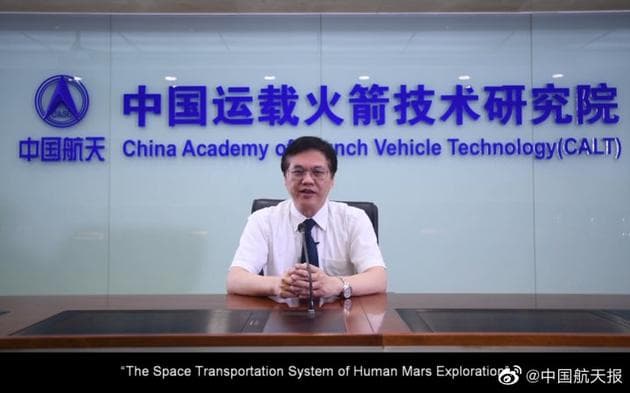
The Chinese crewed Mars story that circulates in English is a story about five years: 2033, 2035, 2037, 2041, 2043. It is worth going back to where they come from, because the original reads differently. On 23 June 2021 China Space News, the newspaper of the two state space conglomerates, published a summary of a plenary report Wang Xiaojun had given at the Global Space Exploration Conference in Russia. Wang runs the China Academy of Launch Vehicle Technology, the institute that builds the Long March rockets, and his paper was about transportation: what kind of vehicles a crewed Mars expedition would need, and how they would be staged. The article sets out a three-step conception. Step one is robotic Mars exploration, called the technology preparation phase, covering sample return, choosing a base site and building an in-situ resource utilisation system. Step two is initial exploration, called the preliminary application phase, covering crewed flight around Mars, crewed landing and base construction. Step three is airline-style exploration, called the economic-sphere formation phase, with a large-scale Earth to Mars transport fleet. The five years appear further down, under a heading listing the factors that influence architecture design: transfer orbit type, departure time, departure point, propulsion technology, and whether aerocapture is used. Under departure time it gives those years and then 等, and so on. They are the windows the analysis considered. They are not a manifest, and the article never says a crewed landing happens in any of them.
What the article does contain is unusually concrete engineering, and it deserves to be read for that rather than for the dates. An initial crewed expedition is sized at seven heavy-lift launches plus one crewed launch, all chemical, to get the pieces off Earth. None of it has been built, so it is worth writing in the conditional. The stack would be assembled in low Earth orbit, pushed by a high specific impulse nuclear electric ferry stage to a high elliptical orbit, and would depart from there. Two nuclear transfer vehicles would do the interplanetary legs. The crewed one is drawn at 246 tonnes total mass, 108 tonnes of liquid hydrogen and 65 tonnes of payload including a deep space habitation module and a crew spacecraft. The cargo one is drawn at 328 tonnes, 76 tonnes of hydrogen and 206 tonnes of payload. Both are specified with three nuclear thermal engines of 10-tonne-class thrust in a dual-mode arrangement, with a nuclear electric system powering the subsystems. Crew and cargo would fly separately. Aerocapture would be used at Mars. The Mars lander and ascent vehicle would be chemical. The round trip is given as several hundred days, the distance as millions to hundreds of millions of kilometres, and the profile as several and possibly more than ten rendezvous and docking events. The article also notes, in one sentence, that China has studied a space elevator as an alternative departure point because it would reduce the transport scale required. That sentence is a useful calibration of where this work sits.
Set that against what China has approved. The Mars programme was formally approved on 11 January 2016, with two published stages: orbit, land and rove, done by Tianwen-1 in 2021, and return, assigned to Tianwen-3. Tianwen-3 is real and progressing. On 12 March 2026, during the annual Two Sessions, its chief designer Liu Jizhong said the key technologies had been broken through, prototypes were being built and the programme would move to flight model development within the year, for two launches around 2028, on the Long March 5 named in CNSA's own roadmap deck and at least 500 grams of Martian material back on Earth around 2031. China's own official long-range roadmap, presented to the United Nations by CNSA's Lunar Exploration and Space Engineering Center on 30 January 2024, is equally clear about where the crewed part sits. Its planetary exploration timeline runs 2025, 2030, 2040, 2050. Tianwen-2, Tianwen-3 and Tianwen-4 occupy the near end. Mars Research Station and Manned Mars Exploration sit in the 2040 to 2050 band. The crewed lunar landing, which is the approved and funded Chinese human spaceflight goal, is given as around 2030. That is a roadmap that puts people on Mars roughly a decade after Wang's earliest candidate window, and it is the one the agency itself published. Times on this page are UTC unless stated; the Chinese sources quoted here give them in Beijing time, UTC+8.
The 2026 evidence points the same way. A draft of the 15th Five-Year Plan, covering 2026 to 2030, circulated after the National People's Congress opened on 5 March 2026. Its deep space passage names a second phase of planetary exploration projects, near-Earth asteroid defence, solar system edge exploration, reusable heavy-lift launch vehicles, construction of the international lunar research station and implementation of lunar exploration projects. There is no crewed Mars line. The hardware picture is consistent with that. Every published Chinese crewed Mars architecture assumes super heavy-lift vehicles, and CNSA's own heavy-lift roadmap gives basic flight verification around 2030, a two-stage tandem configuration of 100 to 150 tonnes to low Earth orbit and a two-stage fully reusable configuration of 80 tonnes around 2040, and a routine round-trip transport system by 2050. Even the nearer-term human-rated Long March 10 had not flown as of August 2026, although CALT indicated in December 2025 that a major milestone was scheduled for the year. None of this makes the Chinese interest in crewed Mars fake. It makes it what CALT itself called it: a development route and a mission architecture, worked in enough detail to size the vehicles, and waiting on a decision nobody in Beijing has yet published.
Mission facts
The source document
Almost everything specific in circulation about a Chinese crewed Mars mission traces to one article: 中国载人火星探测“三步走”设想, a three-step conception for Chinese crewed Mars exploration, published on 23 June 2021 by 中国航天报 (China Space News), the newspaper of the two state space conglomerates CASC and CASIC, edited by 胡蓝月 and sourced to CALT. It summarises a plenary report given at the 2021 Global Space Exploration Conference in Russia.↗
Who presented it
王小军 (Wang Xiaojun), president of the First Academy of the China Aerospace Science and Technology Corporation, which is the China Academy of Launch Vehicle Technology (CALT), and a vice-president of the International Astronautical Federation. His paper was titled 《载人火星探测航天运输系统》, Space Transportation System for Crewed Mars Exploration. He was speaking as a rocket designer about transport architecture. No agency was announcing a mission.↗
Step one
机器人火星探测, robotic Mars exploration, labelled the technology preparation phase (技术准备阶段). Its listed tasks are Mars sample return, survey and selection of a site for a Mars base, and construction of an in-situ resource utilisation system. This is the only step for which China currently has an approved mission.↗
Step two
初级探测, initial exploration, labelled the preliminary application phase (初步应用阶段). Its listed tasks are crewed flight around Mars, orbital exploration, crewed Mars landing exploration, and construction of a Mars base. The architecture for this step uses combined nuclear electric and nuclear thermal propulsion, separate crew and cargo flights (人货分运), assembly in low Earth orbit, departure from a high elliptical orbit, and aerocapture at Mars.↗
Step three
航班化探测, which translates roughly as flight-scheduled or airline-style exploration, labelled the economic-sphere formation phase (经济圈形成阶段). Its listed tasks are a large-scale Earth to Mars transport fleet and large-scale development and application. The article describes departures from an Earth space station or the Sun-Earth L2 point onto Earth-Mars cycler orbits, with transfer craft already parked on the cycler and refuelled from ground or orbital depots.↗
What 2033 actually is
The years 2033, 2035, 2037, 2041 and 2043 appear under 出发时间, departure time, which is one of five factors the article lists as influencing the design of the mission architecture, alongside transfer orbit type, departure point, propulsion technology and whether aerocapture is used. The list ends with 等, meaning and so on. The article does not call them a manifest, does not assign a mission to any of them, and does not say a crewed landing happens in any of them. Chinese Wikipedia's summary, and much English reporting, render the same line as a schedule of five crewed Mars missions.↗
The launch stack
Under 设计参数, design parameters, the Earth ascent segment of one initial crewed mission is given as seven heavy-lift launch vehicles plus one crewed launch vehicle, all on chemical propellants. That is eight launches of vehicles China does not yet fly, for a single expedition.↗
The two transfer ships
载人型转移运载器, the crewed transfer vehicle: 246 tonnes total mass, loaded with 108 tonnes of liquid hydrogen, carrying 65 tonnes of payload including a deep space habitation module and a crew spacecraft. 载货型转移运载器, the cargo transfer vehicle: 328 tonnes total mass, 76 tonnes of liquid hydrogen, 206 tonnes of payload. Both are Earth-to-Mars vehicles; the Mars lander and ascent vehicle are separate and chemically propelled.↗
Propulsion
The transfer vehicle is dual-mode nuclear thermal and nuclear electric (核热核电双模式), with three nuclear thermal engines of 10-tonne-class thrust as main power and a nuclear electric system feeding the subsystems. A separate high specific impulse nuclear electric ferry stage moves the stack from Earth orbit. The article calls nuclear thermal propulsion an important choice for crewed Mars mission design and places nuclear fusion propulsion further out, needing theoretical and technical breakthroughs.↗
The space elevator paragraph
The same article records that China has also studied a 天梯, a space elevator, as a new kind of transport system to serve as the space departure point, on the grounds that it would reduce the scale of the transport needed for Mars exploration. It is one sentence in a research summary with no project behind it, and it is a fair measure of how far upstream this work sits.↗
The mission as described
Enter Earth orbit, assemble in Earth orbit, transfer to Mars, land and ascend, dock in Mars orbit, return to Earth. Flight time is given as several hundred days round trip, flight distance from millions to hundreds of millions of kilometres, and orbital rendezvous and docking events as several, or even more than ten.↗
What China's official roadmap says
CNSA's Lunar Exploration and Space Engineering Center presented China's Deep Space Exploration to the UN COPUOS Scientific and Technical Subcommittee on 30 January 2024. Its planetary exploration timeline runs 2025, 2030, 2040, 2050 and carries Tianwen-2 (asteroid sample return), Tianwen-3 (Mars sample return) and Tianwen-4 (Jupiter system) in the near term, with Mars Research Station and Manned Mars Exploration placed in the 2040 to 2050 band. The same deck gives the crewed lunar landing as around 2030 and the basic model of the International Lunar Research Station as 2033.↗
What is actually approved
China's independent Mars programme was formally approved (立项) on 11 January 2016. Its published stages are 绕、落、巡 (orbit, land, rove), completed by Tianwen-1 in 2021, and 回 (return), assigned to Tianwen-3. Chinese Wikipedia's article on the programme lists those two missions and nothing else. There is no approved crewed Mars project, no named crewed Mars vehicle in development, and no committed landing date.↗
Where the funded Mars work stands
On 12 March 2026, during the annual Two Sessions in Beijing, Tianwen-3 chief designer 刘继忠 (Liu Jizhong) told reporters the mission had achieved breakthroughs in its key technologies, was building prototypes, and would move to flight model development within 2026. Launch is around 2028, with no less than 500 grams of samples due back around 2031. The two launches are Long March 5 flights, which is the launcher named in CNSA's 2024 UN deck and in Chinese Wikipedia's programme infobox rather than in this Xinhua report. In September 2024 the same official invited international partners to help define the mission and tasks of a 火星科研站, a Mars research station.↗
The 15th Five-Year Plan
A draft of the 15th Five-Year Plan covering 2026 to 2030 circulated after the National People's Congress opened on 5 March 2026. Reading an unofficial translation posted by the research site NPC Observer, SpaceNews reported that the frontier technology column's deep space passage identifies a second phase of planetary exploration, near-Earth asteroid defence, solar system edge exploration, reusable heavy-lift launch vehicles, construction of the international lunar research station and implementation of lunar exploration projects. Crewed Mars is not among them. In the same session Premier Li Qiang's work report named aviation and aerospace an emerging pillar industry.↗
The rocket that does not exist yet
Every published Chinese crewed Mars architecture assumes super heavy-lift vehicles. CNSA's 2024 UN deck sets out a heavy-lift roadmap of basic flight verification and single sub-stage reusable return by about 2030 (basic type, 35 to 50 tonnes to trans-lunar orbit), a two-stage tandem configuration at 100 to 150 tonnes to low Earth orbit and a two-stage fully reusable configuration at 80 tonnes to low Earth orbit by about 2040, and a routine round-trip transport system by 2050. The nearer-term human-rated vehicle, the Long March 10, had not flown as of August 2026, though CALT indicated on 11 December 2025 that it featured in 2026 human spaceflight tasks.↗
Mission timeline
- 11 Jan 2016China's independent Mars exploration programme is formally approved, with the stated aim of doing as much of orbit, land, rove and return as possible using Chinese launch vehicles.
- 23 Jul 202012:41:15 Beijing time: Tianwen-1 launches from Wenchang on a Long March 5, carrying an orbiter, a lander and the Zhurong rover.
- 15 May 202107:18 Beijing time: the Tianwen-1 lander sets down in southern Utopia Planitia, making China, in Chinese Wikipedia's phrasing, the second country to land fully successfully on Mars. This completes step one of the three-step conception in everything but sample return.
- Jun 2021At the Global Space Exploration Conference in Russia, CALT president Wang Xiaojun gives a plenary report on the space transportation system for crewed Mars exploration, covering the development route, the mission architecture, and the composition, characteristics and design parameters of the transport system.
- 23 Jun 2021China Space News publishes the three-step conception, with the phase names, the candidate departure years, the eight-launch Earth ascent segment and the 246 and 328 tonne nuclear transfer vehicles. It remains the most detailed public Chinese crewed Mars document we could find.
- 30 Jan 2024CNSA's Lunar Exploration and Space Engineering Center presents China's deep space roadmap to the UN COPUOS Scientific and Technical Subcommittee. Manned Mars Exploration and a Mars Research Station sit in the 2040 to 2050 band; the crewed lunar landing sits at around 2030.
- 5 Sep 2024At the second Deep Space Exploration (Tiandu) International Conference in Huangshan, Anhui, Tianwen-3 chief designer Liu Jizhong says the mission will fly two launches around 2028, and invites other countries and institutions to jointly define the mission, requirements, concept and key technologies of a Mars research station.
- 11 Dec 2025CALT states that the commanders of the Long March 2F, Long March 7 and Long March 10 series each reported on 2026 human spaceflight engineering tasks, indicating a major Long March 10 milestone in 2026. The Long March 10 is built for the crewed lunar landing and has no Mars role.
- 5 Mar 2026Premier Li Qiang's work report to the National People's Congress names aviation and aerospace an emerging pillar industry. A draft of the 15th Five-Year Plan circulates; its deep space passage names planetary exploration, asteroid defence, solar system edge exploration, heavy-lift reusables and the lunar research station, and no crewed Mars project.
- 12 Mar 2026Liu Jizhong tells reporters in Beijing that Tianwen-3 has broken through its key technologies and will enter flight model development within 2026, for launch around 2028 and at least 500 grams of samples returned around 2031.
- 24 Aug 2026As of this date we could find no Chinese government document, CNSA white paper or CASC programme announcement approving a crewed Mars mission, funding a crewed Mars vehicle or naming a landing date. CNSA usually publishes a space white paper after a new Five-Year Plan is approved; none had appeared.
A filled dot marks something that physically happened. A hollow one marks an announcement, a naming or a target.
In pictures
Tap a photo to enlarge.
Sources
- 中国航天报 (China Space News), 23 June 2021: 中国载人火星探测“三步走”设想
- CNSA Lunar Exploration and Space Engineering Center, China's Deep Space Exploration, presented to UN COPUOS STSC, 30 January 2024
- Chinese Wikipedia: 中国火星探测任务
- Chinese Wikipedia: 天问三号
- 新华网 (Xinhua), 5 September 2024: 中国探火新消息!天问三号任务计划2028年前后实施发射
- Xinhua, 12 March 2026: China's Mars sample return mission to start flight model development in 2026
- SpaceNews (Andrew Jones), 12 March 2026: China's Tianwen-3 Mars sample return mission moves into spacecraft construction phase
- SpaceNews (Andrew Jones), 6 March 2026: China designates space sector an emerging pillar industry, sets deep space ambitions in new economic blueprint
- SpaceNews (Andrew Jones), 12 December 2025: China plans 2026 debut of new rocket for crewed lunar and LEO missions
Facts on this page were verified on 24 August 2026. Where sources disagree, the disagreement is stated rather than resolved silently.