Kazachok
Roscosmos, with ESA · Multinational · Lander · 2015 · Multipolar MarsCancelled
Built, tested, mated to the rover and never launched. ESA suspended the ExoMars cooperation with Roscosmos on 17 March 2022 and terminated it in July; Roscosmos said the platform was home in Russia on 30 October 2024.
TL;DR· 15 min read
Kazachok was the Russian landing platform that would have set Europe's Rosalind Franklin rover down on Oxia Planum in June 2023. It was finished: 827.9 kg, thirteen instruments integrated, the rover mounted on it, and ready to ship to Baikonur in April 2022. ESA's Council suspended the cooperation on 17 March 2022 after Russia invaded Ukraine and terminated it in July, and the platform went home to Russia in 2024 with nowhere to go. The European lander that replaced it carries no science instruments.
Kazachok was a Russian landing platform that would have set the European rover Rosalind Franklin down on Oxia Planum in June 2023 and then stayed put for a year as a weather station, seismic station and radiation monitor. Thirteen instruments were built for it, eleven Russian and two European, and every one of them was integrated into the spacecraft. It was ready to be shipped to Baikonur in April 2022. Instead Russia invaded Ukraine, ESA stopped the mission five months before its launch window, and the hardware was taken apart and sent back to the countries that had made it. It went home to Russia in 2024, finished, tested and with nowhere to go.
- 827.9 kgplatform mass, including a 45 kg science payload
- 13instruments built, tested and integrated: 11 Russian and two European
- 0science instruments on the European lander that replaced it
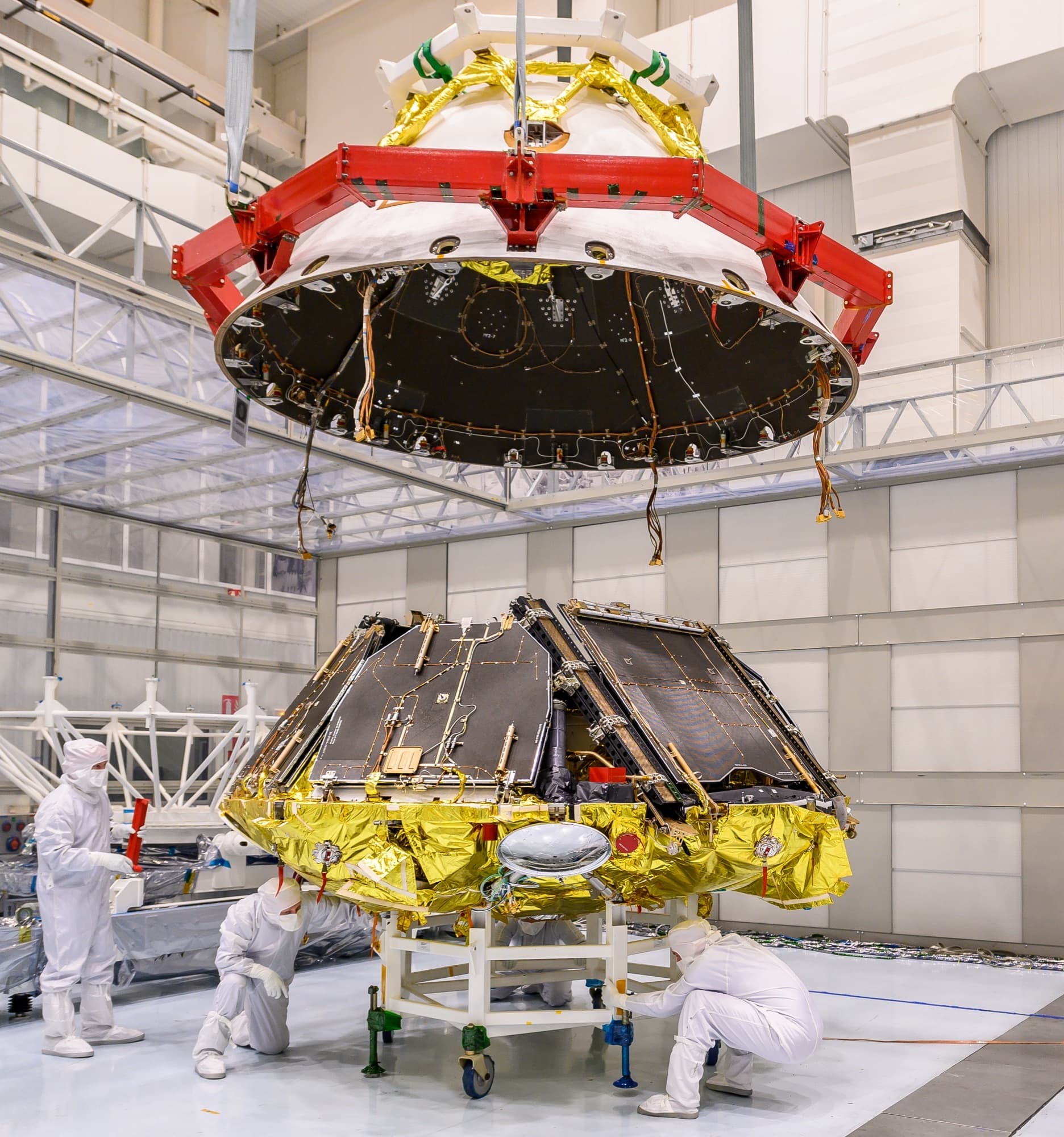
Kazachok was the half of ExoMars that Russia built. Under the division of labour RBC summarised as the mission collapsed, Roscosmos supplied the Proton-M launcher, the descent module and the landing platform, ESA supplied the carrier module and the Rosalind Franklin rover, and each side put instruments on the other's hardware. The platform's job had two parts. First it had to survive the landing at Oxia Planum and let the rover drive off down a ramp. Then it had to stay where it was and become a Martian weather station. Thirteen instruments were built for it, weighing 45 kg on an 827.9 kg platform: cameras to characterise the site, an infrared Fourier spectrometer, a diode laser spectrometer, a gas chromatograph mass spectrometer, a magnetometer, an active neutron spectrometer and dosimeter, a radio thermometer reading soil temperatures to a metre down, a dust suite measuring particle size, impacts and atmospheric charging, a seismometer, a Belgian radio science experiment to measure how Mars wobbles, and a Swedish package on water vapour, temperature and ultraviolet. Four more sensor packages from Finland, Spain and the Czech Republic sat inside the Russian meteorology and magnetometer instruments. The list is worth reading slowly, because none of it ever switched on at Mars.
The hardware was real and it travelled. On 19 March 2019 the flight platform, built and assembled at NPO Lavochkin and packed to planetary protection requirements, was flown to Thales Alenia Space in Italy for testing, with a set of ground support equipment alongside it. The rest of the descent module, its onboard equipment, batteries, aerodynamic shield and back cover, followed in stages across the year. Roscosmos announced the platform's name at the same time. Two months later Dmitry Rogozin, speaking at Moscow State University, revealed what the alternative had been: he had wanted to call it Novichok, he said, and decided his colleagues would not get the joke. The mission then slipped twice, from 2018 to 2020 and, on 12 March 2020, from 2020 to a window in the second half of 2022, because testing was unfinished and the pandemic had stopped engineers travelling between partner companies. By January 2022 the descent module was at Turin with the rover mounted on it. The launch window was 20 September to 1 October 2022 and the landing was expected by June 2023. ESA has since stated that the spacecraft was ready to move to the launch campaign at Baikonur in April 2022.
It never went. Russia invaded Ukraine in February 2022, and ESA's Council met in Paris on 16 and 17 March. Its decision is worth quoting exactly, because the wording was careful and is often paraphrased into something stronger. The Council unanimously acknowledged the present impossibility of carrying out the ongoing cooperation with Roscosmos on the ExoMars rover mission with a launch in 2022, mandated the Director General to take appropriate steps to suspend the cooperation activities accordingly, and authorised a fast-track industrial study of the options for going on without Russia. That wording suspends the cooperation without ending it, and the distinction held for four months. The end came on 12 July 2022, when, according to Roscosmos, ESA's Director General notified the corporation that under a decision of the Council of member states ESA had terminated the bilateral cooperation on the ExoMars 2022 mission because of the complex geopolitical situation. ESA's own public account of the episode gives only the month. From that point the problem stopped being a mission and became an inventory: every piece of built flight hardware had to go back to whoever had made it.
That took two and a half years. On 23 March 2022 Roscosmos said flatly that it could not get the descent module out of Europe at all, because European Union airspace was closed to Russian aircraft, and that any Russian Mars programme would therefore need a new landing platform. Rogozin's line was that repeating Kazachok would be no trouble, since all the drawings existed and this was Russia's own work. The hardware meanwhile went into storage at a Thales Alenia Space site in Italy to await instructions. A mutual return plan was agreed with ESA and announced on 26 March 2023, with Roscosmos staff already working in Turin, and Roscosmos used the announcement to note that the two Russian instruments aboard the rover would be dismounted and to wish ESA a successful launch in October 2028 without Russian participation. Finally, on 30 October 2024, Tatyana Tishchenko of the Roscosmos international cooperation department said the platform and all other Russian material were back on Russian territory, apart from individual pieces of foreign-made ground test equipment that the European Union would not license for re-export. She said Roscosmos hoped for joint Mars and Venus expeditions with China and India instead. We have found no public statement since about what Kazachok itself will be used for, and no Mars mission appears in the Russian national space project running to 2036.
What Europe kept is instructive. ESA plans to reuse three qualified items of European equipment built for the Russian descent module: the onboard computer, the radar Doppler altimeter and the parachute system, whose supersonic canopy came from a United States manufacturer and whose subsonic one is European. Everything else is new: aeroshell, landing platform, landing module and rover egress system, with Thales Alenia Space as industrial lead, Airbus providing the landing platform and Sener in Spain building the legs that ESA filmed snapping open in pairs in under a second on 6 August 2026. The two Russian instruments that had been mounted on the rover, the infrared spectrometer ISEM and the neutron spectrometer ADRON-RM, were dismounted and sent back; the first has been replaced by a British-built instrument, ENFYS, from Aberystwyth University, and ESA states plainly that the second will not be replaced. And the new lander carries no science at all. ESA has said that to make a 2028 launch the platform will be built only to deliver the rover and let it egress, with engineering sensors and some cameras but no dedicated solar arrays and no science complement, and that it will stop working a few sols after touchdown. Korablev, Rodionov and Zelenyi ended their 2024 paper by noting that although ExoMars 2022 was terminated, the scientific tasks had not lost their relevance. The instruments came home to Russia, and their science has not been remanifested on any mission we could identify.
Mission facts
What it was
The surface platform of the ExoMars 2022 mission, the responsibility of Roscosmos and the Space Research Institute of the Russian Academy of Sciences, built by NPO Lavochkin. Once the rover had driven off, Kazachok would have remained where it landed and worked as a stationary automatic station, powered by solar panels and rechargeable batteries. ESA gives its nominal mission lifetime as one Earth year; the eoPortal mission entry gives about two Earth years, a figure that traces back to a 2018 conference abstract by the Russian science team.↗
The name
Казачок means little Cossack and is also an East Slavic folk dance. The name was announced by Roscosmos in March 2019 as the platform arrived in Europe. On 23 May 2019, speaking at Moscow State University, Roscosmos director general Dmitry Rogozin said what the alternative had been, in remarks RIA Novosti reported: "Я, правда, хотел назвать его «Новичком», но решил, что коллеги не поймут" ("I did actually want to call it Novichok, but decided my colleagues would not get it"). Novichok is the name of a class of nerve agent, and in 2019 the word carried an obvious diplomatic charge.↗
Mass and payload
ESA gives the surface platform a mass of 827.9 kg including a scientific payload of 45 kg. Korablev, Rodionov and Zelenyi's 2024 paper in Solar System Research gives the same 45 kg for the instrument complex, and counts it as 11 Russian and two European instruments.↗
The instruments
Two European-led: LaRa, a Belgian radio science experiment measuring the rotation and orientation of Mars from Doppler shifts, and HABIT, a Swedish package on water vapour, ground and air temperature and ultraviolet radiation. Eleven Russian-led: METEO M (meteorology), MAIGRET (magnetometer), TSPP (four cameras), BIP (instrument interface and memory), FAST (infrared Fourier spectrometer), ADRON-EM (active neutron spectrometer and dosimeter), M-DLS (diode laser spectrometer), PAT-M (radio thermometer reading soil to 1 m), Dust Suite, SEM (seismometer) and MGAP (gas chromatograph mass spectrometer). Four European sensor packages sat inside METEO M and MAIGRET, from Finland, Spain and the Czech Republic.↗
What it was for
Korablev, Rodionov and Zelenyi list the objectives as long-term climate monitoring, atmospheric composition, the mechanisms of dust lifting and the electrical phenomena that go with them, interactions between atmosphere and surface, the abundance of water in the subsurface layer, radiation monitoring, and the internal structure of Mars. ESA adds that the radiation measurements were to be compared with the dosimeter on FREND aboard the Trace Gas Orbiter.↗
How it would have landed
A European carrier module would have released the Russian descent module before entry. Aerodynamic braking and then parachutes would shed most of the speed, and the final braking and touchdown would have been done by the platform's own throttleable rocket engines, with the rover driving off down a ramp afterwards. ESA states that the parachute system was fully qualified, with a supersonic parachute from a United States manufacturer and a European subsonic one.↗
Built in Russia, tested in Italy
Roscosmos recorded that on 19 March 2019 the flight article of the Kazachok landing platform, manufactured and assembled at NPO Lavochkin, was shipped to Thales Alenia Space in Italy for testing, packed to planetary protection requirements and accompanied by ground support equipment. Components of the descent module, its onboard equipment, batteries, aerodynamic shield and back cover, followed in stages through 2019. Lavochkin was the head coordinator on the Russian side and the developer and manufacturer of the descent module with its landing platform.↗
The schedule it lost
Launch on a Proton-M with a Briz-M upper stage from Baikonur in a window running 20 September to 1 October 2022, with arrival at Oxia Planum on 10 June 2023 after about 264 days of cruise; RBC, reporting the same plan, wrote only that the landing was expected by June 2023. ESA states that the spacecraft was ready to move to the launch campaign at Baikonur in April 2022 and was halted. The 2022 window was the third: the mission had slipped from 2018 to 2020, then on 12 March 2020 from 2020 to 2022 because of outstanding testing and the COVID-19 pandemic.↗
The decision, as written
ESA press release N° 9-2022, dated 17 March 2022: "ESA's ruling Council, meeting in Paris on 16-17 March, assessed the situation arising from the war in Ukraine regarding ExoMars, and unanimously: acknowledged the present impossibility of carrying out the ongoing cooperation with Roscosmos on the ExoMars rover mission with a launch in 2022, and mandated the ESA Director General to take appropriate steps to suspend the cooperation activities accordingly; authorised the ESA Director General to carry out a fast-track industrial study to better define the available options for a way forward to implement the ExoMars rover mission."↗
Suspension is not termination
March 2022 suspended the cooperation. Termination came four months later. Roscosmos stated that on 12 July 2022 the ESA Director General notified it, in accordance with a decision of the ESA Council of member states, that ESA had terminated the bilateral cooperation on the ExoMars 2022 mission because of the complex geopolitical situation, and that both sides were working on options for returning Russian equipment held in the European Union and European equipment held in Russia. ESA's own public FAQ dates the Council decision only to July 2022 without a day.↗
Russia said it would build another
On 23 March 2022 Roscosmos said its Mars programme would now need a new landing platform, and quoted director general Dmitry Rogozin: "Повторить посадочный модуль «Казачок», который мы делали под миссию ExoMars, не представляет труда. Все чертежи есть, это наша работа" ("Repeating the Kazachok landing module that we made for the ExoMars mission is no trouble. All the drawings exist, this is our work"). No such module has been announced since, and no Russian Mars mission appears in the national space project running to 2036.↗
Getting it home took two and a half years
On 23 March 2022 Roscosmos said it could not bring the descent module back from Europe at all, because European Union airspace was closed to Russian aircraft, and that its Mars programme would therefore need a new landing platform. On 26 March 2023 Roscosmos said it had agreed a plan of mutual return with ESA and that its staff were already working at Thales Alenia Space in Turin. On 30 October 2024 Tatyana Tishchenko, director of the Roscosmos international cooperation department, told the outlet Pro Kosmos that the platform and all other Russian hardware were back in Russia, except for individual items of foreign-made ground test equipment for which the European Union had not granted re-export permission.↗
The Russian instruments on the rover
Two Russian instruments were riding on Rosalind Franklin itself: ISEM, an infrared spectrometer, and ADRON-RM, a neutron spectrometer for subsurface water ice. Both were dismounted and returned with the rest of the Russian hardware. The infrared spectrometer has been replaced by a British-built instrument, ENFYS, led by Aberystwyth University, a test model of which shipped to Turin in October 2025; ESA states that the neutron spectrometer will not be replaced at all. Roscosmos's own comment on the removal, in March 2023: "мы можем только пожелать нашим коллегам из ЕКА успешно осуществить запуск марсохода в октябре 2028 года без нашего участия" ("we can only wish our colleagues at ESA a successful launch of the rover in October 2028 without our participation").↗
What replaced it
A new European entry, descent and landing module, funded by ESA member states at the November 2022 ministerial council. ESA plans to reuse the qualified onboard computer, the radar Doppler altimeter and the parachute system that had been built as European equipment for the Russian descent module. Thales Alenia Space is the industrial lead, Airbus provides the landing platform, and Sener in Spain designed and built the legs. On 6 August 2026 ESA published footage of those legs deploying in pairs in under a second on a full-scale model in Turin, and repeated a landing in 2030.↗
The science did not survive
ESA states that to make a 2028 launch the lander design is simplified and the new landing platform will be built only to deliver the rover and let it drive off. It will carry engineering sensors and some cameras to validate European landing technology, but no dedicated solar arrays and no science complement, and will stop working a few sols after touchdown once the rover has its arrays open and a link to Earth. Kazachok's thirteen instruments have no successor on the mission.↗
Mission timeline
- Mar to Nov 2015ESA calls on the European scientific community for surface platform instruments in March, receives nine proposals, and in November approves six European elements: two European-led instruments, LaRa and HABIT, and four sensor packages inside two Russian-led instruments.
- 19 Mar 2019The flight article of the landing platform, built and assembled at NPO Lavochkin, is flown to Thales Alenia Space in Italy for testing, packed to planetary protection requirements. Roscosmos announces its name at the same time: Kazachok.
- 23 May 2019Rogozin tells an audience at Moscow State University that he had wanted to call the module Novichok and decided his colleagues would not get it.
- 12 Mar 2020ESA and Roscosmos announce the launch slips from July 2020 to the August to October 2022 window, citing the need for more testing of hardware and final software and the travel restrictions of the COVID-19 pandemic.
- Jan 2022The descent module with Kazachok is at Thales Alenia Space in Turin with the Rosalind Franklin rover mounted on it. The launch window is 20 September to 1 October 2022 and the landing at Oxia Planum is expected by June 2023.
- 16 to 17 Mar 2022ESA's Council, meeting in Paris, unanimously acknowledges the present impossibility of carrying out the cooperation with Roscosmos on the ExoMars rover mission with a launch in 2022, and mandates the Director General to suspend it. The spacecraft was due to move to the Baikonur launch campaign in April.
- 23 Mar 2022Roscosmos says it cannot return the descent module with Kazachok from Europe because European Union airspace is closed to Russian aircraft, and that a Russian Mars programme will therefore need a new landing platform. Rogozin: reproducing Kazachok is no trouble, all the drawings exist, this is our work.
- Apr 2022With the launch campaign cancelled, the ExoMars elements are prepared for storage at a Thales Alenia Space site in Italy to await further instruction. The rover and the platform, mated and tested, go into a clean room instead of a Proton fairing.
- 12 Jul 2022ESA's Director General notifies Roscosmos, under a decision of the ESA Council of member states, that the bilateral cooperation on ExoMars 2022 is terminated. Both sides begin work on returning each other's hardware.
- Nov 2022At ESA's ministerial council, member states commit to fund a new mission, with a new European lander to carry Rosalind Franklin to the surface. Kazachok has no role in it.
- 26 Mar 2023Roscosmos announces a plan of mutual return agreed with ESA, with its staff already at work in Turin, and confirms that the Russian instruments on the rover, ADRON-RM and ISEM, will be dismounted. It wishes ESA a successful launch in October 2028 without Russian participation.
- 30 Oct 2024Tatyana Tishchenko of Roscosmos says the Kazachok platform and all other Russian hardware are back on Russian territory, apart from foreign-made ground test equipment refused re-export permission by the European Union. She adds that Roscosmos hopes for joint Mars and Venus expeditions with China and India.
A filled dot marks something that physically happened. A hollow one marks an announcement, a naming or a target.
In pictures
Tap a photo to enlarge.
Sources
- ESA press release N° 9-2022, 17 March 2022: ExoMars suspended
- ESA FAQ: The rebirth of ESA's ExoMars Rosalind Franklin mission, published 13 March 2023 and since updated
- ESA science portal: ExoMars 2022 surface platform, last updated 12 March 2020
- O. I. Korablev, D. S. Rodionov and L. M. Zelenyi, Комплекс научной аппаратуры посадочной платформы ЭкзоМарс-2022, Solar System Research vol. 58 no. 1 (2024), pp. 3-31
- Roscosmos, 20 March 2019: Посадочная платформа миссии «ЭкзоМарс-2020» доставлена в Турин (archived)
- RIA Novosti, 23 May 2019: Рогозин: десантный модуль миссии «Экзомарс-2020» могли назвать «Новичком» (archived)
- RBC, 23 March 2022: «Роскосмос» назвал невозможным возвращение платформы «Казачок» из Европы (archived)
- TASS in English, 13 July 2022: Russia, ESA working on options of equipment return under ExoMars project
- iXBT, 26 March 2023: Roscosmos on the mutual return plan and the removal of ADRON-RM and ISEM
- Interfax, 30 October 2024: Посадочную платформу «Казачок» миссии ExoMars-2022 вернули в Россию из Европы
- ESA, 6 August 2026: ExoMars stretches out its legs
- eoPortal Directory: ExoMars 2022
- ESA press release N° 6-2020, 12 March 2020: ExoMars to take off for the Red Planet in 2022
- English Wikipedia: Rosalind Franklin (rover)
Facts on this page were verified on 27 August 2026. Where sources disagree, the disagreement is stated rather than resolved silently.