MAVEN
NASA · United States · Orbiter · 2014 · The long occupationEnded
Declared unrecoverable on 3 June 2026, after eleven years in Mars orbit against a one-year primary science mission. Its last signal came on 6 December 2025 and why it started spinning is still unexplained.
TL;DR· 12 min read
MAVEN spent eleven years measuring how fast the solar wind and ultraviolet sunlight strip gas from the top of Mars, and doubled as a radio relay for the rovers. It measured a loss of about 100 grams a second and, from argon isotopes, that 66 per cent of the atmospheric argon is gone. On 6 December 2025 it passed behind Mars and never came back; a fragment of signal showed it in safe mode and spinning far too fast. NASA declared it unrecoverable on 3 June 2026, with the root cause still unpublished.
MAVEN was built to answer one question: where did the air of Mars go. For eleven years it measured how fast the solar wind and ultraviolet sunlight peel gas off the top of the planet, and it doubled as one of the radio relays that carry every picture the rovers take. On 6 December 2025 it passed behind Mars during a radio science campaign and never came back. A recovered scrap of signal showed it in safe mode and spinning far too fast, an anomaly review board concluded the spin had drained its batteries, and on 3 June 2026 NASA said it was not recoverable. The root cause has still not been published.
- 11 yrin Mars orbit, against a one-year primary science mission
- 100 g/srate the solar wind was stripping gas from Mars, MAVEN's 2015 measurement
- 6 Dec 2025last signal; NASA declared the mission over on 3 June 2026
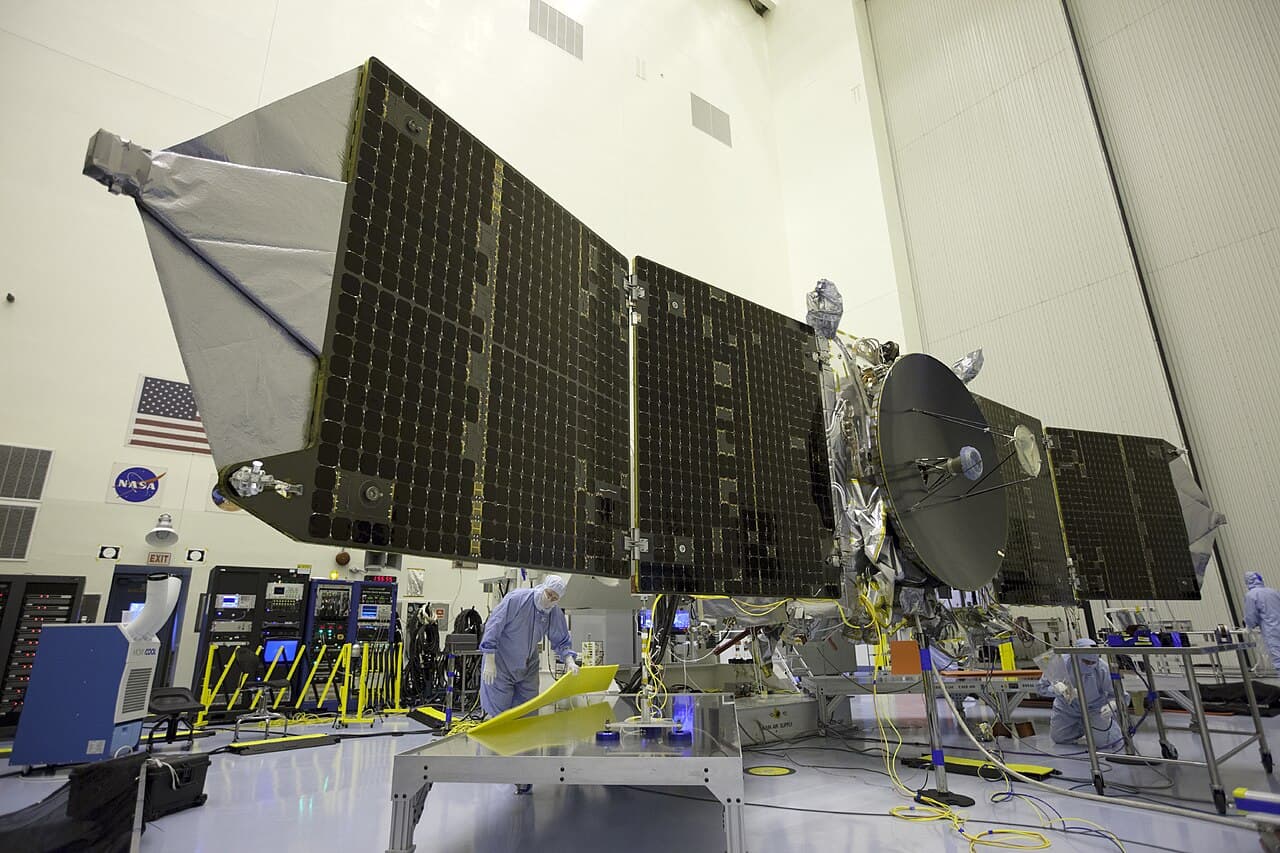
MAVEN flew under NASA's Mars Scout programme, with the science led by a principal investigator, Bruce Jakosky of the University of Colorado, rather than by a NASA centre. Its job was to measure, directly and continuously, how fast Mars loses its air. Lockheed Martin built it: a body 2.29 m wide and 3.47 m tall wrapped around a propellant tank, 11.4 m across the solar wings, 2,454 kg fuelled and 809 kg dry, carrying 65 kg of instruments. The launch nearly slipped. The federal government shut down on 1 October 2013, processing stopped, and the window to Mars closed on 7 December; NASA granted an emergency exception on 3 October and work resumed. It left Cape Canaveral on an Atlas V 401 on 18 November 2013 at 18:28 UTC and burned into Mars orbit on 22 September 2014 at 02:24 UTC, which is why NASA's own pages date the arrival to the evening of 21 September. The orbit was deliberately awkward: about 150 by 6,000 km, inclined 75 degrees, four and a half hours a lap, so that the spacecraft kept cutting down through the layer where atmosphere thins into space. The plan added five 'deep dip' campaigns of about five days each, dropping periapsis to near 125 km, low enough to taste the gas rather than infer it.
The idea that the solar wind had stripped Mars was decades old before MAVEN. What MAVEN did was put numbers on it and watch it happen. In November 2015 the team reported that Mars was losing gas at roughly 100 grams a second, that almost three quarters of the escaping ions leave down the tail behind the planet and nearly a quarter through a plume over the poles, and that the rate climbs during solar storms. In March 2017 came the harder number. Argon is a noble gas: it cannot be locked into rock, so the only way to remove it is to knock it off the top. Comparing the ratio of argon-38 to argon-36 high in the atmosphere with the ratio Curiosity measures at the surface, Jakosky and colleagues concluded that 66 per cent of the argon Mars ever had is gone. The release on that paper says about 65 per cent, which sits inside the paper's own uncertainty of plus or minus 5 per cent; it is the same measurement rounded differently. The carbon dioxide figure that people quote next is much softer: the paper says sputtering could have removed a bar or more of CO2 only if the oxygen being lost came mainly from CO2 rather than from water. In May 2025 the team finally caught sputtering directly, mapping argon thrown up exactly where energetic particles were hitting, at more than four times the modelled rate.
MAVEN's other job was radio. Its UHF package could record a rover on one pass and play it to Earth on the next, and NASA states that MAVEN holds the solar system record for the most data relayed from another planet in a single day. The agency has not published the number behind that claim, and NASA's own relay page says the European Trace Gas Orbiter sends the most relay data per day on average, so the two statements are not in conflict; they measure different things. To sharpen MAVEN as a relay before Perseverance arrived, NASA aerobraked it between February and April 2019, dragging the high point of the orbit from about 6,050 km down to 4,570 km and the low point from 151 to 132 km, which took it from 5.3 laps a day to 6.6. Its last notable act had nothing to do with Mars. Over about ten days in the autumn of 2025 the team improvised an observing campaign on 3I/ATLAS, the third interstellar object ever found, using the ultraviolet spectrograph to pick out hydrogen boiling off the comet as sunlight turned its ice to vapour. Weeks later the spacecraft was gone.
The last telemetry arrived on 4 December 2025 and everything in it was normal. On 6 December MAVEN went behind Mars during a radio science campaign, and the Deep Space Network heard nothing when it should have re-emerged. One fragment of tracking data survived from that radio science campaign, and it said two things: the spacecraft was in safe mode and rotating far faster than it should, and the signal frequency implied its orbit had changed. Curiosity was asked to help, pointing Mastcam along MAVEN's reference orbit on 16 and 20 December; nothing was there. Solar conjunction then shut the link to Mars from 29 December to 16 January, and when it reopened NASA listened again with the Deep Space Network and the Green Bank Observatory and heard nothing. An anomaly review board convened in mid-February concluded that the rotation had drained the batteries, cutting power to the radio, and that MAVEN could not be recovered. NASA announced the end on 3 June 2026, 12 years, 6 months and 16 days after launch. What made it spin has not been published; the board's final report was expected later in 2026. One caution worth stating plainly: JPL's Horizons service stops publishing an ephemeris for MAVEN after 1 March 2026. That is a fact about a file, and it says nothing about the spacecraft. Horizons still carries trajectories for missions that ended years earlier.
Mission facts
Launch
18 November 2013 at 18:28:00 UTC (1:28 p.m. EST) on an Atlas V 401 with a single-engine Centaur, from Cape Canaveral. NSSDCA records MAVEN as part of NASA's Mars Scout programme.↗
The launch nearly slipped
The United States federal government shut down on 1 October 2013 and pre-launch processing stopped. NASA granted MAVEN an emergency exception on 3 October and work resumed. The interplanetary window ran from 18 November to 7 December 2013; missing it would have meant waiting until 2016.↗
Mars orbit insertion
22 September 2014 at 02:24 UTC. NASA's own pages date it 21 September 2014, because that was 10:24 p.m. EDT on the 21st in the United States. Both refer to the same burn.↗
Spacecraft
2,454 kg fuelled and 809 kg dry, built by Lockheed Martin Space around a 1.3 m propellant tank; body 2.29 m wide and 3.47 m tall, 11.4 m across the solar wings, 12 square metres of cells producing 1,150 to 1,700 W, two 55 amp-hour lithium-ion batteries, a 2 m high-gain antenna.↗
Instruments
Eight instruments totalling 65 kg: magnetometer, Neutral Gas and Ion Mass Spectrometer, Langmuir Probe and Waves, Imaging Ultraviolet Spectrograph, Solar Wind Electron Analyzer, Solar Wind Ion Analyzer, Solar Energetic Particles, and SupraThermal And Thermal Ion Composition. For comparison, India's Mars Orbiter Mission, which arrived two days later, carried 15 kg in five instruments.↗
Science orbit
Roughly 150 by 6,000 km, inclined 75 degrees, 4.5 hours a lap, chosen so the spacecraft repeatedly cut down through the region where the atmosphere thins into space. The plan called for five 'deep dip' campaigns of about five days each with periapsis lowered to near 125 km.↗
Aerobraking, 2019
Between February and April 2019 MAVEN used atmospheric drag to pull apoapsis down from about 6,050 km to 4,570 km and periapsis from 151 km to 132 km, taking it from 5.3 to 6.6 orbits a day. The point was relay: more laps means more chances to collect from a rover and more chances to dump the data to Earth.↗
Cost
The Planetary Society's budget dataset gives the realised cost through the two-year prime mission as $582.5 million: $366.8 million development, $187 million for launch services, $28 million for two years of operations, with extended operations averaging about $20.5 million a year afterwards. The same dataset notes this was nearly $90 million below the original estimate, which is why the pre-launch figure of about $671 million is the one that still circulates in coverage.↗
The escape rate
Announced 5 November 2015: Mars is losing gas to space at about 100 grams a second, and the rate rises sharply during solar storms. Almost 75 per cent of the escaping ions leave down the tail behind the planet, nearly 25 per cent through a plume over the poles, and only a small fraction from the surrounding cloud of gas.↗
How much has been lost
Jakosky and colleagues compared the ratio of argon-38 to argon-36 high in the atmosphere with the ratio Curiosity measures at the surface. Argon is a noble gas, so it cannot be locked into rock; the only way to remove it is to knock it off the top. Their paper (Science, 31 March 2017) states that 66 per cent of the atmospheric argon has been lost to space, and quotes the uncertainty as 66 per cent plus or minus 5. The release issued on the same paper on 30 March 2017 says 'about 65 percent of the argon that was ever in the atmosphere has been lost to space'. On the paper's own error bar the two are the same measurement, rounded differently.↗
The carbon dioxide number is softer
The same paper says sputtering loss of CO2 'can approach a bar or more' only on the branch where the oxygen being lost comes mainly from CO2 rather than from water, and roughly half a bar or more on an independent estimate of the present-day oxygen loss rate. These are model-dependent inferences hung off the argon measurement, and neither figure is an observation of CO2.↗
Sputtering seen directly
Curry and colleagues, Science Advances, 28 May 2025. Nine years of data from three instruments at once produced a map of argon at high altitude in exactly the places energetic particles were striking the atmosphere. Sputtered argon rates came out more than four times higher than models predicted, and rose during a solar storm.↗
Relay role
MAVEN carried a UHF relay package and was one of the orbiters that carry rover data to Earth. NASA states that MAVEN 'holds the solar system record for most data relayed from another planet in a single day' but has not published the figure. NASA's own relay page separately says ESA's Trace Gas Orbiter sends the most relay data per day on average, which is a different measure.↗
Loss of signal
Telemetry before the 6 December 2025 pass behind Mars showed all subsystems working normally (NASA's 9 December 2025 blog post). The Deep Space Network heard nothing when MAVEN should have re-emerged. NASA states that no spacecraft telemetry had been received since 4 December, and that the team recovered a brief fragment of tracking data from a 6 December radio science campaign. NASA has not said which receivers recovered it.↗
What the fragment said
The spacecraft was in safe mode and rotating at an unusually high rate when it emerged from behind Mars, and the frequency of the signal indicated its orbit trajectory had changed. The anomaly review board concluded that the rotation drained the batteries, cutting power to the communications system. NASA states the preliminary findings do not address a root cause, which is still being investigated, with a final report expected later in 2026.↗
Horizons is not evidence
JPL's Horizons service returns no ephemeris for MAVEN (target -202) after 1 March 2026. That says something about the last published trajectory file and nothing about the spacecraft: Horizons still carries predicted trajectories for missions that ended years ago. The evidence that MAVEN is dead is NASA's review board. The gap in the file proves nothing. Checked against Horizons on 23 August 2026.↗
Mission timeline
- 1 to 3 Oct 2013A federal government shutdown halts pre-launch processing. NASA grants MAVEN an emergency exception on 3 October and the November window is saved.
- 18 Nov 2013Launch at 18:28 UTC on an Atlas V 401 from Cape Canaveral.
- 22 Sep 2014Mars orbit insertion at 02:24 UTC, two days before India's Mars Orbiter Mission arrives.
- 5 Nov 2015MAVEN reports Mars losing gas to space at about 100 grams a second, three quarters of it down the tail, and the rate rising during solar storms.
- 16 Nov 2015The one-year primary science mission ends. Everything after this is extended mission.
- 31 Mar 2017The argon isotope paper puts a number on the total: 66 per cent of the argon Mars ever had has been lost to space.
- Feb to Apr 2019Aerobraking lowers apoapsis by about 1,500 km and raises the orbit rate from 5.3 to 6.6 laps a day, improving MAVEN as a relay ahead of Perseverance.
- 28 May 2025Science Advances publishes the first direct observation of atmospheric sputtering at Mars, at more than four times the modelled rate.
- Sep to Oct 2025Over about ten days the team improvises a campaign to image interstellar comet 3I/ATLAS in the ultraviolet and detect hydrogen coming off it.
- 6 Dec 2025MAVEN passes behind Mars and the Deep Space Network hears nothing when it should re-emerge. The last telemetry was two days earlier.
- 16 and 20 Dec 2025Curiosity points its Mastcam along MAVEN's reference orbit to look for the spacecraft. It is not detected. Solar conjunction then closes the link to Mars from 29 December to 16 January.
- 3 Jun 2026NASA declares MAVEN unrecoverable after an anomaly review board convened in February. The mission is over after 12 years, 6 months and 16 days from launch.
A filled dot marks something that physically happened. A hollow one marks an announcement, a naming or a target.
In pictures
Tap a photo to enlarge.
Sources
- NASA news release (3 June 2026): NASA Says Farewell to MAVEN Mars Mission
- NASA MAVEN blog (15 December 2025): NASA Continues MAVEN Spacecraft Recontact Efforts
- NASA MAVEN blog (23 December 2025): NASA Works MAVEN Spacecraft Issue Ahead of Solar Conjunction
- NASA MAVEN blog (26 January 2026): NASA Resumes Efforts to Reestablish Contact With MAVEN
- NASA MAVEN blog (4 March 2026): NASA Anomaly Review Board Investigates MAVEN Loss of Signal
- NASA MAVEN blog (9 December 2025): NASA Teams Work MAVEN Spacecraft Signal Loss
- NASA science mission page: MAVEN
- NSSDCA Master Catalog: MAVEN (2013-063A), archived 20 July 2025
- LASP: MAVEN science orbit
- LASP / NASA (5 November 2015): MAVEN Reveals Speed of Solar Wind Stripping Martian Atmosphere
- Jakosky et al., Mars' atmospheric history derived from upper-atmosphere measurements of 38Ar/36Ar, Science 355, 1408 (31 March 2017)
- NASA (May 2025): NASA's MAVEN Makes First Observation of Atmospheric Sputtering at Mars
- The Planetary Society: The Cost of the MAVEN Mission to Mars (Planetary Science Budget Dataset)
- NASA: Mars Relay Network
- NASA / LASP release (30 March 2017): MAVEN Reveals Most of Mars' Atmosphere Was Lost to Space
Facts on this page were verified on 23 August 2026. Where sources disagree, the disagreement is stated rather than resolved silently.