Mars 1M No. 1 and No. 2
OKB-1 (USSR) · Soviet Union · Flyby · 1960 · The first attemptsFailure
Two spacecraft, two launch failures, on 10 and 14 October 1960. Neither reached Earth orbit, and the USSR never acknowledged either flight; almost everything known about them comes from Western tracking and from post-Soviet memoirs.
TL;DR· 10 min read
The Soviet Union's first two attempts to reach another planet, launched on 10 and 14 October 1960, both failed on the third stage of the brand new 8K78 rocket and burned up over Siberia. Neither reached Earth orbit, and Moscow never acknowledged either flight. The State Commission had already stripped the camera and the life-detecting spectroreflectometer on 3 October to save mass, so neither craft could have photographed Mars even if the rocket had worked.
The Soviet Union's first two attempts to reach another planet left the pad four days apart in October 1960, and neither one got as far as Earth orbit. Both 1M spacecraft burned up over Siberia when the brand new four-stage rocket carrying them failed. Because Moscow announced nothing, the outside world assembled the story from radar tracks, a NASA report to Congress, and, three decades later, the engineers' own memoirs.
- 1stSoviet attempt to send a spacecraft to another planet
- 0 of 2reached Earth orbit
- 650 kgeach craft, carrying about 10 kg of instruments
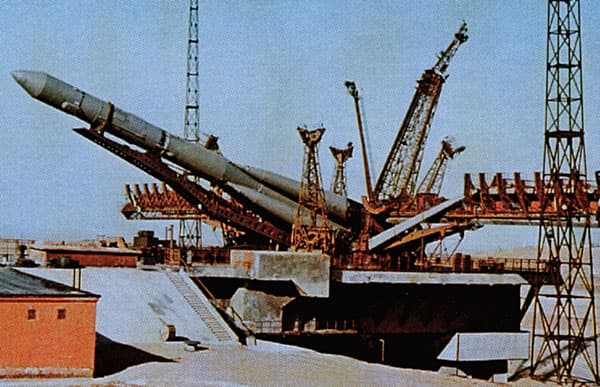
The 1960 Mars window was set by celestial mechanics; the launch date was set by politics. Nikita Khrushchev had been promised a flight to Mars, and Sergei Korolev's OKB-1 had until roughly the middle of October to produce one. Boris Chertok, who ran the spacecraft side of the work at the launch range, wrote afterwards that everyone involved, from ministers down to fitters, understood the schedule was impossible and that nobody was willing to say so out loud. A brand new four-stage rocket had to be built (index 8K78, the machine later called Molniya) and a brand new interplanetary spacecraft with it (index 1M, from the Russian for first Martian). As late as the spring of 1960 there was still no working documentation at the factories. Two half-assembled 1M craft were flown to Tyuratam in an An-12 at the end of August, about six weeks before the launch date. September went on soldering. The onboard radio complex, built by a bureau that had never once run an integrated test of it, failed continuously: transmitters smoked, diodes punched through, a telemetry commutator died, and the daily defect list ran past twenty items. Leonid Voskresensky, preparing the rocket, offered Chertok his own forecast in plain language: forget the Martian tasks, on the first attempt we will not fly further than Siberia.
The spacecraft was close kin to the Venera 1 design: a sealed cylinder about two metres tall with two solar wings, a 2.33 m mesh high-gain dish and a long antenna arm, roughly 650 kg all up with only about 10 kg of instruments aboard. Those instruments were the entire point. There was a magnetometer on a boom, a cosmic ray counter, a plasma ion trap, a radiometer, a micrometeorite detector, a phototelevision camera that would shoot the Martian surface through a viewport when a sensor reported sunlit ground below, and a spectroreflectometer built by Professor Lebedinsky to look for the CH band, then considered a plausible signature of organic life. By late September the camera had produced one wobbly test image and then refused to repeat it, and the schedule had slid so far past the optimal date that the ballistics team came to the State Commission asking for mass back. On 3 October the commission voted to remove the camera and the life detector. To ease the decision, Korolev had the spectroreflectometer tested out on the steppe near the pad first; to general delight it reported that there was no life at Tyuratam. Lebedinsky, Chertok wrote, took the ruling like the death of someone close. Both 1M craft therefore flew with no means of photographing anything.
1M No. 1 lifted off on 10 October 1960 at 14:27:49 UTC (17:27 Moscow) from Site 1 at NIIP-5, the pad Yuri Gagarin would use six months later. It was the maiden flight of the 8K78. The first two stages worked. On the third stage, Blok I, the gyro horizon issued a false pitch command at around T+300 to 310 seconds, most probably because vibration had broken a contact in its command potentiometer. The stage swung more than seven degrees off attitude, a limit contact closed, and the engine was commanded off. The destruct command followed at about T+324 seconds. The stack reached roughly 120 km and burned up over eastern Siberia. Four days later, on 14 October at 13:51:03 UTC, 1M No. 2 arrived at the same ending by a different route. A leak in a liquid oxygen line had been chilling the third stage's kerosene valve while the rocket still stood on the pad, and by ignition the valve was frozen solid. The start command went out at about T+290 seconds, the valve did not open, the engine never lit, and the second Mars probe followed the first. Chertok noted the bitter detail that formal blame in both cases fell on OKB-1 itself and never on the subcontractors his team had spent six weeks cursing.
Nothing was announced. A launch that fails before orbit leaves no object to catalogue and produces no communique, so for years the two flights existed publicly only as rumour and a Western nickname. American reporters coined Marsnik, a splice of Mars and Sputnik. NASA's catalogue still carries them as Mars 1960A and Mars 1960B and, more confusingly, as Korabl 4 and Korabl 5, numbers from a retrospective Western sequence rather than anything Soviet engineers used. In 1962 the NASA Administrator told Congress that the 10 October launch had been a Mars attempt; some Soviet scientists denied for decades that it had been anything of the kind. The argument was eventually settled from the inside. V. G. Perminov, later the lead designer for Mars and Venus spacecraft at the Lavochkin bureau, wrote in a 1999 monograph published by NASA's History Division that both October 1960 launches were Mars missions and were identical to one another, and Chertok's memoirs describe preparing the pair side by side. What the failures bought was experience. The deep space complex at Yevpatoria in Crimea, whose antenna arrays were assembled on frames made from battleship gun turrets and railway bridge trusses, had been declared ready to work these missions. The same rocket, the same tracking station and much of the same team came back two years later.
Mission facts
Launch, 1M No. 1
10 October 1960, 14:27:49 UTC (17:27 Moscow time), Molniya 8K78 vehicle L1-4M from Site 1 at NIIP-5, Tyuratam (Baikonur). This was the maiden flight of the 8K78.↗
Launch, 1M No. 2
14 October 1960, 13:51:03 UTC (16:51 Moscow time), Molniya 8K78 vehicle L1-5M from the same pad, four days after the first.↗
Launch vehicle
8K78, the four-stage development of Korolev's R-7 later named Molniya. These two launches were its first two flights. Both failed on the third stage, Blok I, before the fourth stage (Blok L) was ever reached.↗
Who built it
OKB-1 under chief designer Sergei Korolev, with Vadim Petrov as lead designer for the 1M spacecraft. Blocks were assembled at Factory No. 88; final assembly and testing happened at the launch range itself.↗
Mass
About 650 kg each. NSSDCA lists 650 kg for No. 1 and 640 kg for No. 2; Perminov and Russian sources give 650 kg for both, and no source we found explains the 10 kg difference.↗
Spacecraft design
Near-identical to the Venera 1 design: a sealed cylindrical body about 2 m tall, two solar panel wings feeding silver-zinc batteries, a 2.33 m mesh high-gain antenna and a long antenna arm.↗
Science payload
About 10 kg: a boom-mounted magnetometer, a cosmic ray counter, a plasma ion trap, a radiometer, a micrometeorite detector, a spectroreflectometer for the CH band (then thought to be a possible marker of organic life), and a phototelevision camera in the sealed module shooting through a viewport.↗
Instruments removed before launch
On 3 October 1960 the State Commission voted to strip the phototelevision unit and Professor Lebedinsky's spectroreflectometer to recover mass as the launch slipped past the optimal date. Chertok records that the life detector was first tried out on the steppe near the pad, where it reported that there was no life at Tyuratam.↗
Failure, 1M No. 1
Control was lost on the third stage around T+300 to 310 seconds when the gyro horizon issued a false pitch command, most likely from a broken contact in its command potentiometer caused by vibration. The stage swung past seven degrees, a limit contact closed and the engine was shut down. Destruct followed at about T+324 seconds; the stack reached roughly 120 km and burned up over eastern Siberia.↗
Failure, 1M No. 2
A leak in a liquid oxygen line chilled the third stage's kerosene valve while the rocket still stood on the pad. The valve froze shut, so when the start command went out at about T+290 seconds the third stage engine never lit, and the vehicle burned up over Siberia.↗
Intended arrival
1M No. 2 would have flown past Mars on 15 May 1961.↗
Ground segment
The deep space complex at Yevpatoria in Crimea (NIP-16, the Pluton complex) was declared ready to work these launches in October 1960. Its ADU-1000 arrays of eight 16 m dishes were mounted on steerable frames built from battleship gun turrets and railway bridge trusses.↗
Public acknowledgement
None at the time, and none for decades. NASA's Administrator told Congress in 1962 that the 10 October launch had been a Mars attempt; some Soviet scientists denied it. V. G. Perminov, later lead designer for Mars and Venus spacecraft at the Lavochkin bureau, confirmed in a 1999 NASA monograph that both October 1960 launches were Mars missions and were identical to each other.↗
Names
The Western press coined Marsnik 1 and Marsnik 2. NASA's catalogue lists them as Mars 1960A and Mars 1960B, and also as Korabl 4 and Korabl 5. The internal Soviet designations were simply 1M No. 1 and 1M No. 2; no public Soviet name was ever assigned.↗
Mission timeline
- 30 Aug 1960Boris Chertok flies to Tyuratam as technical director for the spacecraft; Arkady Ostashev is his deputy.
- 31 Aug 1960An An-12 delivers two half-assembled 1M craft to the range. No. 1 goes straight to electrical testing, No. 2 into the vacuum chamber for a leak check.
- 9 Sep 1960At a technical management meeting the onboard radio complex is found to be simply inoperable. Its lead engineer asks for one more day; the request draws laughter.
- 27 Sep 1960Round-the-clock rework finally gets the team to a full integrated test. So many deviations appear that launch on the optimal date is judged impossible.
- 29 Sep 1960The phototelevision unit produces something resembling a test picture, to general jubilation, then fails on the repeat run.
- 3 Oct 1960The State Commission removes the camera and the life-detecting spectroreflectometer to save mass. Both craft will now fly with no way of photographing Mars.
- 4 Oct 1960The third anniversary of Sputnik is marked at the range with champagne sent by a French winemaker, a week after the optimal Mars date has already been missed.
- 6 Oct 1960Chertok releases 1M No. 1 for mating with the fourth stage and turns the whole team onto the backup craft, No. 2.
- 10 Oct 1960Launch at 14:27:49 UTC on the 8K78's maiden flight. The third stage's gyro horizon fails, the engine is cut, and the vehicle is destroyed at about T+324 seconds over eastern Siberia.
- 14 Oct 1960Launch at 13:51:03 UTC. A frozen kerosene valve on the third stage prevents ignition and the second Mars craft follows the first into the Siberian sky.
- 15 May 1961The date on which 1M No. 2 was to have flown past Mars.
- Jul 1999V. G. Perminov's monograph, published by the NASA History Division, confirms from inside the Soviet programme that both October 1960 launches were Mars missions.
A filled dot marks something that physically happened. A hollow one marks an announcement, a naming or a target.
In pictures
Tap a photo to enlarge.
Sources
- Boris Chertok, Rakety i lyudi, vol. 2, chapter Pervye puski k Marsu (The first launches to Mars)
- V. G. Perminov, The Difficult Road to Mars, NASA Monographs in Aerospace History No. 15 (1999)
- NSSDCA Master Catalog: Mars 1960A / Marsnik 1 (archived)
- NSSDCA Master Catalog: Mars 1960B / Marsnik 2 (archived)
- Jonathan McDowell, GCAT launch catalogue
- Asif Siddiqi, Deep Space Chronicle, NASA SP-2002-4524
- RussianSpaceWeb (Anatoly Zak): Russia's unmanned missions to Mars
- Russian Wikipedia: Mars 1960A
- Russian Wikipedia: Mars 1960B
- Encyclopedia Astronautica: Molniya 8K78
- Pluton deep space communications complex, Yevpatoria
Facts on this page were verified on 23 August 2026. Where sources disagree, the disagreement is stated rather than resolved silently.