The Soviet crewed Mars programme
USSR · Soviet Union · Program · 1960 · Reaching MarsCancelled
Cancelled, and never built. Design ran at OKB-1 from 1959, was halted by decree on 13 May 1961, continued anyway, was revived in 1969 as Aelita and died with the N1; the only hardware was a Moscow mock-up.
TL;DR· 20 min read
The Soviet Union studied crewed flights to Mars from 1959 and never built anything to fly. Korolev's OKB-1 sketched a Martian Piloted Complex of about 1,630 tonnes needing 20 to 25 N1 launches, and the magazine Ogonyok reports that a 1960 decree fixed a departure for 8 June 1971. Decree 420-174 of 13 May 1961 halted the work, the bureau carried on anyway, and the 1969 competition code-named Aelita died with the N1. The only hardware was a Moscow mock-up in which three men lived for 366 days.
Before the Moon race there was a Mars race, and the Soviet Union entered it first. From 1959 a small group inside Sergei Korolev's OKB-1 worked on ships to carry people to Mars, and the magazine Ogonyok reports that a government decree of 23 June 1960 set them a departure date: 8 June 1971. The N1 rocket, the vehicle the world remembers as the loser of the Moon race, was sized for that Mars ship rather than for the Moon. Little of this reaches English-language accounts, and what does is often wrong about which project was which. Nothing was ever built to fly.
- 8 Jun 1971departure date Ogonyok attributes to the 1960 decree, and never approached
- 1,630 tdesign launch mass on paper for Tikhonravov's Mars complex, 20 to 25 N1 launches to assemble it
- 366 dayslongest anyone actually spent inside the hardware, sealed in a mock-up in Moscow
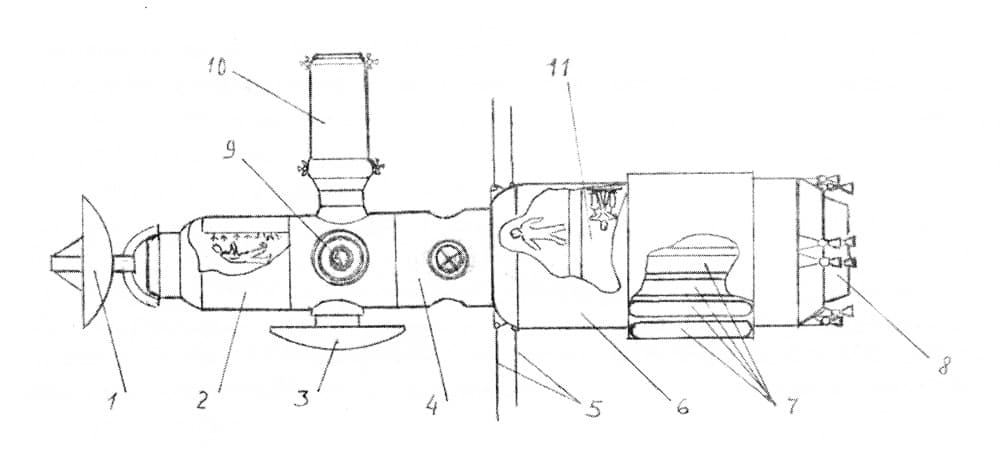
Soviet planning for a crewed flight to Mars began before the Soviet Union had put anyone into orbit. From 1959 a group inside department 9 of Korolev's OKB-1, under Mikhail Tikhonravov, sketched a Martian Piloted Complex that would be assembled in low Earth orbit out of separately launched blocks, cross to Mars on ordinary chemical propellants, enter orbit, put a crew on the surface and bring a small capsule home. The surviving numbers are enormous and they do not agree with each other. Igor Afanasyev, writing in 1996, gives a launch mass of about 1,630 tonnes assembled from 20 to 25 N1 launches, an expedition of more than two and a half years and a returning fragment of just 15 tonnes. Mark Wade repeats 1,630 tonnes and 20 to 25 launches in his text but tabulates 1,360 tonnes in low Earth orbit, 900 days and a year of surface exploration by a crew of six. Alexander Zheleznyakov gives about 1,600 tonnes, not fewer than 20 launches and a four-year expedition of which roughly two years would be spent at the planet. None of these is a measurement of anything. They are recollections and reconstructions of a paper study whose own documents are largely gone, and the spread between them is the honest measure of how much is now recoverable.
Two groups then split the problem. Gleb Maksimov's sector took the cheap road: a three-person ship of about 75 tonnes launched by a single N1 and thrown onto a free-return trajectory by a kerosene and oxygen stage, which would sweep past Mars after ten and a half months, drop automatic landers and let the planet's gravity bend it home. This is the vehicle later called TMK-1, and it is the one the government put a date on. Decrees 714-295 and 715-296 of 23 June 1960 authorised the rocket, and the magazine Ogonyok reports that the same decision named 8 June 1971 as the day the ship would leave. Konstantin Feoktistov's sector took the hard road: a full landing expedition assembled in orbit and driven by ion engines fed from a nuclear reactor, with five landers that would be assembled on the surface into a nuclear-powered train and driven from one Martian pole to the other over a year. Leonid Gorshkov, who was in Feoktistov's group, records a 7 MW reactor and a crew of six in the 1960 version. The ion engines were to produce 7.5 kilograms of thrust, so departure from Earth would have meant an outward spiral lasting months. Solar panels for the same engines would have needed something like 36,000 square metres, which is why there was a reactor at all.
Then the government cancelled it, and this is the part that almost never appears in English accounts. On 13 May 1961, less than a year after authorising the programme and a month after Gagarin's flight, the Central Committee and the Council of Ministers issued decree No. 420-174, on the revision of plans for space objects towards tasks of defence significance. Its opening states the purpose plainly: to concentrate materials and design bureau effort first of all on the defence of the country. It then orders, item by item, a halt to development of the heavy interplanetary ship for flight to Mars and Venus, a halt to work preparing expeditions to the surfaces of the Moon, Mars and Venus, and a slip of the N1 rocket itself to 1965. The scanned original is on the Roscosmos site. What makes the decree interesting is how little it stopped. Maksimov's draft project was completed on 12 October 1961, five months later. Bugrov, who was in the room for much of it, describes the work as continuous from 1960 to 1974, with the configuration settling only in 1964 into something far smaller than the MPK: 400 to 500 tonnes, later 500 to 600, assembled from 75-tonne blocks in four to six N1 launches. A cancelled Soviet programme was not always a stopped one. It was a programme with no protection.
The Mars work came back after the Moon was lost. On 27 January 1969, at a council held in the presence of the Central Committee's Sergei Serbin, Mstislav Keldysh, president of the Academy of Sciences, said the lunar landing should be slipped to 1972 and asked out loud whether the Soviet Union should be thinking about Mars instead. Chertok records him saying he was for Mars, and proposing that two N1 launches with an orbital docking could put a crewed Mars satellite up in 1975. At a second meeting on 3 June the room was unenthusiastic: Chertok writes that Mishin's Mars report was heard without any enthusiasm, and that Keldysh alone spoke for continuing, and then only if it did not damage the lunar programme. The minister, Sergei Afanasyev, was not: an order followed that summer creating a competitive Mars programme under the code name Aelita, and its date and number are themselves contested. Chertok dates it 30 June and describes it as tasking Chelomei with a Mars complex on the UR-700M or UR-900 rocket. Wade and Zak give it the number 232 and the same date, and Wade attributes it to the wrong ministry. Mikhail Evtifyev, who worked the TsNIIMash side, dates Order No. 232 of the Minister of General Machine Building to 30 July 1969 and describes it as covering a rocket and space complex for an expedition to Mars. Three bureaus competed. Feoktistov's answer was the Mars Expeditionary Complex, 630 days, 175 metres long, nuclear-electric, thirty days in Mars orbit and five on the surface for three of the crew.
TsNIIMash spent Aelita designing the thing that would actually land, and the record of that work is a study in ambition being negotiated downwards. The heaviest version was 122 tonnes: a six-wheeled articulated train for three people, thirty days of driving at about 12 km/h over a planned 1,500 kilometres, with a 100 kW reactor in the rear wagon, to be shielded by Martian soil augered into a hollow container. Then came 95 tonnes, then 80 with a fixed laboratory and a buggy of 20 km range, then 45 tonnes cut to seven days, and finally 23 tonnes for two people and four days, of which Evtifyev writes that little science was expected and the job was to plant a flag. The Aelita report ran to two thick volumes, and a competition for the best detailed design was to follow. It never happened. A government expert commission looked at Chelomei's rocket and ship in 1972 and recommended deferring crewed Mars flight indefinitely on cost. On 23 November 1972 the fourth N1 failed. Glushko stopped the rocket by his own order on 24 June 1974, and the formal write-off came in February 1976. What survived is not nothing. The Ground Experimental Complex in Moscow that housed the mock-up went on to host Mars-500 and the SIRIUS isolation runs, and Bugrov records that the water regeneration system built for the Mars ship passed to the Salyut-type orbital stations, then to Mir, where it recycled 21.5 tonnes of water over fifteen years, and then to the ISS.
Mission facts
What this covers
Soviet studies of a crewed flight to Mars, from the first sketches at OKB-1 in 1959 to the closure of the N1 rocket in the 1970s. The main threads are the Martian Piloted Complex (МПК) under Mikhail Tikhonravov, the Heavy Interplanetary Ship (ТМК, Тяжёлый межпланетный корабль) in the Maksimov and Feoktistov variants, the Mars and Venus flyby theme МАВР, and the 1969 programme code-named Аэлита (Aelita) with its Mars Expeditionary Complex (МЭК). None of it flew.↗
Where the work was done
OKB-1, Korolev's bureau at Podlipki, later TsKBEM and today RKK Energia. Bugrov and Evtifyev both place the origin in department 9 under Mikhail Tikhonravov, with a sector under Gleb Maksimov and a sector under Konstantin Feoktistov. Anatoly Zak's RussianSpaceWeb and Mark Wade's Encyclopedia Astronautica instead say Section or Department 3. From 1966 the research institute NII-88, later TsNIIMash, ran its own parallel Mars studies, and from 1969 Vladimir Chelomei's TsKBM and Mikhail Yangel's bureau were brought in.↗
The founding decrees
Central Committee and Council of Ministers decrees No. 714-295 and No. 715-296 of 23 June 1960. Bugrov, who worked on the project, gives the title of 715-296 as "On the creation of powerful launch vehicles, satellites, spacecraft and the mastery of space in 1960-1967" and says it called for a rocket system of 1,000 to 2,000 tonnes launch mass able to place a heavy interplanetary ship of 60 to 80 tonnes into Earth orbit. The magazine Ogonyok states that the same decree fixed the departure date.↗
The departure date
8 June 1971, chosen from the Mars launch window at the favourable opposition of that year. The return date is published two ways. Encyclopedia Astronautica and Russian Wikipedia give 10 July 1974; Ogonyok gives 10 June 1974. Wade also states the voyage lasted three years, one month and two days, which from 8 June 1971 arrives at 10 July 1974 and not 10 June, so the arithmetic favours July. We have not seen the decree text itself and treat the return date as unsettled.↗
MPK, the first complex
Tikhonravov's Martian Piloted Complex would have been assembled in low Earth orbit and flown to Mars on ordinary chemical propellants, entered Mars orbit, landed a crew and brought back a small capsule. Published figures disagree. Igor Afanasyev gives about 1,630 tonnes, 20 to 25 N1 launches, an expedition of more than 2.5 years and 15 tonnes returning. Wade repeats 1,630 tonnes and 20 to 25 launches, then tabulates 1,360 tonnes in low Earth orbit, 900 days total, a crew of six and a year on the surface. Zheleznyakov gives about 1,600 tonnes, not fewer than 20 launches, and a four-year expedition with roughly two years at the planet. Wade dates the MPK study to 1956, which sits oddly with the Russian accounts that date the Mars work to 1959; Wade himself notes that Korolev, defending the N1 draft project in July 1962, said he had first sketched the rocket in 1956 to 1957 to support a large crewed Mars expedition. Bugrov, who worked inside the project, describes a far smaller complex once the configuration settled in 1964: 400 to 500 tonnes, later 500 to 600, assembled from 75-tonne blocks in four to six N1 launches.↗
TMK-1, the Maksimov ship
A three-person flyby ship of about 75 tonnes, to be launched by one N1 and pushed onto a Mars trajectory by a liquid oxygen and kerosene stage, which would have left 30 tonnes on the coast. After 10.5 months it would pass Mars, drop automatic landers and let Mars gravity bend it back towards Earth. Wade gives it 12 m in length and 6 m across the crew section, with a habitation, work, biological and equipment section, an airlock, a solar storm shelter and a re-entry capsule. Wade dates the completion of the draft project (эскизный проект) to 12 October 1961.↗
TMK-E, the Feoktistov ship
Feoktistov's group judged a single-launch flyby too limited and proposed a full landing expedition assembled in orbit and driven by ion engines powered by a nuclear reactor. Leonid Gorshkov, who was in that group, records a 7 MW reactor and a crew of six in the 1960 version. Wade gives the engine design as 7.5 kgf of thrust at a predicted specific impulse of 10,000 seconds, which would have meant a spiral departure lasting months, and says solar power for the same engines would have needed roughly 36,000 square metres of panel, which is why the reactor was chosen. Zheleznyakov writes that Korolev kept the theory and the layout work in house and handed development of the reactor itself to Vasily Grabin's TsNII-58, then building experimental fast-neutron reactors. None of the three figures in this paragraph comes from Gorshkov.↗
The Mars Train
The TMK-E surface plan was a train of five separately landed wagons: a crew cabin with manipulators and a drill, a platform for a convertiplane to fly in the Martian atmosphere, two rocket launch platforms carrying a main and a spare ascent vehicle, and a nuclear reactor wagon to power the whole thing. Wade gives the landers as conical aeroshells 5.5 m across and 9 m high at about 10 tonnes each. Gorshkov describes the train crossing the planet from one pole to the other. In the 1969 rework the reactor went to 15 MW, three reactors replaced one, the landers were cut from five to one and the crew from six to four.↗
The 13 May 1961 cancellation
Decree No. 420-174 of the Central Committee and the Council of Ministers, "On the revision of plans for space objects towards the fulfilment of tasks of defence significance". Its stated purpose is to concentrate resources and design bureau effort first of all on tasks connected with the defence of the country. Point 1(v) orders a halt to development of the heavy interplanetary ship for flight to Mars and Venus, referring to it by that description and citing decree 715-296. Point 1(d) halts work on preparing expeditions to the surface of the Moon, Mars and Venus. Point 1(z) pushes the N1 rocket back to 1965. We read the Roscosmos scan of the signed document; it carries no text layer, so the wording here is our translation of the page image. The decree stopped less than it says: Maksimov's draft project was completed on 12 October 1961, five months later, and Bugrov describes design and test work running on to 1974 and 1975.↗
MAVR, and which MAVR
Two different projects carry this name and English sources merge them. Wade and Zheleznyakov describe МАВР as a 1963 variation of Maksimov's OKB-1 flyby ship adding a Venus pass, at 75 tonnes with a crew of three, and read the name as MArs plus VeneRa. Mikhail Evtifyev, writing about work at TsNIIMash, describes МАВР as a theme assigned there in early June 1966 to department 12 under Golovin, sector Yevich, group Pronin, and reads the name as "Марс, Венера - разом", Mars and Venus at once. His MAVR has a crew of six, an Earth to Mars to Venus to Earth trajectory, a 1975 departure, a flight of 480 to 600 days and an initial mass of 105,680 kg.↗
What MAVR carried
In the TsNIIMash version: a universal habitation block 6 m across divided into five or six decks with six private cabins, a saloon, a greenhouse, a galley, a bathroom, a laboratory, a workshop, a radiation shelter and an airlock; a detachable astronomy block about 7 m long with a telescope and an observer's cabin; separate spherical probes to be dropped at Mars and at Venus; and a 30 square metre parabolic solar concentrator that would have fed the 14 square metre greenhouse through a Fresnel mirror and doubled as the dish for the deep space radio link. Permanent artificial gravity by rotation was rejected in favour of a centrifuge used periodically. The report was approved by TsNIIMash director Yuri Mozzhorin on 12 July 1968.↗
The year in the mock-up
The hardware that did get built was a ground analogue of the TMK habitation section, the experimental rig ЭУ-37, assembled in 1967 to 1969 inside the Ground Experimental Complex or НЭК at the Institute of Medico-Biological Problems in Moscow. Bugrov is explicit that the НЭК was the facility and the TMK mock-up was mounted inside it. The two were not the same thing. Three testers, the physician German Manovtsev, the biologist Andrei Bozhko and the technician Boris Ulybyshev, lived sealed inside it for a year, recycling their own air and water and growing greens in a small greenhouse. Bugrov dates the end of the run to 5 November 1968; Russian accounts give the start as 5 November 1967 and the length as 366 days. Wade instead dates the start to 5 March 1967, which does not match the Russian record. Bozhko later wrote a book about it, "Год в Звездолёте" (A Year in the Starship, 1975).↗
Order No. 232, the contested authorisation
The 1969 re-authorisation is the spine of the Aelita story and its date, number and content are all disputed. Boris Chertok, who was in the room for the meetings that led to it, writes that on 30 June the minister issued an order obliging Chelomei to produce within one year a Mars complex design based on the UR-700M or UR-900 rocket and the MK-700M ship. He gives no number. Wade gives "decree 232 of 30 June 1969", attributes it to the Ministry of Defence, and says the technical specification was written by TsNIIMash and NIITI and the project code-named Aelita; Zak gives 30 June 1969 and No. 232 and follows Chertok in aiming it at Chelomei. Evtifyev, who worked on the TsNIIMash side, writes that on 30 July 1969 Order No. 232 of the Minister of General Machine Building appeared, on development of a rocket and space complex to provide an expedition to the planet Mars, project code Aelita. The ministry in question was General Machine Building, headed by Sergei Afanasyev from 1965 to 1983. Wade's Ministry of Defence is the wrong one.↗
MEK, the OKB-1 answer to Aelita
Mishin had signed off the advance project for an uprated N1M rocket on 28 May 1969, and Feoktistov's group designed the Mars Expeditionary Complex to use it. Afanasyev and Zheleznyakov give 630 days total, 30 days in Mars orbit and 5 days on the surface for three of the crew; Wade gives the same but with five to seven surface days and a crew of three to six. Wade puts it at 175 m long, 17 m span, 150 tonnes, with two YaE-2 reactors totalling 15,000 kW cooled by liquid lithium, 6.2 kgf of thrust at 8,000 seconds specific impulse, a 20-tonne lander 11 m across and a 10-tonne return capsule with a 6 m lens-shaped base shield. Assembly is described as two launches of about 75 tonnes each, by Wade explicitly on the N1M and by Zheleznyakov on the N1, but Afanasyev writes of two unmanned blocks of about 150 tonnes each, twice the total.↗
The landing complex that shrank
Under Aelita, TsNIIMash worked the Mars surface complex down a ladder of decreasing ambition. The heaviest, at 122 tonnes, was a three-wagon six-wheeled train for three people, thirty days of driving at about 12 km/h over a planned 1,500 km route, with a Romashka-type 100 kW reactor in the rear wagon, to be shielded by Martian soil augered into a hollow container. Below it came a 95-tonne two-part variant, an 80-tonne version with a fixed laboratory and a wheeled buggy of 20 km range, a 45-tonne version cut to seven days and 5 km, and finally a 23-tonne "priority" complex for two people and four days, of which Evtifyev writes that almost no scientific return was expected and its task was to plant a flag on the surface of Mars.↗
How it ended
By the end of 1969, Wade writes, Mishin and Yangel had dropped out of the competition, leaving Chelomei. Wade records that a government expert commission reviewed his UR-700M and MK-700 draft project in 1972 and, on the grounds that it needed decades of development and tens of billions of roubles, recommended deferring crewed Mars expeditions indefinitely. On 23 November 1972 the fourth and last N1 failed; Evtifyev writes that this buried both MAVR and Aelita. A government decree of 21 May 1974 replaced Mishin with Valentin Glushko at the head of the new NPO Energia, and on 24 June, after the N1's chief designer Boris Dorofeyev refused to draft it, Glushko wrote and signed the order stopping work on the N1 himself. Chertok records that Glushko's order was backed by neither an order of the minister nor a decision of the Military Industrial Commission, and that the formal Central Committee and Council of Ministers decision to end N1-L3 and write off the money came only in February 1976, and that 6 billion roubles were written off.↗
Mission timeline
- 23 Jun 1960Central Committee and Council of Ministers decrees 714-295 and 715-296 authorise a rocket system of 1,000 to 2,000 tonnes able to lift a 60 to 80 tonne interplanetary ship. Ogonyok reports that the same decision fixed the departure for Mars at 8 June 1971.
- 13 May 1961Decree 420-174 orders a halt to development of the heavy interplanetary ship for Mars and Venus, a halt to preparation of expeditions to the surfaces of the Moon, Mars and Venus, and a slip of the N1 rocket to 1965. The stated reason is concentration of resources on defence tasks. Eleven months after the programme was authorised, it is cancelled by name.
- 12 Oct 1961The draft project for Maksimov's three-person flyby ship is completed anyway, five months after the cancellation. Work continues inside the bureau without a government mandate behind it.
- May 1966The last OKB-1 iteration of the design, known as KK, the space complex for delivering a piloted expedition to Mars, is finished. Four mission profiles are traded, and the orbital-descent scheme is preferred. Then N1-L3 and the Moon absorb the bureau.
- Jun 1966NII-88, later TsNIIMash, is told to study the OKB-1 flyby ship and produce its own advance project for a crewed flyby of two planets. The theme is given the code МАВР, for Mars and Venus at once.
- 5 Nov 1967 to 5 Nov 1968Manovtsev, Bozhko and Ulybyshev spend a year sealed in the ground analogue of the TMK habitation section in Moscow, on regenerated air and water. Bugrov records that everything except food was recycled by physical and chemical means, with a greenhouse of Khibiny cabbage, borage, cress and dill supplying vitamins and fibre.
- 12 Jul 1968TsNIIMash director Yuri Mozzhorin signs off the MAVR report, the product of design research running from 1966 to 1968 on crewed complexes for an expedition flying past Mars and Venus.
- 27 Jan 1969At a council of chief designers, Keldysh says the lunar landing should be slipped to 1972 and asks whether Mars would not be the better goal. Chertok records him saying "I am for Mars" and proposing that two N1 launches with a docking in orbit could place a crewed Mars satellite in 1975.
- 3 Jun 1969At a meeting in Mishin's office, the former office of Korolev, Mishin describes the Mars expedition to the assembled ministers and Party officials. Chertok records that the report was heard without enthusiasm and that only Keldysh spoke for continuing, and then only if it did not damage the lunar programme.
- 30 Jun to 30 Jul 1969The order that started Aelita. Chertok dates it 30 June and describes it as obliging Chelomei to design a Mars complex on the UR-700M or UR-900 within a year; Wade and Zak give the number 232 and the same date; Evtifyev dates Order No. 232 of the Minister of General Machine Building to 30 July and describes it as covering a rocket and space complex for an expedition to Mars under the code name Aelita. Three bureaus begin competing.
- 23 Nov 1972The fourth N1 fails. Evtifyev writes that the theme was closed and the hopes for MAVR and Aelita were buried with it. Wade records that a government expert commission had already reviewed Chelomei's UR-700M and MK-700 draft project that year and recommended putting crewed Mars expeditions off indefinitely.
- 21 May to 24 Jun 1974A government decree of 21 May 1974 makes Valentin Glushko general designer and director of the new NPO Energia in Mishin's place. On 24 June, after the N1's chief designer Boris Dorofeyev refuses to draft it, Glushko writes and signs the order stopping work on the N1 himself. Chertok notes that the order was backed by neither an order of the minister nor a decision of the Military Industrial Commission.
- Feb 1976The Central Committee and Council of Ministers formally end N1-L3 and write off the spending, 6 billion roubles in the prices of the day. A decree of 17 February 1976 creating the reusable system that became Energia and Buran closes the matter.
A filled dot marks something that physically happened. A hollow one marks an announcement, a naming or a target.
In pictures
Tap a photo to enlarge.
Sources
- Central Committee of the CPSU and Council of Ministers decree No. 420-174 of 13 May 1961, on revising space plans towards defence tasks. Roscosmos scan of the signed original, archived 3 Feb 2022
- V. E. Bugrov, Марсианский проект С. П. Королёва (The Mars Project of S. P. Korolev)
- B. E. Chertok, Ракеты и люди: Лунная гонка
- B. E. Chertok, Ракеты и люди: Лунная гонка
- B. E. Chertok, Ракеты и люди: Лунная гонка
- M. D. Evtifyev, А мы могли быть первыми марсианами еще в 80-х годах
- Igor Afanasyev, Пилотируемый полет на Марс... четверть века назад, from Vestnik vozdushnogo flota no. 7-8, 1996, reprinted by Kosmicheskiy Mir, archived 3 Mar 2011
- A. B. Zheleznyakov, «Аэлита», «МАВР» и другие проекты советской пилотируемой экспедиции на Марс, Encyclopedia of Cosmonautics
- Iskander Kuzeyev, Первая марсианская, Ogonyok via Kommersant, 22 Oct 2006
- L. A. Gorshkov, Полёт человека на Марс, Nauka i Zhizn no. 7, 2007
- Mark Wade, Encyclopedia Astronautica: the TMK family index
- Mark Wade, Encyclopedia Astronautica: TMK-E
- Anatoly Zak, RussianSpaceWeb: "Russia's plans for manned Mars missions", page's own last update 23 April 2025, archived 25 Nov 2025
- IMBP RAS: the SIRIUS project and the Ground Experimental Complex
Facts on this page were verified on 24 August 2026. Where sources disagree, the disagreement is stated rather than resolved silently.