Voyager (Mars)
NASA · United States · Program · 1960 · Reaching MarsCancelled
Cancelled at the end of August 1967, when Congress zeroed its fiscal 1968 appropriation: seven years of study and no flight hardware. The orbiter-and-lander architecture went into Viking, which landed on Mars in 1976.
TL;DR· 17 min read
Voyager was NASA's plan to land on Mars in the 1970s: two spacecraft on one Saturn V, each an orbiter carrying a sterilised landing capsule. Mariner 4 measured a far thinner atmosphere in July 1965, which invalidated every landing capsule proposal and forced the move to the Saturn V, and the cost estimate climbed to $2.2 billion. Congress appropriated nothing for fiscal 1968, and NASA stopped work in August 1967 with no hardware ever built. The architecture went into Viking, which landed on Mars in 1976.
Voyager was NASA's plan to land on Mars in the 1970s, and it was big enough that when Congress killed it the agency was left, in the words of its own official history, with no programme for the exploration of the solar system at all. The final version was two spacecraft on one Saturn V, each an orbiter carrying a sterilised landing capsule, to be flown at the Mars windows of 1973, 1975, 1977 and 1979. None of those flights happened. Mariner 4 wrecked the lander design in July 1965 by measuring an atmosphere far thinner than anyone had planned for, the switch to the Saturn V doubled the price, and in August 1967 Congress refused to pay. Nothing was ever built. What survived was the shape of the mission, which flew as Viking.
- $0appropriated for Voyager in the final fiscal 1968 NASA budget, against $71.5 million requested
- $2.2bnestimated research and development cost by April 1967, against $700 million in March 1963
- 0pieces of Voyager flight hardware ever built in seven years of study
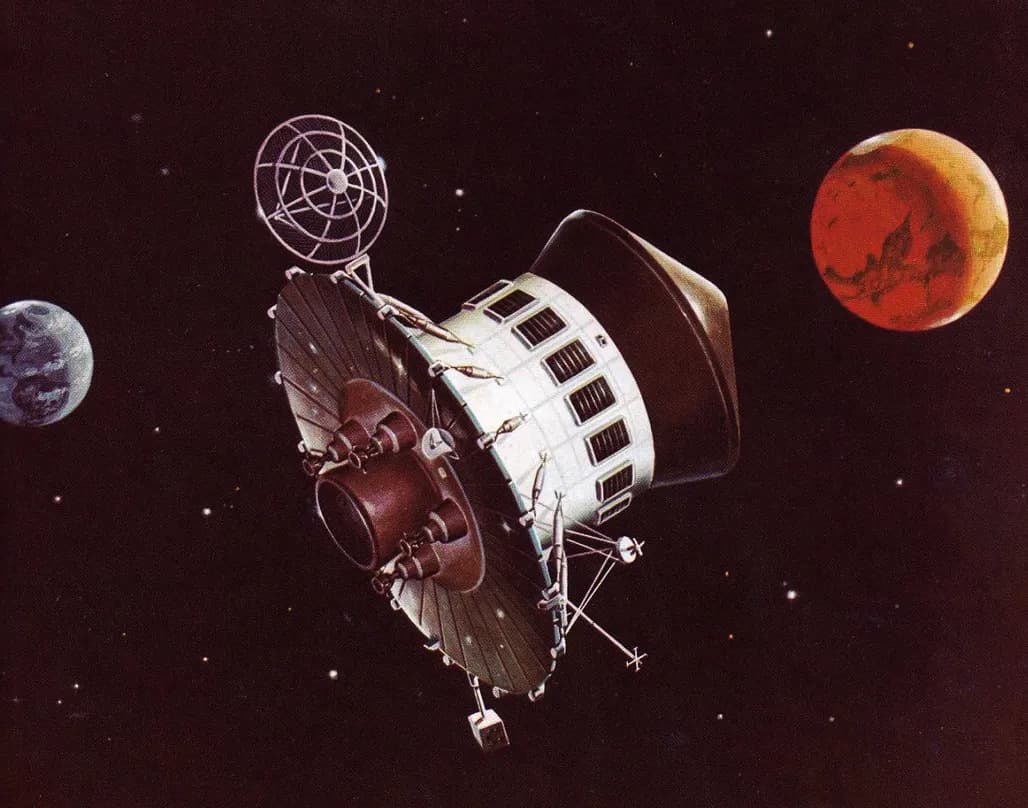
Voyager was born in the spring of 1960 as the thing that would come after Mariner: a heavier class of spacecraft, sized to the Saturn rather than the Atlas, that would orbit Venus and Mars for long periods and drop capsules onto their surfaces. For its first three years it lived at the Jet Propulsion Laboratory, which wanted to build orbiters first and worry about landers much later, and which believed too little was known about either atmosphere to design a landing system at all. NASA Headquarters disagreed, wanted the whole mission studied at once, and wanted industry involved. In March 1963 a request for proposals went to 21 companies; General Electric and AVCO won, and delivered on 15 October 1963 two quite different answers to the same question. General Electric offered two identical 657 kg landers on a single orbiter bus, entering point-down as blunt sphere-cones and righting themselves with rockets, tip bars and explosive anchors, aimed at Syrtis Major and Pandorae Fretum. AVCO offered one 762 kg lander inside an aeroshell, hitting at 12 metres per second on aluminium crush-up pads, tumbling to a stop and then opening six petals to stand itself up. General Electric expected biological instruments to take a third of its 70 kg landed payload; AVCO's landed science came to 91 kg. Seamans signed the project approval document on 16 December 1964, having told the President's science adviser two weeks earlier that four flights would cost $1.25 billion, and having just cancelled Mariner-Mars 69 to protect that money.
Then Mariner 4 flew past Mars. The radio occultation on 14 and 15 July 1965 put the surface pressure at 4.1 to 7.0 millibars, under one percent of Earth's, where Voyager's contractors had been designing to 10 to 30. NASA's official history of the period is blunt about what followed: all the landing capsule proposals had to be thrown out, and new aerodynamic analyses started from the lower pressure. Every fix cost mass. A larger aeroshell, larger parachutes, braking rockets, or all three, would have to come out of a 3,000 kg spacecraft, and the science would have gone instead. The Saturn IB-Centaur could not carry the difference, so in mid-October 1965 NASA killed Saturn IB-Centaur development and put Voyager on the Saturn V, which was so much larger than Voyager needed that it only made sense if two spacecraft flew on each one. Costs went past $2 billion. Homer Newell's space science people were, in the phrase NASA's history preserves, sort of horrified. On 22 December 1965 the 1971 mission was deleted and the first Voyager slid to 1973. Donald Hearth, who ran the programme at headquarters, admitted publicly that the work would now go on a low back burner for a year and a half to two years. It was, in retrospect, the moment the programme stopped being a schedule and became a plan.
What Voyager finally looked like is worth setting out, because almost nobody describes it. The January 1967 programme brochure, written to sell Voyager to Congress, has one three-stage Saturn V lifting two 12-ton spacecraft from a Complex 39 pad at Kennedy inside a 6.7 metre shroud. In the profile the brochure sets out, the upper Voyager would separate after the S-IVB's second burn, the shroud's central section would fall away, and the lower one would follow. Each would mass 10.25 tons after separation, with a ring-shaped body-mounted solar array, course-correction engines derived from the Minuteman missile's second stage, and a main engine whose leading candidate was a modified Apollo Lunar Module descent engine. Each would have carried a 2.5 ton landing capsule inside a sterilisation canister behind a 6.1 metre conical heat shield. Once the orbiter had photographed candidate sites, the capsule was to shed its canister, separate beyond the orbit of Deimos, fire a 188.2 kg solid rocket to drop its periapsis into the atmosphere, enter at two to three miles per second, brake aerodynamically to somewhere between 122 and 305 metres per second by 4,570 metres, throw off the heat shield, light its descent engines, stream a supplemental parachute, hover three metres up and then switch off and drop onto three legs. No capsule was ever built to do any of it. The 1973 lander would have carried 136.1 kg of instruments and run on batteries for a few days; 1975 would have gone nuclear and lasted a Martian year; 1977 and 1979 would have carried a rover.
It never got past design studies. The capsule request for proposals went out on 31 January 1967, four days after the phase B approval document was signed and the Apollo 204 fire killed three astronauts. Grumman, Hughes, Martin Marietta and McDonnell bid; on 17 May Martin Marietta and McDonnell were each given $500,000 for a 90-day study; and that is the entirety of Voyager's hardware history. Everything else was budget. Vietnam was costing $2 billion a month, 67 American cities saw riots or violent demonstrations between June and August 1967, and a Harris survey that summer found the public no longer supported large space spending. Congress had already cut the fiscal 1968 authorisation from $71.5 million to $42 million. Then, in the first week of August, the Manned Spacecraft Center asked 28 contractors to study sample return for crewed Mars and Venus missions in 1975 to 1982, which made Voyager look exactly like what its critics said it was: a foot in the door for a crewed Mars programme costing billions. Karth, who had been defending it, said he was absolutely astounded. On 16 August the House Appropriations Committee reported a bill eliminating Voyager. On 22 August the House passed a NASA budget $511 million below the request. Voyager's final appropriation was zero, and NASA had no approved programme at all for exploring the solar system.
The recovery is the part worth remembering. Langley had entered the Mars business in 1964 doing entry aerodynamics for Voyager, had discarded its own tension-shell heat shield when it failed in the wind tunnel, had spent 1965 on parachutes that could open at Mach 1.2 because nothing existing could, and had a contractor study of an entry system and survivable lander running with AVCO. All of that survived the cancellation. So did the lander design itself: the Voyager lander drawn in September 1966 for 1977 and 1979 had tripod landing gear, a large direct-link high-gain antenna, a smaller relay antenna, radioisotope thermoelectric generators, a boom soil sampler and a television camera, and NASA's own history observes that it was roughly twice Viking's weight with a leg span nearly twice as wide. Viking was named in November 1968, approved by acting administrator Thomas Paine on 4 December 1968 with the more ambitious out-of-orbit landing option, launched on Titan IIIE-Centaurs in 1975 and landed on 20 July 1976. By March 1974 its projected completion cost stood at $927.5 million, a figure in nominal dollars a decade later than Voyager's own estimates and so not directly comparable to them. The word Voyager, meanwhile, sat unused until March 1977, when NASA reassigned it to the two Mariner Jupiter/Saturn 1977 spacecraft a few months before they launched.
Mission facts
What Voyager was
Voyager was a programme of spacecraft rather than a single one. It was first considered in the spring of 1960, when NASA's semiannual report to Congress said that preliminary studies were under way for a second planetary series after Mariner, with orbiters for Venus and Mars "phased in time and capabilities with the Saturn launch vehicle" and landing capsules to work on the surface. Edgar Cortright described a 2,400 pound (1,090 kg) version at congressional hearings in March 1961.↗
Approvals, in order
Project approval document for preliminary studies signed 21 November 1962. Associate Administrator Robert Seamans signed the phase I project approval document on 16 December 1964, revised 14 January 1965 and 15 October 1965. The phase B project approval document, covering the landing capsule system, was signed on 27 January 1967. Phase C, the actual fabrication of spacecraft, was never authorised.↗
The 1963 design studies
Request for Proposal 10-929 went to 21 companies on 5 March 1963 for an advanced spacecraft to fly "orbiter/lander missions to Mars and Venus from 1967 through 1975". Thirteen companies bid, ten were judged acceptable, and General Electric's Missile and Space Division at Valley Forge and AVCO's Research and Advanced Development Division were picked in early April. Both reported on 15 October 1963. GE proposed two identical 657 kg landers on one orbiter bus; AVCO proposed a single 762 kg lander. Total system weights came out at 3,187 kg (GE) and 2,961 kg (AVCO).↗
The 1965 preliminary designs
Three firms were selected in April 1965 for 90-day phase IA preliminary design studies under JPL: the Aerospace Division of Boeing in Seattle, GE Missile and Space at Valley Forge, and TRW Space Technology Laboratories at Redondo Beach. TRW's summary volume, report 5410-0001-RU-000 dated 30 July 1965 under JPL contract 951113, describes a 1971 Voyager spacecraft attached at six points to its landing capsule and to a Centaur interstage, with a double-gimballed 6-foot high-gain antenna, and puts the spacecraft bus 320 pounds under the 2,000 pounds allotted to it by the JPL mission specification. That allocation covers the bus alone; the capsule and propellant fall outside it.↗
What Mariner 4 did to it
The radio occultation on 14 and 15 July 1965 gave a Martian surface pressure of 4.1 to 7.0 millibars, under one percent of Earth's 1,013 millibars, where Voyager's designers had been working to 10 to 30 millibars. Ezell and Ezell's NASA history states the consequence flatly: "All proposals for landing capsules had to be thrown out as new aerodynamic analyses were performed based on the much lower pressure range." A capsule now needed a bigger aeroshell, bigger parachutes or braking rockets, and all three cost mass. The pressure figures are Kliore and colleagues in Science; the quotation and the 10 to 30 millibar design range are SP-4212 p. 102.↗
Why that killed the launch vehicle too
With a 3,000 kg spacecraft limit, the extra deceleration hardware would have eaten the science payload, and no version fitted the Saturn IB-Centaur. In mid-October 1965 NASA terminated Saturn IB-Centaur development and moved Voyager to the Saturn V. One Saturn V could carry two Voyagers, which was the only way to use a booster Donald Hearth had told Administrator Webb in February 1963 was 6.6 times more capable than Voyager needed.↗
The cost history
Voyager's price is quoted as one number by people who quote it at all, and it moved constantly. NASA's own table of estimates runs: $700 million for four flights (8 March 1963); $450 million for two (7 August 1964); $1,250 million for four (14 December 1964, the source of the widely repeated $1.25 billion); $946 million (1965 reviews); $1,000 million after the Saturn V decision (headquarters) against $1,300 million (JPL); $1,578 million (JPL, December 1965) against $1,200 million (Hearth); $1,800 million (January 1966); $1,429 million for spacecraft and lander without launch vehicles (25 October 1966); and $2,200 million on 18 April 1967 including $400 million of launch vehicles but excluding operations, $40 million of facilities and $55 million of Deep Space Network antennas.↗
The 1973 mission as it stood in January 1967
Two 12-ton Voyagers on one Saturn V from Complex 39 at Kennedy, in a 6.7 m diameter shroud massing 4.7 tons. Each spacecraft would mass 10.25 tons after separation, with a ring-shaped body-mounted solar array, course-correction engines derived from the Minuteman second stage, and a main engine whose leading candidate was a modified Apollo Lunar Module descent engine. The fully loaded orbiter propulsion system alone would weigh 6.5 tons. Initial orbit periapsis about 1,127 km, apoapsis beyond Deimos.↗
The landing capsule
A 2.5 ton capsule inside a sterilisation canister, with a 6.1 m conical heat shield. On paper it would eject the canister, separate from the orbiter beyond Deimos, and fire a 188.2 kg solid deorbit rocket. It would then enter at two to three miles per second, brake aerodynamically to between 122 and 305 m/s by 4,570 m altitude, throw off the heat shield, light its descent engines and deploy a supplemental parachute, hover at three metres, then cut the engines and drop onto three legs. This sequence was never flown.↗
A different landing profile four months earlier
The September 1966 JPL Voyager Project Estimate 14 describes the same job differently: braking rockets and radar altimeter at about 6,100 m and 140 to 335 m/s depending on atmospheric density, lander separated pyrotechnically from the aeroshell at 610 m slant range and 45 to 105 m/s, terminal descent engines stabilising the vehicle at 1.5 m/s at 25 m, engine cutoff at 3 m to avoid disturbing the ground, touchdown at 3 to 8 m/s. Two snapshots of an unbuilt design taken four months apart do not agree, and neither is more official than the other.↗
Landed mass, growing
The January 1967 brochure gives a battery-powered 1973 lander of up to 390 kg carrying 136.1 kg of science, a radioisotope-powered 1975 lander of up to 499 kg able to work a full Martian year, and up to 680.4 kg in 1977 and 1979 with a lander-deployed rover. The 1973 orbiter would carry 181.4 kg of instruments across a two-year life. The landed science figure moved constantly in the programme's last year: the Voyager Capsule Advisory Group recommended 45 kg for 1973 on 19 July 1966, the January 1967 brochure says 136.1 kg, and revised project guidelines of 10 July 1967 specify a 90 to 115 kg science subsystem. Required surface lifetime moved too, from at least 24 hours on 12 April 1967 to at least 30 days on 10 July 1967.↗
How far it actually got
Phase B. The capsule request for proposals went to 36 contractors on 31 January 1967; Grumman, Hughes, Martin Marietta and McDonnell bid on 2 March; and on 17 May 1967 Martin Marietta's Denver division and McDonnell's Astronautics Company were each given $500,000 for a 90-day design study, on contracts dated 1 June 1967. Those two studies were completed after the programme was dead. No spacecraft contractor for phase C was ever chosen and no hardware was cut.↗
Who was supposed to run it
This was never settled. JPL held it, then the 27 January 1967 approval document gave Marshall the spacecraft and the Saturn V with JPL and Langley sharing the lander, then Webb postponed that on 8 February 1967, and a Voyager Interim Project Office of 77 people under Hearth opened in a downtown Pasadena bank building on 20 March 1967. A later study by a Harvard Graduate School of Business Administration team called the result "an unusual and complex management structure".↗
The last straw
In the first week of August 1967, with the Voyager appropriation still in play, the Manned Spacecraft Center in Houston sent 28 contractors a request for proposals for a "Planetary Surface Sample Return Probe Study for Manned Mars/Venus Reconnaissance/Retrieval Missions" for 1975 to 1982. Representative Joseph Karth, who had been fighting to save Voyager, told a reporter he was "absolutely astounded" and that "a manned mission to Mars or Venus by 1975 or 1977 is now and always has been out of the question". On 16 August the House Appropriations Committee reported a bill eliminating Voyager entirely.↗
The budget line
Fiscal 1968: requested $71.5 million. House authorisation $50.0 million, Senate authorisation $0, conference $42.0 million, final appropriation $0. NASA's whole fiscal 1968 request of $5,100 million came out at $4,588.9 million. Funds for the proposed Mariner 1971 with an atmospheric probe went with it.↗
What it became
Viking, and the resemblance is not metaphorical. The Voyager lander drawn in September 1966 for the 1977 and 1979 landings already had tripod landing gear, a large direct-link high-gain antenna, a smaller relay antenna, radioisotope thermoelectric generators, a boom soil sampler and a television camera. NASA's own history notes that its leg span was nearly twice Viking's and its proposed weight about twice Viking's. Viking was approved on 4 December 1968 and landed on Mars on 20 July 1976.↗
Mission timeline
- Apr to Sep 1960Voyager first appears as an advanced mission concept. NASA's semiannual report to Congress covering this period tells legislators that preliminary mission studies are under way for a second planetary series after Mariner: Venus and Mars orbiters "phased in time and capabilities with the Saturn launch vehicle", carrying landing capsules to work on the surface.
- 21 Nov 1962A project approval document is signed for preliminary Voyager studies. JPL had begun looking at Voyager-class missions in 1961 and had concluded that too little was known about either planet's atmosphere to design a lander at all.
- 15 Oct 1963General Electric and AVCO deliver the first contracted Voyager design studies. GE proposes two 657 kg landers on one orbiter with landing sites at Syrtis Major and Pandorae Fretum; AVCO proposes a single 762 kg lander that survives a 12 m/s impact on crush-up pads and rights itself on six petals.
- 16 Dec 1964Seamans signs the Voyager project approval document. Two days earlier, on 14 December, he had written to the President's science adviser Donald Hornig that four flights, two in 1971 and two in 1973, were expected to cost $1.25 billion. Mariner-Mars 69 had been cancelled on 20 November to protect Voyager.
- 14 to 15 Jul 1965Mariner 4's radio occultation gives a Martian surface pressure of 4.1 to 7.0 millibars. Every Voyager landing capsule proposal on the table is invalidated: all of them had been designed to the earlier estimate of 10 to 30 millibars.
- Oct 1965NASA terminates Saturn IB-Centaur development and moves Voyager to the Saturn V, two spacecraft per launch. There will now be no 1969 test flight, the 1971 opportunity becomes an orbiter-only mission, and cost estimates run past $2 billion.
- 22 Dec 1965Homer Newell's office tells JPL there will be no 1971 Voyager at all; the first flight slips to 1973. The Bureau of the Budget had cut NASA's fiscal 1967 request from $5.6 billion to $5.012 billion and left Voyager $10 million of the $150 million it wanted for hardware.
- 27 Jan 1967The phase B project approval document is signed, giving Marshall the spacecraft and the launch vehicle and splitting the lander between JPL and Langley. The same day, the Apollo 204 fire kills Grissom, White and Chaffee, and the plan is never executed.
- 17 May 1967Martin Marietta's Denver division and McDonnell's Astronautics Company are each awarded $500,000 for a 90-day phase B design study of the Voyager landing capsule, on contracts dated 1 June. This is as far as Voyager ever gets.
- Aug 1967The Manned Spacecraft Center asks 28 contractors to study sample return for crewed Mars and Venus missions in 1975 to 1982. Karth, Voyager's main defender in the House, is "absolutely astounded". Voyager now looks like a foot in the door for a crewed Mars programme nobody in Congress will fund.
- 16 to 22 Aug 1967On 16 August the House Appropriations Committee reports a bill eliminating Voyager entirely and cutting the lunar and planetary budget by a further $6.9 million, leaving funds only for Mariner 69. On 22 August the House passes a $4,588.9 million NASA budget, $511 million below the request. President Johnson declines to fight it.
- 29 to 30 Aug 1967Voyager ends. NASA's own summary data gives 29 August 1967 as the cancellation date for the 1973 mission; Oran Nicks' memo of 30 August, telling all officers that Voyager would not proceed into phase C, is annotated in NASA's history as the day "Voyager effectively ended". Portree, working from the January 1967 programme brochure, dates the abandonment only to September 1967.
A filled dot marks something that physically happened. A hollow one marks an announcement, a naming or a target.
In pictures
Tap a photo to enlarge.
Sources
- Edward Clinton Ezell and Linda Neuman Ezell, On Mars: Exploration of the Red Planet 1958-1978 (NASA SP-4212, 1984)
- Same volume, Appendix B "Voyager Project Highlights, 1966-1967" and Appendix C summary data
- David S. F. Portree, "The First Voyager (1967)", No Shortage of Dreams, 2019
- A. Kliore et al., "Occultation Experiment: Results of the First Direct Measurement of Mars's Atmosphere and Ionosphere", Science 149 (3689), 1965
- TRW Systems Group, Voyager Spacecraft, Volume 1: Summary, Phase 1A Study Report (5410-0001-RU-000, NASA CR-71468), 30 July 1965, under JPL contract 951113
- General Electric Missile and Space Division, Voyager Design Study, Volume I: Design Summary, 15 October 1963 (NTRS)
- R. Fellows, "Goals of the Voyager Program", 1 August 1965 (NTRS)
- David S. F. Portree, Humans to Mars: Fifty Years of Mission Planning 1950-2000 (NASA SP-2001-4521)
- JPL, "Slice of History: Mariner Jupiter Saturn 1977"
- English Wikipedia: Voyager program (Mars)
Facts on this page were verified on 24 August 2026. Where sources disagree, the disagreement is stated rather than resolved silently.