Sputnik 22, Mars 1 and Sputnik 24
OKB-1 (USSR) · Soviet Union · Flyby · 1962 · The first attemptsPartial
Three launches, 24 October to 4 November 1962: two never left Earth orbit and were never announced. The third, Mars 1, lost its attitude control gas within days and fell silent on 21 March 1963 at 106 million km.
TL;DR· 12 min read
The USSR launched three Mars craft in twelve days at the height of the Cuban missile crisis, and only one escaped Earth orbit. That one became Mars 1, the first spacecraft ever placed on a trajectory to Mars, but a badly seated nitrogen valve had bled away all its attitude control gas by 5 November 1962. It managed 61 radio sessions over about 140 days, fell silent on 21 March 1963 at 106 million km, and passed Mars unheard on 19 June 1963.
In twelve days at the end of 1962, while the world stood closer to nuclear war than at any point before or since, the Soviet Union tried three times to reach Mars. Two of the three never escaped Earth orbit and were never acknowledged. The third became Mars 1, the first spacecraft ever placed on a trajectory to Mars, which spoke to Yevpatoria for about 140 days and then went quiet at 106 million km, further away than any spacecraft had been heard from before.
- 106M kmdistance at the last contact with Mars 1, a record for its time
- 61radio sessions with Mars 1, and over 3,000 commands sent
- 1 of 3craft that escaped Earth orbit
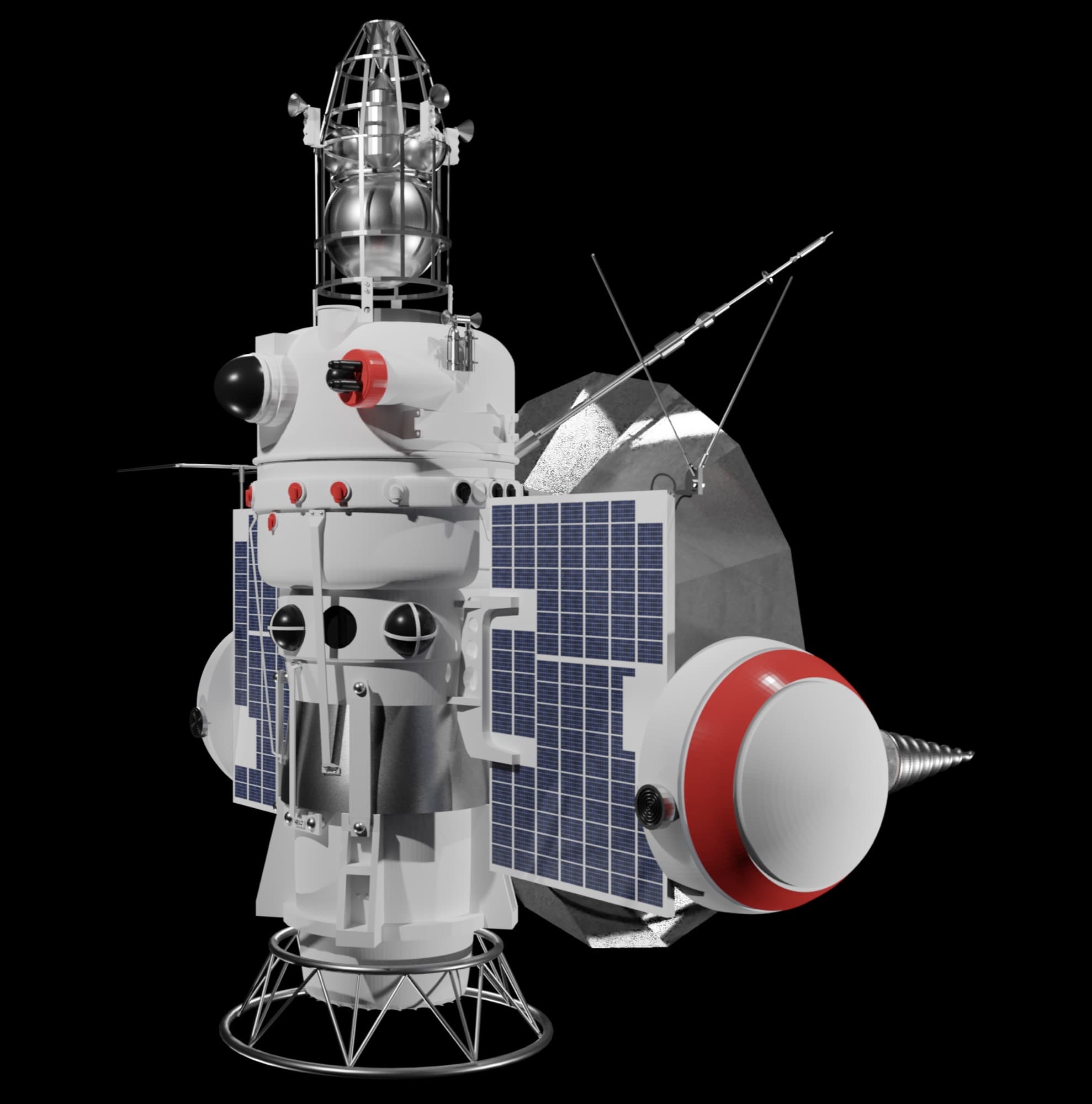
The 1962 window allowed three shots between 24 October and 4 November, and OKB-1 filled all three. Two flyby craft, 2MV-4 No. 3 and No. 4, and one impact craft carrying a lander, 2MV-3 No. 1, were prepared in parallel in the assembly building on twelve-hour shifts. The 2MV was the second-generation design: a sealed orbital module holding guidance, power, thermal control and radio, and beneath it either a science module for a flyby or a descent capsule for an impact mission. After 1960 Chertok had insisted on a high-rate centimetre-band link working through a parabolic dish, backed by a decimetre link on low-gain antennas and a metre-band emergency link on omnidirectional antennas for use when the spacecraft was not oriented. Reliability work on the chronically unreliable Blok L fourth stage had eaten into the mass budget, which Chertok found painful because it devalued the science the whole flight existed to carry. Nobody on the team knew what was happening in the Caribbean. Chertok flew out from Moscow on 15 October, the day before President Kennedy was shown the U-2 photographs of Soviet missiles in Cuba, and the first Mars rocket was rolled out to Site 1 on the morning of 21 October, the day before Kennedy went on television.
2MV-4 No. 3 left the pad on 24 October at 17:55:04 UTC on vehicle T103-15. The first three stages worked. Then the Blok L escape stage, which had already destroyed the entire 1962 Venus campaign, destroyed this one too: about seventeen seconds into the burn its turbopump exploded, traced afterwards to leaking lubricant, and the spacecraft came apart. Twenty-four objects were eventually catalogued, the spacecraft itself reentering on 29 October and the last of them, the spent Blok L stage, not until late February 1963. Because the launch was never announced, Western catalogues invented a name for the debris: Sputnik 22. This flight is attached to one of the most quoted near-miss stories of the nuclear age, that a Ballistic Missile Early Warning System radar in Alaska picked up the breakup and briefly read it as the start of a Soviet attack. NASA's own catalogue repeats it. It deserves care: the 24 October incident is not documented anywhere near as well as the two better-attested false alarms of 28 October 1962, at Moorestown and at Laredo, both of which involved satellites being misread as missiles, and popular lists of nuclear close calls sometimes blur the three together. What is documented from the Soviet side is the mirror image of the same fear. Chertok wrote that they told nobody about the Mars launch, and worried that in that atmosphere American air defences might read it as a combat launch.
Three days later the crisis reached the launch site itself. On the morning of 27 October, Black Saturday, Chertok walked to the assembly building and found submachine gunners climbing to the roof, soldiers in full kit and gas masks fanning out along the perimeter, and the always-shrouded duty combat R-7A uncovered with crews swarming over it, while the Mars rocket that should have flown by 29 October stood abandoned. Colonel Anatoly Kirillov, head of the range's first directorate, had opened the sealed envelope from the special safe during the night. His orders were to mate the missile with the warhead held in a separate store, roll it to Site 1, fuel it, aim it and wait for a launch command. The pad prepared for 2MV-4 No. 4 was the pad the warhead needed. Chertok asked whether the Mars rocket could be left in place a little longer in case the strike was called off; Kirillov, who had commanded an artillery battery in the war, replied that he would face a military tribunal, and that every line to Moscow was closed. Chertok got through anyway, on a half-forgotten back route through switchboards, and reached Korolev, who said only that he knew everything, that nobody should do anything stupid, and rang off. That evening Kirillov's jeep braked hard on the concrete outside and he shouted a single word: stand down.
The reprieve let the second flyby craft fly on 1 November. The day held one more oddity. At 14:15 Moscow time a Soviet high-altitude nuclear test, shot K-5, detonated roughly 60 km up and some 500 km from the range, and every radio band at Baikonur fell silent for over an hour. The ionosphere had recovered by launch at 16:14:16 UTC on vehicle T103-16, the ninth flight of the four-stage 8K78. This time Blok L worked, and an 893.5 kg spacecraft went to Mars. TASS named it Mars 1 the next day. Within days the telemetry showed a nitrogen valve in the attitude control system that had not seated properly, and by 5 November the entire gas supply had escaped through it. Investigators, forensic specialists among them, traced the cause to crumbs of rosin from soldering the valve's electromagnet winding lodging under the seat, and reproduced the fault at the factory. Without three-axis pointing there could be no course correction and no high-gain link, so the craft was spun for solar illumination and worked through its low-gain decimetre antenna. It managed 61 sessions across about 140 days, accepted more than 3,000 commands, and returned data on cosmic ray intensity, magnetic fields, solar wind ions and meteoroid densities out to 1.24 astronomical units. The last session was on 21 March 1963, at 106 million km.
The third craft never got its chance. 2MV-3 No. 1 lifted off on 4 November at 15:35:15 UTC on T103-17, carrying the only Mars lander of the series: a sphere roughly 90 cm across with its centre of gravity offset so it would present its blunt face to the atmosphere, instrumented for temperature, pressure, density, composition and gamma rays, and buoyant in case it came down in water, which was not yet an absurd contingency to plan for. Cavitation in the core stage propellant lines around T+260 seconds shook the vehicle hard. Chertok recorded that a shutdown command reached the Blok L engine 33 seconds into its burn; other reconstructions hold that the vibration jarred loose an igniter or fuse so the stage never fired at all. Either way the spacecraft stayed in Earth orbit. McDowell's catalogue has it reentering the next day, on 5 November, with the settling-motor unit staying up until 19 January 1963; NSSDCA instead gives 19 January 1963 for the spacecraft itself. Which tracked object was which has never been settled. Western catalogues called it Sputnik 24. Mars 1 itself passed Mars on 19 June 1963, silent, at a distance usually given as about 193,000 km, and settled into a solar orbit it occupies still. It remains the only spacecraft of the Soviet 1962 campaign that reached deep space, and the first close-up pictures of Mars would come, two years later, from NASA's Mariner 4.
Mission facts
Launch 1 of 3
2MV-4 No. 3, 24 October 1962, 17:55:04 UTC (20:55 Moscow), Molniya 8K78 vehicle T103-15 from Site 1 at NIIP-5 (Baikonur). Catalogued in the West as Sputnik 22; the USSR announced nothing.↗
Launch 2 of 3
2MV-4 No. 4, 1 November 1962, 16:14:16 UTC (19:14 Moscow), vehicle T103-16 from the same pad. This was the ninth flight of the four-stage 8K78. TASS named it Mars 1 the following day.↗
Launch 3 of 3
2MV-3 No. 1, 4 November 1962, 15:35:15 UTC (18:35 Moscow), vehicle T103-17 from the same pad. Catalogued in the West as Sputnik 24; the USSR announced nothing.↗
Spacecraft type
The 2MV second-generation bus, shared between Mars and Venus. A unified sealed orbital module carried guidance, power, thermal control and communications; below it sat either a science module (2MV-2 and 2MV-4, flyby) or a descent capsule (2MV-1 and 2MV-3, impact). Only the flyby versions carried phototelevision cameras.↗
Mars 1 mass and size
893.5 kg, 3.3 m long and 1.1 m in diameter, 4 m across with solar panels and radiators deployed. Solar array area 2.6 square metres, feeding a 42 amp-hour cadmium-nickel battery; interior sealed at 1.1 atmospheres.↗
Mars 1 instruments
Phototelevision camera, spectroreflectometer for organic coatings, ozone-band spectrograph, magnetometer on a boom, gas-discharge and scintillation radiation counters, cosmic ray counters, a radio telescope at 150 and 1500 m wavelengths, ion and electron traps, and a micrometeoroid detector.↗
The lander that did not fly
2MV-3 No. 1 carried the only Mars lander of the series: a spheroid roughly 90 cm across with its centre of gravity offset so it would enter blunt face down, instrumented for temperature, pressure, density, atmospheric composition and gamma rays, and buoyant in case it came down in water. Its life-detection instrument had been removed before launch, after it failed to perform adequately in ground tests.↗
Failure, 24 October
The Blok L escape stage's S1.5400A1 engine exploded about 17 seconds into the trans-Mars burn when its turbopump failed, traced to leaking lubricant. Twenty-four objects were catalogued, four of them identifiable hardware (the spacecraft, the Blok I, the Blok L and the settling-motor unit) and twenty of them debris; the spacecraft itself reentered on 29 October 1962 and the last object down was the spent Blok L stage on 26 February 1963.↗
Failure, 4 November
Cavitation in the core stage propellant lines around T+260 seconds shook the vehicle hard. Chertok recorded a shutdown command reaching the Blok L engine 33 seconds into its burn; other reconstructions say ascent vibration jarred loose an igniter or fuse so the stage never fired. Catalogues disagree about which tracked object was the spacecraft: McDowell's satcat has the spacecraft (00451) decaying on 5 November 1962 and the settling-motor unit (00454) on 19 January 1963, while NSSDCA has a presumed booster decaying on 25 December 1962 and the Mars spacecraft itself on 19 January 1963, and LePage puts the decay of escape-stage and lander components between 27 December 1962 and 19 January 1963.↗
Mars 1's fatal fault
A nitrogen valve in the attitude control system never seated properly. By 5 November the entire gas supply had bled out through it. Investigators, including forensic specialists, traced the cause to rosin crumbs from soldering the valve's electromagnet winding lodging under the seat, and reproduced the fault at the factory.↗
How Mars 1 kept working
Without three-axis pointing there could be no midcourse correction and no high-gain link, so the craft was put on gyroscopic spin stabilisation to keep the solar panels lit and worked through the low-gain decimetre antenna. Sessions ran at two-day intervals until 13 December 1962, then five-day intervals.↗
Mars 1's operating record
61 radio sessions over about 140 days (37 sessions and over 600 commands in the first month alone), with more than 3,000 commands sent in total. Data returned on cosmic ray intensity, magnetic fields, solar wind ions and meteoroid densities out to 1.24 astronomical units.↗
Last contact with Mars 1
21 March 1963, at 106 million km from Earth (NSSDCA gives 106,760,000 km). This exceeded Mariner 2's final range of about 87 million km on 3 January 1963 and was a record for radio contact with a spacecraft at the time.↗
Mars encounter
19 June 1963, a silent, uncontrolled pass at about 193,000 km according to NSSDCA and Russian sources, or about 197,000 km according to Siddiqi. Mars 1 then continued in solar orbit (perihelion 0.924 AU, aphelion 1.604 AU, eccentricity 0.269, inclination 2.68 degrees, period 519 days).↗
Ground segment
The Pluton deep space complex at Yevpatoria in Crimea (NIP-16) handled the sessions. The 2.6 m telescope of the Crimean Astrophysical Observatory also tracked Mars 1, and in February 1963 the same Yevpatoria complex carried out a radar detection of Mars.↗
Names
Only Mars 1 was ever named by the USSR. Sputnik 22 and Sputnik 24 are Western catalogue labels; Sputnik 22 was first listed as Sputnik 29 by US Naval Space Command, and Mars 1 appears in some Western lists as Sputnik 23 or Sputnik 30.↗
Mission timeline
- 15 Oct 1962Chertok flies from Vnukovo to the launch range with the main test team. Three rockets and three spacecraft are prepared in parallel on twelve-hour shifts; the window closes on 4 November.
- 21 Oct 1962The first Mars rocket is rolled out to Site 1 without ceremony. The same day, in Cuba, the twentieth R-12 missile is being readied for combat duty.
- 24 Oct 19622MV-4 No. 3 launches at 17:55:04 UTC. Three stages work; the Blok L turbopump explodes about 17 seconds into the escape burn and the spacecraft breaks into two dozen pieces. Western catalogues will call the debris Sputnik 22.
- 25 Oct 1962The next 8K78, carrying 2MV-4 No. 4, is rolled out to Site 1 for a launch no later than 29 October. It is standing on the pad through the worst hours of the crisis.
- 27 Oct 1962Black Saturday. Baikonur goes onto a wartime footing; the Mars rocket is ordered off the pad to make room for a nuclear-armed R-7A. The stand-down comes that evening.
- 1 Nov 1962At 14:15 Moscow time the Soviet high-altitude nuclear test K-5 detonates roughly 500 km from the range, blacking out every radio band for over an hour. Mars 1 launches at 16:14:16 UTC once the ionosphere recovers.
- 2 Nov 1962Pravda and the radio announcer Yuri Levitan report the launch of a space rocket toward Mars. The craft is named Mars 1.
- 4 Nov 19622MV-3 No. 1, the lander mission, launches at 15:35:15 UTC. The Blok L fails again and the spacecraft stays in Earth orbit, reentering the next day.
- 5 Nov 1962Mars 1 has lost all its attitude control nitrogen. Keldysh and Chertok fly to Yevpatoria and conclude there will be no photographs of Mars.
- 15 Dec 1962Pravda publishes the trajectory, a photograph of the spacecraft and the science programme. By then the team already knows the craft will not reach Mars alive.
- 21 Mar 1963Last contact with Mars 1, at 106 million km, the greatest distance from which any spacecraft had been heard.
- 19 Jun 1963Mars 1 makes a silent, uncontrolled pass of Mars at roughly 193,000 km and continues in solar orbit.
A filled dot marks something that physically happened. A hollow one marks an announcement, a naming or a target.
In pictures
Tap a photo to enlarge.
Sources
- Boris Chertok, Rakety i lyudi, vol. 2, chapter I snova na Veneru i Mars (Again to Venus and Mars)
- Boris Chertok, Rakety i lyudi, vol. 3, chapter Karibskiy raketnyy krizis... i Mars (The Cuban missile crisis and Mars)
- NSSDCA Master Catalog: Mars 1, 1962-061A (archived)
- NSSDCA Master Catalog: Sputnik 22, 1962-057A (archived)
- NSSDCA Master Catalog: Sputnik 24, 1962-062A (archived)
- Asif Siddiqi, Deep Space Chronicle, NASA SP-2002-4524
- Russian Wikipedia: Mars-1
- Jonathan McDowell, GCAT launch catalogue
- Jonathan McDowell, GCAT satellite catalogue
- Andrew LePage, You Can't Fail Unless You Try: The Soviet Venus and Mars Missions of 1962
- RussianSpaceWeb (Anatoly Zak): Russia's unmanned missions to Mars
- Alan Phillips, 20 Mishaps That Might Have Started Accidental Nuclear War
Facts on this page were verified on 23 August 2026. Where sources disagree, the disagreement is stated rather than resolved silently.