Mars Excursion Module
NASA · United States · Lander · 1963 · Reaching MarsCancelled
Never built, and never formally cancelled: no crewed Mars programme was ever approved for it to belong to. It was designed three times between 1963 and 1967, by Philco Aeronutronic, Marshall and North American Rockwell.
TL;DR· 17 min read
The Mars Excursion Module was America's crewed Mars lander on paper, designed seriously three times and never built. The 1963 Aeronutronic design was a 30-foot columbium lifting body for three astronauts, drawn for a Martian atmosphere of 85 millibars. Mariner 4 measured 4.1 to 7.0 millibars in July 1965, which killed the lifting body and left a blunt Apollo cone that fell most of the way and then braked on rockets. No MEM was ever approved for development, so it has no cancellation date.
The Mars Excursion Module was the American crewed Mars lander, and for about eight years it was a real engineering document rather than an idea. The 1963 design was a 30-foot columbium-skinned lifting body for three astronauts, drawn to glide down under control through what everyone then believed was a Martian atmosphere about a tenth as thick as Earth's, to land tail-down on four crushable legs and to use its descent stage as a launch pad, exactly as the Lunar Module would. Mariner 4 measured that atmosphere in July 1965 and found it twelve to twenty times thinner than that. The lifting body could not work. What replaced it was a blunt Apollo cone that fell most of the way and then braked on rockets, and nothing was ever built.
- 3crew the 1963 preliminary design settled on, against the two its guidelines assumed
- 85 to 6 mbarassumed Martian surface pressure before Mariner 4 and after it, which destroyed the lifting-body design
- $6.2bnAeronutronic's 1963 upper-limit estimate for a ten-year MEM programme of eleven vehicles
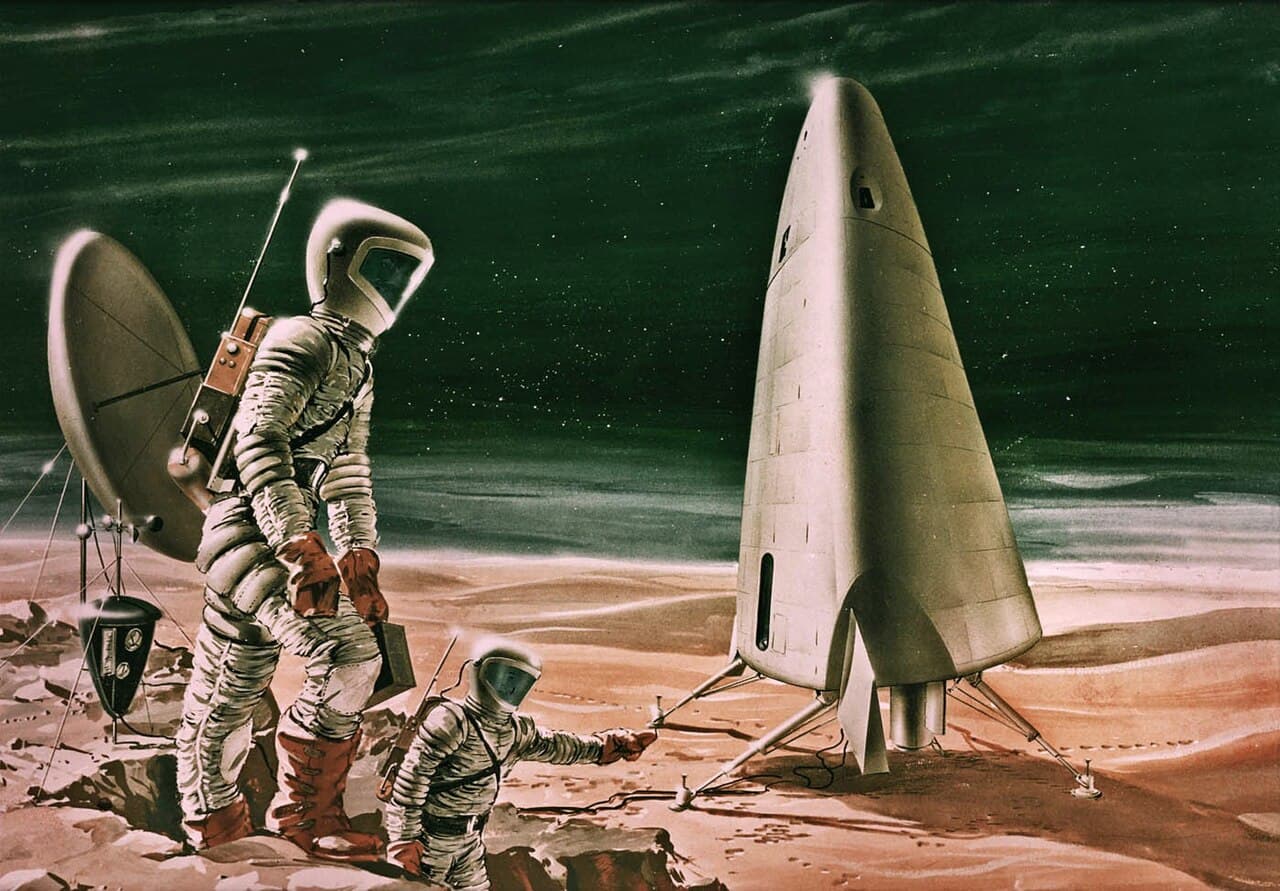
The Mars Excursion Module began as a piece of homework. In 1961 Maxime Faget started a low-level crewed Mars study at what became the Manned Spacecraft Center in Houston, and by late 1962 it had grown into a real effort under David Hammock and Bruce Jackson. What it produced was a mission profile and what NASA's own historian of Mars planning calls the first detailed design for a piloted Mars lander. The design work went out to the Aeronutronic Division of Philco under contract NAS9-1608 in May 1963, run by Franklin Dixon, and was finished by November. It ran in two halves. The parametric phase swept the whole space of entry vehicles, from a winged glider with a lift-to-drag ratio of 3.6 down to a near-ballistic Apollo capsule at 0.5, looking at trajectories, heating and landing footprints. The preliminary design phase then built out a single answer at L/D 1.0: a modified 20 degree half-cone with two stubby winglets, about 30 feet long and 33 feet across the tail, sitting on the mothership's back behind a thermal and meteoroid shield. Aeronutronic offered two arrangements, a tail lander on four crushable-pad legs and a canted lander on three, and picked the tail lander because it launched vertically rather than at 45 degrees. It would carry three astronauts, deliver 2,000 pounds of surface equipment and bring back at least 800 pounds of samples.
The whole vehicle was a bet on the Martian atmosphere, and Dixon said so. He told the 1964 Marshall symposium that as recently as March 1963 the published density models varied by two orders of magnitude at a given altitude, so a nominal atmosphere had to be invented before anything could be designed. Aeronutronic chose 85 millibars at the surface, about a tenth of Earth's, 94 percent nitrogen. In that atmosphere a lifting body works: the MEM would enter nose-up at 24 degrees, feel less than one Earth gravity of deceleration, open a single parachute at Mach 1.5 below 100,000 feet, swing to tail-down, light its retrorocket and hover for up to 60 seconds while the pilot picked a spot. The structure was a hot structure rather than an ablator, columbium or titanium-molybdenum with nickel alloy on the aft surfaces, chosen because columbium survived the calculated peak temperatures while the alternatives did not. Weight was the recurring embarrassment: the guideline was 55,000 pounds in Mars orbit, and the three-crew, 40-day design came out at 58,070 to 66,964. Dixon noted you could hit 55,000 pounds with a crew of two and a 10-day stay, and said plainly that neither adjustment was reasonable. He costed the MEM alone at $6.2 billion over ten years for eleven vehicles.
Mariner 4 ended it in a single afternoon. The radio occultation on 14 and 15 July 1965 put the Martian surface pressure at 4.1 to 7.0 millibars, twelve to twenty times thinner than the 85 millibars Aeronutronic had assumed, and under one percent of Earth's. Gordon Woodcock at Marshall spelled out the engineering consequence in a memorandum the following June. Earlier crewed lander studies had worked to about 25 millibars and a scale height of 20 kilometres or more, in which a lifting entry brings you to subsonic speed at a comfortable altitude and parachutes finish the job. Run the same entry in the real atmosphere and the vehicle is still doing about Mach 2 when it runs out of sky, which, in Woodcock's careful phrasing, made the feasibility of using parachutes very questionable. His replacement was an Apollo shape at a lift-to-drag ratio of about 0.4, entering from Mars orbit rather than straight off the interplanetary trajectory because the direct entry corridor was too narrow to be safe, braking aerodynamically to about 500 metres per second and then falling the rest of the way on rockets. His four-man vehicle was costed at 56,140 kg at entry and 40,940 kg on the ground, carrying a 27,300 kg ascent stage that would stand ready to launch off the descent stage. He also sketched two variants with the ascent stage removed: a logistics lander for 22 to 24 tonnes of cargo, and a three-deck shelter for five people for 500 days.
The final MEM was North American Rockwell's, designed for Houston between October 1966 and August 1967 under contract NAS9-6464 and published in January 1968. It is the version most people have seen without knowing it, though the cutaway drawing NASA's own history reproduces comes from a February 1971 Manned Spacecraft Center report rather than from NAR's own volumes. NAR made cost a design driver and reused the Apollo command module shape on the argument that a well-understood geometry would be cheaper to qualify, going as far as proposing a single heat shield design for both Earth flight tests and Mars entry, accepting that it would be heavier than a Mars-optimised shield in exchange for not developing two. The vehicle was 30 feet across, ranged from 33 tons for two people and four days up to 54.5 tons for four people and 30 days, and split into a descent stage laboratory with an airlock and an ascent capsule with an Apollo docking unit. Entry would have been at seven Earth gravities, followed by a drogue chute, then a ballute released at 10,000 feet, then the descent engine, at which point two of the crew would climb out of their couches and fly the last stretch standing at controls. It would have burned methane and oxygen, hovered for two minutes and landed on six legs on slopes up to 15 degrees. NAR proposed starting development in 1971, six test articles, a piloted Earth entry and landing test in 1979 and a Mars landing in 1982.
None of it was ever authorised, which is why the MEM has no cancellation date. It was a vehicle inside a programme that did not exist. Its only real moment came on 4 August 1969, two weeks after Apollo 11, when von Braun spent half an hour presenting a 1982 Mars expedition to the Space Task Group with the NAR MEM as the lander and 12 November 1981 as the departure date, noting that the MEM was the only piece of hardware in the plan built purely for Mars and that a go-ahead in 1974 would commit the country to the expedition. The Space Task Group report of 15 September 1969 declined to set a date, recommending only that humans reach Mars before the end of the century and warning that the goal should not assume over-riding priority. The Office of Management and Budget cut NASA's fiscal 1971 request to $3.5 billion that November; the budget that reached Congress on 2 February 1970 was $3.38 billion; and on 7 March 1970 Nixon said only that America would eventually send men to explore Mars. The last formal crewed Mars plan of the era, written at MSC in February 1971, still carried a MEM, and its author noted that formal support for the study had always been very small and non-continuous. No crewed Mars lander has been built since. The Sending people to Mars entry in this catalogue found no funded crewed Mars programme anywhere as of 23 August 2026, and nothing in this batch's sources changes that.
Mission facts
What a MEM was
The MEM was never the whole mission. In every plan that used one, it was the third of three vehicles: a Mars Mission Module carried the crew from Earth orbit to Mars orbit and back, an Earth Return Module brought them home, and the Mars Excursion Module carried a landing party down, housed them on the surface and flew them back to the mothership. It was the Lunar Module's role, scaled up for a planet with an atmosphere and a much deeper gravity well.↗
The 1963 study
Contract NAS9-1608, awarded by NASA's Manned Spacecraft Center to the Aeronutronic Division of Philco Corporation (formerly Ford Aeronutronic). Dr Franklin P. Dixon, Aeronutronic's manager for Advanced Space Systems, ran it. The work began in May 1963 in two phases, parametric then preliminary design, and concluded in November 1963. The objectives were set by the Mars Mission Office at MSC and the goal was "the preliminary design of a feasible Mars Excursion Module for the manned Mars landing mission in the 1970 to 1975 time period".↗
The atmosphere it assumed
This is the whole story of the design. Dixon told the 1964 symposium that in March 1963 "two orders of magnitude variations in density at a given altitude were possible when comparing Mars atmosphere models of responsible investigators", so a nominal one had to be invented. Aeronutronic used a surface pressure of 85 millibars, about a tenth of Earth's, composed of 94 percent nitrogen, 2 percent carbon dioxide and 4 percent argon. Near the end of the study a JPL reading of 25 plus or minus 14 millibars appeared and was adopted as a lower limit.↗
The shape
A modified 20 degree half-cone lifting body with two stubby winglets, chosen from a parametric family that ran from a high-lift winged vehicle at a lift-to-drag ratio of 3.6 down to a near-ballistic Apollo shape at 0.5. The MEM design point was L/D 1.0, enough for the lateral and longitudinal range control needed to reach a chosen site. Portree gives its size as about 30 feet long and 33 feet across the tail.↗
Columbium
The MEM had a hot structure rather than an ablator: "a hot structure of Columbium or Titanium-Molybdenum with Nickel based alloy on aft surfaces". Aeronutronic's own heating estimates showed why the choice mattered. Columbium was unaffected by the peak entry temperatures, while 50 percent molybdenum-titanium failed above about 2,500 degrees Fahrenheit and Inconel X above about 1,400. Portree gives the calculated nose temperature as 3,050 degrees Fahrenheit. Developing columbium hot structure was one of the cost drivers Dixon named.↗
Two configurations
D9-1, the tail lander, was the design choice: it sat on four legs with crushable pads, with living quarters in the lower part of the cone base and the command module at the top. D8-1, the canted lander, landed nose-high on three legs, was about four feet wider and three feet longer, weighed about 2,000 pounds more, and had a tip-off problem launching at 45 degrees to the horizon instead of vertically.↗
Mass, and the guideline it broke
The study guidelines asked for a maximum weight in Mars orbit of 55,000 pounds, which Dixon reported "proved to be optimistic". The three-crew, 40-day MEM came out at 58,070 to 66,964 pounds before deorbit. Reaching 55,000 pounds would have meant cutting the stay to 10 days and the crew to two, which Dixon called unreasonable because it would leave both the science programme and emergency operations marginal.↗
Three crew, not two
"The crew task analysis based on a reasonable scientific and engineering data return from the surface of Mars indicated a need for three crew members for the MEM rather than the minimum of two." They were a captain selected for flight and command, a first officer for geology and meteorology, and a second officer for biology and crew health. They would work a staggered 12-on, 12-off cycle across the roughly 24-hour Martian day, with two outside and one inside during surface operations, and Portree records about 16 man-hours of external work a day.↗
The landing, as designed in 1963
As drawn, the sequence ran: crew suit up and enter the nose cabin; the thermal and meteorite shield is separated; five minutes before deorbit the MEM backs away from the mothership to about 1,000 feet at 5 feet per second; deorbit; entry nose-up at 24 degrees angle of attack with peak deceleration under one Earth gravity; a single parachute below 100,000 feet at Mach 1.5; reorientation to tail-down; retrorocket ignition; hover and horizontal translation for up to 60 seconds; vertical touchdown on four legs with crushable pads and shock absorbers, with radar holding vertical velocity under 10 feet per second.↗
The launch pad detail
Like the Apollo Lunar Module, the MEM's descent stage was to be its launch pad. On the drawings the command module and ascent engines would separate from the living quarters and landing stage, and unlike the Lunar Module the ascent vehicle would also cast off its primary propellant tanks once empty, at about 7,000 feet per second, a step Dixon costed at roughly 8,000 pounds of initial MEM weight saved. It would park in an intermediate orbit for phasing, then transfer, rendezvous and dock with the mothership, and the MEM cabin would be discarded afterwards. No such vehicle was ever built.↗
Propulsion and power
Oxygen difluoride and monomethylhydrazine, at a design specific impulse of 360 seconds. The descent engine was a 30,000 pound thrust plug nozzle throttleable 5 to 1 on a 6 degree gimbal; the ascent engine a fixed 18,000 pound plug nozzle; both pump-fed at 1,225 psi. Attitude control used nitrogen tetroxide with MMH to avoid cryogenic plumbing. Primary power was a 2.5 kilowatt hydrogen-oxygen fuel cell with a 1 kilowatt nickel-cadmium battery backup. The cabin ran a dual atmosphere of 3.5 psi oxygen and 3.5 psi nitrogen.↗
Where it would have landed
Aeronutronic picked its site from Earth-based telescope photographs. Reasoning that life might follow the retreating edge of a melting polar cap in spring, and separately that a high-latitude site gave better line-of-sight to Earth for direct communication, Dixon suggested the dark area Cecropia at 65 degrees north. Portree maps that onto Vastitas Borealis, north of Antoniadi crater on modern charts. Communication was to be 100 watts into a clock-driven 10-foot dish, S-band, to the 210-foot Deep Space Network antennas, at 50 million bits a day.↗
Cost and schedule, 1963
Dixon costed a nine-year MEM development inside a ten-year programme, with astronaut selection in the third year because of how much the crew had to know about each other's jobs. The total was "6.2 billion dollars for a 10-year program" covering design, development, test and eleven MEM systems including a mission vehicle and a backup, peaking near a billion dollars a year in the fifth to seventh years. He estimated that this was 15 to 20 percent of the full mission and development cost, and said flatly that estimating the total was extremely difficult that far in advance.↗
What Mariner 4 did to it
The 14 to 15 July 1965 radio occultation gave a surface pressure of 4.1 to 7.0 millibars. Gordon Woodcock's June 1966 Marshall memorandum sets out the consequence: earlier crewed lander studies had assumed roughly 25 millibars and a scale height of 20 kilometres or more, in which a lifting entry could reach subsonic speed and open parachutes; Mariner 4 gave about 6 millibars and a scale height of 8 kilometres. Simulating entry in the real atmosphere, Woodcock found terminal conditions were still supersonic, about Mach 2, "thus making very questionable the feasibility of utilizing parachutes or similar devices".↗
The redesign, June 1966
Woodcock's answer was an Apollo-shaped vehicle with a modest lift-to-drag ratio of about 0.4, entering from Mars orbit rather than directly, braking aerodynamically to about 500 metres per second and then igniting rockets. His rough-order-of-magnitude weight statement for a four-astronaut vehicle gives 56,140 kg at entry, 4,500 kg of ablator and forward shell to be jettisoned at engine ignition, 40,940 kg landed and a 27,300 kg ascent stage sitting ready to launch, with 100 seconds of hover provided. Ascent used three RL-10 engines modified for liquid oxygen and methane. Woodcock noted the lander would probably be wider than the Saturn V itself, so a hammerhead shroud would be needed to launch it.↗
The last detailed design
North American Rockwell, the Apollo command module contractor, designed a MEM for the Manned Spacecraft Center between October 1966 and August 1967 under contract NAS9-6464, publishing in January 1968 in the SID-67-755 report series; NTRS holds Volume 4, the briefing brochure, as SID-67-755-4 and NASA CR-92561, with G. S. Canetti named as author. Portree calls it the first detailed MEM study to incorporate the Mariner 4 results. It was drawn as a 30-foot-diameter Apollo cone: 33 tons in its lightest form for two people and four days, 54.5 tons for four people and 30 days, entering at 7 g, slowing on a drogue and then a ballute to be released at 10,000 feet, to be flown to touchdown by two standing astronauts on methane and oxygen, with six legs good for a 15 degree slope. NAR proposed development from 1971, six MEM test articles, a piloted Earth entry and landing test in 1979, and a Mars landing in 1982.↗
Mission timeline
- May 1963Aeronutronic begins the MEM study for the Manned Spacecraft Center under contract NAS9-1608, in two phases: a parametric survey of aerodynamic shapes and trajectories, then a preliminary design.
- Nov 1963The study concludes on the tail lander configuration D9-1: a modified half-cone lifting body of lift-to-drag ratio 1.0, columbium hot structure, three crew, 40 days on Mars, 58,070 to 66,964 pounds.
- 28 to 30 Jan 1964Dixon presents the design at the Symposium on Manned Planetary Missions, run by Marshall's Future Projects Office under J. N. Smith. The proceedings are printed as NASA TM X-53049 and dated 12 June 1964, and that print date is widely and wrongly given as the date of the meeting; the volume's own foreword dates the symposium to 28 to 30 January 1964.
- Nov 1964Dixon presents the design in Houston at the American Institute of Aeronautics and Astronautics 3rd Manned Space Flight Conference. Portree calls this the first public description of it, although the Marshall proceedings carrying the same summary had been printed in June. Aeronutronic believed the vehicle could land on Mars in 1975.
- 14 to 15 Jul 1965Mariner 4's radio occultation measures a Martian surface pressure of 4.1 to 7.0 millibars, twelve to twenty times thinner than the 85 millibars the MEM was designed around. Lifting bodies and gliders sized for a thick atmosphere stop being viable.
- 7 Jun 1966Gordon Woodcock of Marshall's Advanced Systems Office issues NASA TM X-53475, "An Initial Concept of a Manned Mars Excursion Vehicle for a Tenuous Mars Atmosphere", recommending an Apollo shape, entry from orbit and rocket braking instead of parachutes.
- Oct 1966 to Aug 1967North American Rockwell designs a MEM for the Manned Spacecraft Center under contract NAS9-6464, this time a 30-foot Apollo cone for up to four astronauts and 30 days, with a test programme built around six MEM test articles.
- Jan 1968NAR publishes its MEM report as SID-67-755 and NASA CR-92561, in the same month Boeing publishes its nuclear Mars ship study. Portree dates both to January 1968; the NTRS record for Volume 4 carries a publication date of 1 November 1967, so the month is not firm. Neither report leads to any hardware.
- 4 Aug 1969Wernher von Braun spends 30 minutes presenting a 1982 Mars expedition to the Space Task Group, using the Boeing ship and the NAR MEM. In his plan the MEM is the only element built solely for Mars, and a go-ahead in 1974 would be the de facto commitment to the expedition.
- 15 Sep 1969The Space Task Group report recommends sending humans to Mars only "before the end of this century" and warns that the goal "should not assume over-riding priority" in a constrained budget. No date is set and no MEM development is approved.
- 7 Mar 1970President Nixon issues his post-Apollo space policy. On Mars he says only that "we will eventually send men to explore the planet Mars". NASA's budget request had already fallen to $3.38 billion when it went to Congress on 2 February.
- Feb 1971The Manned Spacecraft Center's Advanced Studies Office issues the last formal crewed Mars plan of the era, a chemically propelled expedition for the 1987-88 window. It still carries a MEM, and its report is where the standard cutaway drawing of the NAR lander survives.
A filled dot marks something that physically happened. A hollow one marks an announcement, a naming or a target.
In pictures
Tap a photo to enlarge.
Sources
- Franklin P. Dixon, "Summary Presentation: Study of a Manned Mars Excursion Module", in Proceedings of the Symposium on Manned Planetary Missions 1963/1964 Status, NASA TM X-53049, Marshall Space Flight Center, 12 June 1964, pp. 441-462
- NTRS catalogue record for the same symposium proceedings (NASA TM X-53049)
- G. R. Woodcock, "An Initial Concept of a Manned Mars Excursion Vehicle for a Tenuous Mars Atmosphere", NASA TM X-53475, Marshall Space Flight Center Advanced Systems Office, 7 June 1966
- David S. F. Portree, Humans to Mars: Fifty Years of Mission Planning 1950-2000 (NASA SP-2001-4521)
- G. S. Canetti, North American Rockwell Corp., Definition of Experimental Tests for a Manned Mars Excursion Module, Volume 4: Briefing Brochure, SID-67-755-4 / NASA CR-92561, contract NAS9-6464 (NTRS)
- F. P. Dixon, "An early manned Mars landing mission using the Mars Excursion Module", AIAA 3rd Manned Space Flight Meeting, Houston, November 1964 (NTRS)
- T. W. Neumann, "The preliminary design of a Mars excursion module" (NTRS)
- A. Kliore et al., "Occultation Experiment: Results of the First Direct Measurement of Mars's Atmosphere and Ionosphere", Science 149 (3689), 1965
- David S. F. Portree, "Gumdrops on Mars (1966)", No Shortage of Dreams
- Edward Clinton Ezell and Linda Neuman Ezell, On Mars: Exploration of the Red Planet 1958-1978 (NASA SP-4212, 1984)
- English Wikipedia: Mars Excursion Module
Facts on this page were verified on 24 August 2026. Where sources disagree, the disagreement is stated rather than resolved silently.