Mariner 3
NASA · United States · Flyby · 1964 · The first attemptsFailure
Killed by its own nose cone on 5 November 1964: the payload shroud never separated, the solar panels could not open, and the batteries died 8 hours 43 minutes after liftoff. Silent in solar orbit ever since.
TL;DR· 9 min read
Mariner 3 was America's first attempt to fly a camera past Mars, and it died before it had properly left Earth. The Atlas-Agena D worked, but the new lightweight fiberglass shroud never came off, so the four solar panels stayed folded and the trapped mass left the probe about 255 metres per second short of a Mars trajectory. The batteries ran flat 8 hours 43 minutes after the 5 November 1964 launch, and it has been silent in solar orbit ever since. Twenty-three days later its identical twin Mariner 4 flew the mission with an all-metal shroud.
Mariner 3 was America's first attempt to fly a camera past Mars, and it died before it had properly left Earth. The Atlas-Agena D worked. The new lightweight fiberglass shroud wrapped over the spacecraft did not: it never came off, so the four solar panels stayed folded inside it, the trapped mass left the probe about 255 metres per second short of a Mars trajectory, and 8 hours 43 minutes after the 19:22:05 UTC launch on 5 November 1964 the batteries ran flat. Twenty-three days later, with a hurriedly built all-metal shroud, its identical twin Mariner 4 flew the mission instead.
- 8h 43mfrom liftoff to dead batteries
- 255 m/sshort of the speed needed to reach Mars
- 23 daysfrom the failure to Mariner 4's successful launch
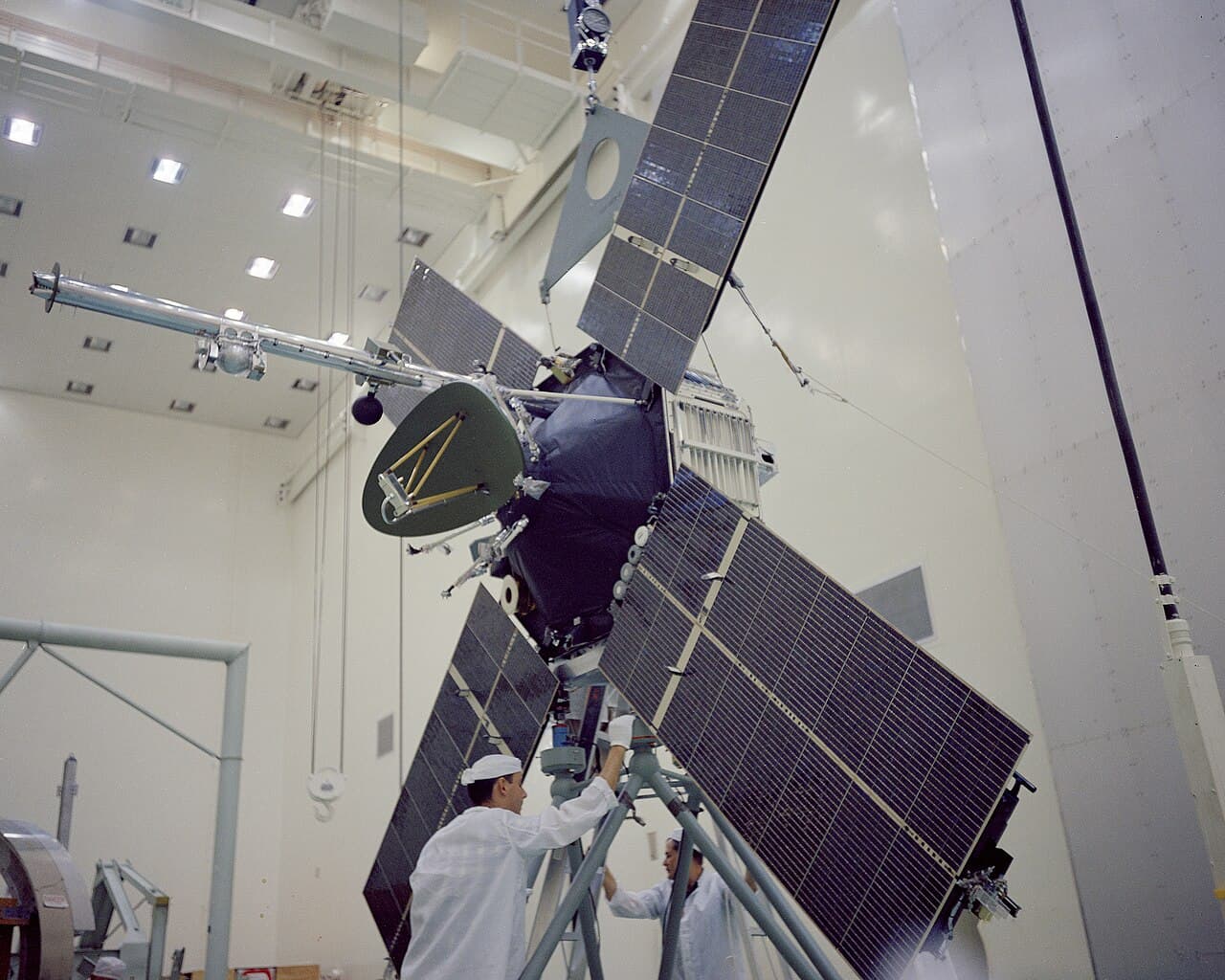
The Mariner-Mars 1964 project was built around a simple hedge: make two identical spacecraft, fly them both in the same launch window, and accept that one of them will probably not make it. Mariner 2 had reached Venus in 1962 on a bus adapted from the Ranger lunar probes, but Mars was further, colder and darker, and the new spacecraft needed a bigger frame, four folding solar panels instead of two, and something Mariner 2 had never carried: a television camera on a steerable scan platform. The heavier spacecraft needed the more powerful Agena D upper stage, and the taller, wider stack needed a new fairing. Lockheed decided in November 1963 to adapt its UNIPAC concept into an over-the-nose shroud, a one-piece fiberglass and magnesium shell capped by a beryllium nose dome and released by spring cartridges, so the spacecraft could be sealed inside a clean environment on the pad. Of the two Atlas-Agena pads at Cape Kennedy, LC-13 came free first, and Atlas 289D was erected there on 17 August 1964. The backup stack, Atlas 288D, went up on LC-12 on 28 September. The plan was that the first spacecraft off the pad would fly the mission and the second would be the insurance.
Mariner 3 lifted off at 19:22:05 UTC on 5 November 1964. Nothing looked wrong. The Atlas separated on time, the Agena D burned, and the spacecraft was released onto what tracking initially took to be a Mars trajectory. Then the first telemetry pass came in about an hour later and the picture fell apart. The science instruments were reporting, which meant the spacecraft was alive on internal power, but there was no current coming from the solar panels at all, and the tracked velocity was low. Both symptoms pointed the same way: the shroud was still on, holding the panels folded and dragging a few hundred kilograms of dead fiberglass along for the ride. Controllers switched off the rate gyros to stretch the battery, then sent a command to jettison the shroud manually. Nothing moved. Someone proposed firing the side-mounted midcourse engine in the hope that the thrust would shake the shroud free, a genuinely desperate idea that was never tried, because 8 hours 43 minutes after launch the batteries went flat and Mariner 3 stopped talking. It has not made a sound since.
The post-mortem was fast and unusually conclusive. By 8 November, three days after the failure, engineers had verified the failure mode. The shroud's fiberglass honeycomb core had no vents, so as the rocket climbed and the outside air pressure dropped, the air trapped inside the core pushed outward hard enough to separate the skin from the core, and the deformed structure would not release. The published account of this is worded as the probable cause rather than a proven one. The fix was to stop being clever about weight. Lockheed built an all-metal shroud, delivered the flight article to Cape Kennedy on 22 November, seventeen days after the failure, and had it cleared to fly by 26 November. Mariner 4 launched on 28 November, two days before the 1964 transfer window shut. It is worth pausing on that schedule: a failure investigation, a redesign, a fabrication and a flight qualification, all completed in twenty-three days, in an era with no computer-aided design and no email. The window would not reopen for two years.
What Mariner 3 would have done is a small, sad footnote. It had been assigned the slower of the two available trajectories, a Type II transfer sweeping more than half a turn around the Sun, arriving at Mars on 17 July 1965 after 254 days, with a planned closest approach around 13,840 km, a number that survives only in satellite catalogues rather than in NASA records and a camera track roughly 20 degrees of longitude east of the one Mariner 4 eventually flew. Had both spacecraft worked, the 1964 window would have produced two independent strips of Martian surface rather than one, and the resulting picture of the planet would have been slightly less lopsided. Instead Mariner 3 coasted out into a heliocentric orbit it was never meant to occupy, roughly 0.983 by 1.311 astronomical units, circling the Sun about once every 448 days with its nose cone still on and its panels still folded. It is out there now. NASA's own master catalogue does not even list a trajectory for it: the entry ends with the shroud, and everything that follows has to be reconstructed from tracking catalogues maintained by other people.
Mission facts
Launch
5 November 1964, 19:22:05 UTC (2:22 p.m. EST), Atlas LV-3 Agena D from Launch Complex 13, Cape Kennedy Air Force Station (the station carried that name from 1964 until 1974, when it reverted to Cape Canaveral Air Force Station)↗
Launch vehicle
Atlas booster 289D with an Agena D upper stage. Atlas 289D was erected on LC-13 on 17 August 1964; the backup stack (Atlas 288D and the spacecraft that became Mariner 4) went up on LC-12 on 28 September 1964, so the twin that failed flew on the higher-numbered booster↗
Spacecraft
Mariner C series, flight serial MC-2, built by NASA's Jet Propulsion Laboratory. Identical to Mariner 4: an octagonal magnesium bus 127 cm across the diagonal and 45.7 cm high, 289 cm tall overall with the low-gain antenna mast, 688 cm across the four deployed solar panels↗
Mass
260.8 kg at launch. NSSDCA lists 260.8 kg for Mariner 3 and 260.68 kg for the identical Mariner 4, a difference of 120 grams that neither page explains; both figures are quoted in the literature↗
Payload
A television camera on a scan platform plus six field-and-particle sensors: helium magnetometer, solar plasma probe, trapped radiation detector, cosmic ray telescope, ionization chamber with Geiger-Mueller tube, and a cosmic dust detector (an aluminium plate with two penetration detectors and a microphone)↗
Power
Four folding solar panels, quoted by NSSDCA as 28,244 cells on the Mariner 3 page and 28,224 cells on the identical Mariner 4 page. About 700 W near Earth, roughly 300 to 310 W at Mars distance, backed by a rechargeable silver-zinc battery. None of it mattered: the panels never unfolded↗
The shroud
A modified UNIPAC over-the-nose fairing supplied by Lockheed: a one-piece fiberglass and magnesium section joined to a beryllium nose dome by a spring cartridge system, chosen in November 1963 in place of a simple clamshell so the payload could be sealed for prelaunch handling↗
Failure mechanism
The accepted explanation, reached by the project within three days, is that the shroud's fiberglass honeycomb core was unvented: on the way up, the pressure difference between the sealed core and the thinning air outside separated the skin from the core, deforming the structure so that the shroud could not release. The published secondary account states this as a probable rather than a proven cause, and the primary failure documentation (NASA SP-139 and JPL TR 32-740) has not been read against it here↗
First telemetry
About an hour after launch the science instruments reported themselves alive, but there was no sign of power from the solar panels and the tracked velocity was below nominal, which pointed at either the Agena or the shroud failing to let go↗
Rescue attempts
Controllers turned off the rate gyros to save power, sent a manual shroud-jettison command that did nothing, and considered a brief firing of the side-mounted midcourse engine to shake the shroud loose. They ran out of battery before they could try it↗
End of mission
Batteries exhausted 8 hours 43 minutes after launch, which places the last transmission near 04:05 UTC on 6 November 1964 (a time derived from the published launch time and interval, since no source gives it directly)↗
Velocity shortfall
About 255 m/s slower than the Mars trajectory required, against a midcourse propulsion budget of roughly 81 m/s. Even if the shroud had been shed later, Mariner 3 would have missed Mars by millions of kilometres↗
Intended mission
A Type II transfer (more than 180 degrees around the Sun), 254 days in flight, Mars arrival 17 July 1965, with a flyby planned at roughly 13,840 km (that distance comes from the Weebau satellite catalogue rather than from NASA, which publishes nothing on Mariner 3 beyond the launch) and a ground track about 20 degrees of longitude east of the one Mariner 4 eventually flew↗
Where it is now
Derelict in heliocentric orbit, roughly 0.983 by 1.311 AU, eccentricity about 0.143, inclination about 0.52 degrees to the ecliptic, period about 448 days. NSSDCA publishes no trajectory record for it at all↗
The fix
The failure mode was reproduced on the ground by 8 November. Lockheed delivered an all-metal replacement shroud to Cape Kennedy on 22 November, 17 days after the failure, and it was cleared for flight by 26 November↗
Cost
No separate figure was published for Mariner 3. Total research, development, launch and support for the whole Mariner series (Mariners 1 through 10) came to about 554 million dollars in period money↗
Mission timeline
- 17 Aug 1964Atlas 289D is erected on Launch Complex 13, the first of the two Atlas-Agena pads at Cape Kennedy to come free after a Vela launch in July
- 28 Sep 1964The backup stack, Atlas 288D with the spare Mariner, is erected on Launch Complex 12. Within five weeks it will become the primary mission
- 5 Nov 196419:22:05 UTC: launch. The boost phase is clean and the Agena D burns as planned
- 5 Nov 1964About one hour after launch: first telemetry pass. Instruments are alive, but there is no solar panel power and the velocity is low. The shroud is still on
- 5 Nov 1964Controllers shut down the rate gyros to conserve battery, then send a manual jettison command to the shroud. Nothing happens
- 6 Nov 1964Roughly 04:05 UTC: the batteries are exhausted 8 hours 43 minutes after launch and the mission is declared over before the midcourse engine can be fired at the shroud
- 8 Nov 1964Engineers report that they have verified the failure mode of the fiberglass shroud: the unvented honeycomb core separating from the skin under ascent pressure differential
- 22 Nov 1964Lockheed delivers the flight model of an all-metal replacement shroud to Cape Kennedy, 17 days after the failure
- 26 Nov 1964The new shroud completes its testing and is cleared to fly
- 28 Nov 1964Mariner 4 launches from LC-12 with the metal shroud, two days before the 1964 Mars window closes. The shroud separates normally
- 17 Jul 1965The date Mariner 3 was meant to reach Mars on its slower Type II trajectory. By then Mariner 4's pictures had already been on Earth for two days
A filled dot marks something that physically happened. A hollow one marks an announcement, a naming or a target.
In pictures
Tap a photo to enlarge.
Sources
- NSSDCA Master Catalog: Mariner 3 (1964-073A), archived January 2025
- NSSDCA launch and trajectory record for Mariner 3, archived March 2025
- Drew Ex Machina: 50 Years Ago Today, The Launch of Mariner 3 (Andrew LePage)
- Drew Ex Machina: What If Mariner 3 Had Reached Mars? (Andrew LePage)
- NASA History: 55 Years Ago, Mariner 4 First to Explore Mars
- NASA JPL mission page: Mariner 3
- NSSDCA Master Catalog: Mariner 4 (1964-077A)
- Wikipedia: Mariner 3
- Weebau spaceflight catalogue: Mariner 3
- NTRS: Mariner Mars 1964 Project Report, Mission and Spacecraft Development, Volume I (JPL TR 32-740)
Facts on this page were verified on 23 August 2026. Where sources disagree, the disagreement is stated rather than resolved silently.