Zond 2
OKB-1 (USSR) · Soviet Union · Flyby · 1964 · The first attemptsFailure
Crippled hours after launch on 30 November 1964 by a jammed solar panel, on about half power, it fired the first electric thrusters beyond Earth orbit, went silent by May 1965 and passed Mars unheard on 6 August 1965.
TL;DR· 11 min read
Zond 2 was crippled within hours of its launch on 30 November 1964, when one solar panel failed to unfold and left it on about half its design power, and it went silent months before it arrived. It was a 3MV-4A engineering test flight ordered to impact Mars and deliver pennants if the systems worked. Its six ablative pulsed plasma thrusters, the first electric propulsion operated beyond Earth orbit, shook the panel free on 15 December, after the first midcourse correction window had passed. It passed Mars unheard on 6 August 1965.
Zond 2 is the Soviet Mars mission that is hardest to describe accurately, because almost every catalogue entry about it contains at least one thing that is wrong. It was a 3MV-4A engineering test flight aimed at Mars, with orders to impact the planet and deliver pennants if everything worked. Nothing did. It flew on roughly half its design power because a solar panel would not unfold, fired the first electric thrusters ever operated beyond Earth orbit, and stopped talking months before it arrived.
- 6plasma thrusters, the first electric propulsion beyond Earth orbit
- ~50%of design power after one solar panel jammed
- 1,500 kmreported miss distance at Mars on 6 Aug 1965, and disputed
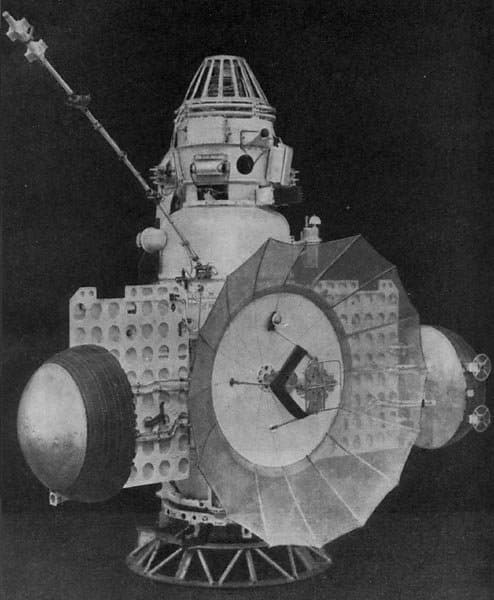
By 1964 the Soviet planetary programme had moved to a third-generation bus, the 3MV, and had settled into a naming convention that has confused people ever since. Craft that Moscow wanted credit for were announced as Mars or Venera. Craft flown mainly to shake down hardware were announced as Zond, Russian for probe, with the destination simply omitted from the communique. Zond 2 was one of these. A letter from Leonid Smirnov, chairman of the Military Industrial Commission, to the Central Committee dated 28 November 1964, two days before launch, sets out what the flight was actually for: a single 3MV-4A spacecraft to test elements of the 3MV design and carry out scientific work in interplanetary space, and, if everything functioned normally, to be steered into Mars to deliver commemorative pennants to the surface. The TASS communique of 2 December described only systems testing and interplanetary research, and did not mention Mars. Zond 2 left Site 1 at Baikonur on 30 November 1964 on a four-stage 8K78, went into a 153 by 219 km parking orbit, and was pushed onto a trans-Mars trajectory by the Blok L stage. Even the basic numbers are unsettled: the launch time is published as 13:12 or 13:25 UTC, and the mass as 890, 950, 960 or 996 kg.
The trouble began within hours of separation. Antennas deployed and the panels were commanded open, but the first communication session showed onboard power at roughly half what it should have been. One of the two solar wings had not unfolded. The cause is given as a broken tug cord meant to pull the panel free at separation from Blok L, or as a protective shroud that failed to retract, depending on which reconstruction you read. Controllers spent a fortnight manoeuvring the spacecraft to shake the panel loose, and on 15 December 1964 it finally opened. By then the date for the first midcourse correction had passed, and with it any realistic chance of steering the craft into Mars as Smirnov's letter had envisaged. Weeks of running on reduced power had also left the spacecraft in poor thermal condition, and Russian accounts add that the onboard programme timer had failed shortly after injection onto the interplanetary trajectory, which put the thermal regime further out of shape. Whatever the exact chain, Zond 2 was already a wounded spacecraft by the middle of December, three weeks into a journey meant to last eight months. Perminov's summary, written by a designer rather than a historian, runs to a single sentence: Zond 2 did not fulfil its mission because the solar panels did not open entirely.
The part that worked was the part that had never flown to another planet before. Zond 2 carried six ablative pulsed plasma thrusters designed by A. M. Andrianov at the Institute of Atomic Energy, where Lev Artsimovich's department ran the Soviet plasma work. They were not gridded ion engines, though a great deal of what is written about them calls them ion engines. Each one discharged a capacitor bank of about 100 microfarads at roughly a kilovolt across two coaxial electrodes separated by a fluoroplast insulator, vaporising and ionising a sliver of the plastic and flinging it out at up to 16 km/s at a temperature near 30,000 K. Their job was attitude control: they could be commanded from the ground to act in place of the compressed nitrogen jets, which is exactly the failure mode that had killed Mars 1 two years earlier. Accounts of the test differ in detail. NSSDCA places it across 8 to 18 December 1964, English Wikipedia gives 14 December with 70 minutes of running at 4.2 million km from Earth, Russian sources give a total of 70 minutes, and Siddiqi records a double firing of all six on 18 December, just before contact began to deteriorate. All agree they ran, and that firing them is what shook the stuck panel open.
After December the record thins out and the sources stop agreeing. NSSDCA records a putative but unconfirmed midcourse manoeuvre on 17 February 1965. A declassified United States weekly intelligence review from 1965 gives 7 April 1965 as the date of the last communication session. The Russian Academy of Sciences space council says May 1965, and Soviet authorities announced the loss publicly on 5 May 1965. Andrew LePage, who has worked through the Soviet documents most carefully, notes that communications were already erratic by 18 December 1964. The honest reading is a range: contact went some time between the middle of December 1964 and the beginning of May 1965, and nothing we consulted narrows it further. Zond 2 then coasted, silent, and reached Mars on 6 August 1965. The distance is disputed too. The figure normally quoted is 1,500 km at a relative speed of 5.62 km/s, which would have been an extraordinarily close pass for an uncorrected trajectory; some later reconstructions put the miss near 650,000 km. Since nothing was tracking the spacecraft by then, both numbers are trajectory propagations rather than measurements. Zond 2 is in a solar orbit of roughly 0.98 by 1.52 astronomical units, period near 508 days.
What Zond 2 is worth remembering for is not its arrival. It is that a crippled spacecraft three weeks out from Earth, running on half power, fired a set of experimental plasma thrusters that had never been operated on an interplanetary trajectory, and used their recoil to unjam a stuck solar panel. That is a good deal more interesting than the flyby it did not manage. It was not, however, the first electric thruster to work in space: NASA's SERT-1 ran a mercury electron-bombardment ion engine successfully on a suborbital flight to about 1,000 km on 20 July 1964, four months earlier. As far as the published record goes, Zond 2 was the first to operate on a spacecraft that had left Earth orbit, and the first flown as a working attitude control actuator rather than as a pure demonstration. Three months after its last confirmed signal, the question the whole 1M and 2MV effort had been built around was answered from somewhere else entirely, when Mariner 4 returned twenty-one close-up frames of a cratered, apparently lifeless surface in July 1965. The Soviet Union would not put a working spacecraft into Mars orbit until 1971.
Mission facts
Launch
30 November 1964 from Site 1 at NIIP-5 (Baikonur) on a four-stage Molniya 8K78, vehicle G15000-29. Sources give the time as 13:12 UTC (NSSDCA and Siddiqi) or 13:25 UTC (McDowell's GCAT); we could not resolve the 13-minute difference.↗
Designation
3MV-4A No. 2. The 3MV was the third-generation planetary bus, with 3MV-3 for Mars impact and 3MV-4 for Mars flyby; the A suffix marks a modified test article. Some catalogues drop the A and write 3MV-4 No. 2.↗
Mass
Published figures disagree badly: 890 kg (NSSDCA, McDowell), 950 kg (LePage), 960 kg (Russian Wikipedia) and 996 kg (Siddiqi). No source we consulted explains the spread.↗
Actual objectives
A letter from Leonid Smirnov, chairman of the Military Industrial Commission, to the Central Committee dated 28 November 1964, two days before launch, states the flight was to test 3MV elements and do interplanetary science, and, if the systems worked, to impact Mars and deliver commemorative pennants to the surface.↗
What was announced
The TASS communique of 2 December 1964 gave only two goals: shaking down onboard systems in long-duration spaceflight, and scientific research in interplanetary space. Mars was not mentioned.↗
Ascent profile
The fourth stage placed the spacecraft in a 153 by 219 km parking orbit and then reignited to inject it toward Mars. The spent Blok I and the settling-motor unit reentered on 1 and 2 December 1964.↗
Instruments
Radiation detector, charged-particle detector, magnetometer, piezoelectric micrometeoroid detector, radio telescope, cosmic-ray nuclear component experiment, ultraviolet and X-ray solar radiation experiment, and an imaging system. Perminov notes Zond 2's radio suite dropped the 8 cm and metre-wavelength transmitters that Mars 1 carried.↗
Plasma thrusters
Six ablative pulsed plasma thrusters designed by A. M. Andrianov at the Institute of Atomic Energy, where Lev Artsimovich led the plasma work. A capacitor bank of about 100 microfarads at roughly 1 kV discharged across coaxial electrodes separated by a fluoroplast (PTFE) insulator, ejecting plasma at up to 16 km/s at temperatures near 30,000 K. They were an alternative actuator for the attitude control system, commandable from the ground in place of the nitrogen jets.↗
Thruster test
Total running time is given as 70 minutes. Accounts of the timing differ: NSSDCA says 8 to 18 December 1964, English Wikipedia gives 14 December at 4.2 million km from Earth, and Siddiqi records all six firing twice on 18 December just before communications deteriorated.↗
Solar panel failure
One of the two panels did not unfold after separation from Blok L, leaving power at roughly half the expected level. The cause is given as a broken tug cord meant to pull the panel free at separation, or a protective shroud that failed to retract. Firing the plasma engines to shake the spacecraft finally freed it on 15 December 1964, after the date for the first midcourse correction had passed.↗
Secondary failure
Russian sources add that the onboard programme timer failed shortly after injection onto the interplanetary trajectory, leaving the spacecraft in poor thermal conditions; weeks of reduced power then took the rest of the onboard systems down.↗
Loss of contact
Contested. NSSDCA records a putative, unconfirmed midcourse manoeuvre on 17 February 1965 and loss of contact in early May 1965. A declassified US weekly intelligence review gives 7 April 1965 as the last session. The Russian Academy of Sciences space council says May 1965. Soviet authorities announced the loss publicly on 5 May 1965, and LePage notes communications were already erratic by 18 December 1964.↗
Mars encounter
6 August 1965, a silent uncontrolled pass. The commonly cited miss distance is 1,500 km at a relative speed of 5.62 km/s; some later reconstructions put it near 650,000 km. Nothing was tracking the spacecraft, so both figures come from trajectory propagation and neither was measured.↗
Final orbit
Heliocentric, roughly 0.98 by 1.52 astronomical units, inclined about 6.4 degrees to the ecliptic, with a period near 508 days.↗
The Zond name
Zond means probe in Russian. It was the label used for 3MV flights announced as engineering tests rather than as Mars or Venera missions, so the destination could be left out of the communique. Zond 1 (Venus, April 1964) and Zond 3 (lunar far side, July 1965) carried the same name.↗
Mission timeline
- 28 Nov 1964Leonid Smirnov's letter to the Central Committee sets out the real objectives: test the 3MV design, do interplanetary science, and impact Mars with pennants if all goes well.
- 30 Nov 1964Launch from Site 1 at Baikonur into a 153 by 219 km parking orbit, then injection toward Mars by Blok L. Within hours the first session shows power at about half the expected level.
- 2 Dec 1964TASS announces the flight as Zond 2, describing systems testing and interplanetary research and saying nothing about Mars.
- 8 to 18 Dec 1964The six plasma thrusters are test-fired, the first electric propulsion operated on a spacecraft beyond Earth orbit. Sources place the firings anywhere in this window.
- 15 Dec 1964Shaking the spacecraft with the plasma engines finally frees the jammed solar panel. The window for the first midcourse correction has already closed.
- 18 Dec 1964All six thrusters are fired twice, according to Siddiqi. Communications with the spacecraft are becoming erratic.
- 17 Feb 1965A midcourse correction is reported by some accounts. NSSDCA describes it as putative and unconfirmed.
- 7 Apr 1965Date given for the last communication session in a declassified United States weekly intelligence review from 1965.
- 5 May 1965Soviet authorities publicly announce that contact with Zond 2 has been lost.
- 15 Jul 1965NASA's Mariner 4 flies past Mars and returns the first close-up photographs of the surface, three months after Zond 2's last confirmed signal.
- 6 Aug 1965Zond 2 passes Mars, silent, at a reported 1,500 km, and continues in solar orbit.
A filled dot marks something that physically happened. A hollow one marks an announcement, a naming or a target.
In pictures
Tap a photo to enlarge.
Sources
- NSSDCA Master Catalog: Zond 2, 1964-078C (archived)
- Andrew LePage, The Mysterious Mission of Zond 2 to Mars
- Andrew LePage, Zond 2: Old Mysteries Solved and New Questions Raised
- Andrew LePage, The Soviet Zond Missions of 1963-65: Planetary Probe Test Flights
- Asif Siddiqi, Deep Space Chronicle, NASA SP-2002-4524
- V. G. Perminov, The Difficult Road to Mars, NASA Monographs in Aerospace History No. 15 (1999)
- Russian Wikipedia: Zond-2
- Nauka i Zhizn: the plasma-erosion engine of A. M. Andrianov
- US Weekly Intelligence Review No. 21, 1965 (declassified, ISCAP)
- Jonathan McDowell, GCAT launch catalogue
- Andrew LePage, The First Ion Engine Test in Space (SERT-1, 20 July 1964)
- RussianSpaceWeb (Anatoly Zak): Russia's unmanned missions to Mars
Facts on this page were verified on 23 August 2026. Where sources disagree, the disagreement is stated rather than resolved silently.