Zond 3
OKB-1 (USSR) · Soviet Union · Flyby · 1964 · The first attemptsSuccess
Success: launched 18 July 1965 towards the orbit of Mars with no Mars at the end of it, it photographed the unseen third of the lunar far side and replayed those frames to 153.5 million km by March 1966.
TL;DR· 14 min read
Zond 3 was a 3MV-4, the Mars flyby variant of the Soviet planetary bus, that missed the November 1964 Mars window and flew anyway on 18 July 1965, out towards the orbit of Mars with no Mars at the end of it. Passing the Moon 33 hours after launch, it photographed in 25 frames the far side that Luna 3 had missed, then replayed those same pictures from ever greater ranges to prove a Mars communications link. The last session came on 3 March 1966 at 153.5 million km, 228 days after launch. English catalogues file it under the Moon.
Zond 3 is the Mars spacecraft that never went to Mars and is almost never counted as one. It was a 3MV-4, the Mars flyby variant of the Soviet third-generation planetary bus, built for the November 1964 window and not finished in time. Rather than scrap it, the programme launched it in July 1965 on a trajectory that reached out to Mars distance, to find out whether the bus, the camera and above all the radio could survive the range. The Moon happened to be in the way, and the pictures it took there are the only part of the flight most people have heard of.
- 228days of operation, from launch to the last session on 3 March 1966
- 153.5M kmrange at final contact, which was the point of the whole flight
- 25photographs of the Moon returned, from a camera built for photographing planets
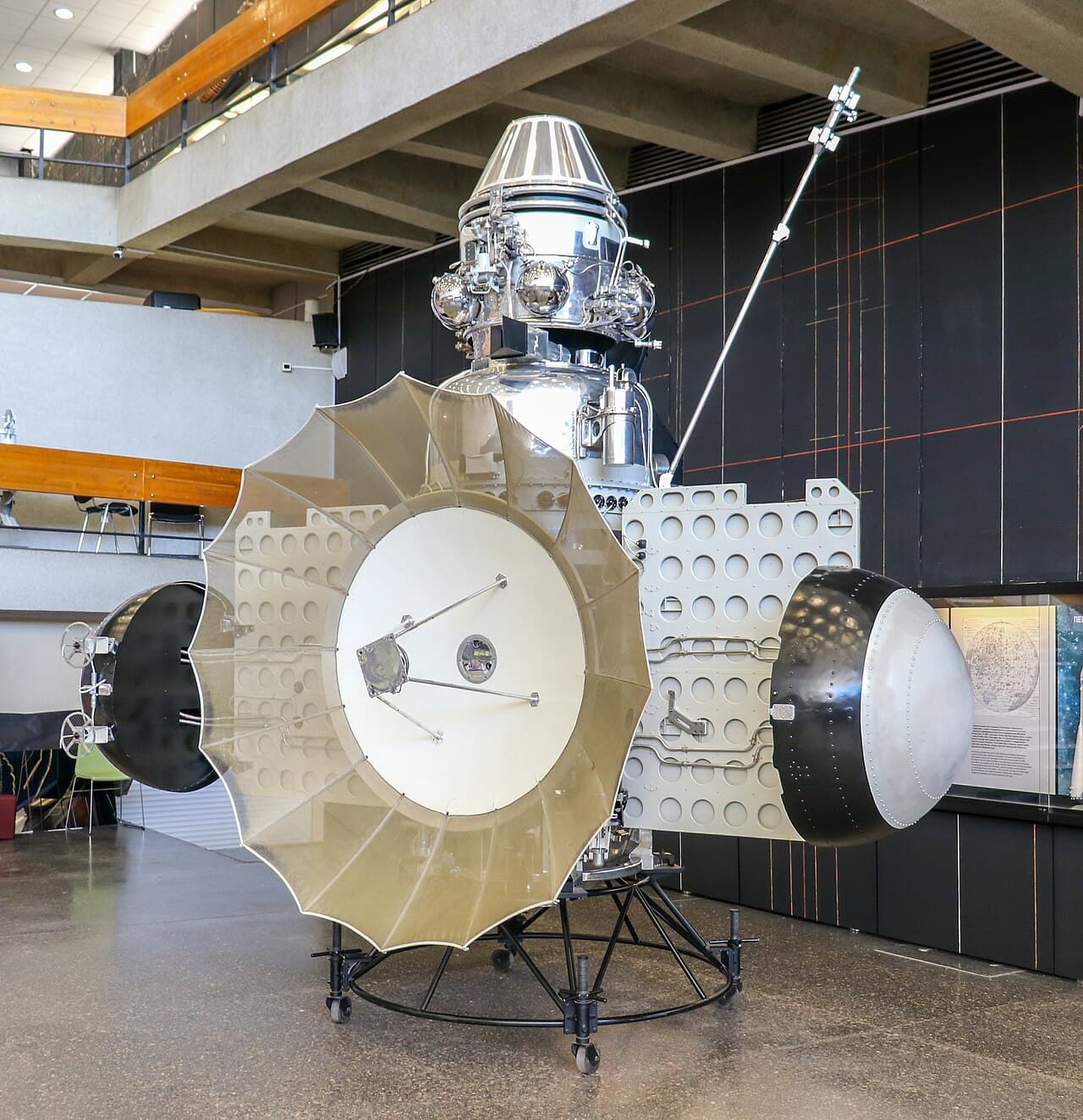
The Soviet third-generation planetary bus, the 3MV, came in four variants, and the numbering says what each was for: 3MV-1 to land on Venus, 3MV-2 to fly past it, 3MV-3 to land on Mars, 3MV-4 to fly past Mars. Zond 3 was a 3MV-4, vehicle number 3, and it was built for the 1964 Mars window. It did not make it. Asif Siddiqi's NASA chronicle puts the matter in one sentence: the spacecraft had originally been slated for a Mars flyby in late 1964 but could not be prepared on time. Its stablemate, 3MV-4A number 2, went instead, on 30 November 1964, became Zond 2, and lost about half its power within hours to a solar panel that would not unfold. Number 3 sat on the ground while the window closed. What the programme did with it next is the reason this page exists. Rather than write the vehicle off, they flew it in July 1965 on a departure trajectory aimed out towards the orbit of Mars, with no Mars at the end of it. NASA's own catalogue states the case plainly: the spacecraft was launched on a Mars trajectory, although Mars was no longer attainable, as a spacecraft test. Andrew LePage describes the same flight as a simulated trajectory to Mars, simulated because Mars would not be in position for a low-energy encounter for another year and a half.
The Moon was a bonus that fell out of the geometry. Leaving Earth in mid-July on that trajectory took the spacecraft past the Moon after only thirty-three hours, and it went past on the sunlit side, south of the lunar equator, which was close to the best possible geometry for photographing the strip of far side that Luna 3 had missed in 1959. On 20 July 1965 the command went up at 03:57 Moscow time, three hours ahead of UT. Fourteen minutes later the film began to advance; at 04:24 Moscow, 01:24 UT, the camera started shooting, and it stopped sixty-eight minutes later at 05:32 Moscow. Twenty-five frames came out of it, plus three ultraviolet spectra, taken between 11,570 and 9,960 km with the closest point of 9,220 km falling in the middle. The 1966 Bolshaya Sovetskaya Entsiklopediya yearbook explains the frame count in a way that gives the whole flight away: the number of frames was set by the fact that the apparatus installed on Zond 3 was intended for photographing planets. This was a Mars camera. Each frame ran 1,100 lines of 860 elements and took about 34 minutes to send, against the 800 by 800 that Varvarov's account gives for the American Ranger probes and 200 by 200 for the Mars pictures Mariner 4 had begun returning five days earlier.
What Zond 3 was really doing began once the Moon was behind it. The pictures were not sent down at once. The first playback came on 29 July, nine days after the encounter, when the spacecraft was about 2.2 million kilometres out. The same frames went again in mid-August, again in mid-September, and a last time on 23 October 1965 from 31.5 million kilometres. That is the experiment. A phototelevision system that keeps its images on developed film can replay them indefinitely, so one known picture could be pushed through the radio link at ever greater range and the result compared against the original on the ground. Varvarov's contemporaneous Soviet account states the design target outright: the Zond 3 television system was built to send images from distances of up to several hundred million kilometres, and the images were deliberately not sent in real time, because a stored frame can be read out slowly through a narrow band while a live one cannot. NASA's catalogue records that some signals were still being transmitted from the distance of the orbit of Mars, thus proving the ability of the communications system. Two other firsts came out of the same flight: the first Soviet course correction guided by a star rather than the Sun alone, and, from that, the discovery of the dusty bag effect, in which particles shed by the spacecraft drift alongside it and blind the star sensor.
Nothing in that programme is lunar, and yet Zond 3 is filed under the Moon almost everywhere in English. Both of Siddiqi's chronicles give its objective as lunar flyby. Wikipedia's List of missions to Mars, consulted for this entry, carries Zond 2 and not Zond 3. The far-side pictures are genuinely the most consequential thing it did, and they do belong to the Moon: azmth's Moon catalogue tells that story through Luna 3, which took the first far-side photographs in October 1959, and Zond 3 finished the job, leaving about 1.5 million square kilometres of the far side unshot out of roughly 19 million. But the flight itself was Mars-programme hardware flying a Mars-programme profile to qualify a Mars-programme radio link, and the qualification was cashed in at once. Venera 2 and Venera 3 left Baikonur on 12 and 16 November 1965 on the same bus, and the dusty bag correction was applied from Venera 3 onwards. LePage's summary of what the flight proved is that the 3MV design could survive the 107-day transit to Venus. What it never did was reach Mars. Regular sessions stopped on 3 March 1966 at 153.5 million kilometres, and the Soviet Union would not put a working spacecraft into Mars orbit for nearly six more years.
Mission facts
Launch
18 July 1965 from Site 1 at NIIP-5 (Baikonur) on a four-stage Molniya 8K78 with a Blok L escape stage. The time is published two ways: 14:32:05 UT in Jonathan McDowell's launch catalogue and 14:32 UT in Siddiqi's Beyond Earth, whose earlier Deep Space Chronicle prints no launch time at all, against 14:38:00 UT in NASA's NSSDCA launch record, which Russian Wikipedia and Andrew LePage both follow. Nothing we consulted reconciles the six-minute gap.↗
Vehicle serial
8K78 no. U15000-32 in McDowell's catalogue. Siddiqi's Beyond Earth gives the same rocket as 8K78 no. U103-32, also U15000-32, which is the usual Soviet double-numbering of a launch vehicle. Russian Wikipedia calls the rocket a Molniya-M, a later variant; the two NASA chronicles and McDowell all give the plain 8K78.↗
Designation
3MV-4 No. 3. In the 3MV family the suffix is the destination: 3MV-1 to land on Venus, 3MV-2 to fly past Venus, 3MV-3 to land on Mars, 3MV-4 to fly past Mars. Siddiqi's running text and Russian Wikipedia both give 3MV-4 No. 3, while the Zond series table at the back of Siddiqi's Beyond Earth prints 3MV-4A / 3 and the chronological launch table in the same book prints 3MV-4 / 3. LePage calls the second Zond variant as a class a modified version of the Mars flyby spacecraft designated 3MV-4A, but calls this particular vehicle 3MV-4 number 3. The A suffix is the one Siddiqi gives Zond 2.↗
Mass
950 kg (Siddiqi, English Wikipedia) or 960 kg (NSSDCA, Russian Wikipedia, LePage). We found no source that explains the difference.↗
Why it flew after the window
Siddiqi states that the spacecraft had originally been slated for a Mars flyby in late 1964 but could not be prepared on time, and that Soviet designers then diverted it to a lunar flyby in 1965 to test its basic systems. NSSDCA goes further: it is believed Zond 3 was initially designed as a companion to Zond 2 for the 1964 Mars window, the opportunity was missed, and the spacecraft was launched on a Mars trajectory, although Mars was no longer attainable, as a spacecraft test.↗
The dissenting reading
LePage treats it as an engineering test flight rather than specifically a Zond 2 companion, and puts the July launch down to delays in preparing the improved 3MV rather than to a choice of date, adding that as luck would have it the Moon could be easily reached at that time of year on the departure trajectory towards the orbit of Mars. Russian Wikipedia, citing Boris Chertok's Rakety i lyudi volume 3, says Zond 3 was similar in construction to Zond 2, that is, originally an interplanetary spacecraft subsequently adapted to lunar tasks. All three accounts agree the vehicle was Mars hardware; they disagree on whether a Mars flight was ever formally assigned to this particular airframe.↗
Trajectory
A 163.5 by 209.0 km parking orbit at 64.78 degrees, then escape. The resulting heliocentric orbit is 0.90 by 1.56 astronomical units, eccentricity 0.2683, inclination 0.5 degrees, period 500 days. Russian Wikipedia describes that orbit as crossing the orbit of Mars; NSSDCA says only that signals were still being received from the distance of the orbit of Mars. LePage rounds the parking orbit to 164 by 210 km.↗
Camera
A 15P52 phototelevision unit of 6.5 kg, developed by NII-885 in Moscow rather than by VNII-380, which had built the Luna 3 system: those details are Siddiqi's. The optics are from the 1966 Soviet yearbook: a 106.4 mm lens at f/8 on special 25 mm film, exposures of 1/100 and 1/300 second, the film developed, fixed and dried on board before scanning, and each 1,100-line frame taking about 34 minutes to send. LePage gives the exposures differently, as 1/30 and 1/100 second, and describes the two scan modes: a quick-look pass of 67 lines in about 135 seconds, or the full 1,100-line frame.↗
It was planetary equipment
The 1966 Bolshaya Sovetskaya Entsiklopediya yearbook explains the frame count in one sentence: the number of frames was set by the fact that the apparatus installed on Zond 3 was intended for photographing planets. At the chosen field of view neighbouring frames overlapped heavily, so 25 were enough to cover the target area. Each frame was 1,100 lines of 860 elements, which N. Varvarov's contemporaneous Soviet account sets against 800 by 800 for the American Ranger probes and 200 by 200 for the Mars frames Mariner 4 had begun returning five days before.↗
Lunar imaging session
20 July 1965, about 33 hours after launch. The command went up at 03:57 Moscow time (00:57 UT); film transport started 14 minutes later; photography ran from 04:24 to 05:32 Moscow (01:24 to 02:32 UT), 68 minutes, at intervals of roughly 2.25 minutes. Imaging began at 11,570 km from the lunar surface, passed a minimum of 9,220 km and ended at 9,960 km. Closest approach is given as 9,220 km by the Soviet yearbook, Siddiqi and Russian Wikipedia, as 9,219 km by English Wikipedia and LePage, and rounded to 9,200 km by NSSDCA. 25 visible frames plus three ultraviolet spectra in Siddiqi's count; LePage's montage carries 24 usable photographs, with frames 8, 9 and 10 given over to the ultraviolet spectra.↗
Coverage
About 19 million square kilometres of the far side. Varvarov states that about 1.5 million square kilometres, near the north and south poles, were left unphotographed after Luna 3 and Zond 3 together. NASA and Siddiqi describe it as the unseen 30 percent of the far side. During the session the spacecraft's position relative to the centre of the Moon changed by about 60 degrees, so each area was shot from several angles.↗
The actual experiment
Because the images sat on developed film aboard, the same frames could be replayed indefinitely. The first playback was on 29 July 1965, nine days after the flyby, at about 2.2 million km. The frames were sent again in mid-August, again in mid-September, and a final time on 23 October 1965 from 31.5 million km. NSSDCA records that some signals were still being transmitted from the distance of the orbit of Mars, thus proving the ability of the communications system.↗
Designed range
N. Varvarov's contemporaneous Soviet account states that the Zond 3 television system was designed to transmit television images from distances of up to several hundred million kilometres, and explains why the transmission was not in real time: a real-time picture needs a wide radio bandwidth, noise at the receiver grows with distance, and a stored image can instead be read out slowly through a narrow band and replayed as often as required.↗
Two firsts on the way
Siddiqi records that Zond 3 demonstrated successful course corrections using both solar and stellar orientation, a first for a Soviet spacecraft. Russian sources add what came out of that: the discovery of the dusty bag effect, in which small particles shed by the spacecraft travel alongside it and stop the orientation system from picking out stars. The effect was allowed for on later automatic stations from Venera 3 onwards.↗
The disputed thruster
NSSDCA states that Zond 3 also had an experimental ion engine, and both of Siddiqi's chronicles list ion thrusters among its instruments. Russian Wikipedia's Zond 3 article does not mention them. The Soviet electric propulsion firing that is documented belongs to Zond 2: Siddiqi records it firing six plasma electric rocket engines on 14 December 1964 at 5.37 million km from Earth, left on for 70 minutes, and Russian Wikipedia describes those as six ablative pulsed engines running on fluoroplastic. We found no Russian-language account of a firing aboard Zond 3 and treat the claim as unconfirmed.↗
End of mission
Regular communication sessions were maintained until 3 March 1966 at a range of 153.5 million km, 228 days after launch. Siddiqi is less precise, giving last contact as sometime in early March 1966 at the same distance. The spacecraft remains in solar orbit.↗
Mission timeline
- 30 Nov 1964The 1964 Mars window: 3MV-4A No. 2 leaves Baikonur as Zond 2 and loses roughly half its power within hours to a solar panel that will not unfold. Its stablemate, 3MV-4 No. 3, is not ready in time and stays on the ground as the window closes.
- 18 Jul 1965Launch from Site 1 at NIIP-5 on a Molniya 8K78 with Blok L, into a 163.5 by 209.0 km parking orbit and then onto an escape trajectory reaching out to the orbit of Mars. The published launch time is either 14:32 or 14:38 UT depending on the catalogue.
- 19 to 20 Jul 1965On the 33-hour coast to the Moon the spacecraft makes the first Soviet course correction guided by a star as well as by the Sun, and in the process the dusty bag effect is found: debris shed by the spacecraft drifting alongside it and blinding the star sensor.
- 20 Jul 196501:24 to 02:32 UT (04:24 to 05:32 Moscow): the camera runs for 68 minutes as the spacecraft crosses from the near side to the far side south of the lunar equator, from 11,570 km in to 9,220 km and back out to 9,960 km. 25 frames and three ultraviolet spectra.
- 29 Jul 1965First playback to Earth, nine days after the encounter, from about 2.2 million km. Each 1,100-line frame takes roughly 34 minutes to send.
- 6 Aug 1965Zond 2, silent since the spring, passes Mars unheard. The vehicle that was meant to fly the 1964 Mars mission has arrived with nothing to say; the vehicle that missed the window is three weeks into a working flight.
- Aug to Sep 1965The same lunar frames are transmitted again in mid-August and again in mid-September, each time from further out, so the received quality can be measured against an image already known on the ground.
- 23 Oct 1965The last photo transmission, from 31.5 million km. This is the session both NASA and Siddiqi single out as the demonstration the flight existed to make.
- 12 and 16 Nov 1965Venera 2 (963 kg) and Venera 3 (960 kg) leave Baikonur on the same 3MV bus in the next available window. The dusty bag lesson from Zond 3 is applied from Venera 3 onwards.
- 3 Mar 1966The last communication session, at 153.5 million km, 228 days after launch. Siddiqi gives it only as early March 1966. Zond 3 continues in a 0.90 by 1.56 AU solar orbit with a period near 500 days.
- Dec 1965 and Apr 1969The scientific harvest lands on the lunar side of the ledger. NASA's catalogue lists both publications: Yu. N. Lipskiy's Zond-3 photographs of the moon's far side in Sky and Telescope for December 1965, pages 338 to 341, and his Atlas of the Far Side of the Moon, which reached NASA in translation as TT F-514 in April 1969. Russian sources add that the Sternberg Astronomical Institute compiled that atlas from the Luna 3 and Zond 3 frames with a catalogue of about 4,000 newly identified features.
A filled dot marks something that physically happened. A hollow one marks an announcement, a naming or a target.
In pictures
Tap a photo to enlarge.
Sources
- NSSDCA Master Catalog: Zond 3 (1965-056A), archived 15 Aug 2025
- NSSDCA launch and trajectory record for Zond 3
- Asif A. Siddiqi, Beyond Earth: A Chronicle of Deep Space Exploration 1958-2016 (NASA SP-2018-4041), entry 57
- Asif A. Siddiqi, Deep Space Chronicle (NASA SP-2002-4524), entry 57
- Russian Wikipedia: Zond-3 (Зонд-3)
- Bolshaya Sovetskaya Entsiklopediya yearbook 1966, Советские космические исследования в 1965 г
- N. Varvarov, «7 континент»
- Andrew LePage, The Soviet Zond 3 Lunar Flyby: Revealing the Rest of the Far Side (18 Jul 2025)
- Andrew LePage, The Soviet Zond Missions of 1963-65: Planetary Probe Test Flights
- Jonathan McDowell, GCAT launch catalogue
- English Wikipedia: Zond 3
- English Wikipedia: List of missions to Mars
- Russian Wikipedia: Zond-2 (Зонд-2)
Facts on this page were verified on 27 August 2026. Where sources disagree, the disagreement is stated rather than resolved silently.