Mariner 4
NASA · United States · Flyby · 1965 · The first attemptsSuccess
Flew 9,846 km above Mars at 01:00:57 UTC on 15 July 1965 and returned the first close-up photographs of another planet. Communications were terminated 21 December 1967; the spacecraft is derelict in solar orbit.
TL;DR· 15 min read
Mariner 4 returned the first close-up photographs of another planet, sweeping 9,846 km above Mars at 01:00:57 UTC on 15 July 1965. It sent home 21 complete frames plus 21 lines of a 22nd at eight and a third bits per second, and its radio occultation measured a surface pressure of 4.1 to 7.0 millibars, below even the 10 to 40 millibars that pre-flight spectroscopy had allowed. The cratered strip covered about 1 percent of the planet and made Mars look dead, an impression Mariner 9 overturned in 1971 and 1972. Communications were terminated on 21 December 1967.
Mariner 4 is the mission that took Mars away from us and then gave it back as a real place. On the night of 14 to 15 July 1965 it swept 9,846 km above the surface, exposed a strip of pictures onto a loop of magnetic tape, and then spent nearly three weeks trickling them home at eight and a third bits per second. What came out of the tape was cratered, cold and airless-looking, and it ended a century of hope that Mars was a slightly drier Earth with canals on it. The picture count that circulates is 22. The engineering record says 21 complete frames plus 21 lines of a 22nd, and both numbers have a legitimate source.
- 1stclose-up photographs of another planet
- 21 + 21 linespictures returned: 21 complete frames plus 21 lines of a 22nd
- 9,846 kmclosest approach above the Martian surface
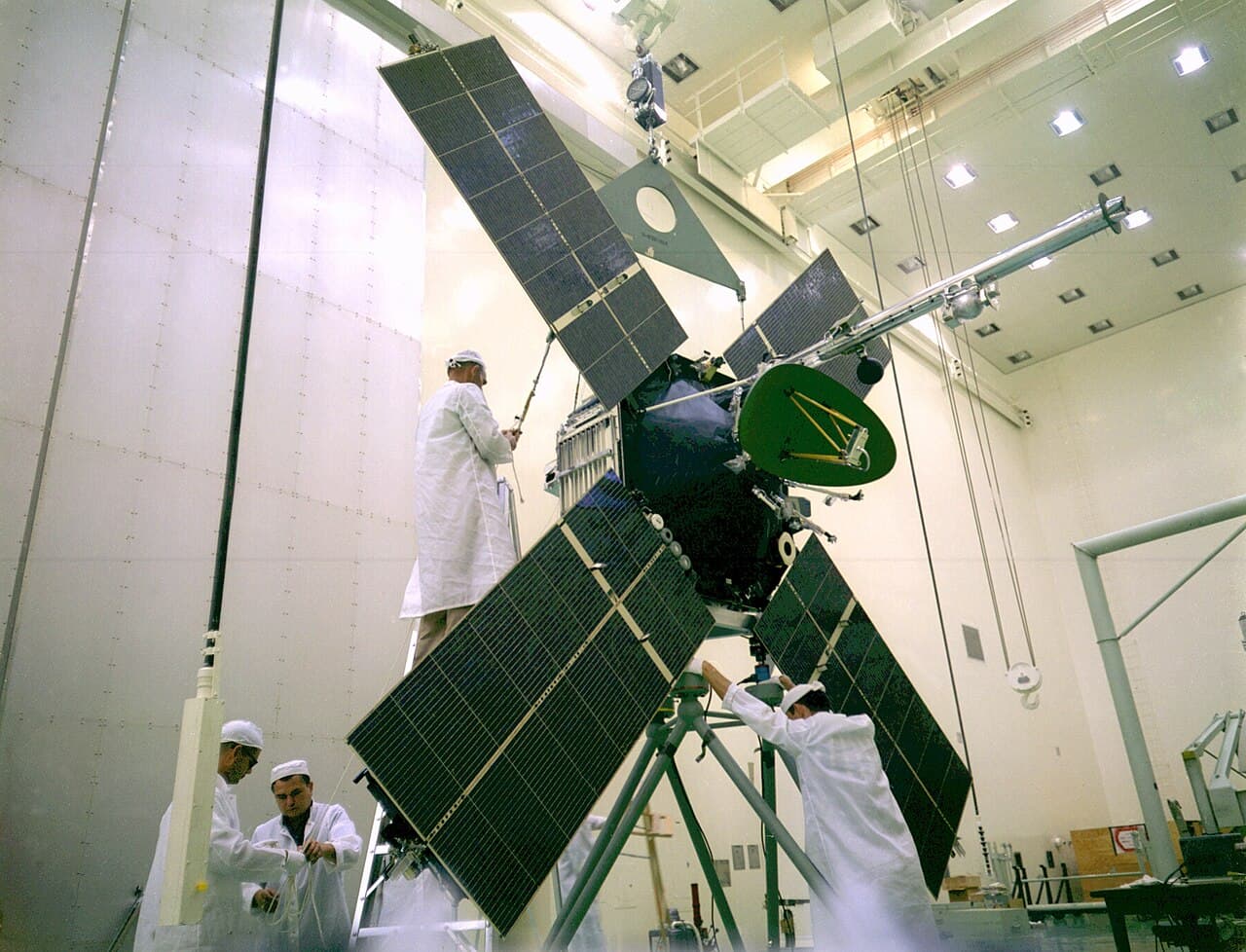
Mariner 4 flew because its twin died. Mariner 3 had launched on 5 November 1964 and never shed its fiberglass shroud, so the second spacecraft, already stacked on the neighbouring pad at Cape Kennedy, inherited both the mission and an all-metal replacement fairing built from scratch in seventeen days. It lifted off at 14:22:01 UTC on 28 November 1964 with two days left in the Mars window. Two days after that, the Soviet Union launched Zond 2 on the same errand; one of its two solar panels jammed at separation and was only shaken free on 15 December, and the spacecraft lost its voice altogether in May 1965 and drifted past Mars silent. The cruise was long and only intermittently calm. Attitude reference came from Sun sensors plus a tracker locked onto Canopus, the second-brightest star in the sky and conveniently placed near the south ecliptic pole, and the tracker spent about a day hopping across the wrong stars before it settled, then lost its grip six more times in three weeks. The suspected culprit was dust shaken loose from the spacecraft itself, glinting in sunlight as it drifted through the sensor's field of view. A single midcourse burn on 5 December 1964, 20.07 seconds after turns of 39.16 degrees in pitch and 156.08 in roll, set up the encounter. The crossing took 228 days from launch to Mars.
The encounter itself was over in less time than a lunch break. Planetary science mode came on at 15:41:49 UTC on 14 July 1965. The camera sequence started at 00:18:36 UTC on 15 July and ran about twenty-five minutes: a narrow-angle Cassegrain telescope firing through alternating red and green filters onto a slow-scan vidicon tube, each frame digitised to 200 lines of 200 pixels at six bits per pixel. Two of every three exposures were written to a 330-foot loop of quarter-inch magnetic tape, which is why the surviving images come in overlapping pairs. At 01:00:57 UTC Mariner 4 passed 9,846 km above the surface at about 7 km/s, then, at 02:19:11, slid behind the planet as seen from Earth and went quiet. That silence was itself an experiment. As the radio signal grazed the atmosphere going in and coming out at 03:13:04, its frequency, phase and amplitude were bent and dimmed in ways that could be read backwards into a density profile. Arvydas Kliore and colleagues turned that into what their paper called the first direct measurement of Mars's atmosphere and ionosphere: a surface pressure of 4.1 to 7.0 millibars, below even the 10 to 40 millibars that pre-flight spectroscopy had allowed and about a tenth of what older optical estimates had suggested. Mars did not have a thin atmosphere. Mars had almost none.
Getting the pictures home took nineteen days. At 216 million km the usable link ran at eight and a third bits per second, so the 240,000 image bits in a frame needed exactly eight hours of clean signal, and in practice rather more, relayed to JPL through Deep Space Network dishes in California, Australia and South Africa. Playback began about eight and a half hours after the spacecraft reappeared, ran through 24 July, and then started over so the whole tape could be sent a second time and the two copies compared for errors, finishing on 3 August. Waiting for the first computer-processed frame was more than some engineers could stand. On 15 July, staff from JPL's Telecommunications Section took the strips of paper coming off the real-time data translator, on which each of the 40,000 pixels of frame one appeared as a number from 0 to 63, cut them up, stapled them side by side to a display panel, and coloured the numbers in by hand like a paint-by-numbers kit. Richard Grumm, who ran the tape recorder operations, is credited with the idea and with the run to a nearby art store for chalk pastels. His initials, RLG, are in the bottom right corner. The finished panel was framed and given to JPL director William Pickering, and it hangs at JPL still.
What the pictures showed was craters. Frame 11, which Leighton called one of the most remarkable scientific photographs of the age, is dominated by the basin the IAU named Mariner crater in 1967, about 157 km across in the planetary nomenclature gazetteer, which gives 156.58 km on its current MDIM 2.1 control network and 170 km on the older MDIM 2.0; across frames 5 through 15 the team counted about seventy craters ranging from a few kilometres to at least 120 km. In their Science paper of 6 August 1965 Leighton, Murray, Sharp, Allen and Sloan drew the obvious and devastating inference: a surface that densely cratered is extremely old, and neither a thick atmosphere nor oceans can have existed since it formed. Combined with 4 to 7 millibars of air, minus 100 C daytime temperatures, no detectable magnetic field and therefore no shield against solar and cosmic radiation, the Mars of 1965 looked less like a drier Earth and more like a slightly rusty Moon. A hundred years of imagined canals, seasonal vegetation and Lowell's dying civilisation went out with it. Percival Lowell's canals had already been abandoned by working astronomers decades earlier, but the popular Mars, the one Wells and Bradbury wrote for, survived until Mariner 4's strip of grey craters landed on the front pages. President Johnson unveiled the rest of the pictures at the White House on 29 July and said that it may just be that life as we know it, with its humanity, is more unique than many have thought.
The verdict was also, in an important sense, wrong. Mariner 4 imaged roughly 1 percent of Mars, and the strip happened to cross the ancient southern highlands, the oldest and least interesting terrain on the planet. Valles Marineris, the Tharsis volcanoes, the layered polar deposits and the dried river networks were all outside the frame, and it took Mariner 9's orbital survey in 1971 and 1972 to put them back. For six years, though, the dead-planet reading held, and it reshaped what NASA planned next. The spacecraft outlived all of it. Routine contact ended at 22:05:07 UTC on 1 October 1965, when 309.2 million km and unfavourable antenna geometry finally beat the link; intermittent telemetry returned on 3 May 1966, and full data acquisition resumed in late 1967, when Mariner 4 was pressed back into service for attitude control tests supporting Mariner 5 at Venus. On 15 September 1967 its dust detector logged 17 hits in fifteen minutes, apparently a micrometeoroid shower that nudged the spacecraft and probably scarred its thermal shield. The attitude gas ran out on 7 December 1967. On 10 and 11 December another 83 hits knocked it off pointing and the signal faded. Controllers gave up on 21 December 1967. Mariner 4 is still circling the Sun, roughly 1.11 by 1.57 astronomical units, once every 567 days.
Mission facts
Launch
28 November 1964, 14:22:01 UTC (9:22 a.m. EST), Atlas LV-3 Agena D from Launch Complex 12, Cape Kennedy Air Force Station. Atlas booster 288D, Agena D 6932, spacecraft serial MC-3. Shroud jettisoned and Agena separated from the Atlas at 14:27:23 UTC; Agena first burn 14:28:14 to 14:30:38 into a 172 by 184 km parking orbit; second burn 15:02:53 to 15:04:28 onto the Mars transfer; spacecraft separation 15:07:09; panels deployed and scan platform unlatched 15:15:00; Sun acquisition 16 minutes later↗
Spacecraft
Octagonal magnesium bus 127 cm across the diagonal and 45.7 cm high, 289 cm tall overall, 688 cm span across four solar panels, 116.8 cm high-gain dish. Mass 260.68 kg per NSSDCA's fact sheet (the identical Mariner 3 is listed at 260.8 kg)↗
Power and propulsion
28,224 solar cells in four 176 by 90 cm panels giving 310 W at Mars, plus a 1,200 watt-hour rechargeable silver-zinc battery. Monopropellant hydrazine midcourse motor of 222 N, twelve cold nitrogen attitude jets on the panel tips, and four solar pressure vanes of 0.65 square metres each↗
Instruments
Television camera plus six field-and-particle experiments: helium magnetometer, cosmic dust detector, cosmic ray telescope, trapped radiation detector, solar plasma probe, and ionization chamber with Geiger counter. Radio occultation and celestial mechanics were run using the spacecraft's own radio link↗
Camera
Cassegrain reflector of 30.5 cm effective focal length, 1.05 by 1.05 degree field of view, red and green filters, exposures of 0.08 and 0.20 seconds, slow-scan vidicon with a 0.22 by 0.22 inch target. Principal investigator Robert B. Leighton of Caltech. Each frame was digitised to 200 lines by 200 pixels at 6 bits per pixel, 240,000 bits. No frame was taken at closest approach: TR 32-884's picture tables run from shutter 1 at 00:18:33 UTC, altitude 14,496 km, to shutter 22 at 00:43:21 UTC, altitude 10,743 km, all of it before the 01:00:57 flyby, and NASA puts the best resolution achieved at just under a mile per pixel (a little under 1.6 km), from a range of about 12,600 km↗
Tape recorder
5.24 million bits on a two-track, quarter-inch, 330-foot magnetic tape loop. Two of every three exposures the camera took were written to tape, producing a chain of overlapping, alternately filtered pairs across the disc↗
Telecommunications
Dual S-band transmitter (7 W triode cavity amplifier and 10 W travelling wave tube), one receiver, low- and high-gain antennas, and a link that ran at 8 1/3 or 33 1/3 bits per second. At Mars range only the slower rate was usable, which is why a single picture took more than eight hours to arrive: the release quotes about 250,000 bits per picture, and the 240,000 bits of image data alone need exactly eight hours at that rate↗
Canopus lock
Attitude reference came from Sun sensors plus a Canopus star tracker. The tracker spent about a day star-hopping across the wrong stars before it locked on, and lost lock six times in three weeks, blamed on dust shed by the spacecraft scattering sunlight into the sensor↗
Midcourse manoeuvre
5 December 1964: a pitch turn of 39.16 degrees negative, a roll turn of 156.08 degrees positive, and a 20.07 second burn. It was the only trajectory correction of the mission↗
Encounter
Planetary science mode on at 15:41:49 UTC 14 July 1965; camera sequence started 00:18:36 UTC 15 July; closest approach 9,846 km above the surface at 01:00:57 UTC 15 July, with the spacecraft 216 million km from Earth and moving about 7 km/s relative to Mars↗
Pictures
21 complete frames plus 21 lines of a 22nd, described by NSSDCA as a normal recording sequence rather than a fault. They cover a discontinuous swath from about 40 N, 170 E down to 35 S, 200 E and then across to the terminator at 50 S, 255 E (longitudes east-positive), roughly 1 percent of the planet↗
Playback
Transmission began about 8.5 hours after the spacecraft reappeared from behind Mars. The first complete pass ran 15 to 24 July 1965; the whole tape was then sent a second time so the two copies could be compared for errors, finishing 3 August 1965. Some accounts date completion to 2 August↗
Occultation and atmosphere result
Mariner 4 passed behind Mars as seen from Earth at 02:19:11 UTC and reappeared at 03:13:04 UTC on 15 July 1965; reading the bent and dimmed radio signal on the way in and out gave what Kliore and colleagues titled the first direct measurement of Mars's atmosphere and ionosphere. Surface pressure came out at 4.1 to 7.0 millibars, roughly 1 percent of Earth's, against pre-flight spectroscopic estimates of 10 to 40 millibars and older optical estimates roughly ten times the measured value, with daytime temperatures near minus 100 C and a daytime ionosphere peaking near 100,000 electrons per cubic centimetre↗
Magnetic field result
No planetary magnetic field was detected. The two teams published different upper limits from different instruments: Smith and colleagues put the Martian dipole moment at no more than 3 x 10^-4 of Earth's from magnetometer data, while O'Gallagher and Simpson set 0.1 percent of Earth's from the absence of trapped charged particles↗
End of mission
Routine data ended 22:05:07 UTC on 1 October 1965 at 309.2 million km when range and antenna geometry beat the link. Intermittent contact returned 3 May 1966 and full acquisition in late 1967. Attitude control gas ran out 7 December 1967, 83 micrometeoroid hits on 10 and 11 December degraded the signal, and communications were terminated on 21 December 1967↗
Cost
About 83.2 million dollars in period money, per NSSDCA's master catalog entry. Total research, development, launch and support for the whole Mariner series (Mariners 1 through 10) came to about 554 million dollars↗
Where it is now
Derelict in heliocentric orbit at roughly 1.11 by 1.57 AU, eccentricity 0.173, inclination 2.544 degrees, period 567.11 days↗
Mission timeline
- 28 Nov 196414:22:01 UTC: launch from LC-12 on Atlas 288D with the hastily built all-metal shroud that replaced the one that killed Mariner 3. Two days later the Soviet Union launches Zond 2 at Mars; it will fail silently on the way
- 5 Dec 1964The only midcourse correction of the mission: a 20.07 second burn after turns of 39.16 degrees in pitch and 156.08 degrees in roll
- 14 Jul 196515:41:49 UTC: planetary science mode is commanded on, more than eight and a half hours before the camera starts
- 15 Jul 196500:18:36 UTC: the camera sequence begins. Over roughly 25 minutes the vidicon exposes frames through alternating red and green filters and the recorder writes two of every three to a loop of quarter-inch tape
- 15 Jul 196501:00:57 UTC: closest approach, 9,846 km above the surface, 216 million km from Earth. The spacecraft never slows down and never comes back
- 15 Jul 196502:19:11 to 03:13:04 UTC: Mariner 4 passes behind Mars and the radio signal cuts out, then returns. Bending the signal through the atmosphere on the way in and out yields the first direct measurement of Mars's atmosphere and ionosphere
- 15 Jul 1965At JPL, staff from the Telecommunications Section cut the printouts of the first frame's pixel values into strips, staple them to a display panel, and colour the numbers in by hand with pastels. Richard Grumm signs it RLG in the corner
- 16 Jul 1965With only one complete picture on the ground, the New York Times runs an editorial headed Triumph of Mariner 4
- 24 Jul 1965The first full playback of the tape is complete. The recorder is then replayed from the beginning so the two copies can be compared bit for bit
- 29 Jul 1965The remaining pictures are unveiled at a White House ceremony. President Johnson remarks that it may just be that life as we know it, with its humanity, is more unique than many have thought
- 6 Aug 1965Leighton, Murray, Sharp, Allen and Sloan publish in Science: the surface is densely cratered, craters run up to at least 120 km across, and neither a dense atmosphere nor oceans can have been present since that surface formed
- 21 Dec 1967Communications with Mariner 4 are terminated, three years and 23 days after launch, after the attitude gas ran out on 7 December and a micrometeoroid swarm knocked the spacecraft off pointing
A filled dot marks something that physically happened. A hollow one marks an announcement, a naming or a target.
In pictures
Tap a photo to enlarge.
Sources
- NSSDCA Master Catalog: Mariner 4 (1964-077A), archived August 2025
- NSSDCA experiment record: Mariner 4 Mars TV Camera (1964-077A-01), archived April 2024
- NSSDCA launch and trajectory record for Mariner 4, archived July 2025
- Leighton, Murray, Sharp, Allen and Sloan, Mariner IV Photography of Mars: Initial Results, Science 149(3684):627-630, 6 Aug 1965
- Kliore, Cain, Levy, Eshleman, Fjeldbo and Drake, Occultation Experiment: Results of the First Direct Measurement of Mars's Atmosphere and Ionosphere, Science 149(3689):1243-1248, 10 Sep 1965
- Smith, Davis, Coleman and Jones, Magnetic Field Measurements near Mars, Science 149(3689):1241-1242, 10 Sep 1965
- O'Gallagher and Simpson, Search for Trapped Electrons and a Magnetic Moment at Mars by Mariner IV, Science 149(3689):1233-1239, 10 Sep 1965
- JPL press release, June 1965: Mariner IV Charts Vast Expanse Between Earth and Mars
- NASA Science: Triumph of Mariner 4
- NASA History: 55 Years Ago, Mariner 4 First to Explore Mars
- NASA JPL: First TV Image of Mars (Hand Colored), PIA14033
- NTRS: Mariner Mars 1964 Project Report, Television Experiment, Part I, Investigators' Report (JPL TR 32-884, Dec 1967)
- Wikipedia list of craters on Mars (H-N)
- IAU/USGS Gazetteer of Planetary Nomenclature: Mariner (Mars crater, feature 3711)
- The American Presidency Project: Lyndon B. Johnson, Remarks Upon Viewing New Mariner 4 Pictures From Mars, 29 July 1965
- NSSDCA Master Catalog: Zond 2 (1964-078C), archived July 2025
- NTRS: Mariner Mars 1964 Project Report, Scientific Experiments (JPL TR 32-883, July 1968)
- Andrew LePage, Drew Ex Machina: The Launch of Mariner 3, 5 November 2014
- Dan Goods (JPL), Directed Play: First TV Image of Mars, from an interview with Richard Grumm, archived December 2022
Facts on this page were verified on 24 September 2026. Where sources disagree, the disagreement is stated rather than resolved silently.