Mars 4NM and 5NM
USSR · Soviet Union · Program · 1968 · Reaching MarsCancelled
Never built: both flights died with the N1, which failed on all four of its test launches. Designed at Lavochkin from 1970, 4NM would have landed a rover and 5NM flown 200 g of Martian soil home.
TL;DR· 15 min read
4NM and 5NM were two flights of one Soviet plan, designed at the Lavochkin bureau from 1970 and each sized for a single N1 launch. 4NM would have landed a Lunokhod-derived rover in the 1973 window to prove the gliding aeroshell; 5NM, a 20 tonne spacecraft, would have dug and flown 200 grams of Martian soil home. Neither got past paper. The N1 failed on all four of its test flights and was abandoned, and no source names a dated decision cancelling the pair.
In the summer of 1970 the Lavochkin design bureau issued a technical proposal for a 20 tonne spacecraft that would land on Mars, dig, and fly a capsule of Martian soil home. It was called 5NM. A companion flight, 4NM, would go first and set a rover on the surface to prove the landing system. Both were sized for a single launch of the N1, the rocket that was supposed to put Soviet cosmonauts on the Moon. The N1 flew four times and blew up four times. Everything designed to ride it, including these two, went with it.
- 20 tdesign mass of the 5NM spacecraft, against 4,650 kg for Mars 2 and Mars 3
- 4 of 4N1 test launches that failed, all of them during first-stage flight
- 200 gof Martian soil the 5NM return capsule was designed to carry home
The Soviet Union spent the autumn of 1970 doing something no other space programme had managed. On 24 September a small sphere came down in Kazakhstan carrying 101 grams of the Moon, retrieved by a machine with nobody aboard it. On 17 November a second machine rolled off its landing stage and started driving. Lavochkin had, inside two months, demonstrated robotic sample return and robotic surface mobility, the two capabilities that a Mars programme would need. The bureau had already started sizing the Mars version. Vladimir Perminov, who would rise to deputy chief designer, traces the idea to a conversation in the summer of 1968, when he suggested to Georgi Babakin that the rover sitting on a lunar landing platform could be swapped for a rocket, and the rocks flown home. Babakin called it a difficult problem and told his engineers to work on it. At the beginning of 1970, with the lunar version solved, Babakin asked for a technical proposal on doing the same at Mars. It was issued that summer under the designation 5NM, written 5НМ in Cyrillic, and it was enormous. The N1 would put 98 tonnes into Earth orbit: a 78 tonne two-stage rocket to push the payload out of Earth orbit, and on top of it a 20 tonne spacecraft. Mars 2 and Mars 3, then still ten months from launch and the heaviest things anyone had ever aimed at Mars, weighed about 4,650 kg each, or 4,625 kg in the Russian sources.
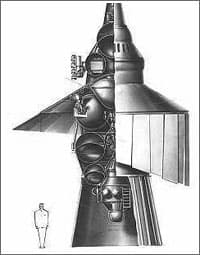
The machine itself was designed the way Lavochkin designed things, out of parts that already existed. The 3,600 kg orbiter reused the toroidal instrument compartment from the M-71 project that became Mars 2 and Mars 3, and a propulsion system with a spherical tank from the failed M-69 project of 1969. It would carry the lander out, fly the cruise corrections, then push itself onto a flyby path and relay the descent telemetry home. The 16 tonne lander was the ambitious half. Its heat shield had a rigid centre 6.5 m across, the widest that would fit inside the N1's shroud, ringed by 30 petals that would swing out once the spacecraft was clear of Earth to form a cone 11 m in diameter. The cone was deliberately asymmetric so the lander would glide, shedding speed across a long shallow entry rather than in one violent deceleration. At 200 m/s the shield would be thrown away and four throttleable engines would fly the machine down. There was no parachute anywhere in the sequence, a decision Perminov attributes to Korolev's view that a Mars landing belonged on engines. On top of the landing stage would stand a two-stage rocket carrying a 750 kg Mars-to-Earth cruise module borrowed from Venera 4 and Venera 6, and a 15 kg capsule with room for 200 grams of soil.
Then there was 4NM, and 4NM is the part that hurts. Its job was to fly first, in the 1973 window, and land a rover: partly to prove the systems and above all to prove the gliding aeroshell, partly, as Encyclopedia Astronautica puts it, to secure a scientific and propaganda first before the full sample return was risked. The rover is described as a modified Lunokhod, which points at VNIITransmash in Leningrad and Alexander Kemurdzhian, the team that built the lunar chassis and also built the 4.5 kg skiing PrOP-M robots that rode Mars 2 and Mars 3 down in 1971 and were never deployed. Past that, the record thins out to almost nothing. We could not find a published mass for the 4NM rover, or its dimensions, or its instrument list, or how it would have been powered. Nuclear power for it is asserted here and there and we could not trace the assertion to any source, so this entry does not repeat it. What is documented is the shape of the plan and how it moved. By 1971 the rover flight had slipped to the 1975 window, had grown from one surface vehicle to two, had been redesignated M-75 and had been booked onto N1 vehicle No. 19. The sample return became M-77 on N1 No. 20. Two Soviet rovers, arriving together, twenty-eight years before Spirit and Opportunity landed three weeks apart in January 2004.
It never got past paper, and the reasons come in two layers. The inner layer was the bureau's own doubt. A scientific and technical council reviewed the sample return and concluded it should not be flown on the schedule proposed, for two reasons Perminov states without softening: that Earth's biological safety was not assured, because a capsule whose parachute failed would break open and release whatever was in the soil, and that none of the onboard systems had been tested in real flight and nobody could promise three years of correct operation. Minister of General Machine Building Sergei Afanasyev liked it anyway, thought the biological problem solvable, pressed Babakin to begin and offered Perminov the chief designer's job. Babakin refused; Perminov declined. Then, on 3 August 1971, Babakin died at 56, and Lantratov records that the work was frozen. The outer layer was simpler. The N1 flew on 21 February 1969, 3 July 1969, 27 June 1971 and 23 November 1972, and failed during first-stage flight every time; the second attempt fell back onto its own pad and wrecked the launch complex. Glushko replaced Mishin in May 1974 and stopped the rocket by order; it was formally closed in 1976. No source we found records a dated decision cancelling 4NM and 5NM. They simply had nowhere to launch from. What survived was the ambition, which Kryukov reworked in 1973 into a Proton-sized project called 5M.
Mission facts
What this entry covers
One programme with two flight vehicles. It was never two programmes. 5NM (Cyrillic 5НМ) was the sample return spacecraft. 4NM (4НМ) was the precursor flight that would land a rover and prove the descent hardware before the sample return was risked. Both were designed at the Lavochkin machine-building plant (from 1974, NPO Lavochkin) and both were sized around one launch of the N1. Neither designation appears in most English mission lists, which is part of why the pair are usually described, when they are described at all, as a footnote to the N1 rather than as a Mars programme.↗
Where the idea came from
Vladimir Perminov, later deputy chief designer at NPO Lavochkin, recounts a visit to chief designer Georgi Babakin in the summer of 1968, during a conversation about using the bureau's lunar rover to ferry cosmonauts collecting rock samples. Perminov's suggestion was to replace the rover on the landing platform with a rocket and let the machine bring the rocks home by itself. Babakin called it a difficult problem and set the bureau to work on it. That line of work became the Ye-8-5 lunar sample return vehicles, and then 5NM.↗
The precedent that made it credible
Luna 16, a Ye-8-5 vehicle, landed on the Moon at 05:18 UT on 20 September 1970 and its 34 kg capsule came down 80 km southeast of Dzhezkazgan in Kazakhstan at 05:26 UT on 24 September 1970 with 101 grams of lunar soil aboard. Lunokhod 1 rolled onto the Moon on 17 November 1970. Lavochkin had, within two months, both halves of the machine 5NM needed: a robotic sample return and a working planetary rover.↗
How far 5NM actually got
A technical proposal (техническое предложение), issued in the summer of 1970 on Babakin's instruction given at the beginning of that year. Russian Wikipedia says a preliminary design (эскизный проект) was also defended for this first variant, and Konstantin Lantratov's 1996 Novosti Kosmonavtiki history says a preliminary design was developed and defended and detailed design work begun. No source we consulted describes any 4NM or 5NM hardware being cut, welded or tested. This was a paper programme throughout.↗
The launch stack
The N1 or N1M would place 98 tonnes in low Earth orbit: a 78 tonne two-stage trans-Mars injection rocket plus the 20 tonne 5NM spacecraft. Perminov's Russian text gives the N1's capacity as more than 90 tonnes and the spacecraft as 20 tonnes. Anatoly Zak records a proposal to replace the N1's fourth stage (Block G) and fifth stage (Block D) for the sample return flight with a single hydrogen-burning Block Sr designed for the L3M lunar complex.↗
The 5NM orbiter
3,600 kg, built out of parts that had already been to Mars or been built for it: a toroidal instrument compartment taken from the M-71 project (the Mars 2 and Mars 3 bus) and a propulsion system with a spherical propellant tank from the M-69 project. Its job was to carry the lander, make the cruise corrections, then move onto a flyby trajectory and relay the lander's descent telemetry to Earth. It would not have entered Mars orbit: Perminov's Russian original has the Earth-Mars orbital module transferred to a flyby trajectory to serve as the relay. Encyclopedia Astronautica says instead that the orbiter would brake into Mars orbit on 22 September 1976. We follow Perminov, who was the project's lead designer.↗
The 5NM lander
16 tonnes. The aerodynamic shield had a rigid central section 6.5 m across, which is the widest that fitted the N1 shroud, with 30 petals hinged around its rim. The petals would open once the spacecraft was on its interplanetary trajectory to form an 11 m cone. The shield was asymmetric, so the lander would glide rather than fall, and it would be discarded at 200 m/s. Four throttleable liquid engines fed from four spherical tanks would fly the rest of the descent. There was no parachute at all, a choice Perminov credits to Korolev's view that a Mars landing should be flown on engines.↗
The return train
A two-stage ascent rocket would sit on top of the landing stage, carrying a 750 kg Mars-to-Earth cruise module derived from the Venera 4 and Venera 6 orbital compartment, topped by a return capsule of 15 kg holding 200 grams of Martian soil. The capsule was a relative of the Ye-8-5 lunar return sphere and would re-enter ballistically, deploy a parachute at 200 m/s and switch on a radio beacon for the recovery teams. Mark Wade's Encyclopedia Astronautica gives the capsule as 13 kg in its opening summary paragraph and 15 kg in its body text; Perminov gives 15 kg in both the Russian and the English versions.↗
The 970-day timetable
Perminov's flight-profile figure dates the whole expedition: launch to Mars 17 September 1975, a 377-day interplanetary leg, arrival at Mars 22 September 1976, three days on the surface, ascent to a Martian orbit with a 500 km pericentre and a 12 hour period, about 302 days waiting there for the planets to line up, departure from Mars 27 July 1977, a 291-day return leg and Earth arrival on 14 May 1978. Total expedition 970 days. Perminov's text says the wait in Mars orbit was 10 months, where the figure caption says 302 days, which is closer to ten months than to the 200 days Encyclopedia Astronautica gives. We checked the caption against itself: 17 September 1975 to 14 May 1978 is exactly 970 days, and 27 July 1977 to 14 May 1978 is exactly 291 days, but the 377-day outbound leg is six days longer than the gap between the caption's own launch and arrival dates, which are 371 days apart.↗
What 4NM was for
Perminov states it plainly: to test the systems of the spacecraft and the lander, and to explore Mars with a rover, it was planned to fly 4NM in 1973. Encyclopedia Astronautica describes it as the same vehicle with the return rocket replaced by a rover, adding that this would check out the systems and secure a scientific and propaganda first before the full sample return was attempted. Anatoly Zak adds that the point of the precursor was to prove the deployable gliding aeroshell, the single riskiest item in the design.↗
The rover itself
Encyclopedia Astronautica describes it as a modified version of the Lunokhod rover. The Lunokhod running gear was built by VNIITransmash in Leningrad under Alexander Kemurdzhian, the same organisation and the same designer behind the 4.5 kg PrOP-M skiing robots that rode Mars 2 and Mars 3 down in 1971. Beyond that the record is thin. None of the sources we consulted gives the 4NM rover's mass, its dimensions, its instruments or how it would have been powered. Claims that it was nuclear powered circulate, but we found no source for them and do not repeat them here.↗
The 1971 replan
By 1971 both flights had slipped. The rover mission, now carrying two mobile surface vehicles rather than one, was redesignated M-75 and assigned to N1 vehicle No. 19 for the 1975 window. The sample return became M-77 and was assigned to N1 No. 20 for 1977. That pairing of two rovers on one mission is worth noticing: NASA landed Spirit on 4 January 2004 and Opportunity on 25 January 2004, a pair of rovers twenty-eight years after the Soviet pair would have arrived.↗
The objections
The sample return was reviewed by a scientific and technical council, and Perminov records that the conclusion was against flying it on schedule for two reasons. First, biological safety: if the capsule's parachute failed and it broke open, any Martian microbes in the soil would be loose on Earth. Second, none of the onboard systems had been proved in real flight, and nobody could be confident they would work for nearly three years. Minister of General Machine Building Sergei Afanasyev liked the project anyway, accepted the biological argument as reasonable but expected it to be solved, tried to persuade Babakin to start, and offered Perminov the chief designer post. Babakin refused and Perminov declined.↗
Babakin's death
Georgi Nikolaevich Babakin died on 3 August 1971, four months before Mars 3 landed. He was born on 31 October 1914 old style, 13 November new style, which makes him 56 on either calendar, though Encyclopedia Astronautica says 57. Sergei Sergeyevich Kryukov, whom Babakin had brought in from OKB-1 as first deputy in 1970, succeeded him as chief designer. Lantratov writes that work on the sample return was frozen after Babakin's death.↗
What actually killed it
The N1. It flew four times, on 21 February 1969, 3 July 1969, 27 June 1971 and 23 November 1972, and every flight failed during first-stage operation. The second failure destroyed one launch pad and badly damaged the other. Valentin Glushko replaced Vasily Mishin in May 1974 and stopped work on the N1 by his own order; the programme was formally closed in 1976. Russian Wikipedia's article on the N1 lists the heavy Mars rover 4NM and the Mars sample return station 5NM among the payloads it was meant to carry.↗
When it was cancelled
There is no agreed date and no named decision. Encyclopedia Astronautica says the project was shelved after the council's objections, revived after Babakin's death, still being worked on in 1972 according to Chertok's memoirs, and finally ended by the cancellation of the N1 in 1974. Russian Wikipedia dates the closure to 1973, tied to the N1's failures. Lantratov has the work frozen after August 1971 and Kryukov proposing a Proton-based replacement in 1973. All three agree on the cause and none of them cites a document.↗
Mission timeline
- 1968Perminov suggests to Babakin that the rover on a lunar landing platform could be replaced by a rocket, and the samples flown home. Babakin sets the bureau to work on it.
- 21 Feb 1969The first N1, vehicle 3L, is launched at 12:18:07 and destroyed at about 12.2 km after its engine-monitoring system shuts down the whole first stage 68 seconds into flight.
- 3 Jul 1969The second N1, vehicle 5L, rises about 200 m, loses its engines, falls back and explodes on the pad. One launch complex is effectively destroyed and the second badly damaged. Two years go into the analysis.
- 1970At the beginning of the year Babakin instructs his engineers to prepare a technical proposal for returning Martian soil. The 5NM proposal is issued that summer: 98 tonnes to Earth orbit on an N1, a 20 tonne spacecraft, launch in September 1975.
- 24 Sep 1970The Luna 16 capsule lands in Kazakhstan at 05:26 UT with 101 grams of lunar soil. The technique 5NM depended on has now worked once, at the Moon.
- 17 Nov 1970Lunokhod 1 rolls off its landing stage. The chassis lineage that 4NM's Mars rover would have drawn on is now proven on another world.
- 1971Both flights slip. The rover mission, now with two surface vehicles, becomes M-75 on N1 No. 19 for the 1975 window; the sample return becomes M-77 on N1 No. 20 for 1977.
- 27 Jun 1971The third N1, vehicle 6L, is thrown into an uncommanded roll its steering nozzles cannot hold, breaks up in flight and digs a crater 45 m across and 15 m deep 16.2 km from the pad.
- 3 Aug 1971Georgi Babakin dies. Sergei Kryukov succeeds him as chief designer at Lavochkin. Lantratov records that work on the sample return is frozen from this point.
- 23 Nov 1972The fourth and last N1, vehicle 7L, is launched with more than 13,000 sensors aboard and fails during first-stage flight like the three before it. No N1 ever flies again.
- 1973With N1 work suspended, Kryukov proposes a new Mars sample return sized for the Proton rocket. Russian Wikipedia dates the closure of the N1-based project to this year. The year 4NM was once meant to fly passes with nothing launched.
- May 1974 to 1976Glushko replaces Mishin in May 1974 and halts N1 work by his own order. The rocket is formally closed in 1976, and the two N1 flight articles already built are destroyed. Encyclopedia Astronautica dates the final end of the single-launch Mars project to the 1974 cancellation.
A filled dot marks something that physically happened. A hollow one marks an announcement, a naming or a target.
In pictures
Tap a photo to enlarge.
Sources
- V. G. Perminov, The Difficult Road to Mars (NASA Monographs in Aerospace History No. 15, 1999)
- V. G. Perminov, «Советский грунт с Марса», Novosti Kosmonavtiki no. 213 (August 2000)
- Anatoly Zak, RussianSpaceWeb: Origin of the Soviet Mars sample-return project
- Mark Wade, Encyclopedia Astronautica: Mars 5NM
- K. Lantratov, «На Марс!», Novosti Kosmonavtiki no. 21 (1996), part II, reproduced by the Russian online journal Марсианское время
- Russian Wikipedia: Марс (космическая программа)
- Russian Wikipedia: Н-1
- Russian Wikipedia: Бабакин, Георгий Николаевич
- Russian Wikipedia: Крюков, Сергей Сергеевич
- Asif A. Siddiqi, Beyond Earth: A Chronicle of Deep Space Exploration 1958-2016 (NASA SP-2018-4041)
- Russian Wikipedia: Марсоход
- English Wikipedia: Soviet Mars program
Facts on this page were verified on 24 August 2026. Where sources disagree, the disagreement is stated rather than resolved silently.