Mars Climate Orbiter
NASA · United States · Orbiter · 1999 · The losing decadeFailure
Lost at orbit insertion on 23 September 1999: the carrier vanished 49 seconds early and never returned. One root cause, a ground file giving thruster impulse in pound-force seconds where newton-seconds were specified.
TL;DR· 13 min read
Mars Climate Orbiter never entered orbit. Its carrier signal vanished 49 seconds early on 23 September 1999 and never came back. A ground application called SM_FORCES had written thruster impulse into a navigation file in pound-force seconds where the specification required newton-seconds, a factor of 4.45, so nine months of small thruster firings walked the computed trajectory away from the real one. The reconstructed closest approach was 57 km, against an 80 km survival floor.
Mars Climate Orbiter was to be the first interplanetary weather satellite and the radio relay that Mars Polar Lander would speak through. It never entered orbit. A ground application called SM_FORCES wrote thruster impulse into a navigation file in pound-force seconds where the written specification required newton-seconds, a factor of 4.45, and across nine months of small thruster firings that error quietly walked the computed trajectory away from the real one. The spacecraft arrived roughly 170 km lower than planned and did not re-emerge from behind the planet.
- 4.45the conversion factor from pound-force to newtons, and the size of the navigation error
- 57 kmreconstructed closest approach to Mars, against an 80 km survival floor
- 170 kmlower than planned at arrival, after nine months of accumulating error
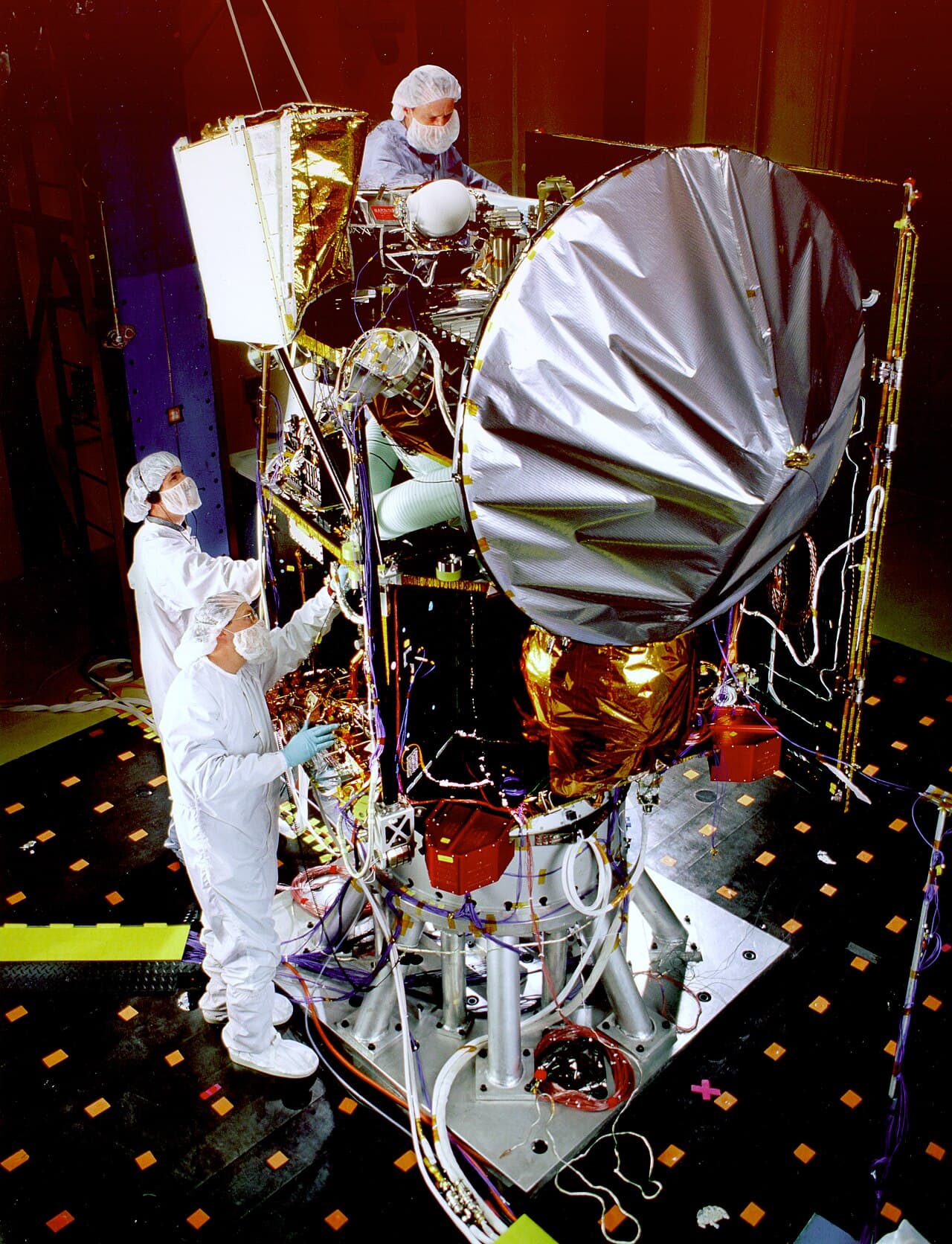
Mars Climate Orbiter was one half of a two-spacecraft package. NASA's Mars Surveyor Program had settled on a rhythm of launching to Mars every 26 months, and for the 1998 and 1999 window it sent an orbiter and a lander built by the same prime contractor, Lockheed Martin Astronautics of Denver, under the same JPL project office. The orbiter's job was weather. It carried a colour camera for daily global imaging and a pressure modulator infrared radiometer to take the temperature, dust and water vapour of the atmosphere layer by layer, and once it had aerobraked down into a two-hour polar mapping orbit it was to spend a full Martian year watching the planet's climate machine work. It had a second job too, one that turned out to matter more in hindsight than in the plan: it was to be the UHF relay for Mars Polar Lander, passing over the landing site around ten times a Martian day. It launched on 11 December 1998 at 18:45:51 UTC on a Delta II from Cape Canaveral, weighing 629 kg with propellant, and by every account it behaved beautifully. The mishap board later noted that the spacecraft "operated as commanded and the mission was categorized as extremely successful until right before Mars orbit insertion."
The failure lived in a file. Reaction wheels spin up as they absorb disturbance torques, and periodically a spacecraft has to fire thrusters to bleed that momentum off, a manoeuvre called angular momentum desaturation. Those thruster pulses nudge the spacecraft, so navigators need to know exactly how hard each one pushed. On MCO the number came from a ground program named SM_FORCES, which took telemetry from each desaturation, computed a velocity change from the thruster's impulse bit and firing time, and wrote the result into a file the navigation software read. A written software interface specification said the impulse figures in that file would be in newton-seconds. They were in pound-force seconds. One pound-force is 4.45 newtons, so every desaturation was fed into the trajectory model at rather less than a quarter of its true strength. The same calculation was also performed onboard the spacecraft, in metric, correctly. Two features of MCO's design turned a small bookkeeping error into a fatal one. Its single solar array was asymmetric about the body, so solar pressure built up momentum far faster than on the symmetric Mars Global Surveyor, and desaturations occurred 10 to 14 times more often than the navigation team expected. And the thrust was directed mostly across the Earth line of sight, where Doppler tracking could barely see it, and mostly across the flight path, where it pushed the spacecraft sideways towards Mars.
So the error accumulated invisibly, and then it stopped being invisible without anyone being able to say why. From April 1999 the navigation team knew something was wrong with the way the desaturation manoeuvres were being modelled. Through spring and summer, the orbit solutions computed from Doppler data alone kept putting the incoming flight path closer to the planet than the solutions that combined Doppler and ranging. Those concerns went around by email rather than through the project's formal anomaly process, and were never closed out. The final planned correction, TCM-4, was computed on 8 September and flown on 15 September, aiming for a first periapsis of 226 km. Over the following week the estimate slid to 150 to 170 km. About an hour before the insertion burn, with Mars' gravity now clearly bending the trajectory and better data in hand, the number came out as low as 110 km. The altitude the spacecraft could survive was 80 km. A contingency manoeuvre, TCM-5, existed on paper and could have lifted the periapsis, but the analysis and procedures to commit to it had never been finished, the onboard insertion sequence had priority, and it was discussed out loud and never sent. The engine lit at 09:00:46 UTC on 23 September 1999. The carrier vanished at 09:04:52 UTC, 49 seconds early, and never returned. After the fact, with corrected small-force values, the reconstructed closest approach was 57 km.
The board's finding is often quoted as a joke about metric and imperial units, which is a shame, because the report is much harder on itself than the joke is. It named one root cause and eight contributing causes, and the contributing causes are the interesting part: undetected mismodelling of velocity changes, a navigation team unfamiliar with the spacecraft it was flying, TCM-5 not performed, a systems engineering process that did not survive the handover from development to operations, inadequate communication between project elements, inadequate navigation staffing, inadequate training, and a verification and validation process that did not cover ground software. Behind all of them sits a sentence the board wrote plainly: "The Board recognizes that mistakes occur on spacecraft projects. However, sufficient processes are usually in place on projects to catch these mistakes before they become critical to mission success. Unfortunately for MCO, the root cause was not caught by the processes in-place in the MCO project." Its second report, published on 13 March 2000, put the same argument at programme level, finding that Mars Surveyor had accepted deep cuts in money and people without instilling the discipline that would have compensated, and that some projects and programmes had put too much emphasis on the faster and cheaper parts of Faster, Better, Cheaper over the better part.
There is one more thing worth saying about the loss. Mars Climate Orbiter was the relay Mars Polar Lander was meant to talk through, so when it died the lander lost its primary communications path ten weeks before arrival and fell back on Mars Global Surveyor and a direct-to-Earth link. It also, more usefully, gained a review board. The Phase I report published on 10 November 1999 was written explicitly to help the lander survive, and its recommendations ran through MPL's remaining weeks: verify the consistent use of units, audit the software for specification compliance on every file passed between JPL and Lockheed Martin, compare navigation solutions by independent methods, prepare properly for a contingency TCM-5, construct a fault tree for the rest of the mission. JPL stood up a Mission Safety and Success Team of more than fifty senior engineers and a Red Team to track the work. None of it saved Mars Polar Lander, and the fault tree those teams built actually contained the failure mode that killed it. But the units problem, the thing everyone remembers, never recurred. Both PMIRR instruments built for Mars were lost before reaching orbit, one with Mars Observer in 1993 and one here. As of 24 September 2026 no debris, impact site or heliocentric trace of Mars Climate Orbiter has ever been identified. The board could only say that it was destroyed in the atmosphere or passed through and out into solar orbit, and twenty-seven years later that is still where the record stands.
Mission facts
Launch
11 December 1998, 18:45:51 UTC (1:45:51 p.m. EST), on a Delta II 7425 from Pad A of Launch Complex 17, Cape Canaveral Air Station, Florida. Jonathan McDowell's launch catalogue lists the vehicle as Delta 7425-9.5, serial D264, and the time as 18:45:52 UTC, a one-second difference from NSSDCA.↗
Mass
629 kg at launch, including 291 kg of propellant. NSSDCA's summary box quotes 338 kg, which is the dry mass, so two different numbers for the same spacecraft circulate freely. The mishap board's own mission chart also gives 629 kg.↗
Spacecraft
A box about 2.1 m high, 1.6 m wide and 2 m deep, built as stacked propulsion and equipment modules, with a single 11 square metre solar array wing measuring 5.5 m tip to tip and a 1.3 m high-gain dish on a mast. Propulsion was a 640 N hydrazine and nitrogen tetroxide main engine plus hydrazine thrusters.↗
Instruments
Two. The Mars Color Imager (MARCI), a 2.2 kg wide-angle and medium-angle camera pair under Michael Malin, and the Pressure Modulator Infrared Radiometer (PMIRR), an atmospheric sounder under Daniel McCleese of JPL with Vasily Moroz of the Space Research Institute (IKI) in Moscow as co-principal investigator.↗
Instrument heritage
PMIRR had already been lost once. A Pressure Modulator Infrared Radiometer with the same name and the same principal investigator flew on Mars Observer, which fell silent on 22 August 1993 UTC (still 21 August in Pasadena), less than three days before its own orbit insertion. The rebuilt instrument was lost with Mars Climate Orbiter six years later.↗
Who built and flew it
Lockheed Martin Astronautics of Denver was prime contractor for both Mars Surveyor '98 spacecraft. JPL kept project management, systems engineering, mission and navigation design. After launch, operations passed to the Mars Surveyor Operations Project, with LMA performing real-time commanding from Denver and JPL performing navigation.↗
Root cause, as written
"The MCO MIB has determined that the root cause for the loss of the MCO spacecraft was the failure to use metric units in the coding of a ground software file, 'Small Forces,' used in trajectory models. Specifically, thruster performance data in English units instead of metric units was used in the software application code titled SM_FORCES (small forces)."↗
Where the error was not
Not on the spacecraft. The board is explicit: "The AMD software installed on the spacecraft used metric units for the computation and was correct. In the case of the ground software, the impulse bit reported to the AMD file was in English units of pounds (force)-seconds (lbf-s) rather than the metric units specified." And: "Mismodeling only occurred in the ground software."↗
Why it mattered so much
Angular momentum desaturation events, the thruster pulses that bleed momentum out of the reaction wheels, happened 10 to 14 times more often than the navigation team expected, because MCO's single solar array was asymmetric about the spacecraft body where Mars Global Surveyor's arrays were symmetric. Every one of those firings was fed into the trajectory model 4.45 times too small.↗
Why nobody caught it
The thrust during a desaturation event was mostly perpendicular to the Earth line of sight, so Doppler tracking could barely see it, and mostly perpendicular to the flight path, so it pushed the spacecraft sideways towards Mars rather than along its track. A systematic error was present and effectively invisible.↗
The warnings
Through spring and summer 1999 working-level concerns existed about disagreements between navigation solutions, and the Doppler-only solutions consistently put the flight path closer to the planet. Those discrepancies were reported informally, by email, rather than through the project's Incident, Surprise, Anomaly process, and were never resolved.↗
Planned versus actual periapsis
Trajectory correction manoeuvre 4, computed 8 September and executed 15 September 1999, targeted a first periapsis of 226 km. During the following week orbit determination showed it falling to 150 to 170 km. About an hour before insertion, better tracking put it as low as 110 km. The minimum survivable periapsis was 80 km. Reconstruction after the loss, using corrected small-force values, gave 57 km.↗
The manoeuvre that was not flown
A contingency trajectory correction manoeuvre 5 existed and could have raised the periapsis. In the board's words: "A request to perform a TCM-5 was discussed verbally shortly before the MOI onboard procedure was initiated, but was never executed." The analysis, tests and procedures needed to commit to it had never been completed, and the onboard insertion timeline took priority.↗
Loss of signal
Main engine start at 09:00:46 UTC on 23 September 1999, for a planned 16 minute 23 second burn (the exact duration is NSSDCA's figure; the mishap board's report speaks of a 16-minute burn). Carrier lost at 09:04:52 UTC as the spacecraft passed behind Mars, 49 seconds earlier than predicted. Reacquisition was expected after a 21 minute occultation, at about 09:27 UTC. Nothing was heard. All times are Earth-received; NSSDCA puts the one-way signal travel time at 10 minutes 55 seconds, so the events at Mars happened roughly eleven minutes before these clock readings. Recovery attempts continued to 25 September 1999.↗
Fate of the spacecraft
Unknown in detail. The board wrote that "MCO either was destroyed in the atmosphere or re-entered heliocentric space after leaving Mars' atmosphere." NSSDCA states more confidently that it would have been destroyed by atmospheric stress and friction at 57 km. No wreckage or debris has ever been identified.↗
Cost
NSSDCA records Mars Surveyor '98 spacecraft development at 193.1 million dollars, launch costs at about 91.7 million and mission operations at 42.8 million. Those figures cover both Mars Climate Orbiter and Mars Polar Lander together, which is why single-mission dollar figures quoted for MCO alone vary between retellings.↗
Mission timeline
- 11 Dec 199818:45:51 UTC: Launch on a Delta II 7425 from Pad A of Launch Complex 17, Cape Canaveral. The first of the two Mars Surveyor '98 spacecraft is away.
- Dec 1998 to Mar 1999The ground-produced angular momentum desaturation files are unusable because of format errors and bad attitude quaternions. For four months the navigation team is told by email when a desaturation happens and models the effect itself.
- Apr 1999The corrected files finally come into use, and within a week the data in them looks wrong: the trajectory perturbations are being underestimated. The mismodelling is recognised as a problem and investigated, but never explained.
- 8 Sep 1999The final planned interplanetary manoeuvre, TCM-4, is computed. It is expected to put the first periapsis after orbit insertion at 226 km.
- 15 Sep 1999TCM-4 is executed as planned.
- 16 to 22 Sep 1999Orbit determination in the week before arrival shows the first periapsis dropping to 150 to 170 km. Doppler-only solutions keep putting the flight path closer to the planet than the combined solutions do. The disagreement is not resolved.
- 23 Sep 1999About one hour before insertion, tracking taken as Mars' gravity takes hold gives a first periapsis as low as 110 km. The survival floor is 80 km. A trajectory correction to raise it is discussed verbally and not flown.
- 23 Sep 199909:00:46 UTC Earth-received: the 640 N main engine lights for the only time in the mission, for a planned 16 minute 23 second insertion burn.
- 23 Sep 199909:04:52 UTC: the carrier disappears as the spacecraft goes behind Mars, 49 seconds earlier than predicted. Nothing is heard at the 09:27 reacquisition. Attempts continue until 25 September.
- 29 Sep 1999Six days after the loss, engineers find that the small-force velocity changes used in orbit determination were low by a factor of 4.45, because the impulse data in the desaturation file was delivered in pound-force seconds instead of the specified newton-seconds.
- 10 Nov 1999The Mishap Investigation Board, chaired by Marshall Space Flight Center director Arthur Stephenson, publishes its Phase I report: one root cause, eight contributing causes, and sixteen recommendations aimed at saving Mars Polar Lander, which is three weeks from its own landing.
- 13 Mar 2000The board's second report, on project management in NASA, concludes that the Mars Surveyor Program "agreed to significant cuts in monetary and personnel resources" and that the project "failed to introduce sufficient discipline in the processes used to develop, validate and operate the spacecraft."
A filled dot marks something that physically happened. A hollow one marks an announcement, a naming or a target.
In pictures
Tap a photo to enlarge.
Sources
- Mars Climate Orbiter Mishap Investigation Board, Phase I Report, 10 November 1999 (NASA lessons-learned library copy)
- Report on Project Management in NASA by the Mars Climate Orbiter Mishap Investigation Board (Phase II), 13 March 2000
- NSSDCA Master Catalog: Mars Climate Orbiter (1998-073A)
- NSSDCA launch and trajectory record for Mars Climate Orbiter
- NSSDCA experiment record: Mars Color Imager (MARCI), 1998-073A-01
- NSSDCA experiment record: Pressure Modulated Infrared Radiometer (PMIRR) on Mars Climate Orbiter, 1998-073A-02
- NSSDCA experiment record: PMIRR on Mars Observer, 1992-063A-05
- Report on the Loss of the Mars Polar Lander and Deep Space 2 Missions, JPL Special Review Board (D-18709), 22 March 2000
- Report on the Loss of the Mars Polar Lander and Deep Space 2 Missions, NASA NTRS scan
- Jonathan McDowell, General Catalog of Artificial Space Objects, launch list (Delta 7425-9.5 D264, SLC-17A)
- NASA science mission page: Mars Climate Orbiter
- Mars Observer Mission Failure Investigation Board Report, Volume I (Coffey Board), December 1993
Facts on this page were verified on 24 September 2026. Where sources disagree, the disagreement is stated rather than resolved silently.