Deep Space 2
NASA · United States · Penetrator · 1999 · The losing decadeFailure
Neither probe was ever heard from after 3 December 1999, and nothing confirms Amundsen and Scott separated, entered or reached the ground. The review board named no probable cause, only four plausible failure modes.
TL;DR· 14 min read
Neither Deep Space 2 probe was ever heard from. Amundsen and Scott were two 3.572 kg penetrators carried to Mars on Mars Polar Lander's cruise stage, meant to hit the south polar layered terrain at roughly 200 m/s on 3 December 1999. Nothing confirms that they separated, entered or reached the ground, and the JPL Special Review Board could not identify a probable cause: it listed four plausible failure modes and could not choose between them.
Deep Space 2 was an experiment in making spacecraft absurdly small and absurdly tough. Two probes, each 3.572 kg including its ceramic aeroshell and each about the size of a basketball, were bolted to the cruise stage of Mars Polar Lander with no electrical connection to it, and were meant to be flung loose minutes before entry, fall unguided, shatter their shells on impact at roughly 200 metres per second and drive a penetrator up to a metre into the Martian ground. Neither probe was ever heard from. Unlike the lander they rode with, their loss has no probable cause: the review board could only list four plausible failure modes and say it could not choose between them.
- 2probes, named Amundsen and Scott, neither of which was ever heard from
- 3.572 kgentry mass of each probe, aeroshell included
- 0 of 10advanced technologies the mission was built to validate that could be validated in flight
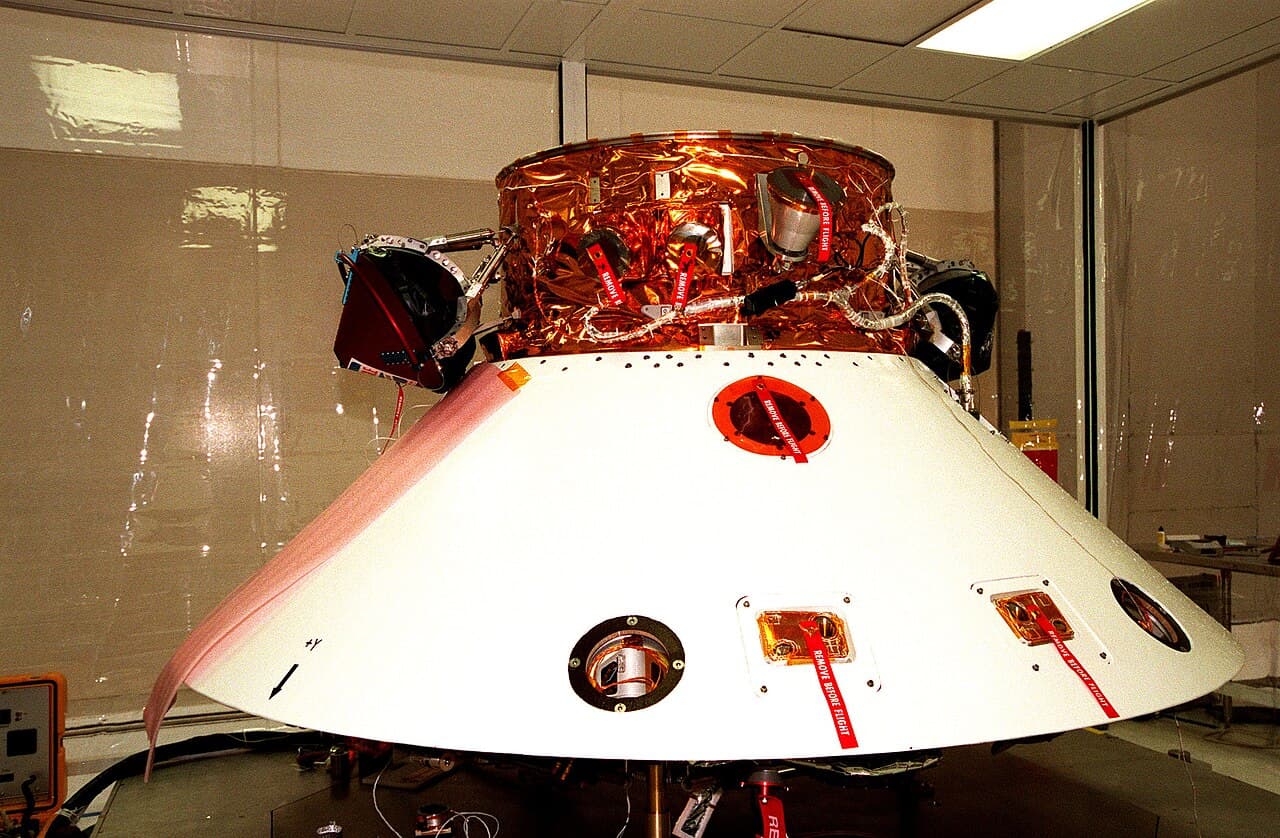
Deep Space 2 was a deliberate provocation. NASA's New Millennium Program existed to fly technology that was too new to trust on a real mission, and its second Deep Space project asked whether a functioning spacecraft could be shrunk to the size and weight of a small melon and then thrown at a planet hard enough to bury part of itself. Each of the two probes weighed 3.572 kg complete with its ceramic aeroshell, and inside that shell sat two pieces joined by a flexible cable: an aftbody, 136 mm across, holding batteries, a radio, a 127 mm antenna and the sensors that would stay on the surface, and a forebody penetrator 35 mm across and 670 grams, packed with a drill, a sample cup, a tunable diode laser to sniff for water vapour, temperature and conductivity sensors, a microcontroller and an impact accelerometer. The design specification was brutal. The aftbody had to take about 60,000 g at impact and the penetrator about 30,000 g, and the penetrator had to keep working down to minus 120 degrees C. Ten separate technologies were being validated at once, among them ultra-low-temperature lithium batteries, a three-dimensional microcontroller, mixed digital and analogue microelectronics, and flexible interconnects used as system cabling.
They travelled as freight. The probes were bolted to Mars Polar Lander's cruise stage beneath the solar panels, with no electrical connection to the lander whatsoever, which meant that from the moment they were installed at the Cape they could not be powered up or tested again. Their entire flight plan lasted about four minutes and depended on a chain of events nobody would ever see. Five minutes before the lander hit the atmosphere, its entry body was to separate from the cruise stage, and that separation was to trip mechanical pyrotechnics releasing the two aeroshells about eighteen seconds later. The probes would then wake up, run health checks, and fall unguided. They had no thrusters and no attitude control at all: their shape alone was supposed to keep them nose-forward through entry. The aeroshells would shatter on contact, the penetrators would drive up to a metre into the ground, and the aftbodies would stay on the surface with their antennas up, waiting to talk to Mars Global Surveyor overhead. Nominal mission: two days, or however long two 600 milliamp-hour lithium cells lasted in the polar cold.
Nothing came back. The first relay pass through Mars Global Surveyor, around 03:30 UTC on 4 December 1999, was supposed to carry a single set of engineering data, and receiving it would have completed the prime mission and validated the technologies. It was silent, as were the passes after it, and the batteries had at most a few days in them anyway. Because the lander they rode with sent no descent telemetry either, the record contains no confirmation that the probes ever separated, ever entered, or ever reached the ground. The review board that took the case in December 1999 worked through the design and test files for two months and came back with a sentence that is unusual in an accident report for its bluntness: it had been unable to identify a probable cause. Where it could rule things out, it did. Premature separation was implausible, since a probe coming loose early would have hit and damaged the cruise stage solar panels and there was no sign of that. A systematic failure of the separation system, a systematic aeroshell flaw, and skipping back out of the atmosphere were all judged implausible. That left four ways to lose two probes at once.
The four survivors of that elimination are worth stating, because they are a catalogue of things nobody had tested. The probes might have bounced: impact on ice was never a design requirement and never tested, and orbital data suggested at least a few centimetres of soft material lying over whatever is underneath, which would support only minimal shear and act like a lubricant on any smooth hard layer below. The electronics or batteries might simply have failed at impact, which the board could not exclude because impact qualification of a complete flight-like probe was never attempted, no working radio was ever impact-tested, and the flight battery cells arrived too late to test and were accepted by similarity to an earlier lot in which one cell of eight had been physically damaged. The antenna's whisker tips might have gone into ionization breakdown in the thin carbon dioxide atmosphere, a regime the antenna was never tested in, degrading the link below threshold. Or a probe might have ended up lying on its side with the antenna touching the ground, a case the antenna was never designed or characterised for. Behind all four sits one decision: a system-level qualification test in the original plan was deleted on cost and schedule grounds, a risk that JPL and NASA management assessed and accepted, and which the board noted "compromised the ground validation of the targeted technologies" while the loss of the probes "precluded flight validation."
Deep Space 2 got closer than anyone before it to putting penetrators on another planet. Russia's Mars 96 had carried two of them in November 1996 and never left Earth orbit. But the honest statement of what Deep Space 2 achieved is uncomfortable and worth making plainly: two objects were carried to Mars, and nobody knows whether they arrived. No hardware has been located, no impact scar has been identified, and the targeted area cannot even be stated cleanly, since the published target of 73 degrees south, 210 degrees west sits in tension both with the same catalogue's claim that the probes would land 50 to 100 km from the lander, and with the lander's own final target of 76 south, 195 west after its landing latitude was moved during cruise. The idea itself has never been retired. Penetrators keep reappearing in mission proposals precisely because they are the cheapest way to get instruments below a planetary surface. As of 23 August 2026 no penetrator has ever been confirmed delivered to the surface of another planet, and the only two that ever left Earth on a working interplanetary trajectory are Amundsen and Scott, wherever they are.
Mission facts
Launch
3 January 1999, 20:21:10 UTC, on the same Delta II 7425 as Mars Polar Lander from Launch Complex 17, Cape Canaveral Air Station. The probes were mounted on the lander's cruise stage beneath the solar panels, self-contained, with no electrical connection to the lander at all.↗
Programme
Part of NASA's New Millennium Program, whose stated purpose was to flight-test new technologies and demonstrate innovative approaches for future missions. The project's specific challenge, in the review board's words, was "to demonstrate that miniaturized components could be delivered to the surface of another planet and conduct science experiments." The mission was designed to validate ten advanced, high-risk technologies.↗
Names
The two probes were named Amundsen and Scott, after the polar explorers, in keeping with a landing site near the Martian south pole. The names were mission designations rather than markings on the hardware.↗
Construction
Each probe massed 3.572 kg in three parts. A ceramic aeroshell 275 mm high and 350 mm across, mass 1.165 kg, designed to shatter on impact. An aftbody 105.3 mm high and 136 mm across holding the batteries, pressure sensor, entry accelerometer, radio and a 127 mm antenna, designed to stay on the surface. And a forebody penetrator 105.6 mm long, 35 mm across and 0.670 kg, carrying the drill, sample chamber, laser water detector, temperature and conductivity sensors and a three-axis impact accelerometer, connected to the aftbody by a flexible cable.↗
Shock and cold design
The aftbody was designed to withstand a peak rigid-body shock of about 60,000 g and the penetrator about 30,000 g. The aftbody could operate between 0 and minus 80 degrees C, the penetrator down to minus 120 degrees C.↗
Impact plan
No propulsion and no active control: the probes were shaped to orient themselves nose-forward in free fall. NSSDCA gives an expected impact at 160 to 200 m/s with an angle of attack under 12 degrees and penetration of 0.3 to 1 m; the review board quotes about 200 m/s. The probes needed to hit within 30 degrees of vertical to penetrate, with 20 degrees expected from a nominal entry, meaning a local slope steeper than about 10 degrees could defeat them. Impacts were expected about 15 to 20 seconds before Mars Polar Lander's touchdown, near 20:15 UTC Earth-received time on 3 December 1999; one-way light time was about 14 minutes, so the impacts, if they happened, happened at Mars at about 20:01 UTC.↗
Separation sequence
About 5 minutes before Mars Polar Lander entered the atmosphere, the lander's entry body was to separate from the cruise stage. That separation was to trip mechanical pyrotechnic devices which released the two Deep Space 2 aeroshells about 18 seconds later. The probes were then to power up and run onboard health checks. None of this was ever confirmed, because there was no telemetry from the lander during descent and the probes could not be powered at all once installed on the cruise stage.↗
Communications
UHF at 7,000 bits per second to Mars Global Surveyor, buffered in the orbiter's camera memory and relayed on to Earth. The first engineering data was expected around 03:30 UTC on 4 December 1999. Each probe carried two non-rechargeable lithium-thionyl chloride cells of 600 milliamp hours, good for roughly one to three days. The nominal mission was two days.↗
Science
A miniature drill was to pull about 0.1 grams of soil into a cup inside the penetrator, heat it in 10 degree C steps and look for released water vapour with a tunable diode laser. Other measurements were subsurface temperature and thermal conductivity, soil hardness and layering inferred from the impact deceleration trace, atmospheric density from the entry accelerometer, and hourly pressure and temperature readings.↗
Board finding
"In contrast, the Board has been unable to identify a probable cause of the loss of DS2. The loss of both probes can be accounted for by a number of possibilities. The Board identified four plausible failure modes."↗
The four plausible failure modes
One, both probes bounce off an unexpectedly slick or hard surface (impact on ice was never a design requirement and never tested, and orbital data suggested a few centimetres of loose material over whatever lies beneath, which could act as a lubricant). Two, both suffer electronic or battery failure at impact. Three, both fail through ionization breakdown at the sharp tips of the antenna whiskers in the roughly 6 torr carbon dioxide atmosphere, a condition the antenna was never tested for. Four, a probe lands on its side with its antenna against the ground, a case the antenna was never designed, tested or characterised for.↗
What was ruled out
The board judged several scenarios implausible: premature separation of both probes, failure of both to separate from the cruise stage, a systematic flaw in the aeroshell design, and skipping out of the atmosphere or landing too far downtrack to reach Mars Global Surveyor. Battery drain before entry from a sneak electrical path was rated plausible but unsupported; an inadvertent probe turn-on did occur during final assembly and was caught before significant depletion, but the underlying circuit deficiency could not be corrected.↗
The test that was cancelled
The development plan as originally approved included a system-level qualification test, which was deleted on cost and schedule grounds with JPL and NASA management assessing and accepting the risk. More than 50 impact tests were run on subassemblies and materials, but there was no system-level impact test of a flight-like radio subsystem, no successful impact test of a probe integrated with its aeroshell (no suitable air gun was available), and the flight battery cells arrived too late to be impact tested and were qualified by similarity to an earlier lot in which one cell of eight had been physically damaged.↗
Target area
NSSDCA places the target "within the northern boundary of the martian polar layered terrain, near 73 degrees south latitude, 210 degrees west longitude" and also states the probes should land 50 to 100 km from the lander's touchdown point. Those two statements do not agree with each other, or with Mars Polar Lander's final target of 76 S, 195 W, and the 73 S figure appears to predate the decision to move the landing latitude from 75 S to 76 S. No impact point has ever been located, so this entry carries no surface coordinates.↗
Cost
NSSDCA gives the total development cost of the Deep Space 2 probes as 29.2 million dollars, separate from the Mars Surveyor '98 figures that cover Mars Polar Lander and Mars Climate Orbiter.↗
Precedent
Russia's Mars 96, launched 16 November 1996, carried two surface penetrators along with an orbiter and two small stations. It never left Earth orbit, re-entering over the Pacific and South America between about 00:45 and 01:30 UT on 17 November 1996. Deep Space 2 therefore got closer to landing penetrators on another planet than anything before it, but since nothing confirms the probes separated or arrived, no one can claim penetrators have reached Mars.↗
Mission timeline
- 16 Nov 1996Russia's Mars 96 launches carrying two surface penetrators and fails to leave Earth orbit, re-entering the following day. Penetrators remain an untried way of reaching another planet's subsurface.
- 3 Jan 199920:21:10 UTC: Amundsen and Scott launch bolted to Mars Polar Lander's cruise stage, under the solar panels. From integration onward they cannot be powered up or tested; they are dormant cargo for eleven months.
- 23 Sep 1999Mars Climate Orbiter is lost. Deep Space 2 is unaffected in one respect: it had always planned to relay through Mars Global Surveyor rather than the new orbiter.
- 3 Dec 199920:05 UTC Earth-received: Mars Polar Lander's entry body separates from the cruise stage, which should trip the pyrotechnics that release the two probe aeroshells about 18 seconds later. There is no telemetry to confirm any of it.
- 3 Dec 199920:15 UTC Earth-received (about 20:01 UTC at Mars): the probes were due to hit at roughly 200 m/s, 15 to 20 seconds ahead of the lander's touchdown, shattering their aeroshells and driving their penetrators up to a metre down.
- 4 Dec 1999About 03:30 UTC: the first relay pass through Mars Global Surveyor, which was to carry a single set of engineering data and complete the prime mission. Nothing is received.
- 16 Dec 1999JPL's Deputy Director appoints a Special Review Board under John Casani to examine the loss of both Mars Polar Lander and Deep Space 2.
- Dec 1999 to Jan 2000Listening continues through Mars Global Surveyor and, for the lander, through radio telescopes in the United Kingdom, the Netherlands, Italy and at Stanford. Nothing is heard from either probe. The batteries would have been dead within about three days regardless.
- Jan 2000Seven review teams work through the design and test record during January and February 2000. For Deep Space 2 the picture that emerges is of a qualification programme that proved the general approach with more than 50 impact tests but never tested a complete flight-like probe, never impact-tested a working radio, and qualified the flight battery cells by similarity because they arrived too late to test.
- 22 Mar 2000The board publishes. For Mars Polar Lander it names a probable cause. For Deep Space 2 it says it cannot, and lists four plausible failure modes: bouncing off the surface, electronics or batteries failing at impact, ionization breakdown at the antenna tips, and a probe lying on its side with the antenna against the ground.
- As of 23 Aug 2026No Deep Space 2 hardware has ever been identified on Mars, no cause of loss has ever been established, and no penetrator mission has since been landed on another planet.
A filled dot marks something that physically happened. A hollow one marks an announcement, a naming or a target.
In pictures
Tap a photo to enlarge.
Sources
- Report on the Loss of the Mars Polar Lander and Deep Space 2 Missions, JPL Special Review Board (JPL D-18709), 22 March 2000
- Report on the Loss of the Mars Polar Lander and Deep Space 2 Missions, NASA NTRS scan
- NSSDCA Master Catalog: Deep Space 2 (Mars Microprobe, probes Amundsen and Scott)
- NSSDCA Master Catalog: Mars Polar Lander (1999-001A)
- NSSDCA launch and trajectory record for the 3 January 1999 launch
- Mars Climate Orbiter Mishap Investigation Board Phase I Report, 10 November 1999
- NSSDCA Master Catalog: Mars 96 (1996-064A)
- JPL mission page: Mars Polar Lander / Deep Space 2
- Jonathan McDowell, General Catalog of Artificial Space Objects, launch list (Delta 7425-9.5 D265, SLC-17B, 1999 Jan 3)
Facts on this page were verified on 23 August 2026. Where sources disagree, the disagreement is stated rather than resolved silently.