Nozomi
ISAS/JAXA · Japan · Orbiter · 1998 · The losing decadeFailure
Japan's first mission to another planet, and it never reached Mars orbit: a valve in the oxidiser feed failed on 20 December 1998, insertion was abandoned on 9 December 2003, and Nozomi passed Mars at about 1,000 km.
TL;DR· 17 min read
Nozomi was Japan's first mission to another planet, built to study how the solar wind strips the Martian upper atmosphere, and it never reached Mars orbit. A valve in the oxidiser feed failed during the powered Earth swingby of 20 December 1998, leaving the burn about 100 m/s short and costing the propellant reserved for arrival. A solar storm in April 2002 then killed the power supply that ran the main engine's heaters. Insertion was abandoned on 9 December 2003 and Nozomi passed Mars at about 1,000 km.
Nozomi, meaning Hope, was Japan's first mission to another planet, built to study how the solar wind strips away the Martian upper atmosphere. It never got into orbit around Mars, and the reason is a single valve. During the powered Earth swingby of 20 December 1998 a valve in the oxidiser feed failed to open fully, the departure burn came up about 100 m/s short, and the recovery burns the next day consumed the propellant reserved for arrival. What followed was one of the most stubborn salvage operations in the history of spaceflight: a four-year replanned trajectory, a spacecraft flown for eighteen months on a bare radio beacon, and roughly 130 million commands sent to switch one dead power supply back on.
- ~130 millioncommands sent trying to switch one dead power supply back on
- 4 yearsadded to the flight plan after one valve failed to open in December 1998
- 1,000 kmclosest approach to Mars, deliberately raised from 894 km to protect the planet
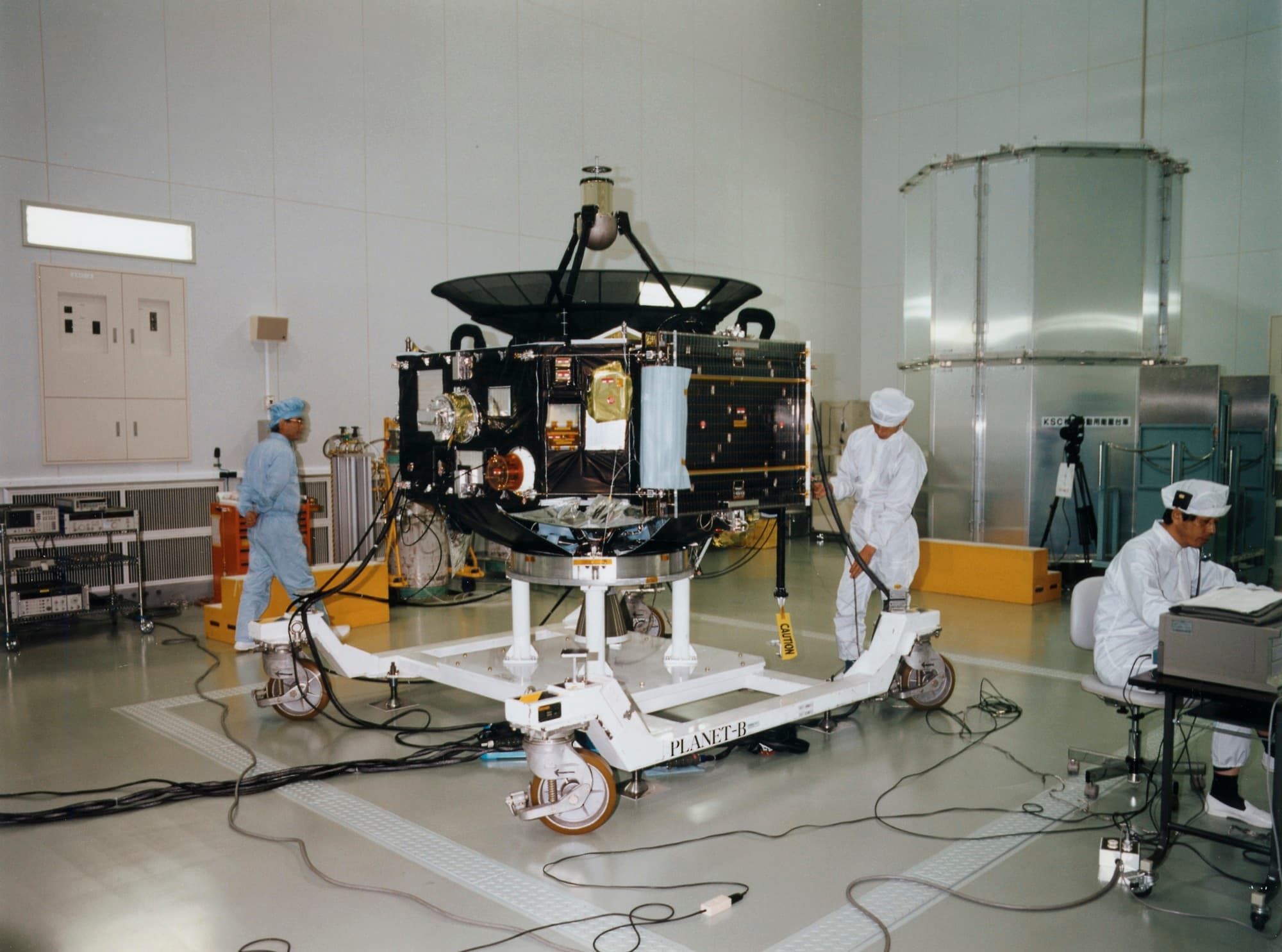
Nozomi was designed to answer a question the American Mars programme of the 1990s was not asking. Mars Pathfinder and Mars Global Surveyor were looking at landforms, geology, weather and the possibility of life. PLANET-B, as it was called before launch, was aimed at the top of the atmosphere, where the solar wind meets a planet with almost no magnetic field to shield it. The prompt was a result from the Soviet Phobos 2 orbiter, which in 1989 detected oxygen streaming away from the night side of Mars at a rate that, if it applied everywhere all the time, would strip the oxygen out of the present atmosphere in about 100 million years. Was the loss really that large, and what drove it? ISAS packed fourteen instruments onto a 540 kg spacecraft, four of them supplied by the United States, Canada, Sweden and Germany, and got the whole payload down to 35 kg including the mast and the mechanisms that unreeled 52 m of wire antenna. A comparable instrument suite on the earlier GEOTAIL satellite weighed around 180 kg. Bolted to the body was a plate carrying the names of 270,000 people who had written in during a two-month campaign at the start of 1998; staff sorting the postcards said the messages made them cry. The M-V rocket lifted it from Uchinoura at 03:12 on the morning of 4 July 1998, Japan time, into a clear sky after weeks of rainy season.
The rocket could not throw Nozomi to Mars directly, so the plan used the Moon and the Earth as levers. Nine orbit-control burns shaped a long ellipse; a lunar swingby on 24 September 1998 passed 4,100 km from the Moon and stretched apogee to 1.71 million km; a second lunar pass followed on 18 December. Then, on 20 December, came the manoeuvre everything depended on: a powered Earth swingby, in which the 500 N bipropellant engine would fire at closest approach and add 430 m/s to the gravitational kick. It fired at 17:10 Japan time, roughly 1,000 km above the Earth, at a moment when Nozomi was invisible from Usuda and from NASA's Deep Space Network. When the DSN reacquired the signal, the numbers were wrong by about 100 m/s. A valve in the oxidiser feed had not opened all the way, starving the engine of nitrogen tetroxide. The valve existed because of another mission's failure: it had been added after NASA lost Mars Observer in 1993, to stop propellant vapour creeping back upstream while the engine sat idle. The next day, exhausted after a night of continuous operations, the team fired two corrective burns. They worked, in that Nozomi ended up on a trajectory to Mars. But they had to be made away from the point in the orbit where fuel goes furthest, and they ate the propellant reserved for stopping at the other end.
So the team went looking for a different way to arrive. Through the last days of 1998 and the first of 1999, ISAS's mission analysis group examined more than ten options, including one and two Mars swingbys, powered and unpowered, and found a trajectory that traded time for fuel: leave Nozomi in a heliocentric ellipse with perihelion at Earth's orbit and aphelion near Mars's, let it go round three times over four years, swing past Earth in December 2002 and again in June 2003 to flip the orientation of that ellipse, and arrive at Mars at the end of 2003 needing far less braking. Arrival moved from 11 October 1999 to 14 December 2003. There were compensations. Joint observations with the American orbiters were lost, but joint observations with Europe's Mars Express became possible, and Mars would now be seen near solar minimum. And the cruise itself became a mission. The ultraviolet spectrometer mapped interplanetary hydrogen to find where the interstellar wind blows from; the extreme-ultraviolet telescope looked at scattered light from helium ions, which ISAS says was the first view of that region from outside; the dust counter logged 96 impacts between 1998 and 2002, including a burst in November 1998 when Nozomi, still circling Earth, flew through the Leonid stream with its solar panels turned edge-on for protection.
The system engineers had signed off on the four-year wait with one caveat: barring an unforeseen event, the spacecraft would hold. The unforeseen event arrived from 150 million km away. A large solar flare on 22 April 2002 hit Nozomi with the heaviest particle dose of its mission, and on 25 April a power supply serving both the communications and the thermal-control functions stopped coming on. The most likely cause was a short circuit somewhere downstream; commanding the supply on gave about two milliseconds of power before the overcurrent breaker did its job and shut it off again, protection turning into obstruction. That one supply ran the heaters that kept the attitude-control hydrazine liquid, and supplied the modulation that made telemetry legible on the ground. Nozomi lost its voice and its warmth at once, and the fuel in the main engine's plumbing froze. An attempt on 15 May to burn out the short by pushing current through it knocked out the X-band transmitter as well. After around 7,500 power-on commands the beacon returned on 15 July. From then until the end, controllers flew the spacecraft essentially blind, using onboard autonomy rules to turn the beacon on or off according to whether some measured value was above or below a threshold they uploaded, then bisecting. At interplanetary distances each yes-or-no answer took tens of minutes.
They flew two Earth swingbys that way. The hydrazine thawed in late August 2002 as Nozomi drew nearer the Sun, attitude control came back, four small burns lined up the geometry, and on 20 December 2002, four years to the day after the failed departure burn, Nozomi passed 36,000 km from Earth exactly as planned. On 19 June 2003 it did it again at about 11,000 km and was on its way to Mars. What it could not do was fire the main engine, because thawing that plumbing needed the heater circuit and the heater circuit needed the dead supply. Recovery attempts resumed in July 2003 and knocked the transmitter out once more. By December, JAXA's tally of commands sent to force that supply on stood at roughly 130 million, including a phase in which the onboard ROM was rewritten to issue them and then restored to its original state. At 20:30 Japan time on 9 December 2003, five days before arrival, the mission was called. The last act was deliberate: because COSPAR asks that an unsterilised orbiter have under a 1 percent chance of hitting Mars within twenty years, and because the navigation error around an 894 km miss could not rule that out, controllers spent thirty-eight minutes that evening pushing the closest approach out to about 1,000 km, cutting the impact odds to roughly 0.1 percent. Nozomi passed Mars on 14 December, left its gravity on 16 December, and is still going round the Sun.
Mission facts
Launch
3 July 1998 at 18:12 UTC, which is 4 July 1998 at 03:12 Japan Standard Time, on the third M-V rocket from Kagoshima Space Center at Uchinoura (now the JAXA Uchinoura Space Center). Japanese sources date the launch 4 July because they use JST. The M-V's first three stages reached a parking orbit, and about twenty minutes later the fourth stage sent the spacecraft toward the Moon; because no real-time telemetry was arranged for that ignition, the team had to wait several hours for overseas tracking to confirm the orbit.↗
Names
PLANET-B before launch, renamed Nozomi (Hope) afterwards in the Japanese tradition. It carried a plate engraved with the names of 270,000 people, gathered in a public campaign that ran from 1 January to 28 February 1998.↗
Spacecraft
About 540 kg at launch including 282 kg of propellant; a body 1.6 m square and 0.58 m high, solar paddles spanning 6.22 m, wire antennas 52 m tip to tip and a 5 m mast. NASA's mission page says 536 kg and NSSDCA's summary box says 258 kg, which is the dry figure; ISAS says 540 kg and we use that.↗
Instruments
Fourteen, including the Mars Imaging Camera, a magnetometer, electron and ion energy analysers, an ion mass imager, a probe for electron temperature, extreme-ultraviolet and ultraviolet spectrometers, a plasma wave and sounder package, a neutral mass spectrometer, a thermal plasma analyser and the Mars Dust Counter. Four came from abroad, one each from the United States, Canada, Sweden and Germany. ISAS gives the payload mass as 35 kg including the mast and antenna mechanisms; NSSDCA quotes a 33 kg budget. For comparison ISAS notes that GEOTAIL carried a similar instrument count at about 180 kg.↗
Science goal
The upper atmosphere of Mars and its interaction with the solar wind, deliberately different from the geology-and-life focus of the American missions of the period. The motivating result was Phobos 2's 1989 detection of oxygen streaming off the night side of Mars, at a rate that, if it ran everywhere continuously, would remove the oxygen from the present atmosphere in about 100 million years, though ISAS notes that resupply from the ground means it would not actually run dry. Nozomi was to establish whether the loss is really that large and by what mechanism.↗
Planned Mars orbit
A near-polar ellipse with periapsis about 150 km at its lowest and apoapsis about 15 Mars radii (a Mars radius is roughly 3,400 km), initial inclination 75 deg. NSSDCA describes the capture orbit as periapsis 300 km, apoapsis 15 Mars radii, inclination 170 deg to the ecliptic, later lowered to a 150 km periapsis and a 38.5 hour period. The periapsis and apoapsis match; the inclinations do not. Mars's equator is tilted about 27 deg to the ecliptic, so a 75 deg Martian-equatorial orbit works out at somewhere between 48 and 102 deg to the ecliptic, never 170, and we have found no source that squares the two.↗
Departure plan
The M-V could not send Nozomi to Mars directly. It went first into a high ellipse around Earth, was trimmed by nine orbit-control burns to an apogee of 400,000 to 500,000 km and a perigee of 800 to 1,700 km, took a lunar swingby on 24 September 1998 that raised apogee to about 1.71 million km (closest approach to the Moon about 4,100 km), took a second lunar swingby on 18 December, and then made a powered Earth swingby on 20 December in which the 500 N bipropellant main engine fired at closest approach.↗
The valve failure
On 20 December 1998 the main engine fired at closest approach, 17:10 JST (08:10 UTC), while Nozomi was out of view of both Usuda and NASA's Deep Space Network. The burn delivered about 100 m/s less than the planned 430 m/s. JAXA's 2004 investigation report attributes this to a valve downstream of the oxidiser tank that did not open fully; ISAS's own history describes it as the valve isolating the helium pressurant from the nitrogen tetroxide tank. Both describe the same job, sealing the line while the bipropellant engine sat idle so that propellant vapour could not migrate upstream. Only the JAXA report says why the valve was there at all, adding that it had been fitted after the loss of NASA's Mars Observer.↗
The fix and the cost
Two corrective burns on 21 December put Nozomi on a Mars transfer trajectory, but they had to be made away from the fuel-optimal point near perigee and so consumed far more propellant than planned, leaving too little for Mars orbit insertion. From the remaining propellant the team worked out that the valve no longer needed to be closed to prevent vapour backflow, opened it during a visible pass on 21 December 1998 and never operated it again.↗
The new trajectory
ISAS's mission analysis group worked through the 1998 new year and found a solution by early January 1999: three loops of a heliocentric ellipse with perihelion at Earth's orbit and aphelion at Mars's orbit over four years, an Earth swingby in December 2002, a second in June 2003 and Mars arrival around the turn of 2003 into 2004. JAXA's 2004 report puts the new insertion opportunity at late December 2003 to early January 2004, the ISAS history page at the beginning of 2004 and the ISAS spacecraft page at January 2004, while the ISAS Q&A says the end of 2003; the date actually worked to was 14 December 2003. More than ten alternatives were examined, including Mars swingbys, powered and unpowered. Arrival slipped from 11 October 1999 to 14 December 2003.↗
The 2002 electrical failure
A solar flare on 22 April 2002 exposed Nozomi to the largest dose of high-energy particles of its mission. JAXA dates the resulting fault 25 April 2002: a common power supply serving both the communications and thermal-control functions could no longer be switched on, most likely because of a short in one of the components downstream. Commanding it on produced about 2 ms of power before the overcurrent breaker tripped. That supply ran the heaters keeping the attitude-control hydrazine liquid, and provided the modulation used to send telemetry, so Nozomi lost both its data downlink and its ability to thaw the main engine's propellant.↗
Flying on a beacon
An attempt on 15 May 2002 to burn out the short by forcing current through it instead knocked the X-band transmitter offline, when an incomplete power rise generated spurious commands and tripped a relay. After roughly 7,500 power-on commands the beacon came back on 15 July 2002. With no telemetry, controllers used the spacecraft's onboard autonomy to read its health: they uploaded threshold comparisons and watched whether the beacon switched on or off, narrowing values like temperature by bisection, at tens of minutes per bit.↗
The thaw and the swingbys
As the spacecraft closed on the Sun the frozen hydrazine warmed and thawed in late August 2002, restoring attitude control. Four trajectory adjustments between September and December 2002 set up an Earth swingby at 36,000 km on 20 December 2002, and a second on 19 June 2003 at 23:59:53 JST (14:59:53 UTC) at an altitude of about 11,000 km. Both were flown with minimal communications, and the second put Nozomi on its Mars arrival trajectory.↗
End of mission
Recovery work resumed in July 2003 and again knocked out the transmitter. Through to December 2003 the team sent roughly 130 million commands to switch the common power supply on continuously, then rewrote the onboard ROM to issue them, then restored the ROM and tried again. At 20:30 JST on 9 December 2003 (11:30 UTC) JAXA confirmed the fault could not be repaired and abandoned Mars orbit insertion.↗
Planetary protection
COSPAR policy requires that an unsterilised Mars orbiter have less than a 1 percent chance of hitting Mars within 20 years of launch. On the trajectory Nozomi was flying in early December, ISAS's own history gives closest approach as 03:19 JST on 14 December at 894 km above the surface. Between 20:45 and 21:23 JST on 9 December (ISAS's history says 21:15) controllers commanded a change that raised the miss distance to about 1,000 km and brought the impact probability to roughly 0.1 percent. JAXA and ISAS publish only that post-manoeuvre figure; neither states what the probability was beforehand.↗
Cruise science
Nozomi observed through the long wait. Its ultraviolet imaging spectrometer measured interplanetary hydrogen Lyman-alpha emission to find the direction and strength of the interstellar wind; the extreme-ultraviolet telescope observed helium-ion scattered light, which ISAS describes as the first time that region was viewed from outside; the Mars Dust Counter registered 96 dust impacts between 1998 and 2002, with speed and mass derived for 79 of them, including a burst during the November 1998 Leonids while the spacecraft was still in Earth orbit. Those data were finally published in full form in February 2026.↗
Mission timeline
- 3 Jul 199818:12 UTC (4 July, 03:12 JST): Launch of PLANET-B on the third M-V rocket from Kagoshima Space Center at Uchinoura, into a high Earth orbit. Renamed Nozomi once in space.
- 24 Sep 1998First lunar swingby, passing about 4,100 km from the Moon and raising apogee to roughly 1.71 million km. Nozomi photographed the lunar far side from about 24,000 km on the way out, and had already returned a joint portrait of Earth and Moon during camera tests in August.
- 20 Dec 199817:10 JST (08:10 UTC): The powered Earth swingby. The 500 N main engine fires at closest approach, around 1,000 km altitude, while the spacecraft is invisible from both Usuda and the DSN. Tracking afterwards shows the burn was about 100 m/s short of the planned 430 m/s, because a valve in the oxidiser feed did not open fully.
- 21 Dec 1998After a night without sleep, the team fires two corrective burns that do put Nozomi on a Mars transfer trajectory, but away from the fuel-optimal point, spending propellant that had been reserved for arrival. The offending valve is opened during a visible pass and left open for the rest of the mission.
- Jan 1999The mission analysis group, working through the new year holiday, finds an alternative: three loops of a heliocentric ellipse, Earth swingbys in December 2002 and June 2003, and Mars arrival around the turn of 2003 into 2004. Arrival slips four years, from 11 October 1999.
- 22 Apr 2002A large solar flare hits Nozomi with the biggest dose of high-energy particles it has ever taken, at a distance of about 150 million km from the Sun.
- 25 Apr 2002The common power supply serving communications and thermal control can no longer be switched on: commanding it produces about 2 ms of power before the breaker trips. Telemetry stops, the heaters stop, and the hydrazine begins to freeze. The main engine is now unusable.
- 15 Jul 2002The radio beacon returns after roughly 7,500 power-on commands, two months after an attempt to burn out the short knocked the transmitter offline entirely. Controllers begin reading the spacecraft's health through beacon on-off responses driven by onboard autonomy rules.
- 20 Dec 2002Earth swingby at 36,000 km, four years to the day after the failed departure burn, executed on minimal communications after the hydrazine thawed in late August and attitude control was recovered.
- 19 Jun 200323:59:53 JST (14:59:53 UTC): Second Earth swingby at about 11,000 km altitude, putting Nozomi on its Mars arrival trajectory.
- 9 Dec 200320:30 JST (11:30 UTC): With roughly 130 million recovery commands sent and the power supply still dead, JAXA confirms the fault cannot be repaired and gives up Mars orbit insertion, five days before arrival. Between 20:45 and 21:23 JST controllers command a trajectory change that raises the Mars miss distance from 894 km to about 1,000 km and cuts the impact probability to roughly 0.1 percent.
- 14 Dec 200303:19 JST (13 December, 18:19 UTC) at the pre-manoeuvre closest approach time: Nozomi passes about 1,000 km above Mars and leaves the planet's gravitational sphere on 16 December, continuing round the Sun with 270,000 names aboard.
A filled dot marks something that physically happened. A hollow one marks an announcement, a naming or a target.
In pictures
Tap a photo to enlarge.
Sources
- JAXA press release, 8 March 2004: investigation into the failure of PLANET-B (Nozomi) to enter Mars orbit (Japanese), archived snapshot
- ISAS topics, 27 December 2003: Mars explorer Nozomi Q&A (Japanese)
- ISAS spacecraft page: Mars explorer Nozomi (Japanese)
- ISAS, History of Japanese space development, ch.9: what PLANET-B was for (Japanese)
- ISAS, History of Japanese space development, ch.9: the M-V-3 launch (Japanese)
- ISAS, History of Japanese space development, ch.9: Nozomi's lunar swingby (Japanese)
- ISAS, History of Japanese space development, ch.9: Earth departure and the new trajectory plan (Japanese), archived snapshot
- ISAS, History of Japanese space development, ch.9: Nozomi's last fight and return to interplanetary space (Japanese)
- NSSDCA Master Catalog: Nozomi (1998-041A), archived snapshot
- Krueger, Kobayashi, Kimura, Arai, Svedhem and Sasaki, "Dust measurements with the Mars Dust Counter on board Nozomi (PLANET-B)", arXiv, 17 February 2026
- ISAS spacecraft page: Sakigake (MS-T5)
- NASA Science mission page: Nozomi
Facts on this page were verified on 23 August 2026. Where sources disagree, the disagreement is stated rather than resolved silently.