Mars Micromissions and the Kitty Hawk airplane
NASA and CNES · Multinational · Program · 1998 · The losing decadeCancelled
No micromission was ever built. NASA and CNES planned 220 kg spacecraft riding Ariane 5 for free to build a six-satellite Mars relay network, starting in 2003 with either a relay orbiter or an aeroplane.
TL;DR· 15 min read
No Mars micromission was ever built. The plan was to bolt 220 kg spacecraft onto the Ariane 5 auxiliary ring, reach Mars for under 50 million dollars a mission, and grow a six-satellite relay and navigation constellation called the Mars Network. The first flight, in 2003, was to be either a relay orbiter or a small aeroplane timed for the centenary of Kitty Hawk. The aeroplane was dropped in November 1999, and the orbiter did not survive the Mars Climate Orbiter and Mars Polar Lander failures.
The Mars Micromission programme was an attempt to make going to Mars cheap by not paying for the ride. Ariane 5 launches commercial television satellites with a spare structural ring, and a 220 kg spacecraft bolted to that ring could climb out of geostationary transfer orbit under its own power, borrow energy from the Moon and go to Mars for about 50 million dollars a mission. The plan was two of them per launch window forever. The first one, in 2003, was to be either the first node of a relay constellation or a small rocket-powered aeroplane timed to fly in the Martian sky exactly one hundred years after Kitty Hawk. Neither was built.
- 220 kglaunch mass of the common micromission spacecraft, of which roughly two thirds was propellant
- 6relay MicroSats in the planned steady-state Mars Network constellation
- 0micromission spacecraft ever completed or launched
The Mars Micromission programme began from a piece of arithmetic about launch vehicles rather than about Mars. Ariane 5 carries two large communications satellites to geostationary transfer orbit with a structural ring, ASAP5, that can hold auxiliary payloads of 100 to 200 kg. A spacecraft attached to two adjacent slots on that ring gets to GTO for nothing, and from GTO it can reach Mars if it is willing to spend most of its own mass on propellant. JPL designed a common 220 kg bus to do exactly that: raise its apogee with a series of perigee burns, spend one to six months looping through the Earth-Moon system, use a lunar flyby to swing the line of apsides into the right direction and then make a powered Earth flyby straight onto a trans-Mars trajectory. Depending on launch date this took between three and seven major burns and up to about 1,650 m/s for a probe carrier or 2,700 m/s for an orbiter that also had to capture at Mars. Roughly two thirds of the launch mass was propellant. The technique had been proposed by Jacques Blamont in a 1996 JPL publication and worked out in detail by Robert Gershman and Paul Penzo. The launches themselves were to come through a NASA partnership with CNES at no cost to NASA, and the target was a recurring mission cost under 50 million dollars, protected by a rule that no mission was allowed to change the shared bus.
The point of all this was not one clever spacecraft but a Martian infrastructure. Following a NASA architecture study begun in summer 1998, JPL proposed a comm/nav MicroSat network: a prototype in the 2003 window into an 800 km near-equatorial orbit, then two more satellites at every subsequent opportunity, equatorial ones for low-latitude landers and near-polar ones for global coverage, reaching a nominal steady state of six. Each was to carry a 6 kg UHF transceiver working around 400 MHz up and 435 MHz down, built from the start for multiple simultaneous users under the emerging CCSDS Proximity-1 protocol, and deliberately merging radiometric tracking with communications so that a completed constellation could give landers and rovers a positioning service comparable in kind to GPS. Each was to return at least 200 megabits per sol to a 34 m Deep Space Network antenna at maximum range and live three years, with a goal of five. Beyond the MicroSats were to sit larger areostationary MARSats for the era of outposts and human missions. The 1999 paper is honest about the limits: six satellites was already a budget number rather than a science number, and more "would be desirable, especially for real-time positioning, but budget constraints will likely preclude this."
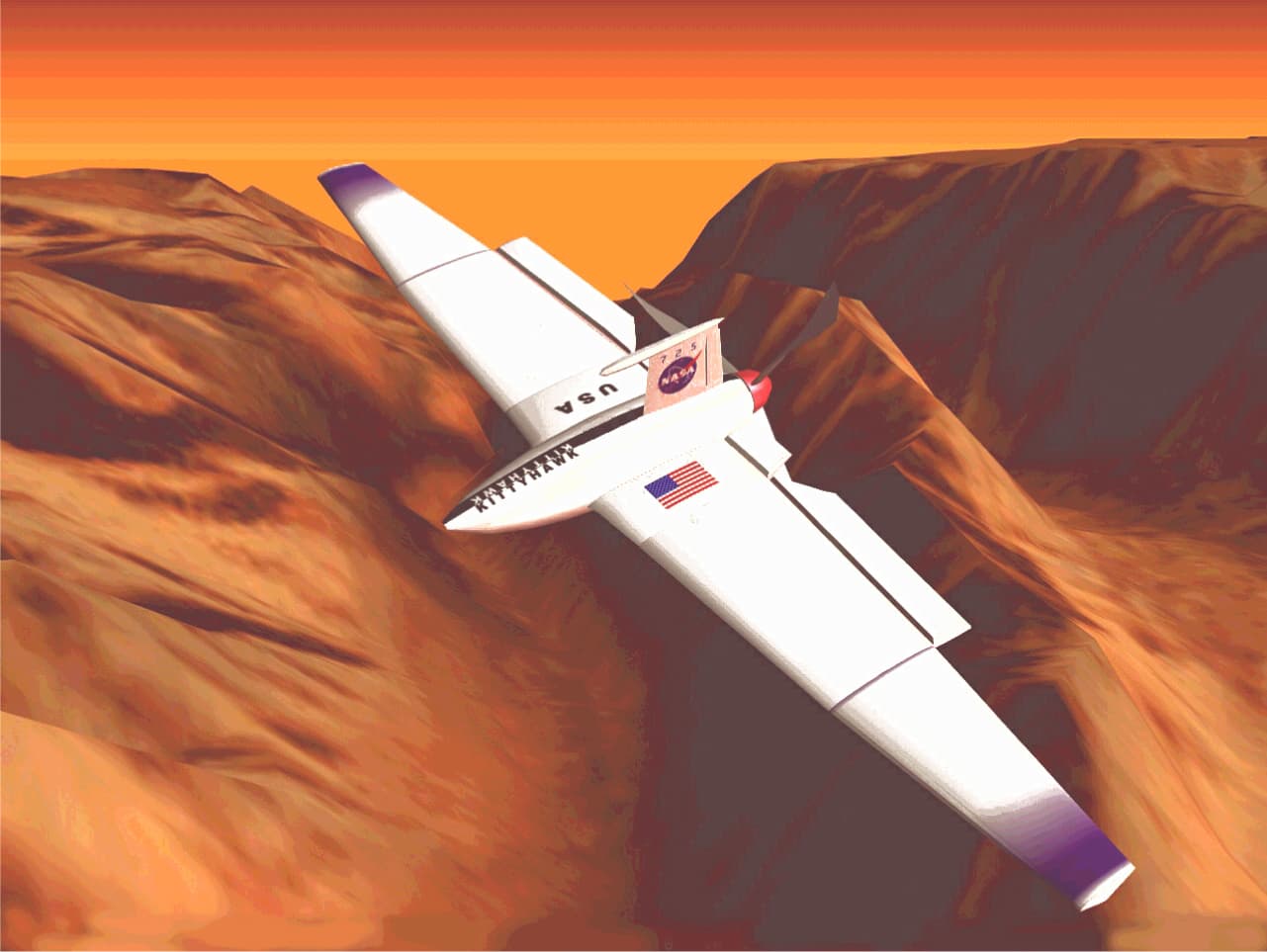
The airplane was the part the public heard about. It arrived twice. In July 1998 Malin Space Science Systems, NASA Ames, the Naval Research Laboratory and Orbital Sciences proposed the Mars Airborne Geophysical Explorer to the Discovery programme, with an aircraft named Kitty Hawk: 135 kg, a 9.75 m wingspan, and a three-hour, 1,800 km flight between 1,000 and 9,000 m above the ground carrying a gravity gradiometer, a magnetometer, an electric field experiment, a laser altimeter, an infrared imaging system and six cameras, launching in May 2003 and flying on 17 December 2003. Discovery did not select it. Then, in February 1999, Dan Goldin challenged NASA directly to fly an aircraft on Mars on the Wright centenary, and a stripped-down airplane appeared in the FY2000 budget as the first micromission. That aircraft, the Mars Airplane Package, was a different animal, because the Ariane 5 ring allowed an aeroshell only 0.8 m across. One NASA concept was a rocket-powered machine of 19 kg with a 2.6 kg payload, a 1.73 m span and 3.2 kg of fuel, cruising at Mach 0.65 in a flow so thin its wing Reynolds number was around 50,000, good for twenty minutes and 200 km. Ames, Dryden and Langley all worked on it; the Ames design was published as the Canyon Flyer.
It ended without ever becoming hardware. On 24 November 1999 JPL announced Ball Aerospace and Technologies of Boulder, Colorado had been selected for negotiation as spacecraft contractor, with two months of negotiation ahead and the award contingent on a NASA funding decision expected by February 2000, and the same release stated that the 2003 micromission would be the communications and navigation orbiter. The Langley engineers who had spent the year on the aircraft record the outcome in one line: the Mars airplane micromission project was cancelled in November 1999, with the announcement that the money had gone to the JPL communications satellite reported on 29 November. Then the orbiter went too. NASA lost Mars Climate Orbiter in September 1999 and Mars Polar Lander in December 1999, and the Mars programme that emerged from those failures had no room for a low-cost secondary-payload line. No micromission spacecraft was completed. The Mars Network was never built, and the relay service Mars actually has was assembled instead by bolting UHF radios onto large science orbiters, which is why every relay pass today depends on a spacecraft that was funded to do something else.
The aircraft had a longer afterlife than the constellation. The aerodynamic work done for the Mars Airplane Package fed directly into ARES, the Aerial Regional-scale Environmental Survey led by Joel Levine at NASA Langley, a much larger rocket-powered airplane folded into a 2.65 m Viking-derived aeroshell and designed to fly at least 500 km at one to two kilometres above the ground. ARES was one of four Mars Scout concepts picked from 25 proposals in December 2002 for further study, and in 2003 NASA chose Phoenix instead. ARES never flew. The centenary itself passed with nothing in the Martian sky; on 17 December 2003 the nearest thing to a Mars aircraft was Spirit, eighteen days from its parachute. Powered flight on Mars finally happened on 19 April 2021, when Ingenuity, a 1.8 kg technology demonstrator, made what NASA describes as the first powered, controlled flight on another planet. It flew 72 times before its last flight on 18 January 2024. Under its solar panel engineers had fixed a piece of cloth the size of a postage stamp, cut from the wing of the Wright Flyer that flew at Kitty Hawk on 17 December 1903. The anniversary was missed by seventeen years, and the fabric got there anyway. One thing is worth saying separately. The micromission architecture was not a proposal for a spacecraft but for infrastructure, funded the way infrastructure has to be, by buying the same cheap article repeatedly until a service exists. Nothing in it was found to be wrong. The launch slots were free, the trajectory was sound, the transceiver was in development and the contractor had been chosen. What did not survive was the funding line, and a constellation cannot be descoped to one and still mean anything.
Mission facts
What a micromission was
A common spacecraft of about 220 kg, developed by JPL for NASA, that in the words of the JPL test engineers "will be capable of carrying robot landers and rovers, cameras, probes, balloons, gliders or aircraft, and telecommunications equipment to Mars at much lower cost than recent NASA Mars missions." It was to fly as a twin auxiliary payload on Ariane 5 in a cooperative venture with CNES. The launch window for the first mission was 1 February to 1 May 2003, by then planned as the first communications and navigation orbiter.↗
The free ride
Launch as an Ariane 5 secondary alongside two geostationary communications satellites, using the Structure for Auxiliary Payloads (ASAP5), which allows single or dual slot launches of 100 to 200 kg. Planetary missions required the dual or twin configuration. Launch services were to come through a NASA partnership with CNES at no cost to NASA. The bus was three-axis stabilised and bi-propellant, its odd shape forced by having to fit one quarter of the ASAP5 ring, and the aim was a per-mission cost after the first of under 50 million dollars, protected by a rule that no mission could make major changes to the shared design.↗
Getting from GTO to Mars
After separation the spacecraft raised its orbit with a series of perigee burns, spent one to six months in the Earth-Moon system, used a lunar flyby to align the Earth escape direction, then made a powered Earth flyby into a trans-Mars trajectory. A six-month launch period required three to seven major burns depending on launch date. The technique was first proposed by Jacques Blamont in JPL Publication 96-26 and extended by Robert Gershman and Paul Penzo.↗
The delta-v bill
1,650 m/s total for the 2003 probe carrier and 2,700 m/s for the 2003 communications orbiter, of which about 750 m/s went simply to leaving geostationary transfer orbit and 500 m/s to trans-Mars injection. The orbiter figures rose to 3,000 m/s for the 2005 window. Roughly two thirds of the 220 kg launch mass was propellant.↗
What it could carry
42 kg to Mars approach in 2003 including entry, descent and landing hardware, or 6 kg into Mars orbit, rising to 45 to 50 kg and 10 to 15 kg by 2007. The probe bay could take one probe of about 80 cm diameter, two of about 65 cm, or three to four of about 40 cm. The same bus was assessed for Venus, Mercury, main-belt and near-Earth asteroids, the Moon and the Earth-Sun libration points.↗
The Mars Network
The relay constellation the micromissions were to build. A prototype MicroSat launched in the 2003 window into an 800 km near-equatorial orbit, then two more at each subsequent opportunity into equatorial and high-inclination orbits, reaching a nominal steady state of six. The paper is candid that more would be desirable, especially for real-time positioning, "but budget constraints will likely preclude this."↗
What the MicroSats would have done
Carried a 6 kg UHF transceiver payload operating on roughly 400 to 405 MHz receive and 435 to 442 MHz transmit, designed from the start for multiple simultaneous users under the CCSDS Proximity-1 protocol, integrating radiometric tracking with communications so the constellation could eventually provide GPS-like navigation at Mars. Minimum specified return to Earth was 200 Mbit per sol at maximum range. Required lifetime was three years from launch with a goal of five.↗
MARSats
The second half of the architecture, never studied in the same detail. Larger areostationary relay satellites were to be added when higher capacity was needed for robotic outposts and eventual human missions, with continuous high-rate contact from the surface, a high-power Ka-band Earth link and, in the furthest projection, an optical terminal. The MicroSat paper covers only the small satellites.↗
Kitty Hawk and MAGE
The airplane idea reached NASA first as a Discovery proposal. On 20 July 1998 Malin Space Science Systems, NASA Ames Research Center, the Naval Research Laboratory and Orbital Sciences Corporation proposed the Mars Airborne Geophysical Explorer, whose aircraft was named Kitty Hawk: 135 kg, 9.75 m wingspan, a three-hour flight of 1,800 km at 1,000 to 9,000 m above ground on 17 December 2003, carrying a gravity gradiometer, magnetometer, electric field experiment, laser altimeter, infrared imaging system and six cameras, launching in May 2003. NASA was expected to announce its next Discovery selections in early November 1998.↗
Goldin's challenge
A second, smaller airplane came out of NASA headquarters. The Langley account of the ARES project records that "a relatively short, but intense, Mars airplane concept development effort was initiated in February 1999 by Dan Goldin's (then NASA Administrator) challenge to fly an aircraft on Mars on the 100th anniversary of the Wright brothers historic flight at Kitty Hawk." Personnel across several NASA research centres were assigned to it under a mandate from the Administrator, and a great deal was done in a very short time.↗
The Mars Airplane Package
In micromission nomenclature the aircraft was MAP, and it was tiny because the Ariane 5 secondary ring limited the aeroshell to 0.8 m across. One of the NASA concepts was a rocket-powered airplane of 19 kg design mass with a 2.6 kg payload allowance, 0.67 square metre wing, 1.73 m span, cruising at Mach 0.65 at a wing Reynolds number around 50,000, with 3.2 kg of fuel giving 20 minutes of powered flight and a 200 km range. Concepts were explored at Ames, Dryden and Langley; the Ames design was published as the Canyon Flyer.↗
How the airplane would have been delivered
The micromission carrier would release the probe one to seven days before atmospheric entry, then immediately burn to retarget itself off an impact trajectory and onto a path from which it could hear the aircraft. The carrier would point at the centre of the airplane's flight error ellipse for the duration of the flight, record the data, and play it back to the Deep Space Network over several weeks. Three kilograms of the 42 kg approach payload allowance was reserved on the carrier for that relay.↗
How far it got
To a selected contractor and no further. On 24 November 1999 JPL announced it had selected Ball Aerospace and Technologies Corp. of Boulder, Colorado for negotiation as spacecraft contractor, with negotiations planned over two months and the award "contingent on funding approval by NASA for the Mars Micromission Project. This decision is expected by February 2000." The same release states that "the 2003 Mars Micromission would be a communication/navigation orbiter, the first of" the Mars Network constellation.↗
When the airplane was dropped
November 1999. The Langley ARES paper states flatly that "the Mars airplane Micromission project was cancelled in November 1999." An independent account dates NASA's announcement that the airplane had been dropped in favour of the JPL communications satellite to Monday 29 November 1999. JPL's own contractor release five days earlier already describes the 2003 mission as the communications and navigation orbiter, so the decision had effectively been taken by then.↗
What the airplane became
The analysis and testing done for MAP fed directly into ARES, the Aerial Regional-scale Environmental Survey led by Joel Levine at NASA Langley, a rocket-powered airplane in a 2.65 m Viking-derived aeroshell flying at least 500 km at 1 to 2 km above ground. ARES was one of four Mars Scout concepts selected in December 2002 for continued study, out of 25 proposals. NASA chose Phoenix instead. ARES was proposed again for later windows and never flew.↗
What actually flew
Nothing until 19 April 2021, when the 1.8 kg helicopter Ingenuity made what NASA calls "the first powered, controlled flight on another planet." It completed 72 flights before flying for the last time on 18 January 2024, and the mission ended on 25 January 2024. Engineers had attached to it a piece of cloth the size of a postage stamp cut from the wing of the Wright Flyer, which first flew at Kitty Hawk on 17 December 1903.↗
Mission timeline
- 20 Jul 1998Malin Space Science Systems, NASA Ames, the Naval Research Laboratory and Orbital Sciences propose the Mars Airborne Geophysical Explorer to NASA's Discovery programme, with an aircraft named Kitty Hawk that would fly 1,800 km on 17 December 2003. The proposal is not selected in the Discovery competition.
- 1 Feb 1999NASA's FY2000 budget proposal, unveiled at a press conference, includes a stripped-down Mars airplane as the first of a planned series of Mars micromissions.
- Feb 1999Administrator Dan Goldin challenges NASA to fly an aircraft on Mars on the hundredth anniversary of the Wright brothers' flight. Teams at Ames, Dryden and Langley start work on the Mars Airplane Package, constrained to an 0.8 m aeroshell by the Ariane 5 secondary payload ring.
- 23 to 26 Aug 1999JPL presents the whole architecture in two companion papers at the AIAA and Utah State small satellite conference: the micromission bus, and the comm/nav MicroSat network it would build. The first launch is described as possible as early as 1 November 2002, with the choice between airplane and orbiter still open.
- 1999The proposed communications and navigation satellite network is funded for a Phase A study, following a NASA Mars Exploration Program Architecture Definition Study begun in summer 1998 that recommended a low-cost relay network at Mars.
- 24 Nov 1999JPL selects Ball Aerospace and Technologies Corp. for negotiation as spacecraft contractor, contingent on NASA funding approval expected by February 2000, and states that the 2003 micromission will be a communication and navigation orbiter.
- Nov 1999The Mars airplane micromission is cancelled. NASA's decision to fly the JPL communications satellite instead is reported as announced on Monday 29 November 1999.
- Feb 2000The month by which NASA funding approval for the Ball Aerospace contract was expected. No micromission spacecraft was subsequently built, and none has launched.
- Dec 2002ARES, the airplane concept that grew out of the cancelled micromission work, is chosen as one of four Mars Scout finalists from 25 proposals, alongside Phoenix, MARVEL and SCIM.
- 2003NASA selects Phoenix as the first Mars Scout mission. ARES is not chosen, and no Mars aircraft is flown.
- 17 Dec 2003The centenary of the Wright brothers' first powered flight passes with nothing flying in the Martian atmosphere. Mars Exploration Rover Spirit is eighteen days from landing, on 4 January 2004.
- 19 Apr 2021Ingenuity makes the first powered, controlled flight on another planet, carrying a postage-stamp-sized piece of the Wright Flyer's wing fabric under its solar panel. It flies 72 times before ending on 25 January 2024.
A filled dot marks something that physically happened. A hollow one marks an announcement, a naming or a target.
In pictures
Tap a photo to enlarge.
Sources
- S. Matousek, K. Leschly, B. Gershman and J. Reimer, Mars Micromissions, paper SSC99-VII-6, 13th AIAA/USU Conference on Small Satellites, Logan, Utah, 23 to 26 August 1999
- R. C. Hastrup, R. J. Cesarone, J. M. Srinivasan and D. D. Morabito, Mars Comm/Nav MicroSat Network, paper SSC99-VII-5, 13th AIAA/USU Conference on Small Satellites, 1999
- NASA NTRS record 20210003330: J. Reimer, B. Gershman, K. Leschly and S. Matousek, Mars Micromissions (23 August 1999)
- D. L. Kern, C. P. Kuo and T. D. Scharton (JPL), Vibration and Acoustic Testing for Mars Micromission Spacecraft
- NASA JPL news release, 24 November 1999: JPL Mars Micromission Contractor Selected for Negotiation
- Malin Space Science Systems news release, 20 July 1998: Airplane Proposed For Mars Survey on Centennial of Wright Brothers' Flight
- M. D. Guynn, M. A. Croom, S. C. Smith, R. W. Parks and P. A. Gelhausen, Evolution of a Mars Airplane Concept for the ARES Mars Scout Mission, AIAA 2003-6578
- John F. McGowan, A Mars Airplane
- English Wikipedia: Mars Scout Program
- English Wikipedia: Aerial Regional-scale Environmental Survey
- NASA science mission page: Ingenuity Mars Helicopter
- NASA history: 120 Years Ago, The First Powered Flight at Kitty Hawk
Facts on this page were verified on 24 August 2026. Where sources disagree, the disagreement is stated rather than resolved silently.