The Phobos and Deimos missions that were never flown
NASA, ESA and national teams · Multinational · Program · 1997 · The long occupationCancelled
Between 1997 and 2018 at least ten serious proposals to visit Phobos or Deimos were made, and none was selected for flight. Aladdin came closest, twice a Discovery finalist; Japan's MMX, chosen outside that process, is scheduled to launch 20 October 2026.
TL;DR· 15 min read
For twenty years teams proposed ways to reach Phobos and Deimos, and every proposal lost. Aladdin, which would have fired impactors at both moons and flown through the plumes to catch the debris, reached the final round of the Discovery competition in 1997 and again in 1999. Three more Martian-moon missions, PADME, PANDORA and MERLIN, went into the 2015 Discovery round and none reached the five finalists. The run was broken from outside that competition by Japan's MMX, which is scheduled to launch on 20 October 2026.
Phobos and Deimos are the easiest interesting destinations in the Solar System that nobody has ever landed on and come back from. They are close, they are small enough that departing costs almost nothing, and their origin is a genuine open question with two incompatible answers. For nearly twenty years teams kept proposing ways to settle it, with harpoons, with hopping robots, with projectiles fired into the surface and a flying carpet to catch the debris. Every one of them lost.
- 2Discovery competitions in which Aladdin reached the final round, 1997 and 1999, without being selected
- 3separate Phobos and Deimos proposals in the 2015 Discovery round, none of which reached the five finalists
- 20 Oct 2026scheduled launch of MMX, the first Martian-moon sample return since Fobos-Grunt in 2011 to reach a launch date
The case for going to Phobos and Deimos has been the same for thirty years, and it is a good one. Two dark little bodies, both about 6 or 7 per cent reflective, with densities somewhere between 1.4 and 2.2 grams per cubic centimetre, far too low for anything like rock all the way through, orbiting the one planet everyone is already going to. Either they formed around Mars, or as fragments of something that did, or they are captured objects from further out, primitive material of a kind poorly represented in meteorite collections, delivered conveniently into Mars orbit. Those two answers imply completely different histories for the inner Solar System, and remote sensing has never been able to choose between them, because their spectra resemble primitive asteroids and also, awkwardly, resemble space-weathered silicates like the Moon's. Settling it requires laboratory isotopic analysis of representative material, which means bringing some home. And bringing some home from Phobos is far cheaper than from Mars itself, because the escape velocity is about eleven metres per second at Phobos and under six at Deimos. The First International Conference on the Exploration of Phobos and Deimos, held at NASA Ames in November 2007, made this the community's formal position: determining the origin of the two moons is the single most important scientific objective there. Proposal after proposal opened by quoting it. What follows is a record of everyone who tried to act on that argument and did not get to fly.
Aladdin got closest, twice, and was the most inventive. Carle Pieters of Brown University led a team with the Johns Hopkins Applied Physics Laboratory, Lockheed Martin, JPL and Johnson Space Center, and their answer to the problem of collecting samples without landing on or anchoring to a body with almost no gravity was to shoot at it. Five small impactors, two aimed at chosen geological units on Phobos, two at Deimos and one spare, would raise plumes of regolith, and the spacecraft would fly through each plume with a flexible fibre maze trap spread open. Because both the impact and the capture happened at around a kilometre per second, the grains would survive. After each launch-and-catch event the exposed segment of the collector would be reeled into the return capsule so that samples from different sites stayed separate, with onboard particle detectors confirming each catch. The team pointed out that three micrograms would be enough for the science and that Aladdin would return orders of magnitude more than the entire catalogue of interplanetary dust particles analysed to that date. The published schedules differ between rounds: the 1997 abstract has launch in January 2001 and samples back in November 2003, the 1999 abstract has launch in May 2003 and return within three years. Aladdin was a finalist in October 1997, when NASA chose Genesis and CONTOUR, and a finalist again in the round that ended in July 1999, when NASA chose MESSENGER and Deep Impact.
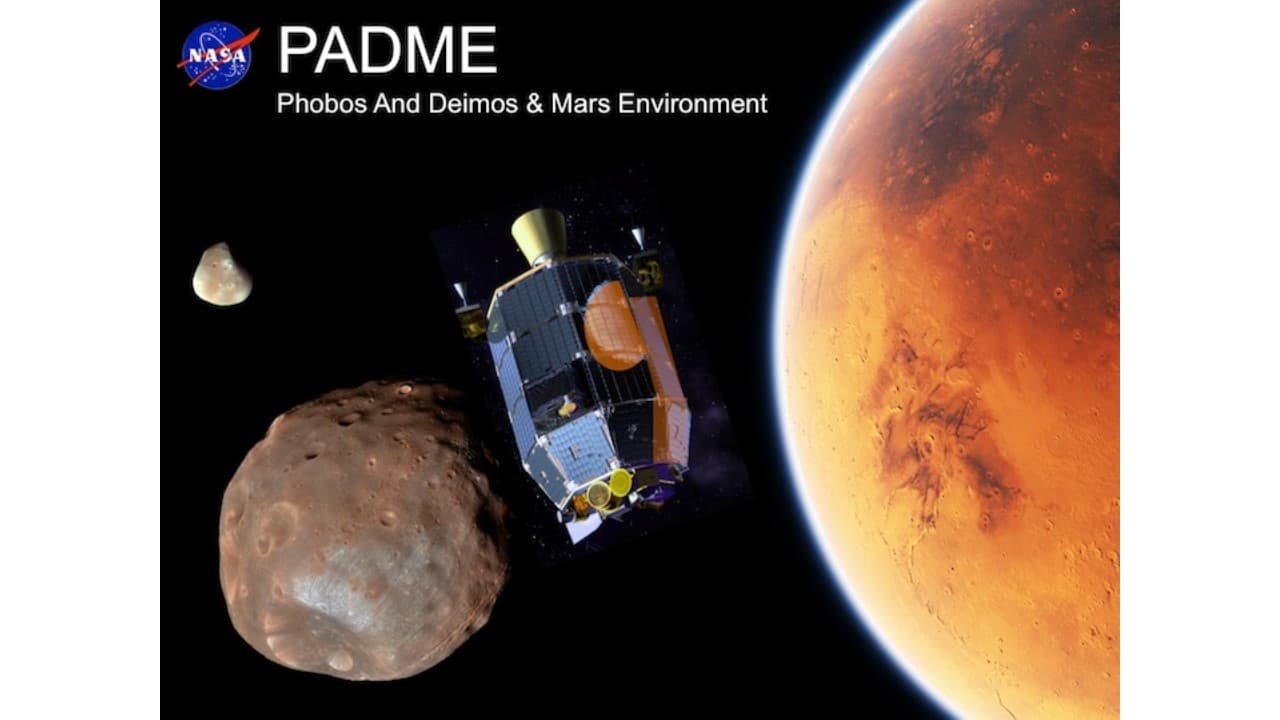
The second wave came after the 2007 Ames conference and ran through to 2015. Pascal Lee proposed Hall, a New Frontiers-class lander and sample return using solar electric propulsion, named for Asaph Hall who found the moons in 1877; its insight was that the large blocks lying on both surfaces are material excavated from the interiors by impacts and are therefore the only reliable route to bulk composition. Daniel Britt proposed Gulliver for Deimos alone. Lee also proposed M4, multiple landings on both moons. Anthony Colaprete's team proposed PCROSS, an LCROSS-style impact-and-observe mission at Phobos. Marco Pavone's group at Stanford, with JPL and MIT, took NASA advanced-concepts money to build spiked hopping robots about 60 cm across, nicknamed hedgehogs, which move by spinning three internal discs and cannot get a wheel stuck, and designed a Phobos Surveyor orbiter to deliver them into Stickney crater. Then in February 2015 three Martian-moon missions went into the same Discovery competition at once. PADME would orbit Mars and make sixteen close passes at Phobos and nine at Deimos on a bus copied from the lunar mission LADEE. PANDORA would orbit each moon in turn with a fuller instrument suite. MERLIN, led by Scott Murchie at APL, would carry almost no remote sensing at all and instead land on Phobos twice.
The disagreement between those three is the most interesting thing in the whole record, because it was an argument about what can be known from a distance. PADME's and PANDORA's teams held that a good enough spectrometer, close enough, could tie the surface to a specific class of meteorite and so settle the origin question. MERLIN's team argued that this fails on the mixed-pixel problem: at any resolution a flyby or orbiter can achieve, each pixel averages together grains of several different compositions, and the history is written in the individual grains. Their answer was a microscopic imaging spectrometer held just above the soil, taking a full spectrum for every pixel of a grain-scale image, which requires being on the ground. NASA did not adjudicate. In September 2015 it named five Discovery finalists and none of the three was among them. Since then a German-led concept, DePhine, has been published, and ESA has twice studied Phobos sample return, as MMSR in 2011 and Phootprint in 2014, without either becoming a mission. One qualification is worth making about the whole list. It is tempting to read ten unflown Phobos proposals as evidence that NASA was blind to the moons, and that is not fair. Discovery is a competition with a hard cost cap and typically 25 to 30 entries per round for one or two slots, so losing is the normal outcome for a good proposal, and Aladdin reaching the last round twice is a strong result rather than a snub. What the record shows is narrower: for two decades the Martian moons were judged compelling enough to propose and never quite compelling enough to beat Mercury, comets, asteroids and Venus.
What finally broke the pattern came from a different direction entirely. JAXA's July 2015 report to the Japanese science ministry records that when it asked each research field for its priorities, the planetary science community named sample return from a Martian moon its most important mission, ISAS judged that assessment sound, and a dedicated study team concluded the job was achievable within existing Japanese capability plus the precision-landing technology SLIM would demonstrate. MMX was announced on 9 June 2015, four months after the Discovery deadline that killed PADME, PANDORA and MERLIN, and it was never a competition entry at all. It carries a NASA gamma-ray and neutron spectrometer, MEGANE, and a French-German rover, IDEFIX, so several of the people and instruments from the losing proposals are aboard it. On 20 August 2026 JAXA announced its launch for 20 October 2026 at 04:41:03 Japan Standard Time, on H3 flight 10 from Tanegashima, with a reserved period to 7 November. If it works, the question the 2007 Ames conference declared most important will finally be answerable in a laboratory, twenty-nine years after Aladdin first proposed to answer it with a carpet and five small cannons. It is worth noting how it got there: not by beating other proposals in a competition, but because a national community was asked to rank its priorities and put the Martian moons first.
Mission facts
Why the moons matter
Their origin is unresolved between two hypotheses, as the Hall proposal stated it: they formed around Mars, or are the collisional remnants of one or two once-larger bodies formed there; or they are captured small bodies, asteroids or comets, or the remnants of larger captured objects. Both moons are dark: the 1997 Aladdin abstract gives 6 to 7 per cent albedo and reported masses implying densities in the range 1.4 to 2.2 g/cm3, far below the terrestrial planets. Only isotopic analysis of representative material settles the question.↗
Aladdin
A Discovery-class sample return to both moons, principal investigator Carle Pieters of Brown University, with the Johns Hopkins Applied Physics Laboratory, Lockheed Martin Astronautics, JPL and Johnson Space Center. Its 1997 abstract has it launching in January 2001 and returning samples in November 2003; the 1999 abstract has launch in May 2003 with samples back within three years, after a thirteen-month phasing orbit at Mars and a five-month prime mission.↗
The flying carpet
Aladdin was named for its sample collector. Rather than land or anchor, it would fire five small impactors at chosen geological units, two on Phobos, two on Deimos and one spare, and fly through the resulting plume with an exposed flexible fibre maze trap. Impact and capture speeds would both have been around 1 km/s, low enough to preserve the grains. Segments of the carpet were to be reeled into a return capsule after each launch-and-catch event so the samples stayed separate.↗
How far Aladdin got
Twice to the last round and no further. In October 1997 NASA picked Genesis and CONTOUR from 34 proposals; Aladdin was one of five finalists, alongside MESSENGER and VESAT. In 1998 five proposals, again including Aladdin and MESSENGER, received 375,000 dollars each for feasibility studies, and in July 1999 NASA chose MESSENGER and Deep Impact.↗
The community moment
The First International Conference on the Exploration of Phobos and Deimos was held at NASA Ames Research Center on 5 to 7 November 2007. Its consensus, quoted afterwards in proposal after proposal, was that the single most important scientific objective at the two moons is determining their origin.↗
Hall
A New Frontiers-class lander and sample return to both moons using solar electric propulsion, principal investigator Pascal Lee of the Mars Institute, SETI Institute and NASA Ames, presented at LPSC in 2010 with an international team spanning Cornell, Guelph, Calgary, Glenn Research Center, Optech and the Australian National University. Named for Asaph Hall, who discovered the moons in 1877. Its sampling targets were the large blocks on the surface, argued to be material excavated from the interiors by impacts.↗
The rest of the field
Gulliver, a Deimos sample return presented at the European Planetary Science Congress in 2010 by Daniel Britt. M4, the Mars Moons Multiple Landings Mission, proposed by Pascal Lee and colleagues at a 2012 Mars concepts workshop. PCROSS, an LCROSS-style impactor and observing satellite for Phobos, presented by Anthony Colaprete and colleagues in 2012. DePhine, the Deimos and Phobos Interior Explorer, a German-led concept led by Jurgen Oberst and published in 2018.↗
Phobos Surveyor
A NASA Innovative Advanced Concepts study by Marco Pavone of Stanford with JPL and MIT, consisting of an orbiter hovering above Phobos that would release small spiked rovers nicknamed hedgehogs, about 60 cm across, which move by hopping using three orthogonal spinning discs rather than wheels. Stickney crater was the preferred target. Two generations of rovers were built and tested on Earth. It never became a proposed mission.↗
The 2015 Discovery round
NASA's Discovery 13 and 14 call drew 28 proposals, 16 of them aimed at small bodies. English Wikipedia gives the deadline as both 16 February 2015 and 26 February 2015 in different sections; 16 February is the better supported, because the SpaceNews report Wikipedia itself cites, dated 23 February 2015, already describes NASA sorting through the proposals it had received. Three were Martian-moon missions: MERLIN, PANDORA and PADME. In September 2015 NASA named five finalists, Psyche, Lucy, NEOCam, DAVINCI and VERITAS. None of the three was among them. Lucy and Psyche were selected for flight in January 2017.↗
PADME
Phobos And Deimos and Mars Environment, principal investigator Pascal Lee at NASA Ames with the Mars Institute, SETI Institute and the University of Colorado. A low-cost orbiter derived directly from the lunar mission LADEE, which would have reached Mars in 2018 and made, per The Planetary Society's account of the Discovery-round version, sixteen close flybys of Phobos and nine of Deimos, imaging at resolutions as fine as 2.8 cm, with a neutron spectrometer for surface composition and a mass spectrometer to sample the dust directly. It also targeted the predicted gossamer dust ring and torus shed by the two moons. The earlier 2014 LPSC abstract describes a smaller version: eleven Phobos flybys, about five at Deimos, imaging below 0.5 m per pixel, and an impact-ionisation dust detector rather than a mass spectrometer.↗
PANDORA
Phobos And Deimos Origin Assessment. Rather than fly past, it would orbit each moon in turn for extended study, carrying cameras, an infrared spectrometer, gamma-ray and neutron spectrometers, and using radio tracking to map the gravity fields and infer the interiors. We were not able to confirm its principal investigator from a source we could open, and do not name one here.↗
MERLIN
Mars-moons Exploration, Reconnaissance and Landed Investigation, principal investigator Scott Murchie of the Johns Hopkins Applied Physics Laboratory. It would have carried the least orbital remote sensing of the three, a camera, a simple dust counter and radio tracking, alongside contact instruments for use on the surface (a microscopic imaging spectrometer, an alpha particle X-ray spectrometer and a gamma-ray spectrometer), in exchange for the one thing the others could not do: landing on Phobos twice, in the areas of differing composition known as the blue and red units.↗
The argument between them
The teams disagreed publicly about whether remote sensing could settle the origin question. PADME and PANDORA argued that flyby or orbital measurements would be sensitive enough to tie the moons to a specific meteorite analogue. MERLIN's team argued the mixed-pixel problem defeats that: every pixel averages many grains of different composition, and the story is in the individual grains, which only a lander with a microscopic imaging spectrometer held just above the soil can resolve.↗
Europe's attempts
ESA studied a Phobos sample return under the name Phootprint, presented by an Airbus Defence and Space team at the 11th International Planetary Probe Workshop on 16 June 2014 and by ESA staff at COSPAR the same year, and earlier a Martian Moon Sample Return study, MMSR, presented at EPSC in 2011 by a team including Patrick Michel and Russian and German co-authors. Neither became a mission.↗
What did get flown at the moons
Not nothing, but nothing that succeeded at the moons themselves. The Soviet Phobos 1 and Phobos 2 launched in 1988 and both were lost, Phobos 2 days before its Phobos encounter. Russia's Fobos-Grunt sample return launched on 8 November 2011 and never left Earth orbit. All three have their own entries in this catalogue.↗
What broke the run
Not an American mission. JAXA's report to the Japanese science ministry in July 2015 records that the Japanese planetary science community identified sample return from a Martian moon as its most important mission, that ISAS agreed and formed a study team, and that the team judged it achievable with existing Japanese technology plus what SLIM would prove. MMX was announced on 9 June 2015 (a date the 2026 JAXA launch release does not itself carry). JAXA announced on 20 August 2026 that it would launch on 20 October 2026 at 04:41:03 Japan Standard Time on H3 flight 10 from Tanegashima, with a reserved window running to 7 November.↗
Mission timeline
- Mar 1997Carle Pieters and colleagues present Aladdin at the 28th Lunar and Planetary Science Conference: a Discovery-class sample return from both moons, to launch in January 2001 and deliver samples to Earth in November 2003.
- Oct 1997NASA selects Genesis and CONTOUR as Discovery 5 and 6 from 34 proposals submitted the previous December. Aladdin is one of the five finalists that lose, along with MESSENGER and VESAT.
- 1998Five proposals out of about 30 are given 375,000 dollars each for feasibility studies. Aladdin is one; so are MESSENGER, Deep Impact, INSIDE Jupiter and Vesper. Aladdin and MESSENGER are the two that had already been finalists in 1997.
- Mar 1999Pieters and colleagues publish the mature Aladdin design at LPSC: launch May 2003, thirteen-month phasing orbit, five sampling sequences using impactors and a reeled fibre-maze collector, samples home within three years.
- Jul 1999NASA selects MESSENGER and Deep Impact as Discovery 7 and 8. Aladdin loses for the second time, and the first serious attempt to bring Phobos and Deimos material to Earth ends.
- 5 to 7 Nov 2007The First International Conference on the Exploration of Phobos and Deimos meets at NASA Ames. Its consensus, that determining the moons' origin is the single most important objective there, becomes the opening paragraph of every proposal that follows.
- Mar 2010Pascal Lee and an international team present Hall at LPSC, a New Frontiers-class lander and sample return using solar electric propulsion, targeting the large surface blocks as interior material. Gulliver, a Deimos sample return, is presented at EPSC the same year.
- Dec 2012Stanford, JPL and MIT publicise the Phobos Surveyor concept under NASA's Innovative Advanced Concepts programme: a hovering orbiter releasing spiked hopping rovers into Stickney crater. Two generations of the rovers have already been built and tested on Earth.
- 17 to 21 Mar 2014Pascal Lee and colleagues present PADME at LPSC, a LADEE-derived orbiter that would reach Mars in 2018 and study both moons and the dust ring and torus they are predicted to shed.
- 16 Feb 2015Proposals close for NASA's Discovery 13 and 14. Of the 28 received, three are Martian-moon missions: MERLIN, PANDORA and PADME. They compete against each other and against 25 others.
- Sep 2015NASA names five Discovery finalists: Psyche, Lucy, NEOCam, DAVINCI and VERITAS. All three Martian-moon proposals are out. Lucy and Psyche are chosen for flight in January 2017.
- 20 Aug 2026JAXA announces that MMX will launch on 20 October 2026 at 04:41:03 Japan Standard Time on H3 flight 10 from the Yoshinobu complex at Tanegashima, with a reserved period to 7 November. Nearly thirty years after Aladdin, a Martian-moon sample return finally has a date.
A filled dot marks something that physically happened. A hollow one marks an announcement, a naming or a target.
In pictures
Tap a photo to enlarge.
Sources
- C. Pieters et al., Aladdin: Phobos-Deimos Sample Return, Lunar and Planetary Science XXVIII (1997), abstract 1113
- C. Pieters et al., Aladdin: Exploration and Sample Return of Phobos and Deimos, Lunar and Planetary Science XXX (1999), abstract 1155
- Pascal Lee et al., Hall: A Phobos and Deimos Sample Return Mission, 41st Lunar and Planetary Science Conference (2010), abstract 1633
- Pascal Lee et al., Phobos And Deimos & Mars Environment (PADME): A LADEE-Derived Mission, 45th Lunar and Planetary Science Conference (2014), abstract 2288
- Van Kane, The Planetary Society (10 August 2015): MERLIN, the creative choices behind a proposal to explore the Martian moons
- English Wikipedia: Discovery Program
- English Wikipedia: Selection of Discovery Mission 13 and 14
- English Wikipedia: Phobos Surveyor
- English Wikipedia: List of missions to Mars
- JAXA/ISAS: Why explore the moons of Mars? (28 April 2021)
- JAXA/ISAS report to MEXT, 2 July 2015
- JAXA press release (20 August 2026): Launch schedule of the MMX spacecraft aboard H3 flight No. 10
Facts on this page were verified on 24 August 2026. Where sources disagree, the disagreement is stated rather than resolved silently.