Mars Pathfinder and Sojourner
NASA · United States · Rover · 1997 · The losing decadeSuccess
Success: bounced into Ares Vallis on airbags on 4 July 1997 and put the first wheels on Mars two days later. Last data came 27 September 1997; NASA stopped calling on 10 March 1998, and HiRISE found the lander in 2006.
TL;DR· 20 min read
Mars Pathfinder bounced into Ares Vallis on airbags on 4 July 1997 and proved that a spacecraft could fly straight into the Martian atmosphere and still work. Its 10.5 kg rover, Sojourner, put the first wheels on Mars two days later, drove about 100 metres in 83 sols and never got more than about 12 metres from the lander. The lander was renamed the Carl Sagan Memorial Station the day after touchdown, and NASA's mirror sites logged 47 million hits on 8 July alone. The last data came on 27 September 1997.
Mars Pathfinder was sold as a technology demonstration: a cheap way to prove that a spacecraft could fly straight into the Martian atmosphere, hit the ground inside a cocoon of airbags, bounce, and still work. It did all of that on 4 July 1997, and then it did something nobody had budgeted for. Its 10.5 kg rover, Sojourner, drove about 100 metres in 83 sols and never got more than about 12 metres from the lander, and the pictures it sent back drew the heaviest single-day traffic the young World Wide Web had recorded to that point. On 8 July 1997 alone, NASA's mirror sites logged 47 million hits. The lander was renamed the Carl Sagan Memorial Station the day after it touched down.
- 1stwheels to drive on Mars, 6 July 1997, after two Soviet PrOP-M walking probes rode down in 1971 and were never deployed
- 100 mroughly the total distance Sojourner covered in 83 sols, never more than about 12 m from the lander
- 47 millionweb hits logged across NASA's Pathfinder mirror sites on 8 July 1997, then a record for any online event
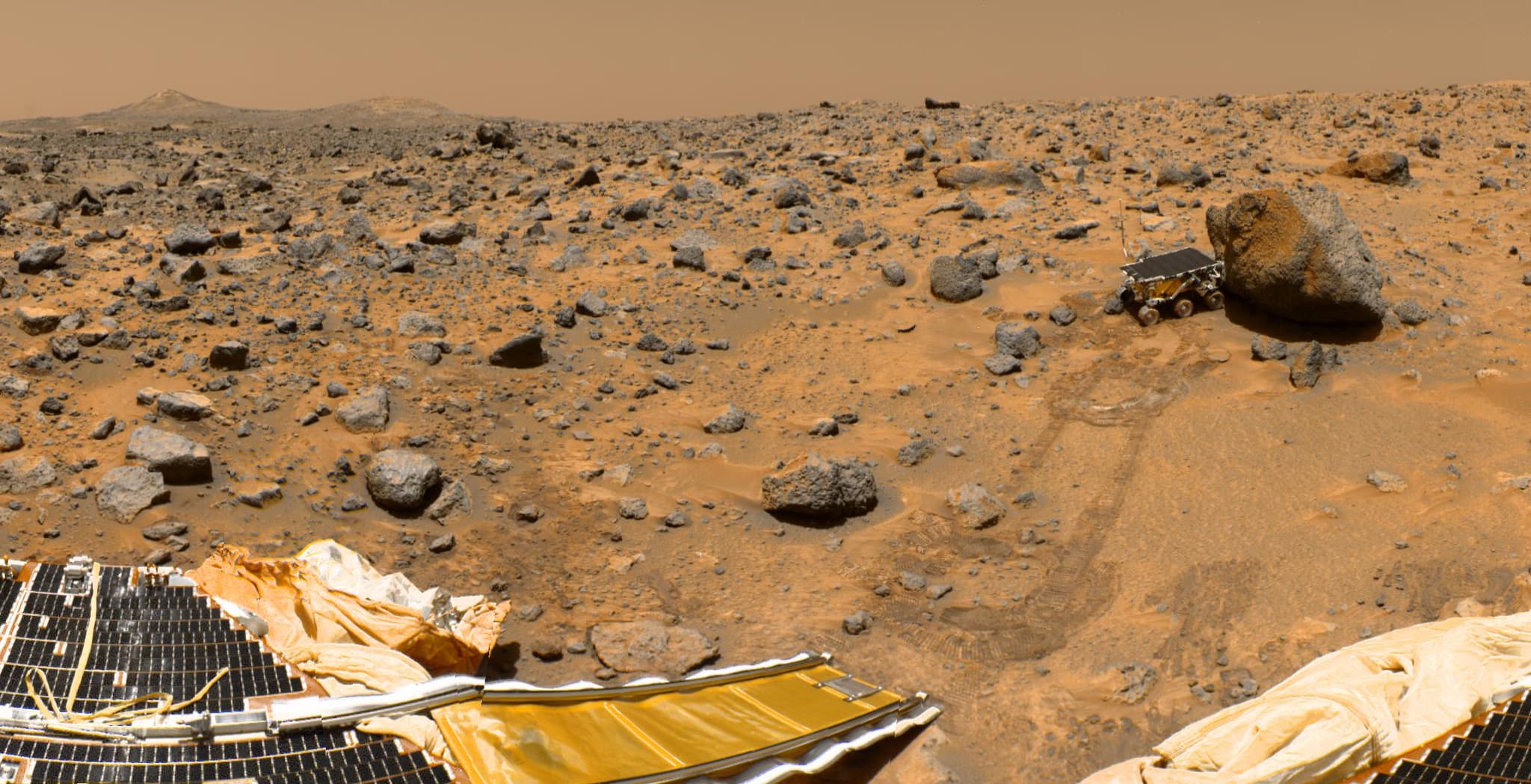
Pathfinder existed because NASA had run out of money and patience for another Viking. Mars Observer had gone silent three days before orbit insertion in August 1993, taking $813 million with it, and no American hardware had touched the Martian surface since 1976. The answer was the Discovery programme: small, cost-capped, fast. Pathfinder was built in about three years for a total of roughly $265 million including launch and operations, which was less than a tenth of what Viking had cost in comparable terms. Its formal objective was almost aggressively unambitious. It was there to demonstrate that a low-cost lander and a free-ranging rover could be delivered to Mars at all. Science was explicitly secondary. It flew a trajectory that took it straight into the atmosphere instead of stopping in orbit first, which saved the mass of a big propulsion system and made the whole thing possible, and which no NASA spacecraft had done at Mars before. The Soviet Mars 2, 3 and 6 descent modules had entered directly from approach in the early 1970s, so this was a first for NASA rather than a first for anybody. Under the faster, better, cheaper banner the mission carried an unspoken second job: if it worked, the programme lived. If it made a crater, the argument that cheap planetary missions were false economy would have won for a decade.
The landing on 4 July 1997 remains the most-copied five minutes in Mars exploration. The cruise stage went about half an hour before entry. The spacecraft hit the top of the atmosphere at roughly 7,300 metres per second, and the heat shield took it down to 400 m/s in about 160 seconds. A parachute deployed, the heat shield dropped away, and the lander winched itself down a 20-metre Kevlar bridle to hang below the backshell. At about 1.6 kilometres the radar found the ground. Four airbags inflated around the lander in about three tenths of a second, three solid rockets in the backshell fired at 98 metres, and the bridle was cut at roughly 21.5 metres with under four seconds left. What hit Ares Vallis was a beach ball travelling about 18 metres per second, with about 12.5 metres per second of sideways skid on top. It bounced as high as 15 metres, bounced roughly fifteen more times, rolled, and came to rest two and a half minutes later about a kilometre from where it first touched, upright on its base petal and tilted 2.5 degrees. It was still dark: local time at the site was about three in the morning. The petals opened 87 minutes after impact and the lander sat waiting for sunrise.
Sojourner was the size of a microwave oven and weighed about 10.5 kilograms, and it drove at one centimetre per second. That is a walking pace of roughly 36 metres an hour if it never stopped, and it stopped constantly. Over 83 sols it covered about 100 metres in total and never got much more than 12 metres from the lander, because every byte it produced had to go through the lander's UHF modem to reach Earth. It was not driven live. The one-way light time ran between about 10.5 and 15 minutes, a round trip of 21 to 30 minutes, so a human at JPL put on stereo goggles, studied the lander's pictures, chose a target, and sent a sequence that the rover then executed for itself using two front cameras and a laser stripe to spot hazards. On sol 3 it drove 36 centimetres to a rock named Barnacle Bill and pressed its spectrometer against it overnight. The result, announced on 8 July, was the first chemical analysis ever made in place on a Martian rock, and it was a surprise: unusually silicon-rich, an andesite, which meant the interior had melted and remelted in a way the Martian meteorites in Earth's collections had not prepared anyone for. Then came Yogi, a metre-scale two-toned boulder that read as more basaltic; Scooby Doo, a white patch that the rover scraped with a wheel; and the Rock Garden, with Shark, Half Dome and Moe stacked and tilted the way a flood leaves stones.
The other thing Pathfinder did was invent the internet space event. In July 1997 the web was about three years old as a mass medium, most people reached it over a modem, and NASA had no idea what it was about to be hit by. JPL's web engineers built twenty mirror sites so the traffic would not simply kill the servers, and fresh pictures went straight onto the web with little delay, instead of reaching the public days later as press-conference prints and wire scans. Between 1 July and 4 August the mirrors logged 565,902,373 hits, and on 8 July alone they logged 47 million, more than twice the busiest day of the 1996 Atlanta Olympics. Those are hits, and a hit was never a person: in 1997 it meant one file served, so a single page with a dozen thumbnails counted a dozen times, and the honest translation is a very large audience rather than 47 million individuals. The number still mattered, because it was the first hard evidence that a robot on another planet could hold a general audience in real time without a television network in the middle. That was also the week the mission acquired its name: on 5 July, at the Planetary Society's Planetfest in Pasadena, Daniel Goldin announced that the lander would be the Carl Sagan Memorial Station. Sagan had died on 20 December 1996, sixteen days after Pathfinder left Earth, and had spent thirty years arguing for exactly this: send the machines, then show everyone what they see.
The end was quiet. The last full data pass finished at 10:23 UTC on 27 September 1997, sol 83, just after Sojourner had finished measuring a rock called Chimp. A carrier signal with nothing in it arrived on 7 October and then nothing at all. The rechargeable battery had been rated for a month and had been cycled for three, and once it failed there was nothing to keep the electronics above the Martian night, which is the ordinary way a solar-powered lander at these latitudes dies. Engineers kept transmitting into the silence until 10 March 1998, when four hours of calling from Goldstone ended at 1:21 p.m. PST with nothing, and the project stopped. Nobody knows what Sojourner did afterwards; JPL's own assumption is that, hearing nothing from the lander, it would have gone into a contingency behaviour within a few days and either circled the Sagan Memorial Station repeatedly or simply stopped and waited for instructions that were never coming. It is presumably still there, a few metres from the lander, under nearly thirty years of dust. In December 2006 HiRISE photographed the site from orbit and found all of it: the lander with its ramps and deck, the backshell and parachute lying to the south where nobody on the ground had ever been able to see them, and bright fragments that are probably the heat shield. Every wheeled thing NASA has landed on Mars since traces its suspension and much of its landing philosophy to this 10.5 kilogram machine and its hundred metres.
Mission facts
Launch
4 December 1996 at 06:58 UTC (1:58 a.m. EST) on a Delta II 7925 from Launch Complex 17B, Cape Canaveral Air Station, Florida. NSSDCA records the time as 06:58:00 UTC; launch-log compilations give 06:58:07 UTC. The 7925 configuration is a Delta II with nine strap-on solid boosters and a Star 48 (PAM-D) third stage.↗
Masses
894 kg at launch including 94 kg of propellant; 584 kg entry vehicle; 370 kg lander once it was on the ground and the airbags were deflated. NSSDCA's summary box lists a single figure of 463 kg without saying what it covers, which is why published masses for this mission vary.↗
Cruise
212 days from Earth to Mars, with four trajectory correction manoeuvres. Pathfinder launched a month after Mars Global Surveyor and arrived more than two months earlier, because it flew a faster trajectory straight at the planet instead of braking into orbit.↗
Entry, descent and landing
Cruise stage released about 30 minutes before entry (34 minutes before touchdown, per the JPL fact sheet). Entry directly from the approach hyperbola at roughly 7,300 m/s, the first time a NASA spacecraft went straight into the Martian atmosphere without first entering orbit. NSSDCA's pre-landing entry-strategy page makes the contrast explicitly: 'unlike Viking, which went into orbit about Mars before deploying the Landers, Mars Pathfinder is on a direct path into the atmosphere'. Viking 1 and 2 were the only earlier NASA craft to enter at Mars, and both did so from orbit at about 4.5 km/s. Heat shield down to 400 m/s in about 160 s, then the parachute, then heat-shield release, then the lander lowered on a 20 m braided Kevlar bridle. Radar lock at about 1.6 km, airbags inflated in about 0.3 s, three solid retro-rockets in the backshell fired at 98 m altitude, and the bridle was cut at about 21.5 m with just under four seconds to go.↗
Where the numbers disagree
NASA's own descriptions of the hardware do not match. NSSDCA gives a 12.5 m parachute and a 5.2 m airbag ball; the JPL NASA Facts sheet gives 11 m and 5.8 m. NSSDCA says the first bounce reached about 12 m, while the JPL fact sheet and JPL's own day-seven reconstruction both say about 15 m. Entry velocity is given as about 7,300 m/s by NSSDCA and 7.6 km/s by the PDS mission description. Rover images are 550 on the JPL fact sheet and NASA's history page, over 600 in the PDS description. Rover height is 280 mm on NSSDCA and 30 cm on the JPL fact sheet, which is the same vehicle rounded differently. The web-traffic peak is reported two ways as well: JPL's 8 August 1997 tally puts the busiest day at 47 million hits on 8 July, while NASA's 2017 twentieth-anniversary retrospective gives 80 million hits on 7 July. We follow the JPL reconstruction where NSSDCA and JPL conflict on the landing dynamics, because it was published from the actual flight data on 11 July 1997.↗
Touchdown
4 July 1997 at 16:56:55 UTC spacecraft event time. The PDS mission description gives that same instant as 9:56:55 a.m. PDT, a straight timezone conversion, which is what shows that the JPL fact sheet's 10:07 a.m. PDT is Earth-received time: NSSDCA's entry-strategy page puts the one-way light time at landing at 10 minutes 35 seconds, and 16:56:55 UTC plus 10m35s is 17:07:30 UTC, or 10:07 a.m. PDT. The PDS puts the Earth-Mars range at arrival at 191 million km, which gives the same light time. It was about 02:58 local true solar time at the site (PDS), before Martian sunrise. Per JPL's 11 July 1997 EDL reconstruction the airbag ball hit at about 18 m/s resultant, with roughly 14 m/s vertical and a 12.5 m/s horizontal skid (NSSDCA rounds the horizontal component to 12 m/s), bounced about 15 times, rolled, and stopped about 2.5 minutes later some 1 km from first impact, upright on its base petal at a tilt of about 2.5 degrees.↗
Landing site
Ares Vallis, a giant outflow channel draining into Chryse Planitia, chosen from Viking orbiter imagery as a rocky flood plain that would deliver a grab bag of rocks washed down from the highlands. JPL published the landing point as 19.13 N, 33.22 W. The often-quoted contradiction over landing accuracy comes down to one preliminary figure. JPL's first-day status report on 4 July 1997 put the lander about 12 miles (19 km) southwest of its target. On 11 July, the day after the landing coordinates were determined, the navigation team presented what JPL's status report called a preliminary landing profile, and Sam Thurman of the entry, descent and landing team said Pathfinder was 'right on the money', within a kilometre of the target landing site. JPL's 8 August release went back to 20 km, saying Pathfinder 'landed right on the money, within 20 kilometers of the targeted landing site'. The 1999 NASA Facts sheet repeats about 20 km southwest and the PDS mission description says about 19 km, so the settled figure is 19 to 20 km and the 1 km is a superseded preliminary estimate. The landing ellipse was roughly 100 by 200 km, so either way it was a bullseye by the standards of the day.↗
Named for Carl Sagan
NASA Administrator Daniel Goldin announced on 5 July 1997, at the Planetary Society's Planetfest '97 in Pasadena, that the lander would be called the Carl Sagan Memorial Station. Sagan had founded the Planetary Society in 1980 and died on 20 December 1996, sixteen days after Pathfinder launched. NASA had done this once before, dedicating Viking Lander 1 to Thomas Mutch in 1981.↗
Named for Sojourner Truth
The rover's name was announced on 14 July 1995. Valerie Ambroise, 12, of Bridgeport, Connecticut, won a year-long worldwide student contest run by the Planetary Society with JPL, which drew about 3,500 entries and nearly 1,700 qualifying essays from students aged 5 to 18. Entrants had to nominate a heroine and argue why her achievements suited Mars exploration. Second place proposed Marie Curie, third place Judith Resnik. Sojourner means traveller.↗
Sojourner, the vehicle, and how it was driven
Six wheels on a rocker-bogie suspension, 630 mm long, 480 mm wide, 280 mm high standing, folded to 180 mm for the cruise, with 130 mm of ground clearance. The JPL fact sheet rounds the same dimensions to 65 by 48 by 30 cm and 18 cm stowed, which is where the widely quoted 30 cm standing height comes from. NSSDCA and JPL's 8 August 1997 release list 10.5 kg; the 1999 JPL fact sheet says about 10.6 kg plus about 5 kg of mounting and deployment hardware; JPL's own naming release of 14 July 1995 called it an 11.5 kg rover, a pre-flight figure that still circulates. Top speed 1 cm/s. Powered by a small solar array (0.2 sq m per NSSDCA, 0.25 sq m per JPL) with non-rechargeable lithium thionyl chloride D cells for backup, and run by an Intel 80C85 doing about 100,000 instructions per second. It was not driven live: the one-way radio delay ran from about 10.5 to nearly 15 minutes over the mission, a round trip of 21 to 30 minutes, so operators on Earth studied stereo images from the lander's camera, picked a waypoint and sent a sequence, and the rover then covered the ground itself using a laser-and-camera hazard-avoidance system. All rover traffic went through the lander over a UHF modem, so Sojourner had to stay in radio range, and it periodically sent a heartbeat so it could retrace its steps if the link dropped.↗
Instruments
Lander: the Imager for Mars Pathfinder (IMP), a stereo multi-filter camera on a 0.8 m pop-up mast led by Peter Smith of the University of Arizona, with magnet targets and wind socks; and the Atmospheric Structure Instrument / Meteorology Package (ASI/MET), which reconstructed the atmosphere from above 120 km down. Rover: an Alpha Proton X-ray Spectrometer from the Max Planck Institute for Chemistry (Rudolf Rieder, PI) with the X-ray section from the University of Chicago, plus two front black-and-white cameras, a rear colour camera, a wheel abrasion experiment and soil mechanics experiments.↗
What the rover did
83 sols of activity against a seven-sol design life. NASA's history office gives the traverse as 330 feet, about 100 m, 'never venturing more than 39 feet', about 12 m, from the lander, and puts the APXS on 16 different rock and soil targets. 550 rover images. The finer breakdown that circulates, nine of the 16 APXS placements on rocks, 11 wheel abrasion runs and 14 soil mechanics experiments, does not appear on any NASA page we could reach and comes from the secondary literature; treat it as unverified. Named targets included Barnacle Bill, Yogi, Scooby Doo, Wedge, Squash, Lamb, Mermaid Dune, Stimpy, and Shark, Half Dome and Moe in the Rock Garden. The last rock it worked on was Chimp.↗
Headline science
Barnacle Bill, the first rock ever measured in place on Mars, came back unexpectedly rich in silicon, putting it in the andesite family and implying that the Martian crust had been melted and remelted more than the Martian meteorites on Earth suggested. Rounded pebbles and cobbles, possible conglomerates and perched flat-topped boulders argued for a warmer, wetter past and catastrophic flooding 1.8 to 3.5 billion years ago. Airborne dust turned out to be magnetic, probably maghemite. Dust devils were imaged and felt by the pressure and temperature sensors, and early morning water-ice clouds were photographed.↗
The software resets
It was the lander's computer that spontaneously rebooted four times in July 1997, and the rover's did not. Flight software team leader Glenn Reeves gave the dates at a JPL briefing on 15 July: 5, 10, 11 and 14 July. The cause was a classic priority inversion in the VxWorks real-time operating system: a low-priority meteorology task (ASI/MET) held a mutex that a high-priority bus task needed, several medium-priority tasks then kept the low-priority task from running, and the bus scheduler, finding that the bus task had missed its hard deadline, reset the computer. Good news made it worse: data rates from the surface were higher than anticipated and science activity proportionally greater, a case the pre-launch tests had never covered. Engineers reproduced it on a duplicate lander at JPL and uploaded a patch on 21 July 1997 that enabled priority inheritance. By Reeves's account, no science or engineering data already collected was lost, and the rest of each day's activities slipped to the next day (the widely circulated summary of a talk by Wind River's David Wilner had said each reset lost data); JPL's status reports at the time say only that a reset terminated the downlink session in progress.↗
Data returned and cost
2.3 billion bits, more than 16,500 lander images, 550 rover images, more than 15 chemical analyses and a long weather record. Total mission cost about $265 million in then-year dollars including launch and operations, of which about $150 million was lander development and construction and about $25 million the rover, built in roughly three years. The Planetary Society's mission page puts the flagship Viking missions at $7 billion, inflation-adjusted for 2020, against $485 million for Pathfinder.↗
End of mission
The last successful data transmission ended at 10:23 UTC (3:23 a.m. PDT) on 27 September 1997, sol 83. A final carrier signal with no data came in on 7 October 1997. Engineers kept calling for five more months. The JPL fact sheet says only 'March 1998', but the project's own final mission status report, archived by NSSDCA, is dated Tuesday 10 March 1998 and describes that day's last-ditch attempt: controllers Ben Toyoshima and Rob Smith spent nearly four hours commanding the lander to switch on its transmitter and listening on the Deep Space Network's 34 m antenna at Goldstone, and the final session ended at 1:21 p.m. PST with nothing heard. Project manager Brian Muirhead said no further attempts would be made. The likely cause was the battery, designed for one month, failing after repeated charge cycles, after which nights got cold enough to break something. Only one objective was left unfinished: the high-resolution Super Pan, of which 83 percent had been received.↗
Mission timeline
- 14 Jul 1995JPL announces that the microrover will be called Sojourner, after the essay by 12-year-old Valerie Ambroise of Bridgeport, Connecticut, in a Planetary Society contest that drew about 3,500 entries.
- 4 Dec 1996Launch at 06:58 UTC (1:58 a.m. EST) on a Delta II 7925 from Complex 17B at Cape Canaveral, bound for a 212-day cruise and a direct hit on the Martian atmosphere.
- 4 Jul 199716:56:55 UTC spacecraft time (the news reaches Earth at 10:07 a.m. PDT, 10m35s later): the airbag ball hits Ares Vallis at about 18 m/s, bounces about 15 m high on the first hop (about 12 m per NSSDCA) and roughly fifteen times more, rolls about 1 km, and stops upright in the dark before Martian dawn. Petals open about 87 minutes later. The first images reach Earth that evening.
- 5 Jul 1997NASA Administrator Daniel Goldin announces at Planetfest '97 that the lander is now the Carl Sagan Memorial Station. Sagan, who founded the Planetary Society, had died on 20 December 1996.
- 6 Jul 199705:40 UTC (late on 5 July Pacific time): Sojourner stands to its full height of 280 mm, rolls down the rear ramp and stops about 10 cm from a rock. Wheels are turning on Mars for the first time. It spends the night with its spectrometer face-down in the soil.
- 8 Jul 1997Rudolf Rieder's team reports the first chemical measurement ever made in place on a Martian rock: Barnacle Bill is unexpectedly silicon-rich, an andesite, which points to a crust that was melted and remelted. The same day NASA's mirror sites log what JPL's 8 August tally called their busiest day, a record 47 million hits, more than twice the busiest day of the 1996 Atlanta Olympics (NASA's 2017 retrospective instead puts 80 million hits on 7 July).
- 21 Jul 1997On sol 17 the flight team uploads the patch that enables priority inheritance in VxWorks, ending the reset problem that had cost the mission a day at a time on 5, 10, 11 and 14 July.
- 3 Aug 1997The lander's 30-sol prime mission is complete. By this point Sojourner has driven 52 m and returned 384 images, and the mission has produced 1.2 gigabits of data and 9,669 pictures. Everything after this is extended mission.
- 27 Sep 1997The last successful data transmission ends at 10:23 UTC, sol 83. Sojourner has just finished a spectrometer study of a rock called Chimp. Nobody realises this is the end.
- 7 Oct 1997A final signal is received carrying no spacecraft data. That is the last anyone hears from the Sagan Memorial Station.
- 10 Mar 1998After five months of calling, NASA formally concludes the mission. The project's final mission status report, dated this day, records a four-hour attempt from Goldstone that ended at 1:21 p.m. PST with no response, and Brian Muirhead saying no further attempts would be made. Suspected cause: the one-month-rated battery gave out, the electronics got too cold, and something vital broke.
- 21 Dec 2006MRO's HiRISE camera photographs the site from orbit, resolving the lander's ramps and science deck, the backshell and parachute to the south where the ground view had never reached them, and four features that may be heat-shield debris. One bright glint had been seen from the surface in 1997 and provisionally called the backshell; the HiRISE view says it is more likely insulation from inside the heat shield.
A filled dot marks something that physically happened. A hollow one marks an announcement, a naming or a target.
Where Sojourner drove
- 132 mdriven, the figure the mission reports
- 78sols from the first drive to the last
- 73stops in the published path
Path: NASA / JPL, Mars Pathfinder rover engineering data, PDS Imaging Node. Mars Pathfinder rover engineering telemetry in engineering units, sols 1 to 78
Ended, last position 22 September 1997. Every waypoint is on the globe, drawn where it was driven, with the sol it happened on. This is the rover's own dead reckoning in the lander frame, anchored at the Carl Sagan Memorial Station. 73 of the 78 sols are in the archive and ten are missing. The archived labels do not define which way the frame's axes point, so the path's orientation relative to north is not established. The odometry counts travel inside a sol only, so the missing sols are not read as driving.
Replay the driveon the globe →In pictures
Tap a photo to enlarge.
Sources
- NSSDCA Master Catalog: Mars Pathfinder (1996-068A), archived
- NSSDCA Master Catalog: Mars Pathfinder Rover / Sojourner (MESURPR), archived
- NASA Facts: Mars Pathfinder (JPL fact sheet, 1999), archived
- JPL news release, 14 July 1995: NASA Names First Rover to Explore the Surface of Mars
- JPL news release, 5 July 1997: NASA Renames Mars Lander in Honor of Late Carl Sagan
- JPL news release, 8 August 1997: Mars Pathfinder Concludes Primary Science Mission
- Mars Pathfinder mission status reports, first week (JPL, ARVAL mirror), archived
- Mars Pathfinder mission status reports, second week
- Mars Pathfinder mission status reports, third week
- Mars Pathfinder Science Results: Geology and Geomorphology (JPL), archived
- NASA Planetary Data System: Mars Pathfinder mission description
- HiRISE observation PSP_001890_1995, Mars Pathfinder landing site, 21 December 2006
- NSSDCA archive: Mars Pathfinder final mission status report, 10 March 1998 (JPL)
- NSSDCA: Mars Pathfinder Atmospheric Entry Strategy
- JPL Horizons API: geocentric range of Mars, 4 July to 28 September 1997, queried 24 Sep 2026 (191.6 million km, 10.65 light-minutes one way, at landing; 265.7 million km, 14.77 light-minutes, at the last data pass on 27 September)
- NSSDCA Master Catalog: Mars Observer (1992-063A), for its $813 million total cost including development, construction, launch and ground support
- Glenn Reeves (JPL flight software lead), 'What really happened on Mars?', authoritative account of the lander resets, 15 December 1997, archived
- Mike Jones, summary of Wind River CTO David Wilner's talk on the Pathfinder resets, 5 December 1997
- The Planetary Society: Mars Pathfinder mission page (inflation-adjusted cost against Viking; web traffic record)
- NASA, 'The Day the Internet Stood Still', Pathfinder 20th-anniversary retrospective by Brian Dunbar (2017)
- JPL Mars Pathfinder rover FAQ (heartbeat and contingency behaviour), archived
- NSSDCA Master Catalog: Mars 3 Lander (1971-049F), PrOP-M walking robot and the 20-second surface transmission, archived
- Jonathan McDowell, GCAT launch list (1996-068: 1996 Dec 4 0658:07 UTC, Delta 7925, LC17B)
- JPL news release, 28 July 2014: Opportunity sets off-world driving record (Lunokhod 2 about 39 km, from LRO images)
Facts on this page were verified on 24 September 2026. Where sources disagree, the disagreement is stated rather than resolved silently.
-33.2200 E, 19.1300 N · Carl Sagan Memorial Station