Martian Moons eXploration (MMX)
JAXA · Japan · Sample return · 2026 · AnnouncedIn development
Awaiting launch as of 9 October 2026: the spacecraft has been at Tanegashima since 31 March 2026, and JAXA set liftoff for 04:41:03 JST on 20 October 2026, which is 19:41:03 UTC on 19 October 2026, on H3 flight 10, with a reserved launch period of 21 October to 7 November 2026 and at least 10 g of Phobos due on Earth in fiscal 2031.
TL;DR· 11 min read
MMX is JAXA's attempt to settle what Phobos is, a captured asteroid or debris from a giant impact on Mars, by going there, landing, and bringing at least ten grams home. On 20 August 2026 JAXA fixed the launch for 20 October 2026 on H3 flight 10, with Mars arrival planned for 2027 and the sample delivered to Earth in Japanese fiscal 2031. It also carries IDEFIX, a small rover from CNES and DLR, to a moon nothing has ever landed on.
MMX is the mission that goes to the moon in our globe. Phobos is a lump of very dark rock about 26 km along its longest axis, orbiting barely 6,000 km above the Martian surface, and nobody knows what it is: a captured asteroid, or debris from a giant impact on Mars that re-accreted. Those two answers imply completely different histories for the inner solar system, and the argument has run for decades because remote sensing cannot settle it. MMX is JAXA's attempt to end it by going there, landing, and bringing at least ten grams home. On 20 August 2026 JAXA fixed the launch for 20 October 2026.
- 10 gof Phobos the mission is required to bring back, at minimum
- 4,480 kglaunch mass, per JAXA's August 2026 launch plan
- 20 Oct 2026scheduled launch, 04:41:03 Japan time, on H3 flight 10
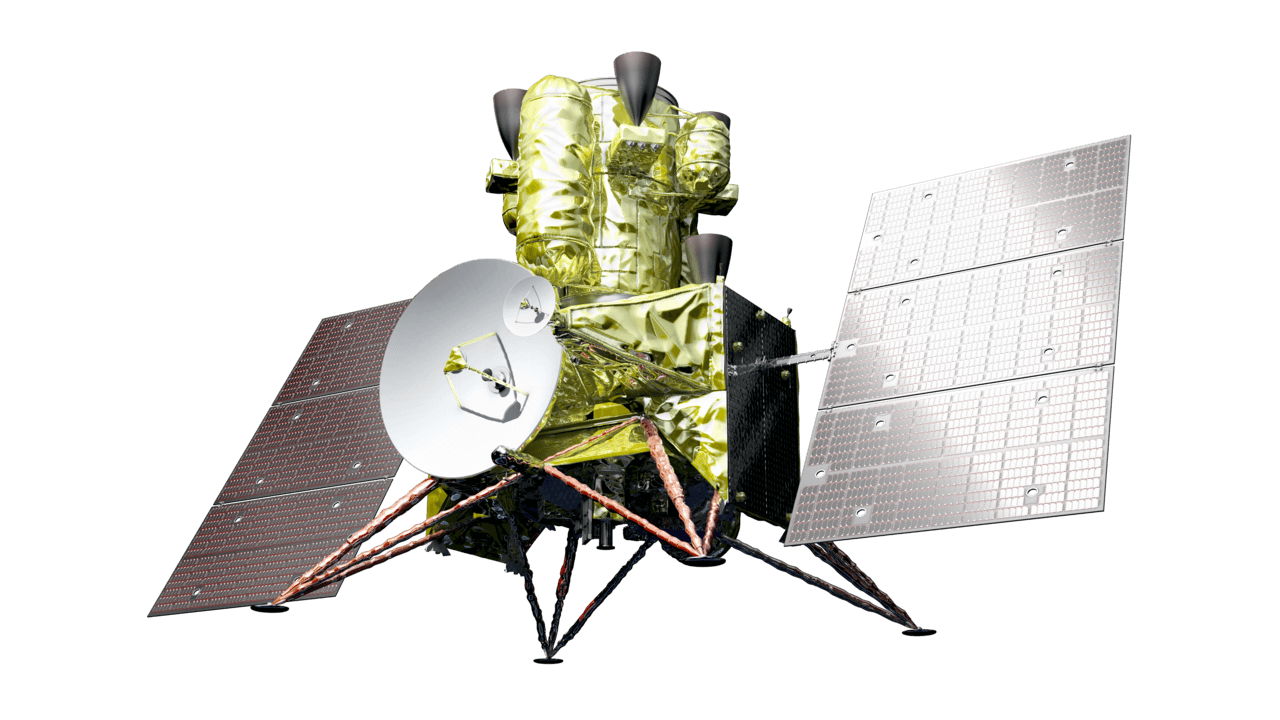
The argument MMX is designed to settle is old and genuinely unresolved. Phobos is very dark, with a geometric albedo of 0.06, and not very dense, about 1.90 g/cm3, which is what you would expect from a primitive carbonaceous asteroid. It also sits in a nearly circular, nearly equatorial orbit only 9,377 km from the centre of Mars, which is not what you would expect from a captured body: capture leaves you with an eccentric, inclined orbit that is hard to circularise. The two families of explanation are therefore capture, with some later dynamical tidying, or a giant impact on Mars that threw debris into orbit which re-accreted into two moons. Spectroscopy from orbit has been run at both moons for decades and cannot decide, because a thin layer of space-weathered, impact-darkened surface looks much the same either way. A sample can decide it. If the grains are chondritic and carry the isotopic signature of the outer asteroid belt, Phobos was captured. If they carry Mars's own isotopic fingerprint, it is impact debris. Ten grams is enough. And there is a bonus either way: Phobos regolith is expected to contain material blasted off Mars itself by later impacts, so the capsule may bring back Martian rock as a side effect of answering a question about a moon.
MMX has been trying to launch for six years. It was approved for full development on 19 February 2020, aiming at a September 2024 launch, Mars orbit in August 2025, departure in 2028 and an Earth return in 2029. Then Japan's new H3 rocket, which MMX depends on entirely, ran into its own troubles, and in December 2023 the mission was reported as slipping two years to the 2026 window, carrying the sample return from 2029 to 2031 with it. That is a long time to hold finished hardware. The Franco-German rover had already been shipped to Japan in early 2024. The spacecraft itself left Kamakura in the early hours of 28 March 2026, went by dedicated ship to Shimama Port and reached Tanegashima on 31 March 2026 for protoflight testing. On 20 August 2026 JAXA published the launch plan: 20 October 2026 at 04:41:03 Japan Standard Time, which is 19:41:03 UTC on 19 October, on H3 flight number 10 in its heaviest configuration, with a reserve period running to 7 November. On 3 September 2026 that document was the most recent word from ISAS, and JPL Horizons had no MMX record at all, as you would expect for a spacecraft that had not yet flown. By 9 October JAXA's press list still showed no later MMX press release, only an MMX press briefing on 24 September, and Horizons had added a record for MMX (-239, revised 7 October) whose only trajectory is JAXA's pre-launch planning trajectory, starting about 1 hour 18 minutes after the planned liftoff.
The flight plan is unusually intricate for a sample return, because you cannot orbit Phobos. It is too small: a conventional close orbit around a 22 km body deep inside Mars's gravity well is not stable. So MMX enters Mars orbit, then flies quasi-satellite orbits, Mars-centred paths tuned so that from Phobos's point of view the spacecraft appears to loop slowly around it and stays nearby for months. From there it maps the moon with a telescopic camera, a wide-angle spectral camera, an infrared spectrometer from France and a gamma-ray and neutron spectrometer from NASA, picks its spots, and descends. It carries two samplers: a corer meant to reach roughly 2 cm down and a pneumatic sampler from NASA that blows regolith loose with gas. It also drops IDEFIX, a rover of about 23 to 25 kg built by CNES and DLR, from somewhere between 40 and 100 m up, to bounce, right itself and then drive on a surface where gravity is around a two-thousandth of Earth's. After Phobos, several flybys of Deimos, then home, with a 60 cm capsule landing in Australia.
For this archive, MMX matters because of what has already been tried and lost. Phobos has been attempted three times and reached zero times. The Soviet Phobos 1 and Phobos 2 both launched in July 1988; Phobos 1 was killed by a bad command sequence on the way, and Phobos 2 reached Mars orbit, returned images of Phobos, and then fell silent in March 1989 days before it was to release two landers. Russia's Phobos-Grunt, a sample return of the same ambition as MMX, was stranded in Earth orbit after its November 2011 launch and burned up two months later. No spacecraft has ever landed on Phobos or Deimos. Everything below the top few microns of the moon in our globe is inference. If MMX flies in October and works, the answer to a question that has been argued for decades will arrive in a capsule in Australia in 2031. If it does not fly this window, the next opportunity is late 2028, and the hardware waits again.
Mission facts
Launch
20 October 2026 at 04:41:03 Japan Standard Time, which is 19:41:03 UTC on 19 October 2026, from the second pad of the Yoshinobu Launch Complex at the Tanegashima Space Center. The reserve launch period runs from 21 October to 7 November 2026, with the launch time reset for each day in that period. JAXA published this schedule on 20 August 2026.↗
Rocket
H3 flight number 10, in the H3-24L configuration: two LE-9 first-stage engines, four SRB-3 solid boosters and the long fairing. About 63 m tall and about 575 tonnes at liftoff excluding the payload. Launch contractor Mitsubishi Heavy Industries.↗
Ascent profile
For the 20 October case: solid booster pairs off at 1 min 56 s and 1 min 58 s, fairing at 3 min 17 s, first-stage cutoff at 4 min 52 s, second-stage first burn from 5 min 12 s to 10 min 40 s, a coast, then a second burn from 1 h 03 min 57 s to 1 h 10 min 21 s, and separation of MMX onto the Mars transfer trajectory at 1 h 11 min 12 s, at 592 km altitude and 11.2 km/s inertial velocity. JAXA notes the post-coast timings change with launch date.↗
Spacecraft
Three modules: an outward propulsion module, an exploration module that does the Phobos work, and a return module. Mass figures disagree by source. JAXA's own August 2026 launch plan gives a launch mass of 4,480 kg, which English Wikipedia now matches while adding a 2,100 kg dry mass; ESA's factsheet says about 4,200 kg including fuel. Planned mission duration five years.↗
The sample
At least 10 g of Phobos material, collected by two systems: C-SMP, a corer designed to take cores from roughly 2 cm depth, and P-SMP, a pneumatic sampler that blows regolith loose with pressurised gas and is listed as NASA-supplied in JAXA's own launch plan. Sources differ on landings: English Wikipedia says the plan is to land once or twice, while ESA's factsheet describes a single landing.↗
Payload
JAXA's launch plan lists: TENGOO telescopic camera, OROCHI wide-angle spectral camera, MIRS near-infrared spectrometer (CNES), MEGANE gamma-ray and neutron spectrometer (listed by JAXA as NASA-provided), a laser altimeter, CMDM dust monitor, MSA ion energy mass analyser, the IDEFIX rover (CNES and DLR), the C-SMP and P-SMP samplers, the sample return capsule, an interplanetary radiation monitor, and an 8K high-definition camera.↗
IDEFIX
A small four-wheeled rover built by CNES and DLR, to be dropped from between 40 and 100 m above Phobos, expected to bounce, then right itself and drive in gravity roughly two thousandths of Earth's. English Wikipedia gives 23.47 kg dry with a 2.44 kg payload and a body of 231 by 376 by 415 mm; European Spaceflight reported it as 25 kg when it shipped to Japan. It carries the RAX Raman spectrometer, the miniRAD radiometer, two navigation cameras and two downward-looking wheel cameras, and is designed for at least 100 days of surface work.↗
Quasi-satellite orbits
Phobos and Deimos are far too small to hold a spacecraft in a conventional orbit, so MMX flies quasi-satellite orbits: Mars-centred paths tuned so that, seen from the moon, the spacecraft appears to loop around it and stays close for long periods. ESA's factsheet describes about three years of operations around Phobos.↗
Phobos, the target
JPL Horizons (record revised 2 June 2025) gives Phobos radii of 13.1 by 11.1 by 9.3 km, a geometric albedo of 0.06, a density of 1.90 plus or minus 0.08 g/cm3, a semi-major axis of 9,377.2 km, an orbital period of 0.319 days and an inclination of 1.082 degrees. That low density, and that very dark surface, are exactly why the origin question is unresolved.↗
Deimos, the secondary target
Horizons gives Deimos radii of 7.8 by 6.0 by 5.1 km, albedo 0.06, density 1.76 plus or minus 0.30 g/cm3, semi-major axis 23,463.2 km and a period of 1.263 days. MMX is to make several Deimos flybys after leaving Phobos and before departing Mars.↗
Coming home
The return module carries a sample return capsule about 60 cm across with its own heat shield. It is to re-enter and land in Australia, after which the sample goes to JAXA's Institute of Space and Astronautical Science. JAXA's launch plan states the goal as sample return in Japanese fiscal 2031, which runs April 2031 to March 2032.↗
ESA's contribution
Deep space communication hardware, specifically a transponder and power amplifier, plus ground station support from ESA's Estrack network.↗
Schedule history
Approved for full development on 19 February 2020, then targeting a September 2024 launch, Mars orbit in August 2025, Mars departure in 2028 and Earth return in 2029. The mission slipped two years to 2026, reported on 6 December 2023, in the wake of delays to the H3 rocket it depends on. The current plan is a 2026 launch, 2027 Mars arrival and a fiscal 2031 return.↗
Where the hardware is
The spacecraft left Kamakura early on 28 March 2026, travelled by dedicated ship to Shimama Port, and arrived at the Tanegashima Space Center on 31 March 2026 for system protoflight testing in the second Spacecraft Test and Assembly Building (STA2). The IDEFIX rover had been delivered from Europe to Japan in February 2024.↗
In JPL Horizons
A JPL Horizons search for MMX on 3 September 2026 returned no match: Horizons found nothing in the major-body index and fell through to the comet and asteroid index, which also reported no matches, as expected for an unlaunched spacecraft. By 9 October 2026 Horizons had a record for MMX as spacecraft -239, revised 7 October 2026, which lists launch at 19:41:03 UTC on 19 October 2026 and carries JAXA's pre-launch planning trajectory (20261019_20281231_MMX_V0.2) through to 31 December 2028. It gives no ephemeris before 20:57:30 UTC on 19 October, so that trajectory is a prediction for a spacecraft still on the ground on 9 October.↗
JAXA's own framing
The launch plan states the aim as achieving humanity's first sample return from the Martian sphere in fiscal 2031, and positions MMX as Japan's first move into the Mars system, gathering detailed surface, subsurface and environmental data on a moon regarded as a possible orbital staging point for future human Mars exploration. That is JAXA's claim about its own mission, written in August 2026, and its accuracy depends on schedules that other agencies control.↗
Mission timeline
- 19 Feb 2020JAXA and Japanese government officials approve MMX to enter full development, then aiming at a September 2024 launch, Mars orbit in August 2025 and an Earth return in 2029.
- 6 Dec 2023The two-year slip is reported: MMX will not make the 2024 Mars window and moves to 2026, pushing the sample return from 2029 to 2031.
- Jan to Feb 2024The Franco-German IDEFIX rover is shipped from Europe and arrives in Japan for integration with the spacecraft.
- 28 Mar 2026The completed spacecraft departs Kamakura in the early morning aboard a dedicated ship bound for Tanegashima.
- 31 Mar 2026MMX arrives at the Tanegashima Space Center and moves into the Spacecraft Test and Assembly Building for protoflight testing.
- 20 Aug 2026JAXA publishes the launch schedule: 20 October 2026 at 04:41:03 Japan time on H3 flight 10, reserve period to 7 November. As of 9 October 2026 this is still JAXA's most recent MMX press release; the one later MMX item on JAXA's Japanese press list is a press briefing on 24 September 2026.
- 20 Oct 2026Planned: liftoff at 04:41:03 Japan time (19:41:03 UTC on 19 October), with separation onto the Mars transfer trajectory 1 h 11 min 12 s later at 592 km altitude and 11.2 km/s.
- 2027Planned: Mars orbit insertion about a year after launch, followed by transfer into quasi-satellite orbits around Phobos and remote observation of both moons.
- 2029Planned, though dates disagree: DLR's mission page says the IDEFIX rover is released to the surface of Phobos in early 2029, while English Wikipedia's infobox still says landing in 2027 and European Spaceflight reported 2027 back in February 2024. JAXA has not published a landing date.
- 2030Planned: after sampling, MMX leaves Phobos, makes several flybys of Deimos, and then departs the Mars system.
- 2031Planned: the return module releases a 60 cm sample capsule that re-enters and lands in Australia, delivering at least 10 g of Phobos. JAXA states the goal as Japanese fiscal 2031, which runs to March 2032.
A filled dot marks something that physically happened. A hollow one marks an announcement, a naming or a target.
In pictures
Tap a photo to enlarge.
Sources
- JAXA press release, 20 Aug 2026: Launch schedule of the MMX spacecraft aboard H3 Launch Vehicle flight No.10
- JAXA ファン!ファン!JAXA!: MMX×H3ロケット10号機特設サイト (MMX and H3 flight 10 launch site, Japanese), read 9 Oct 2026
- JAXA launch plan (Japanese PDF), Aug 2026: 2026 rocket launch plan, MMX / H3
- JAXA ISAS topic: the MMX spacecraft has been delivered to the Tanegashima Space Center (31 Mar 2026)
- JAXA ISAS mission page: Martian Moons eXploration (English)
- JAXA ISAS mission page: 火星衛星探査計画 MMX (Japanese)
- ESA MMX factsheet (27 Oct 2025)
- JPL Horizons: Phobos (401) physical and orbital record, revised 2 Jun 2025
- JPL Horizons: Deimos (402) physical and orbital record, revised 2 Jun 2025
- DLR project page: MMX and the IDEFIX rover
- European Spaceflight, 26 Feb 2024: Europe's Martian Moon Rover Arrives in Japan
- Spaceflight Now (Stephen Clark), 20 Feb 2020: Phobos sample return mission enters development for 2024 launch
- English Wikipedia: Martian Moons eXploration and Idefix (rover)
Facts on this page were verified on 21 September 2026. Where sources disagree, the disagreement is stated rather than resolved silently.