Mars Sample Return (NASA and ESA)
NASA / ESA · Multinational · Program · 2026 · AnnouncedCancelled
Cancelled: Congress declined to fund it in the appropriations bill signed on 23 January 2026, and ESA member states asked for the cancellation of the Earth Return Orbiter in March 2026. No replacement has been started.
TL;DR· 12 min read
Mars Sample Return was cancelled. Congress declined to fund the NASA and ESA campaign in the fiscal year 2026 appropriations bill signed on 23 January 2026, providing $110 million for a Mars Future Missions account instead, and ESA member states asked for the cancellation of the Earth Return Orbiter in March 2026. The tubes Perseverance drilled are still on Mars, ten of them lying at Three Forks and the rest aboard the rover, and nothing is funded to go and get them.
Mars Sample Return was the plan to bring the rock cores that Perseverance has been drilling since 2021 back to Earth: a lander to collect the tubes, the first rocket ever launched from the surface of Mars, a European orbiter to catch the sample container in Mars orbit, and a sealed entry capsule to carry it down through Earth's atmosphere. The congressional Planetary Science Caucus called it the nation's highest-priority planetary science mission. It never got past design. A review board's cost verdict, an architecture rethink, a change of administration and a single line in an appropriations bill ended it. As of 3 September 2026 the tubes are still on Mars, ten of them lying on the ground at Three Forks and the rest riding on the rover, and nothing is funded to go and get them.
- $8-11Bprobable lifecycle cost range found by the 2023 review board
- $110Mgiven instead in the fiscal 2026 bill for Mars technology rather than MSR
- 0sample tubes retrieved from the Martian surface
The idea was simple and the engineering was not. Perseverance would drill finger-sized cores in Jezero Crater and seal them in titanium tubes. A second spacecraft, the Sample Retrieval Lander, would come down nearby, take the tubes aboard, and load them into a Mars Ascent Vehicle, a small rocket that would then do something no machine has ever done: launch from the surface of another planet. In Mars orbit, a European spacecraft called the Earth Return Orbiter, carrying a NASA-built Capture, Containment and Return System, would find the sample container, capture it, sterilise its outside and seal it inside an Earth Entry System for the journey home. Redesigning how the lander loaded the tubes into the container was itself a planetary protection measure, meant to stop Martian dust accumulating on the outside of the thing being brought back. Every step of this had a plausible engineering answer and no flight heritage. The campaign was the highest-priority planetary science mission of the most recent decadal survey, as the co-chairs of the congressional Planetary Science Caucus reminded everyone in January 2026, because samples in a terrestrial laboratory can be interrogated with instruments that will never fit on a spacecraft, and because Perseverance had already cored rocks with, in NASA's words, "qualities that fit the definition of a possible indicator of ancient life", including the arrowhead-shaped rock nicknamed Cheyava Falls. The science case was never seriously disputed. The bill was.
The second independent review board, reporting in September 2023, is the document everything after it responds to. It found no credible, congruent cost, schedule and technical baseline that could be achieved with the funding likely to be available. It put the probable lifecycle cost at $8 billion to $11 billion at 50 to 80 per cent confidence, and it judged the probability of the Earth Return Orbiter or the lander making their 2027 and 2028 launch dates as near zero, with 2030 achievable only with more than a billion dollars a year for three or more years. Note what the board did not say: it did not say 2040. That number came from NASA itself on 15 April 2024, when the agency said that under its own budget outlook the existing design would return samples in 2040, and Bill Nelson said $11 billion was too expensive and 2040 too far away. NASA then asked industry and JPL for something cheaper, accepted eleven studies in September 2024, and on 7 January 2025 announced it would carry two landing architectures forward in parallel: the proven sky crane, or a commercial lander. It expected to pick one and confirm the programme in the second half of 2026.
It never got the chance. The fiscal year 2026 budget request released in May 2025 proposed cancelling Mars Sample Return outright, inside a proposed 47 per cent cut to NASA science. Congress rejected almost all of those cuts. It gave NASA $24.438 billion instead of the requested $18.8 billion, and science $7.25 billion instead of $3.9 billion. On MSR alone it agreed with the administration. The Commerce, Justice and Science bill travelled as part of a three-bill minibus, H.R. 6938, which the House passed 397 to 28 on 8 January 2026 and the Senate passed 82 to 15 on 15 January. The President signed it on 23 January 2026. In place of the programme, the report directed $110 million to a Mars Future Missions account for radar, spectroscopy and entry, descent and landing technologies, less than half the $300 million a House version had proposed. The Planetary Science Caucus co-chairs, Judy Chu and Don Bacon, said they welcomed the rejection of the broader science cuts but were disappointed that the decadal survey's top priority had been dropped. In March 2026, ESA member states asked for the cancellation of the Earth Return Orbiter, ending a 491 million euro Airbus contract signed in October 2020.
What is left is a set of intentions with no money attached. The Senate Commerce Committee's authorisation bill, advanced on 4 March 2026, orders the old programme formally terminated and a new one created with a total cost cap of $8 billion, restricted to flight-proven technology and to international contributions that do not add cost or risk; a plan would be due 120 days after enactment, and as of 23 August 2026 we found no sign that it has been enacted. Four senators asked appropriators for at least $400 million for Mars technology in fiscal 2027, warning of "severe and irreversible harm" to the ability to land anything on Mars for decades. NASA's fiscal 2027 request keeps the figure at $110 million and redirects it to small, capped science missions. Lockheed Martin says it has a plan to return the samples for under $3 billion and stands behind it; no award has been made. Jared Isaacman has said he wants the samples and that step one is closing out the old programme. Meanwhile Perseverance is still working, still coring, and being recertified to drive 100 kilometres, a target originally derived from the rendezvous studies for a lander that is no longer being built.
Mission facts
What it was
A multi-mission campaign by NASA and ESA to return sealed samples collected by the Perseverance rover. NASA's own page now uses the past tense: "Mars Sample Return was a plan for an ambitious, multi-mission campaign that would bring carefully selected Martian samples to Earth for the first time." That page was last updated on 3 August 2026.↗
The samples
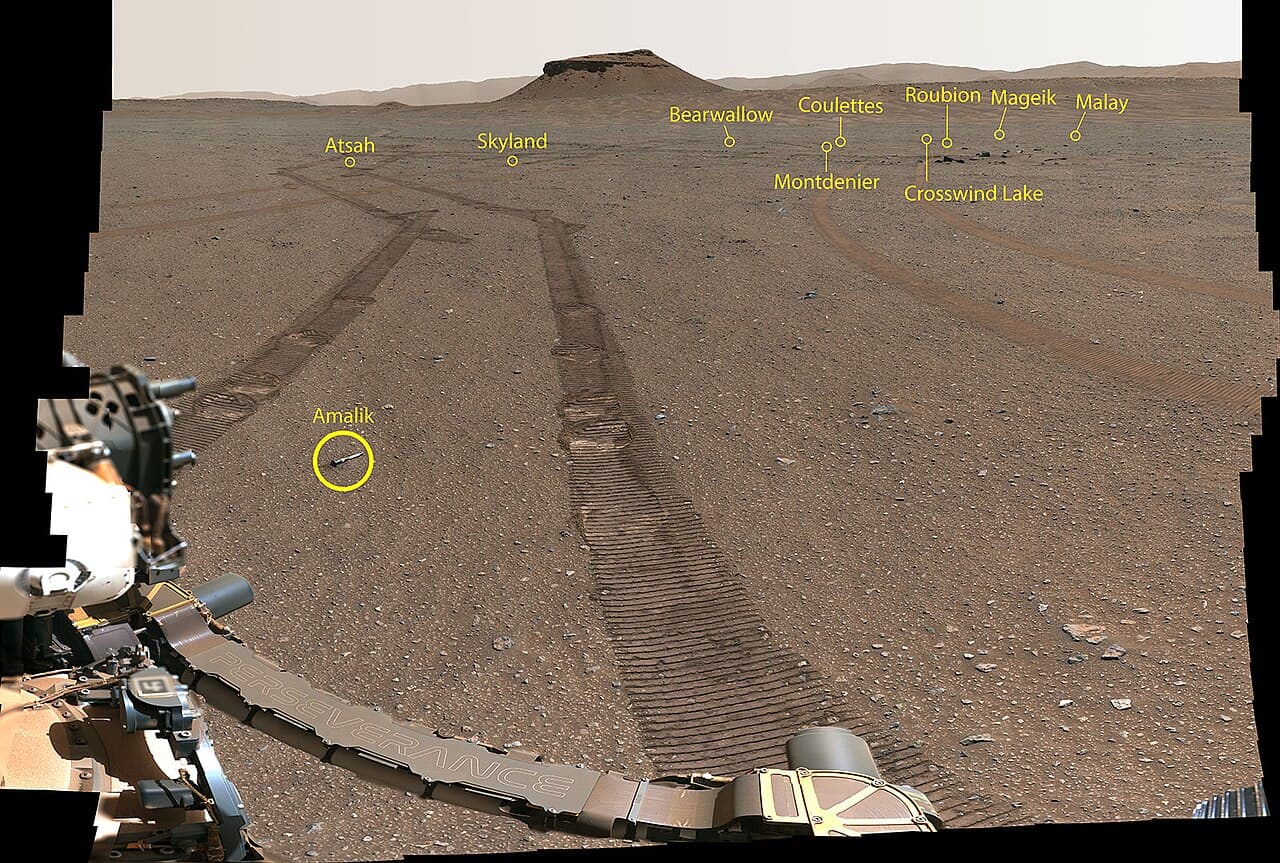
Perseverance has taken samples in pairs where possible. One of each pair was placed at a backup depot on flat ground in Jezero Crater nicknamed Three Forks. NASA confirmed the tenth and final tube on 29 January 2023, less than six weeks after depot construction began; the last tube was imaged on the surface on 28 January 2023, sol 690. The depot also received an atmospheric sample and a witness tube. The other half of each pair stayed aboard the rover, which under the cancelled plan would have been the primary means of delivering samples to the Sample Retrieval Lander.↗
The architecture as of 2025
A Sample Retrieval Lander carrying a smaller Mars Ascent Vehicle powered by a radioisotope power system rather than solar panels, an orbiting sample container holding 30 tubes, and ESA's Earth Return Orbiter carrying a NASA-built Capture, Containment and Return System to catch the container in Mars orbit and seal it inside an Earth Entry System.↗
The second review board
MSR Independent Review Board 2, chaired by Orlando Figueroa, reported in September 2023. Its programmatic assessment put $8 billion to $11 billion as the probable total lifecycle cost at 50 to 80 per cent confidence, and found a "near zero probability" of the Earth Return Orbiter or the Sample Retrieval Lander meeting their 2027 and 2028 launch readiness dates, with 2030 dates possible given adequate funding.↗
Where 2040 came from
Not from the review board. In NASA's response of 15 April 2024, the agency said that "given the Fiscal Year 2025 budget and anticipated budget constraints, as well as the need to maintain a balanced science portfolio, the current mission design will return samples in 2040." Administrator Bill Nelson's line in the same release was: "The bottom line is, an $11 billion budget is too expensive, and a 2040 return date is too far away."↗
The alternatives study
NASA solicited alternative architectures from industry and its own centres in 2024 and accepted 11 studies in September 2024. A strategic review team led by Maria Zuber assessed them.↗
The January 2025 decision
On 7 January 2025 NASA announced it would carry two landing architectures forward in parallel: one reusing the sky crane system flown by Curiosity and Perseverance, the other buying a commercial lander. NASA said it expected to confirm the programme and its design in the second half of 2026. That confirmation never happened.↗
The budget request that killed it
The Trump administration's fiscal year 2026 budget request, released in May 2025, proposed cancelling MSR outright as part of a proposed 47 per cent cut to NASA science, from $7.334 billion to just over $3.9 billion.↗
What Congress actually did
The final fiscal 2026 bill rejected most of the proposed NASA cuts, giving the agency $24.438 billion and science $7.25 billion, but endorsed the cancellation of MSR. The accompanying report directed NASA to spend $110 million from a Mars Future Missions account "to support radar, spectroscopy, entry, descent, and landing systems, and translational precursor technologies". A House version had proposed $300 million.↗
Enactment
The Senate passed H.R. 6938, a three-bill minibus containing the Commerce, Justice and Science bill, by 82 votes to 15 on 15 January 2026, after the House passed it 397 to 28 on 8 January. The President signed it on 23 January 2026.↗
NASA's reaction
Administrator Jared Isaacman said in an interview reported on 16 February 2026 that "with near clarity now on the human exploration focus on the moon, we can free up some of our resources to consider how we would go and retrieve the Mars samples", adding "step one is closing out the old program". Asked about MSR at a 13 February 2026 news conference he said, "Am I interested in getting those samples back? You bet."↗
ESA's side
ESA had contracted Airbus Defence and Space in October 2020 for 491 million euros to build the Earth Return Orbiter. After the US funding decision, ESA's Director of Human and Robotic Exploration Daniel Neuenschwander said Mars Sample Return "is currently not planned to be continued". Following the 345th ESA Council meeting, reported on 28 March 2026, he said member states had "asked for the cancellation of the Earth Return Orbiter mission", with talks under way with Airbus about reusing technology such as the electric propulsion system.↗
The authorisation bill
On 4 March 2026 the Senate Commerce Committee advanced an amended S. 933 that directs the formal termination of the old MSR programme and calls for a new one, capped at $8 billion in total, required to use "existing flight-proven technologies" and limiting international contributions that would "unduly increase" cost and risk, with a plan due 120 days after enactment. As of 23 August 2026 we found no evidence the bill has been enacted or that NASA has begun such a programme.↗
Fiscal 2027
NASA's fiscal year 2027 request, released 3 April 2026, again asks for $110 million for Mars Future Missions but proposes to spend it on lower-cost science missions rather than MSR technologies, including a solicitation planned for October 2026 for a Mars mission launching in 2030 under a $220 million cost cap. Four senators wrote asking appropriators for at least $400 million, warning of "severe and irreversible harm" to US Mars capability.↗
Industry position
Lockheed Martin says it proposed returning the samples for under $3 billion. Whitley Poyser, the company's director of exploration, said on 13 April 2026 that the plan leveraged "proven, demonstrated technologies" and that "we still very much stand behind it". NASA has made no award.↗
Dates and time zone
Dates here are US Eastern-time publication and legislative dates, which for these events do not differ from UTC by more than one calendar day. Congressional votes and signings are recorded in Washington local time.↗
Mission timeline
- Dec 2022 to 29 Jan 2023Perseverance builds the first sample depot on another world at Three Forks in Jezero Crater, laying ten sealed tubes on the ground as a backup set. NASA confirms the tenth and final tube on 29 January 2023, less than six weeks after the work began.
- Sep 2023The second Mars Sample Return Independent Review Board reports: $8 billion to $11 billion probable lifecycle cost, near-zero probability of the 2027 and 2028 launch readiness dates, no credible cost, schedule or technical baseline within likely funding.
- 15 Apr 2024NASA publishes its response. Nelson calls $11 billion too expensive and a 2040 return too far away, and asks industry and JPL for cheaper architectures. NASA states that under its budget outlook the existing design would return samples in 2040.
- Sep 2024NASA accepts 11 alternative architecture studies from industry and its own centres. A strategic review team led by Maria Zuber assesses them.
- 7 Jan 2025NASA announces it will carry two landing options forward in parallel, sky crane and commercial lander, with a smaller ascent vehicle, a 30-tube orbiting sample container and a radioisotope power source, and says it expects to confirm the programme in the second half of 2026.
- May 2025The administration's fiscal year 2026 budget request proposes cancelling MSR and cutting NASA science by 47 per cent.
- 17 Dec 2025At the American Geophysical Union meeting, Perseverance officials say the rover is in excellent shape and continuing to collect samples despite having no plan for their return. Six empty tubes remain available and two filled tubes are still unsealed. Deputy project manager Steve Lee says the rover is being certified to drive at least 100 km, a distance derived from the abandoned MSR rendezvous studies.
- 15 Jan 2026The Senate passes the fiscal 2026 minibus containing the Commerce, Justice and Science bill by 82 votes to 15. The bill restores most NASA science funding but endorses the cancellation of MSR, substituting $110 million for Mars Future Missions.
- 23 Jan 2026The President signs the minibus. MSR is now unfunded law. The congressional Planetary Science Caucus co-chairs say they are "disappointed" that the highest-priority mission of the planetary decadal survey has been dropped.
- 4 Mar 2026The Senate Commerce Committee advances a NASA authorisation bill directing formal termination of the old MSR programme and creation of a new one with an $8 billion cap and a requirement to use flight-proven technology.
- 28 Mar 2026European Spaceflight reports that ESA member states have asked for the cancellation of the Earth Return Orbiter, and that ESA has opened talks with Airbus about reusing technology from it.
- 3 to 15 Apr 2026NASA's fiscal 2027 request keeps Mars Future Missions at $110 million but redirects it to small capped science missions rather than sample-return technology. Four senators write asking appropriators for at least $400 million, warning of "severe and irreversible harm" to the United States' ability to land on Mars.
A filled dot marks something that physically happened. A hollow one marks an announcement, a naming or a target.
In pictures
Tap a photo to enlarge.
Sources
- NASA Science: Mars Sample Return mission page
- NASA: Mars Sample Return Independent Review Board 2 report (September 2023, PDF)
- NASA release 24-056: NASA Sets Path to Return Mars Samples, Seeks Innovative Designs (15 April 2024)
- NASA release 25-001: NASA to Explore Two Landing Options for Returning Samples from Mars (7 January 2025)
- NASA/JPL: NASA's Perseverance Rover Completes Mars Sample Depot (30 January 2023)
- NASA/JPL: NASA's Perseverance Rover Scientists Find Intriguing Mars Rock, Cheyava Falls (25 July 2024)
- SpaceNews: Perseverance continues science mission amid uncertainty about Mars Sample Return (26 December 2025)
- SpacePolicyOnline: Final FY2026 NASA/NOAA Appropriations Bill Clears Senate, White House is Next (15 January 2026, updated 25 January)
- SpaceNews: Congress passes minibus spending bill that rejects proposed NASA cuts (15 January 2026)
- SpaceNews: NASA work on several programs pending responses to White House executive order (16 February 2026)
- SpaceNews: Senate committee advances NASA authorization bill that changes Artemis and extends ISS (4 March 2026)
- European Spaceflight: ESA Member States Call for Cancellation of Earth Return Orbiter (28 March 2026)
- SpaceNews: Senators seek increased funding for NASA Mars missions (15 April 2026)
Facts on this page were verified on 3 September 2026. Where sources disagree, the disagreement is stated rather than resolved silently.