ESCAPADE
NASA / UC Berkeley Space Sciences Laboratory / Rocket Lab · United States · Orbiter · 2026 · AnnouncedOperating
Operating as of 9 October 2026: both orbiters are being tracked, Blue 1.88 million km and Gold 1.96 million km from Earth and falling back towards it, loitering since their 13 November 2025 launch. The burn for Mars is planned for November 2026, arrival September 2027.
TL;DR· 14 min read
ESCAPADE is two identical 535 kg orbiters, Blue and Gold, built by Rocket Lab for a University of California, Berkeley team so that Mars's magnetosphere can be measured from two places at once. They launched together on 13 November 2025 on the second flight of Blue Origin's New Glenn. As of 9 October 2026 they were still looping near Earth, about 1.9 million km out and falling back towards it, waiting on a trans-Mars injection burn planned for November 2026 and arrival at Mars in September 2027.
ESCAPADE is two spacecraft flying one mission. Blue and Gold are identical 535 kg orbiters, built by Rocket Lab for a science team at the University of California, Berkeley, and their point is to be in two places around Mars at once, so that when a measurement changes it is possible to tell whether the change happened in time or in space. They launched together on 13 November 2025 on the second flight of Blue Origin's New Glenn. As of 9 October 2026 they were still nowhere near Mars: Blue was 1.88 million km from Earth and Gold 1.96 million km, both falling back towards Earth for a burn in November 2026 that finally throws them at Mars.
- 2identical orbiters, Blue and Gold, flying as a single mission
- under $80mcost of the whole mission per JPL Horizons; English Wikipedia's $75m total includes the launch
- 1.9m kmfrom Earth on 9 October 2026 and falling back towards it, still 11 months from Mars
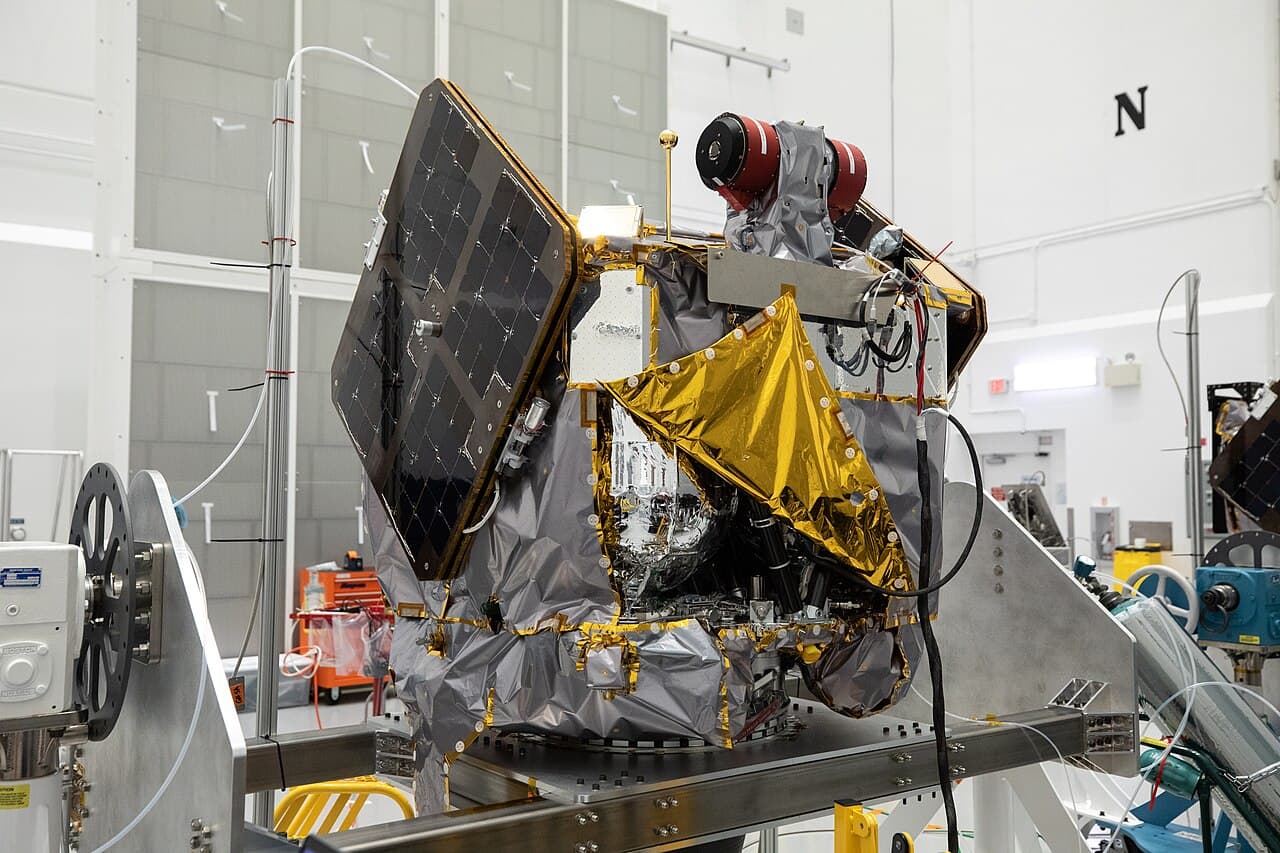
ESCAPADE exists because one spacecraft is not enough. Mars has no global magnetic field, so instead of a clean magnetosphere it has a hybrid one: solar wind pressing directly onto an ionosphere, draped field lines, patches of crustal magnetism left over from a field that died billions of years ago, and atmosphere leaking out through the mess. MAVEN, which cost $582 million, went to Mars in 2014 to study exactly that system, and it did so from a single vantage point, which has a permanent ambiguity built into it. When the instruments see a change, there is no way to know whether the system changed or whether the spacecraft simply moved somewhere different. ESCAPADE answers that by flying two identical sets of instruments, on two identical 535 kg spacecraft named Blue and Gold, at controlled distances from each other. Each carries a magnetometer from NASA Goddard, an electrostatic analyser from UC Berkeley, a Langmuir probe from Embry-Riddle and a visible and infrared camera from Northern Arizona University. The whole thing, both spacecraft, all eight instruments and the rocket, was bought for roughly an eighth of MAVEN's price. That is the actual experiment here: not only the Mars science, but whether a university-led team and a commercial spacecraft builder can put a two-point plasma physics observatory at another planet for the price of a rounding error on a flagship.
Getting it off the ground took six years and three different launch plans. ESCAPADE was designed as a ride-along with the Psyche asteroid mission, which is why its budget assumed the launch would cost almost nothing. When Psyche was assigned to a Falcon Heavy and a higher-energy Mars flyby that ESCAPADE could not use, NASA chose to buy a separate launch rather than cancel, and in February 2023 Blue Origin won it for about $20 million, on the first flight of a rocket that had never flown. The spacecraft reached the Cape in August 2024. On 6 September 2024 NASA stood down from the October launch, and the reason it gave is worth reading carefully, because it was not that the rocket was late: it was that the spacecraft would already be fuelled, that planetary windows turn small slips into months of delay, and that defuelling two loaded spacecraft carries real cost and risk. So ESCAPADE sat out the 2024 Mars window entirely. It finally flew on 13 November 2025 on New Glenn's second flight, after scrubs for cumulonimbus cloud and then for a solar storm, and the same launch brought a New Glenn booster back onto the platform vessel Jacklyn about 600 km out in the Atlantic.
Because it missed the 2024 window, ESCAPADE does not fly the trajectory it was designed for. Instead of a direct transfer, the pair was launched outward into a year-long loiter in Earth's neighbourhood, measuring the solar wind until Mars is in the right place. NASA and JPL Horizons both describe that loiter as being around the Earth-Sun L2 point, roughly 1.5 million km out, and it is worth being precise about what the trajectory actually does, because the shorthand misleads. The Horizons kernels show a wide loop ranging from about 0.55 to 2.5 million km from Earth, which lines up with the L2 direction only twice, briefly: around the start of March 2026, about 2 million km out, and around 30 June 2026, only about 550,000 km out. On 3 September 2026 Horizons put Blue 2.436 million km from Earth and Gold 2.462 million km, about 44,000 km apart, figures that still hold on the kernels revised 21 September 2026, which carry genuine tracking data through 15 September for Blue and 17 September for Gold. On that date the pair was roughly 84 degrees off the Earth-Sun L2 direction, and Blue was only about 270,000 km further from the Sun than Earth was. Far from Earth, yes. At L2, no. The mission has not been trouble-free. In early December 2025 the operations team saw low thrust during a burn on one of the two spacecraft and stood the manoeuvre down; the other had already finished its corrections on schedule. The delayed burn was completed on 6 January 2026. NASA has never said publicly which spacecraft it was or what caused it. Its later news has been sparse: on 26 February 2026 it said the science instruments were all operating, and on 24 July 2026 it released Earth and Moon images one spacecraft took on 3 July from 584,600 km away. Beyond those two articles, this entry says what the navigation data supports and no more.
What comes next is the part that turns two loitering satellites into a Mars mission. The pair is already falling back towards Earth (on 9 October 2026 Horizons put Blue 1.88 million km out and Gold 1.96 million km, both closing), and in November 2026 it dips to a low perigee (Horizons' prediction of 7 October 2026: about 1,670 km up for Blue on 7 November, about 1,030 km for Gold on 9 November) and fires its trans-Mars injection burn at the bottom of that dive, where the burn buys the most energy. Then 11 months of cruise with one major correction and several small ones, arrival a few days apart in September 2027, and an insertion burn of about 11 minutes each into a capture orbit with a period near 60 hours. Roughly six months of trimming follows before Science Campaign A, in which both spacecraft fly the same 170 by 18,400 km orbit at 65 degrees inclination and vary their separation. After five or six months of that, Blue is lowered to a 7,000 km apoapsis and Gold raised to 10,000 km. The different periods, 4.9 and 6.6 hours, make the two orbits precess at different rates in Mars's uneven gravity field, so the spacecraft drift apart on purpose and start sampling widely separated parts of the magnetosphere simultaneously. The Horizons record says the nominal science mission ends less than three years after launch, which would mean 2028, but with science now due to begin in late spring 2028, six months of Campaign A and five of Campaign B carry it into 2029.
Mission facts
Launch
13 November 2025, 20:55 UTC (3:55 p.m. EST), from Launch Complex 36 at Cape Canaveral Space Force Station, on the second flight of Blue Origin's New Glenn (NG-2). Sources disagree by ten minutes: NASA's own launch blog gives 3:55 p.m. EST and English Wikipedia sharpens it to 3:55:01 p.m. EST (20:55:01 UTC), the seconds coming from Wikipedia rather than from NASA, while the spacecraft record inside JPL Horizons says 20:45 UTC. The Horizons trajectory files themselves start at 21:31 UTC (Blue) and 21:32 UTC (Gold), which is spacecraft separation rather than liftoff.↗
Catalogue identities
ESCAPADE-Blue is 2025-260A (JPL Horizons body -9) and ESCAPADE-Gold is 2025-260B (Horizons -10). The New Glenn upper stage that carried them is catalogued separately as 2025-260C (Horizons -9901495), so a Horizons search for the mission name returns three objects, not two.↗
Where they were on 23 August 2026
Horizons, queried on 23 August 2026, put Blue 2,337,000 km from the centre of the Earth and Gold 2,352,000 km out, about 33,000 km apart. Re-queried on 24 September 2026, on kernels revised 21 September 2026 that carry real tracking data through 15 September for Blue and 17 September for Gold, Horizons returns the same figures. Navigation data says nothing about the health of the spacecraft, but it does mean both vehicles were being tracked and their trajectories updated within ten days of that check. Note where that is: on 23 August 2026 the pair sat about 88 degrees away from the Earth-Sun L2 direction, and Blue was only some 80,000 km further from the Sun than Earth itself. They were not at L2 on that date. The loiter is a wide loop that passes through the L2 region, closest to it around the start of March 2026 (2 March for Blue, 5 March for Gold), lines up with the L2 direction once more around 30 June 2026, only about 550,000 km from Earth, and swings far to the side of the Sun-Earth line the rest of the time.↗
Each spacecraft
535 kg fuelled, 209 kg dry. Stowed 1.20 by 1.65 by 1.09 m, 4.88 m long deployed thanks to a 2 m magnetometer boom. Fixed solar arrays giving about 800 W at Earth and 260 W at Mars, 128 W drawn by the science payload, two star trackers, four fine Sun sensors, four reaction wheels, and a 60 cm fixed X-band dish. JPL Horizons names the bus a Rocket Lab Photon; English Wikipedia calls it a Rocket Lab Explorer, the Photon derivative marketed for interplanetary work.↗
Telling them apart
The two are physically identical, so the practical difference is radio: Blue downlinks at 8417.165797 MHz and Gold at 8423.148147 MHz.↗
Instruments
Four per spacecraft, eight in total: EMAG, a magnetometer from NASA's Goddard Space Flight Center; EESA, an electrostatic analyser from UC Berkeley's Space Sciences Laboratory; ELP, a Langmuir probe from Embry-Riddle Aeronautical University; and VISIONS, a visible and infrared camera from Northern Arizona University.↗
Cost
English Wikipedia gives $75 million total, split as $55 million for the two spacecraft and their instruments and $20 million for the New Glenn launch. The JPL Horizons spacecraft record describes it as a low-cost mission of under $80 million. Both figures are far below the $582 million cited for MAVEN, the previous NASA orbiter built to study the same question.↗
Who builds and runs it
Principal investigator Robert Lillis of UC Berkeley's Space Sciences Laboratory, which leads the mission, working with Rocket Lab (spacecraft), Advanced Space, Embry-Riddle Aeronautical University, Blue Origin and NASA. It flies under NASA's SIMPLEx line of small planetary missions.↗
Why two spacecraft
A single orbiter cannot separate a change in time from a change in place. Flying two identical instrument sets at controlled separations lets the team measure how solar wind energy and momentum move through the hybrid magnetosphere Mars makes without a global magnetic field, and how atmosphere escapes through it.↗
The route to Mars
Not a direct transfer. The pair was launched to a loiter that JPL Horizons and NASA both describe as being around the Earth-Sun L2 point roughly 1.5 million km out, where they spend about a year taking space weather data. In practice the Horizons trajectory is a much wider loop, ranging from about 0.55 to 2.5 million km from Earth and lining up with the L2 direction only twice, briefly: around the start of March 2026, about 2 million km out, and around 30 June 2026, only about 550,000 km out. A low-altitude perigee burn in November 2026 sends them onto an 11-month cruise with one major and several minor corrections along the way. Horizons' prediction of 7 October 2026 puts the perigees about 1,670 km above Earth for Blue on 7 November and about 1,030 km for Gold on 9 November; English Wikipedia gives a lower figure, within 600 km.↗
First images
The VISIONS cameras returned their first frames on 21 November 2025, eight days after launch: one spacecraft photographed the edge of its own solar panel in visible and infrared light, the other photographed deep space. NASA said the visible channel looked sensitive enough to catch Martian aurora from orbit.↗
The one known problem
In early December 2025 the operations team saw low thrust during a trajectory correction burn on one of the two spacecraft and stood the manoeuvre down while engineers investigated. NASA said on 15 December 2025 that the other spacecraft had completed both of its corrections as planned, and on 7 January 2026 that the delayed second correction had been completed on 6 January. NASA has never said publicly which spacecraft it was, or what caused the low thrust.↗
Arrival plan
The two arrive at Mars a few days apart in September 2027, each firing for about 11 minutes into a large capture orbit of roughly 60 hours, then spending about six months trimming down. Science Campaign A flies both in the same 170 by 18,400 km orbit, 5.66 hour period, 65 degree inclination, at varying separations.↗
The split
After six months in formation, Blue drops to a 7,000 km apoapsis and Gold rises to 10,000 km. The different periods (4.9 and 6.6 hours) make the orbits precess at different rates in Mars's lumpy gravity field, so the two drift apart and sample distant parts of the magnetosphere at the same moment. That campaign runs five months. Horizons says this ends the nominal science mission less than three years after launch, but the UC Berkeley mission design page has science beginning in late spring 2028, which carries the six-month and five-month campaigns into 2029.↗
How current this entry can be
NASA's ESCAPADE blog has not been updated since 7 January 2026, and the UC Berkeley mission site carries no dated 2026 status posts we could retrieve, but NASA has published two ESCAPADE articles elsewhere on its science site since then. On 26 February 2026 it said the science instruments were all operating as of 25 February, and on 24 July 2026 it released Earth and Moon images that one spacecraft took on 3 July from 584,600 km away. The Horizons navigation product revised on 7 October 2026 carries tracking through 5 October for both spacecraft. As of 9 October 2026 we found no NASA statement on the spacecraft newer than the July article, and this entry claims no more than these sources support.↗
Mission timeline
- Sep 2020ESCAPADE loses the free ride it was designed around. It had been selected as a low-cost ride-along to Mars with the Psyche spacecraft, but Psyche's launch went to Falcon Heavy on a higher-energy Mars flyby that ESCAPADE could not use, and NASA decided to buy the mission its own launch rather than cancel it.
- Feb 2023Blue Origin wins the launch for about $20 million, and the mission is manifested on the very first flight of New Glenn, then targeted for October 2024.
- Aug 2024The two spacecraft arrive at the Cape for launch processing.
- 6 Sep 2024NASA stands down from the October 2024 launch. The stated reason is not the rocket's readiness but the propellant: with a fuelled spacecraft and a planetary window that turns small slips into months, NASA chose to avoid the cost, schedule and technical problems of having to defuel. The next opportunity was described as spring 2025 at the earliest.
- 9 to 12 Nov 2025Two launch attempts are scrubbed, the first for cumulonimbus cloud, the second for a solar storm.
- 13 Nov 2025Launch at 20:55 UTC on New Glenn flight NG-2 from LC-36. The booster, GS1-2-1 (named Never Tell Me The Odds), lands on the platform vessel Jacklyn about 600 km offshore in the Atlantic. A Viasat InRange technology demonstration flew on the same launch.
- 21 Nov 2025First images from the VISIONS cameras, eight days after launch: a solar panel edge in visible and infrared, and a deep space frame from the other spacecraft.
- 15 Dec 2025NASA reports that one spacecraft produced low thrust during a trajectory correction burn and that the manoeuvre has been delayed while engineers investigate. The other has completed both of its corrections.
- 7 Jan 2026NASA reports that the delayed second trajectory correction was completed on 6 January. It is the last post on NASA's ESCAPADE blog; NASA's later updates, on 26 February and 24 July 2026, appeared as articles elsewhere on its science site.
- 7 Oct 2026JPL Horizons publishes revised trajectory kernels for both spacecraft, with real tracking data through 5 October for both. On 9 October Blue is about 1.88 million km from Earth and Gold about 1.96 million km, both falling back towards Earth.
- Nov 2026Planned: the pair leaves the loiter, dives to a low perigee and fires the trans-Mars injection burns, Blue on 7 November and Gold on 9 November in Horizons' prediction of 7 October 2026 (perigees about 1,670 km and 1,030 km up), starting an 11-month cruise.
- Sep 2027Planned: arrival at Mars a few days apart, each with an insertion burn of about 11 minutes into a roughly 60 hour capture orbit, followed by about six months of orbit trimming before science begins.
A filled dot marks something that physically happened. A hollow one marks an announcement, a naming or a target.
In pictures
Tap a photo to enlarge.
Sources
- JPL Horizons API: ESCAPADE-Blue (-9) spacecraft record and Earth-centred state vector, queried 23 Aug 2026, kernel revised 18 Aug 2026
- JPL Horizons API: ESCAPADE-Gold (-10) spacecraft record and state vector, queried 23 Aug 2026
- JPL Horizons API: ESCAPADE-Blue (-9) and ESCAPADE-Gold (-10) records revised 7 Oct 2026 (tracking through 5 Oct 2026), Earth-centred state vectors for 9 Oct 2026, queried 9 Oct 2026
- JPL Horizons API: ESCAPADE-Blue (-9) Earth-centred vectors around the 7 November 2026 perigee, prediction revised 7 Oct 2026, queried 9 Oct 2026
- NASA ESCAPADE blog index (last post 7 January 2026)
- NASA blog, 6 Sep 2024: NASA Stands Down from October Launch for ESCAPADE to Mars
- NASA blog, 13 Nov 2025: Liftoff! NASA's ESCAPADE Begins Journey to Mars
- NASA blog, 24 Nov 2025: NASA's Mars-bound ESCAPADE Mission Captures First Selfies
- NASA blog, 15 Dec 2025: NASA's ESCAPADE Trajectory Correction Maneuver Delayed
- NASA blog, 7 Jan 2026: NASA's Second ESCAPADE Spacecraft Completes Trajectory Maneuver
- NASA mission page: ESCAPADE
- UC Berkeley Space Sciences Laboratory: ESCAPADE mission site
- English Wikipedia: ESCAPADE
- English Wikipedia: New Glenn
- NASA blog, 13 Nov 2025: NASA's Twin ESCAPADE Spacecraft Have Deployed
- NASA Science, 26 Feb 2026 (updated 2 Mar 2026): NASA's ESCAPADE Ready to Study Space Weather from Earth to Mars
- NASA Science, 24 Jul 2026 (updated 30 Jul 2026): NASA's ESCAPADE Snaps Family Portrait of Earth, Moon
- NASA Science: ESCAPADE stories index (newest story 24 July 2026)
- UC Berkeley Space Sciences Laboratory: ESCAPADE mission design
- Space.com, 4 Jan 2026: Live long and loiter, why NASA's ESCAPADE probes will wait a year in space before heading to Mars
Facts on this page were verified on 24 September 2026. Where sources disagree, the disagreement is stated rather than resolved silently.