Aeolus and the Relativity Mars orbiter
NASA and Relativity Space · United States · Orbiter · 2026 · AnnouncedIn development
Announced on 17 June 2026 and still undisclosed in almost every detail: NASA supplies the four-instrument Aeolus payload, Relativity pays for and flies the orbiter. Launch is 2028 on Terran R, which has never flown.
TL;DR· 11 min read
NASA announced on 17 June 2026 that Relativity Space will build, pay for, launch and operate a Mars orbiter carrying Aeolus, a four-instrument NASA Ames suite measuring Martian winds, temperatures, dust and clouds daily across the whole planet. NASA is supplying instruments rather than buying a mission, under its first six-year reimbursable Space Act Agreement, and SpaceNews reports that an undisclosed philanthropic organisation is funding it. Launch is 2028 on Terran R, a rocket that has never flown.
Under this arrangement NASA does not buy a Mars orbiter. It builds the instruments and hands the spacecraft, the rocket and the cruise to a company that pays for them itself. Under the deal announced on 17 June 2026, NASA's Ames Research Center builds a four-instrument suite called Aeolus to measure Martian winds, temperatures, dust and clouds every day across the whole planet, and Relativity Space carries it. Almost everything about the vehicle is still undisclosed. So is the funder: SpaceNews reported that an unnamed philanthropic organisation is paying.
- 4NASA-built instruments in the Aeolus payload suite
- 0orbital launches Relativity Space has achieved, as of 24 August 2026
- 6 yearsterm of the reimbursable Space Act Agreement behind the partnership
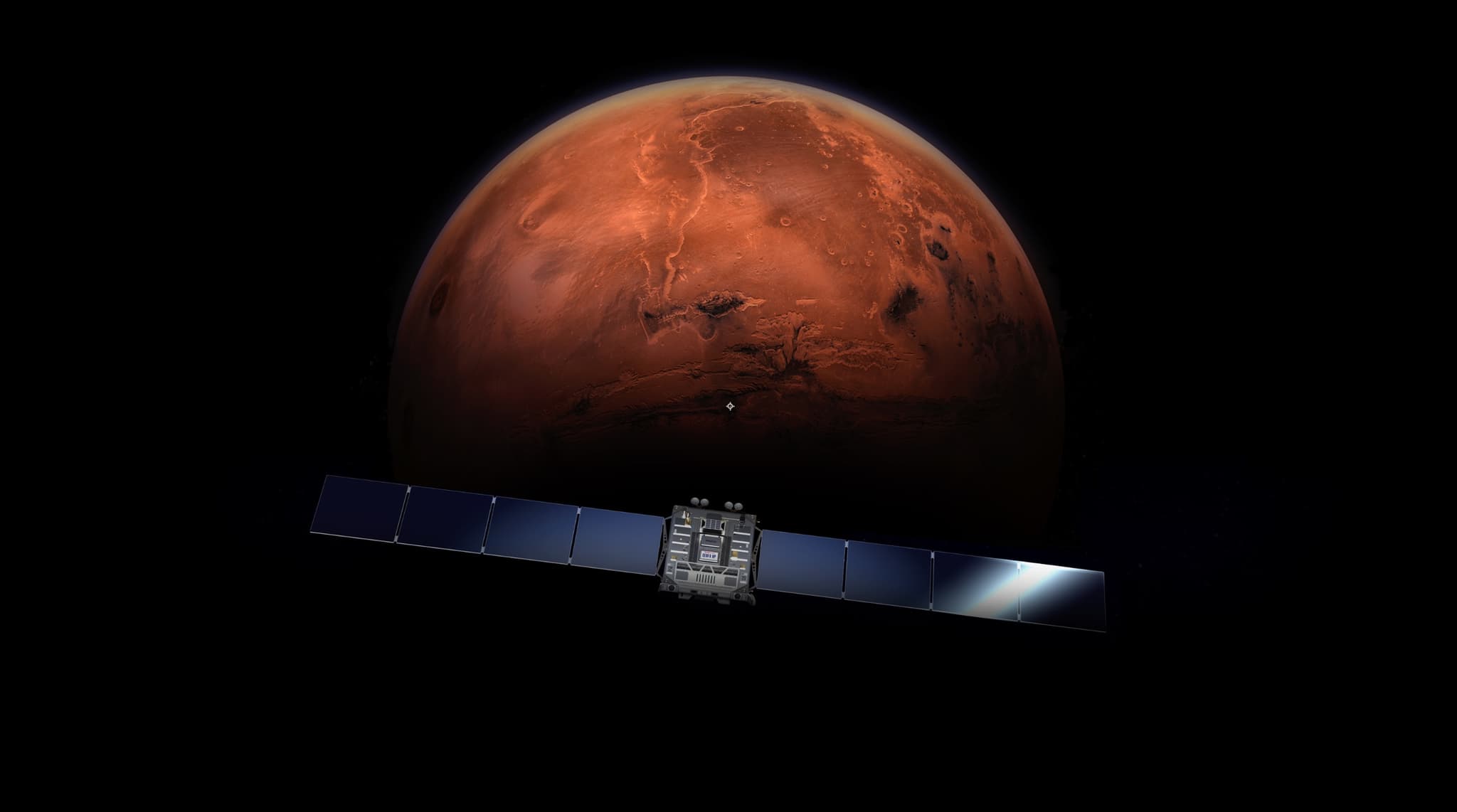
The interesting thing about this mission is the paperwork. NASA did not buy a Mars orbiter. On 17 June 2026, at an event held inside Relativity Space, NASA announced that it would build a four-instrument atmospheric payload called Aeolus at its Ames Research Center, and that Relativity would supply the spacecraft that carries it, the rocket that launches it and the operations that fly it to Mars. NASA supports the instruments for at least one Martian year and writes the software that turns their output into usable science products. The framework is what NASA calls its first six-year reimbursable Space Act Agreement, which means the agency is not the customer in the ordinary sense and no NASA mission cost exists to quote. Relativity has not said what it is spending either. SpaceNews reported that a source familiar with the company's plans said an undisclosed philanthropic organisation is funding it, which is the closest anyone has come to naming the money. Administrator Jared Isaacman framed the point as cadence: "By pairing NASA's world-class instruments with commercial innovation and investment, we can deliver more science, more often." Whether that is a new model or a one-off depends entirely on a rocket that has not yet flown, and it is worth stating at the outset that as of 24 August 2026 the public record contains no mass, no dimensions, no power figure, no science orbit and no arrival date for this spacecraft.
Aeolus itself is older than the partnership by eight years, and its history is the part most coverage leaves out. NASA Ames published it in 2018 as a small-satellite mission concept, paper SSC18-V-06, led by David Mauro with Anthony Colaprete. In that form it was a single spacecraft under 100 kg, with a current best estimate of 32 kg dry and 38 kg wet, that would ride to Mars as a secondary payload on the Next Mars Orbiter, separate from it in a 320 km orbit and climb to a 383 km orbit at 73 degrees inclination so that it could sweep through every local time and see the planet's daily cycle. The payload was four miniaturised Spatial Heterodyne Spectrometers reading Doppler shifts in carbon dioxide and oxygen lines, which is how you measure a wind rather than infer one, plus a Thermal Limb Sounder and a Surface Radiometric Sensor Package. The Next Mars Orbiter was never built. Two of those three instrument names, TLS and SuRSeP, appear unchanged in NASA's 2026 list, alongside a Doppler Wind and Temperature Sounder and a new Wide-Field Context Camera. So the 2026 announcement is not the birth of an idea. It is an eight-year-old Ames concept that lost its ride, found a commercial one, and grew from a 38 kg hitchhiker into a hosted payload on a spacecraft whose mass, size and power remain undisclosed.
Relativity's own account of the mission is broader than NASA's, and the difference matters. NASA's release describes an atmospheric science payload and nothing else. Relativity's programme page adds a shallow radar sounder to map subsurface ice and geology, and a "Relay Data Center" carrying high-bandwidth optical and radio links to Earth, radio relay down to spacecraft on the Martian surface, large storage and server-class onboard computing intended for artificial intelligence models and autonomous science. Neither the radar's builder nor its funder has been named. SpaceNews made the obvious engineering observation: a radar plus that much computing and communications implies substantial power, which drives size and mass, which is exactly what has not been disclosed. Relativity also frames the orbiter as a telecommunications node complementary to the existing Mars relay network, which is a commercial position as much as a scientific one, since NASA's ageing orbiters currently carry that traffic. The company calls the mission a proof of concept for its Interplanetary Sciences Program, and has named no second mission. What exists today is a public commitment, a NASA instrument suite with a real design history, and a set of capabilities described in bullet points.
Then there is the rocket. Terran R is a two-stage partially reusable vehicle intended to lift 33,500 kg to low Earth orbit from Launch Complex 16 at Cape Canaveral, and it has never flown. Relativity's only orbital attempt to date was Terran 1, which flew once in March 2023 and did not reach orbit. Progress on Terran R through 2026 has been real and is documented month by month: by the July company update, published 11 August 2026, the stage one structural qualification campaign was complete after 420 pressure cycles and 4.3 million pounds-force of axial compression while pressurised, the second stage had been mated at NASA Stennis and cryoproofed, the Aeon V engine for flight one had finished acceptance testing, and Launch Complex 16 had permanent power and a partly outfitted integration building. What none of those updates contain is a first flight date. The company said last year it planned a debut in late 2026; SpaceNews reported in June 2026 that industry sources expected 2027; Space.com wrote two days later that the rocket was expected to debut later in 2026. That spread of a year or more, on a vehicle that has to fly, be trusted and then throw a spacecraft to Mars inside the late 2028 window, is the single largest thing standing between this announcement and a mission.
Mission facts
The announcement
17 June 2026, NASA release 26-050, issued the same day Relativity Space announced its Interplanetary Sciences Program. NASA Administrator Jared Isaacman made the announcement at an event held at Relativity Space. NASA's release is dated 17 June 2026 and was last updated 18 June 2026.↗
Who does what
NASA provides the Aeolus instrument suite, designs, builds and integrates it at Ames Research Center in California, supports instrument operations for at least one Martian year, and writes the pipeline that turns raw measurements into science data products. Relativity Space provides the spacecraft, the rocket, cruise operations and spacecraft maintenance.↗
The legal instrument
NASA describes the effort as supported under "NASA's first six-year reimbursable Space Act Agreement." That is not a procurement contract: NASA is not buying a spacecraft, and no NASA mission cost has been published for this flight.↗
What the mission is called
Aeolus is the name of NASA's instrument suite, and Relativity does not use it. Relativity's own programme page calls it "a Mars science orbiter" and never says Aeolus. Most press coverage, including Space.com, calls the whole mission Aeolus. We treat Aeolus as the payload and the orbiter as unnamed.↗
The four instruments
Doppler Wind and Temperature Sounder (DWTS-Ozone), measuring wind and temperature profiles from the surface to about 60 km, in collaboration with GATS; Thermal Limb Sounder (TLS), vertical temperature profiles plus dust and water-ice cloud observations, in collaboration with Xiomas Technologies; Surface Radiometric Sensor Package (SuRSeP), surface energy balance, dust and cloud properties; Wide-Field Context Camera (WFCC), daily global images of atmospheric activity.↗
The instrument NASA did not mention
Relativity's own description of the mission adds "a shallow radar sounder to map subsurface ice and geology, revealing climate and geologic history and high-value landing sites." NASA's release does not mention a radar. Who builds it, and at whose expense, has not been stated.↗
The communications payload
Relativity says the spacecraft will fly a "Relay Data Center" combining high-bandwidth optical and radio-frequency links to Earth, radio-frequency relay to spacecraft on the Martian surface, large data storage, server-class onboard compute and delay-tolerant networking. SpaceNews notes this and the radar together imply high power, which would drive the spacecraft's size and mass, neither of which Relativity has disclosed.↗
Where Aeolus came from
Aeolus is not new. NASA Ames published it as a mission concept in 2018 (paper SSC18-V-06, 32nd Annual AIAA/USU Conference on Small Satellites), led by David Mauro with Anthony Colaprete. It was then a single sub-100 kg spacecraft, current best estimate 32 kg dry and 38 kg wet, flying as a secondary payload with the Next Mars Orbiter (NeMO) and transferring from NeMO's 320 km orbit to a 383 km orbit at 73 degrees inclination for one Martian year of science. NeMO was never built.↗
What the 2018 payload was
The concept carried four miniaturised Spatial Heterodyne Spectrometers paired to two orthogonal telescopes, reading Doppler shifts in carbon dioxide and oxygen lines to get winds directly, plus TLS and SuRSeP. Two of the three 2018 instrument names, TLS and SuRSeP, survive unchanged into the 2026 payload list.↗
Who is paying
Relativity did not disclose what it is spending. SpaceNews reported that "a source familiar with the company's plans said Relativity is working with an undisclosed philanthropic organization to fund it." No figure has been published by either party.↗
The programme it belongs to
The Interplanetary Sciences Program, announced by Relativity on 17 June 2026 as "an initiative to enable radically more science per dollar by building the next generation of interplanetary capabilities." The Mars orbiter is its first mission and is described as a proof of concept; no later missions have been specified beyond a statement about collecting data throughout the Solar System.↗
The rocket
Terran R, a two-stage partially reusable vehicle with a reusable first stage, flying from Launch Complex 16 at Cape Canaveral. NextSpaceflight lists it at 5.4 m diameter, 86.6 m tall, 33,500 kg to low Earth orbit and 15,555 kN of liftoff thrust. It has never flown.↗
Terran R status
As of Relativity's July 2026 company update, published 11 August 2026: the stage one structural qualification campaign is complete, having run 420 pressure cycles and reached 4.3 million pounds-force of axial compression while pressurised; the second stage has been mated to the A2 stand at NASA Stennis and cryoproofed; the Aeon V engine has finished acceptance testing for flight one; and Launch Complex 16 has permanent site power and a partially outfitted integration facility. No first flight date is given in the update.↗
When Terran R flies
Contested and unresolved. SpaceNews reported on 17 June 2026 that the company had said last year it planned a first launch in late 2026, and that "industry sources say they expect that launch to slip to 2027." Space.com wrote two days later that Terran R was "expected to debut sometime later this year." Relativity's own updates through 11 August 2026 give no date.↗
Relativity's flight record
One orbital launch attempt. Terran 1 flew once, in March 2023, and failed to reach orbit; the company shelved it to concentrate on Terran R. Eric Schmidt, chief executive of Google from 2001 to 2011, became chief executive of Relativity in March 2025 while making a significant investment in the company.↗
What has not been disclosed
Spacecraft mass, dimensions, power, propulsion, science orbit, arrival date, mission duration beyond one Martian year of instrument support, total cost, and the identity of the funder. SpaceNews states plainly that Relativity "did not provide technical details about the spacecraft, such as size, mass or power."↗
Mission timeline
- 2018NASA Ames publishes Aeolus as a mission concept: a sub-100 kg spacecraft riding to Mars as a secondary payload on the Next Mars Orbiter, deploying into a 320 km orbit and transferring to 383 km at 73 degrees for one Martian year of wind, temperature and aerosol measurements. NeMO is never built.
- Mar 2023Relativity's Terran 1 makes its only flight and fails to reach orbit. The company shelves the vehicle and concentrates on Terran R.
- Mar 2025Relativity announces that Eric Schmidt has joined as chief executive while making a significant investment in the company. For the next year the company's public communications are almost entirely about Terran R hardware.
- Jan 2026Schmidt Sciences, founded by Eric and Wendy Schmidt, announces the Eric and Wendy Schmidt Observatory System, four observatories including Lazuli, a space telescope with a primary mirror larger than Hubble's, to launch on a Terran R as soon as 2028.
- 17 Jun 2026Relativity announces the Interplanetary Sciences Program. Its first mission is a Mars science and telecommunications orbiter planned for late 2028, carrying a NASA Ames atmospheric instrument suite and a radar sounder.
- 17 Jun 2026NASA issues release 26-050 from an event at Relativity Space, naming the instrument suite Aeolus and setting out the split: NASA provides the instruments, at least one Martian year of instrument operations and the data pipeline; Relativity provides spacecraft, rocket and cruise operations, under NASA's first six-year reimbursable Space Act Agreement.
- 17 Jun 2026SpaceNews reports that Relativity disclosed no spacecraft size, mass or power, did not say what it is spending, and that a source familiar with the plans says an undisclosed philanthropic organisation is funding the mission. The same report notes industry expectations that Terran R's first flight slips to 2027.
- 13 Jul 2026Relativity's June company update repeats that the Interplanetary Sciences Program's first mission is a Mars science orbiter launching in 2028, and reports the Terran R second stage arriving at NASA Stennis.
- 11 Aug 2026Relativity's July company update reports the stage one structural qualification campaign complete, the second stage cryoproofed at Stennis, Aeon V acceptance testing finished for flight one, and Launch Complex 16 energised. The Mars orbiter is not mentioned.
- 2028Planned launch. NASA says 2028; SpaceNews says late 2028, which is where the Earth to Mars window for that year falls. Neither an arrival date nor a science orbit has been published.
A filled dot marks something that physically happened. A hollow one marks an announcement, a naming or a target.
In pictures
Tap a photo to enlarge.
Sources
- NASA release 26-050 (17 Jun 2026): NASA Announces Public-Private Partnership to Advance Mars Science
- SpaceNews, Jeff Foust (17 Jun 2026): Relativity Space to privately develop Mars orbiter mission
- Relativity Space: Interplanetary Sciences Program page
- Relativity Space: June 2026 Company Update (published 13 Jul 2026)
- Relativity Space: July 2026 Company Update (published 11 Aug 2026)
- Relativity Space: press and updates index
- Space.com (19 Jun 2026): A private company will build and launch NASA's next Mars orbiter in 2028
- D. Mauro, A. Colaprete et al., The Aeolus mission concept, an innovative mission to study the winds and climate of Mars, SSC18-V-06, 32nd Annual AIAA/USU Conference on Small Satellites (2018)
- NASA Technical Reports Server citation record for the 2018 Aeolus mission concept paper
- NextSpaceflight: Terran R vehicle data (dimensions, payload, launch site)
- ESA: Aeolus, the Earth-orbiting wind mission of the same name, flown 2018 to 2023
Facts on this page were verified on 24 August 2026. Where sources disagree, the disagreement is stated rather than resolved silently.