Mars Telecommunications Network
NASA · United States · Orbiter · 2025 · AnnouncedIn development
Awarded and under protest: on 1 September 2026 NASA picked Blue Origin for a firm fixed-price contract worth up to about $700 million. Rocket Lab filed a protest with the Government Accountability Office on 11 September; the office has 100 days to rule.
TL;DR· 16 min read
Congress ordered this orbiter and NASA had not asked for it: the reconciliation law signed on 4 July 2025 set aside $700 million for a high-performance Mars telecommunications orbiter, competed under a firm fixed-price contract and delivered to NASA by 31 December 2028. NASA renamed it the Mars Telecommunications Network in February 2026, closed proposals on 15 June and awarded the contract to Blue Origin on 1 September 2026; Rocket Lab protested the award to the Government Accountability Office on 11 September. Meanwhile the relay fleet fell from five orbiters to four when MAVEN was formally ended.
This is a spacecraft Congress ordered NASA to buy rather than one NASA asked for. A single paragraph in the 2025 reconciliation law set aside $700 million for a high-performance Mars telecommunications orbiter, told NASA to compete it under a firm fixed-price contract, and restricted who could bid to companies that had already proposed exactly this kind of spacecraft in earlier sample-return studies. NASA renamed it the Mars Telecommunications Network in February 2026 and ran the procurement at speed. NASA awarded the contract to Blue Origin on 1 September 2026, and Rocket Lab protested the award ten days later. The reason the spacecraft matters is that the relay fleet at Mars is old and one of its five members died in December 2025.
- $700mappropriated by law, to be obligated by the end of fiscal 2026
- 8companies that took part in the studies the law makes bidders prove they did
- 1 Sep 2026NASA awards the contract to Blue Origin; Rocket Lab protests the award on 11 September
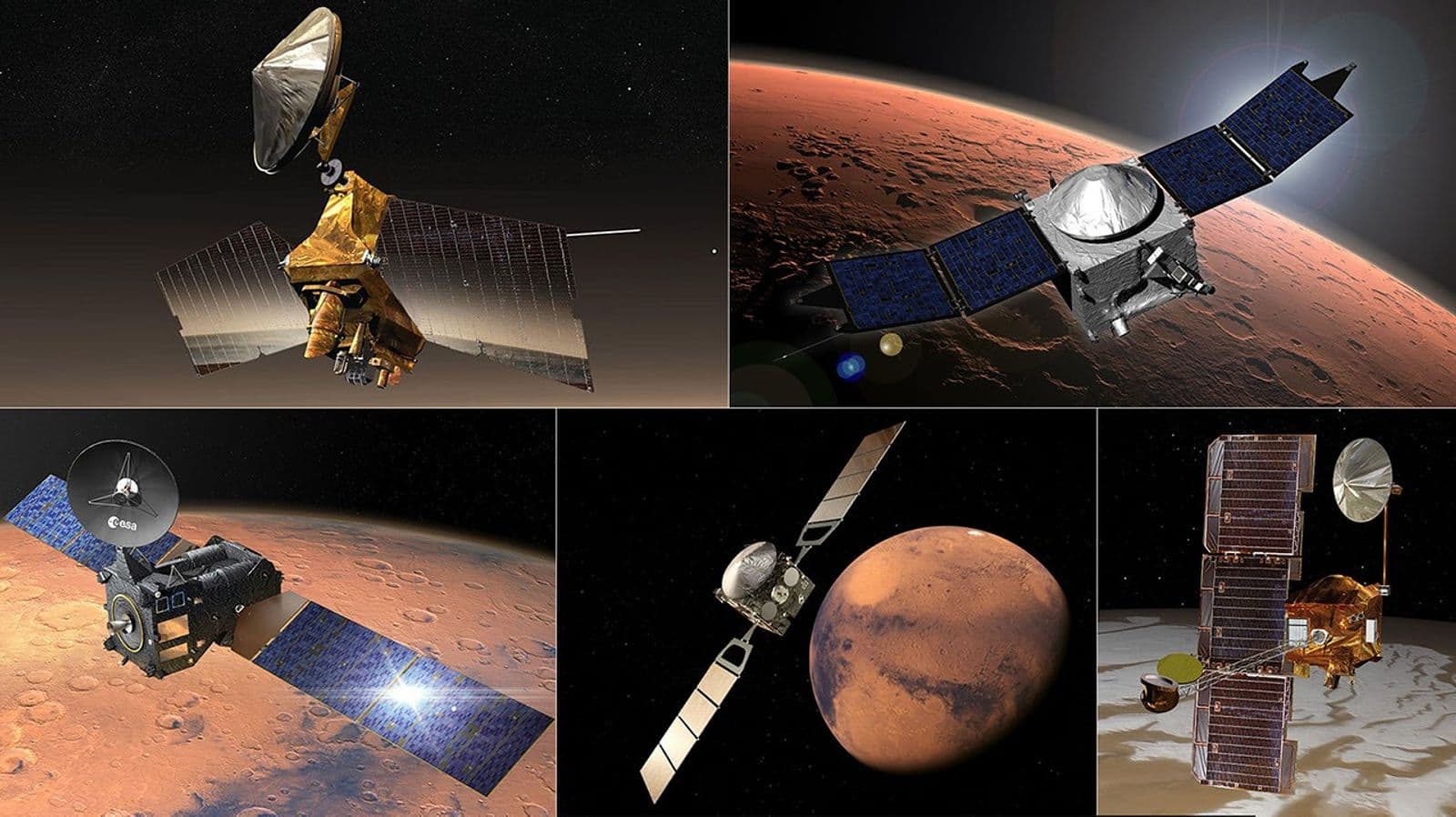
Almost every picture and every byte of data that leaves the surface of Mars goes up to an orbiter first. Curiosity and Perseverance carry small antennas and send the great majority of their data through a relay network that numbered five spacecraft until December 2025 and four since, none of which was built to be a relay. Mars Odyssey arrived in 2001, Mars Express in 2003, Mars Reconnaissance Orbiter in 2006, MAVEN in 2014 and the Trace Gas Orbiter in 2016, and the relay hardware on each is a passenger on a science mission. NASA has known for years that the arrangement is fragile, because a relay that is really a science orbiter retires when the science orbiter does. What it did not have was money for a dedicated replacement. That arrived from an unexpected direction. In the reconciliation bill that became Public Law 119-21 on 4 July 2025, section 40005 appropriated $9.995 billion to NASA for a mixture of Artemis and Mars items, and one paragraph of it set aside $700 million for a high-performance Mars telecommunications orbiter, to be obligated by the end of fiscal 2026, bought under a competitively bid firm fixed-price contract from a United States commercial provider, and delivered to NASA no later than 31 December 2028. Congress had not been asked for it in a budget request. It wrote the requirement itself, down to the contract type.
The paragraph is unusually prescriptive in another way, and this is where the argument starts. It requires the orbiter to be selected from among commercial proposals that received NASA funding in fiscal 2024 or 2025 for commercial design studies of Mars Sample Return, and that proposed a separate, independently launched Mars telecommunication orbiter supporting an end-to-end sample return mission. Eight companies did those sample-return studies: Blue Origin, L3Harris, Lockheed Martin, Northrop Grumman, Rocket Lab, SpaceX, Quantum Space and Whittinghill Aerospace. How many of them proposed a separate telecom orbiter inside their study is not public. One month after the law passed, a slide in Rocket Lab's own investor update said the company was the only commercial provider to have done so. Whether Congress wrote the clause knowing that is not something anyone has confirmed on the record, and NASA has not published the answer. The tension became visible in the procurement itself. NASA's draft request for proposals on 2 April 2026 said the agency would run a full and open competition and merely encouraged bidders to submit non-binding information about their statutory eligibility, which was read on Capitol Hill as sidestepping the law. The final request on 14 May kept the phrase but attached eligibility requirements to it, obliging companies to demonstrate they had done the studies and proposed the orbiter.
The mission NASA has specified is deliberately narrow. Four top-level objectives, all of them plumbing: communications for spacecraft expected to be operating at Mars through 2035, positioning, navigation and timing for those spacecraft, communications for the spacecraft already there, and both services for missions demonstrating entry, descent and landing technologies. At least five years of operation. Up to 100 megabits per second on the direct link to Earth (later revisions set the requirement at 50, with 150 as a goal). Compatibility with the Deep Space Network. Optical communication is neither required nor forbidden. When the February 2026 requirements and the April draft both arrived with no science on board, that sat badly against NASA leadership's repeated line about putting science on every mission, and the agency corrected course: a revised requirements document posted on 9 April, the day of an industry day at Goddard, added an accommodation for a NASA-provided payload of up to 20 kilograms in a box 55 by 55 by 45 centimetres, drawing 60 watts and producing 200 to 1,000 megabits a day, with the possibility of releasing free-flying CubeSats into Mars orbit. What that payload will be has not been decided. Louise Prockter, who runs NASA's planetary science division, told the Mars Exploration Program Analysis Group on 21 April that discussions were under way about what could be flown and when it would have to be ready. Blue Origin, pitching a Blue Ring derivative, says its vehicle could carry as much as 500 kilograms of instruments.
The schedule is the part that should worry a reader. Transfers to Mars are only cheap in windows that open roughly every 26 months, and the one after the late-2026 window opens in late 2028. NASA's own reading of the statutory delivery deadline is that it must launch in that window and be operating at Mars by the end of 2030. To do that it must obligate the $700 million by the end of fiscal 2026, which is why it planned to release the final request on 1 May, take proposals a month later, and have a contractor under contract by 1 October. It slipped two weeks at the first step. Ars Technica reported that one source attributed part of that slip to a letter sent to NASA in May by Senator Roger Wicker of Mississippi, read as favourable to Rocket Lab, whose engine testing happens at Stennis Space Center in his state; NASA, in blackout, would neither confirm the letter existed nor release it. Meanwhile the case for the spacecraft got stronger in the worst way. MAVEN stopped transmitting on 6 December 2025 and NASA formally ended the mission on 3 June 2026. It had been carrying 8 per cent of the relay network's sessions and 18 per cent of the data. NASA named the winner on 1 September 2026, a month ahead of its 1 October target: Blue Origin, under a firm fixed-price contract worth up to about $700 million. Ten days later Rocket Lab protested to the Government Accountability Office, arguing that the award "appears to be inconsistent with the eligibility criteria mandated by Congress", which takes the argument back to the clause Congress wrote. The office has 100 days to rule, and the late-2028 window has not moved.
Mission facts
What it is
A dedicated communications and navigation orbiter at Mars, procured commercially. NASA's four original top-level objectives are to provide communications for spacecraft expected to operate at Mars through 2035, to provide positioning, navigation and timing services for them, to provide communications for existing Mars spacecraft, and to provide communications and PNT for missions demonstrating entry, descent and landing technologies through 2035. Science was not among the objectives in the February draft, which said only that a Science Mission Directorate payload "is not precluded". A revision posted on 9 April 2026 added a fifth objective: "Provide spacecraft bus integration, accommodation, and communication services to a science payload provided by NASA."↗
The money, as written
Public Law 119-21, section 40005, inserts a new section 20306 into title 51 of the United States Code appropriating $9,995,000,000 to NASA for fiscal year 2025, of which "$700,000,000, to be obligated not later than fiscal year 2026, for the procurement, using a competitively bid, firm fixed-price contract with a United States commercial provider ... of a high-performance Mars telecommunications orbiter". The same section funds Gateway at $2.6 billion, SLS for Artemis IV and V at $4.1 billion, and other items.↗
Which law funded it
One law, two names, and no official short title at all. The enacted text is "An Act To provide for reconciliation pursuant to title II of H. Con. Res. 14", H.R. 1 of the 119th Congress, signed 4 July 2025 as Public Law 119-21. Its section 1 is a table of contents where a short title would normally sit: the "One Big Beautiful Bill Act" title was struck during Senate consideration. Reporters call it the One Big Beautiful Bill or simply the budget reconciliation act. NASA calls it the Working Families Tax Cut Act. Senator Cindy Hyde-Smith's own page is headed "The Working Families Tax Cut Act" and glosses it "(One Big Beautiful Bill Act)". They are the same statute.↗
NASA's own wording
NASA's release announcing the final request for proposals states that the Mars Telecommunications Network "is part of NASA's SCaN (Space Communications and Navigation) Program's Moon to Mars strategy, and is enabled by the direction and funding provided by Congress in the Working Families Tax Cut Act." NASA's fiscal 2027 budget request uses the same name throughout, abbreviating it "WFTC Act".↗
The eligibility clause
The law requires the orbiter to be "selected from among the commercial proposals that ... received funding from the Administration in fiscal year 2024 or 2025 for commercial design studies for Mars Sample Return; and ... proposed a separate, independently launched Mars telecommunication orbiter supporting an end-to-end Mars sample return mission". Eight companies took part in those sample-return studies: Blue Origin, L3Harris, Lockheed Martin, Northrop Grumman, Rocket Lab, SpaceX, Quantum Space and Whittinghill Aerospace. NASA has not disclosed which of them proposed a separate telecom orbiter.↗
Rocket Lab's claim
One month after the law was signed, a slide in Rocket Lab's second-quarter 2025 investor update stated that "Rocket Lab was the only commercial provider to propose a MTO as part of an end-to-end Mars Sample Return mission to support human exploration and science missions to Mars." Ars Technica, reporting the slide, asked the obvious question about why a straightforward relay orbiter should require that particular history, and whether Congress was writing for a particular company. NASA has not answered it.↗
Delivery, not launch
The statutory deadline is that the orbiter "shall be delivered to the Administration not later than December 31, 2028". It does not require a launch by that date. NASA's own reading, in the draft procurement documents, is that it expects to launch in late 2028, which is the closing end of that Mars transfer window, and to be fully operational at Mars by the end of 2030.↗
Performance requirements
The draft objectives and requirements published 24 February 2026 call for at least five years of operation, data rates of up to 100 megabits per second on direct links with Earth, and compatibility with NASA's Deep Space Network. Optical communication to Earth is neither required nor precluded. Later revisions changed the link figure: the final requirements (revision D, 28 May 2026) ask for up to 50 megabits per second back to Earth on the high-rate Ka-band link, with 150 as a goal, and keep the five years and Deep Space Network compatibility.↗
The science seat
Neither the February requirements nor the 2 April draft request for proposals included a science payload: the first said only that one "is not precluded", and the second's cover letter said the draft "does not yet reflect recent Agency direction". That sat awkwardly against NASA leadership's stated intention to put science on every mission. A revised requirements document posted on 9 April, the day of an industry day at Goddard, added a requirement to accommodate a NASA-provided payload of up to 20 kg in a volume of 55 by 55 by 45 cm, drawing up to 60 watts and generating 200 to 1,000 megabits of data per day. The industry-day slides, posted 24 April, noted "consideration for deploying free-flying CubeSat payloads in Mars orbit". Louise Prockter, director of NASA's planetary science division, told MEPAG on 21 April that "We are in discussions right now" about what could fly.↗
Full and open, or not
The cover letter to the 2 April draft said NASA "will conduct this acquisition as a full and open competition" and treated the statutory restriction only as an advisory step: it "highly encouraged" bidders to submit nonbinding information on their eligibility, and told them they could compete whatever NASA advised. That raised concern on Capitol Hill that NASA was ignoring the intent of the law. The final request for proposals kept the phrase "full and open competition" but added eligibility requirements tied to the statute, requiring companies to demonstrate they had done the sample-return studies and proposed a telecom orbiter within them.↗
The withdrawn notice
In late January 2026 NASA published a procurement notice listing the companies it considered eligible, naming all eight sample-return study participants, and withdrew it without explanation inside a day.↗
The bidders and the award
Blue Origin and Rocket Lab were the most public bidders. Blue Origin's concept is a version of its Blue Ring spacecraft launched on New Glenn; chief executive Dave Limp posted on 7 May 2026 that it "meets the urgent need for communications, navigation, and relay while also flying up to 500 kg of science instruments to Mars". Rocket Lab's design was based on its Explorer spacecraft platform. On 1 September 2026 NASA awarded Blue Origin a firm fixed-price contract with "a maximum potential value of approximately $700 million to deliver a high-performance Mars telecommunications orbiter to NASA no later than Dec. 31, 2028". Blue Origin is to design, develop, integrate, launch and operate the network, which NASA expects to be operational at Mars by 2030. NASA's release names no spacecraft or rocket and does not say how many proposals it received; Limp said after the award that the orbiter is built on Blue Ring and already in production in Huntsville, Alabama.↗
Rocket Lab's pitch and protest
Rocket Lab has campaigned for the contract in public. Peter Beck, its chief executive, told a 26 February 2026 earnings call, "We've made no secret of the fact that we think Rocket Lab is the strongest contender to deliver NASA's Mars Telecommunications Orbiter program," adding that the company was "well-positioned" and that "others think they can do the job, too". In a blog post in mid-February 2026 the company argued that it "brings a non-Artemis performer into the mix" because it is "free from lunar commitments". After the contract went to Blue Origin, Rocket Lab filed a formal protest with the Government Accountability Office on 11 September 2026, saying that "NASA's award decision appears to be inconsistent with the eligibility criteria mandated by Congress" and that the agency's review of its technical volume was "inconsistent, making incorrect assertions and conclusions". The office has 100 days to rule, which puts its deadline at about 20 December 2026.↗
A senator's letter
Ars Technica reported on 18 May 2026 that one source attributed part of the two-week slip in releasing the final request for proposals to a letter sent to NASA earlier in May by Senator Roger Wicker of Mississippi, which that source read as favourable to Rocket Lab's position. Ars could not obtain a copy, and a NASA spokesperson, citing the procurement blackout, declined to confirm the letter existed or to release it. Rocket Lab tests its Archimedes engine at Stennis Space Center in Mississippi and plans to test engines for its Mars orbiter there.↗
Why the hurry
The relay fleet at Mars is old and shrinking. Mars Odyssey reached Mars in 2001 and Mars Reconnaissance Orbiter in 2006. MAVEN fell silent on 6 December 2025 and NASA formally ended the mission on 3 June 2026. Tiffany Morgan, director of NASA's Mars Exploration Program, said MAVEN had carried 8 per cent of the relay network's sessions but 18 per cent of the data returned, and that "the Mars Relay Network is resilient enough at this point in time to accommodate, for the most part, the loss of MAVEN." Greg Heckler of the SCaN programme described an "urgency" in getting the new network into service.↗
The name change
The project was called the Mars Telecommunications Orbiter, or MTO, from the statute through 2025. NASA renamed it the Mars Telecommunications Network, or MTN, when it published draft objectives on 24 February 2026. Bidders, senators and trade press still use both names, and NASA's own May 2026 release uses MTN while Blue Origin's chief executive was still saying MTO a week earlier.↗
Dates and time zone
Legislative and procurement dates here are Washington local dates, which for these events do not differ from UTC by more than one calendar day. Public Law 119-21 was signed on 4 July 2025. NASA's release announcing the final request for proposals is bylined 14 May 2026 and was last updated 18 May 2026.↗
Mission timeline
- 4 Jul 2025H.R. 1 is signed as Public Law 119-21. Buried in section 40005 is $700,000,000 for a high-performance Mars telecommunications orbiter, to be competed under a firm fixed-price contract and delivered to NASA by 31 December 2028.
- 12 Aug 2025Blue Origin announces a Mars Telecommunications Orbiter based on its Blue Ring spacecraft, supplemented by relay satellites in low Mars orbit carrying UHF links for legacy spacecraft and entry, descent and landing telemetry. Rocket Lab's Peter Beck had pitched the company's own orbiter to investors five days earlier, on 7 August.
- 26 Aug 2025Kevin Coggins, NASA deputy associate administrator for space communications and navigation, tells a Washington Space Business Roundtable event that the agency has no procurement approach yet. "I wouldn't predetermine how we're going to execute that acquisition," he says. "We're going to comply with the language."
- Jan 2026NASA publishes a procurement notice listing eight companies as eligible bidders, then withdraws it without explanation within a day.
- 24 Feb 2026NASA publishes draft objectives and requirements, renaming the project the Mars Telecommunications Network. Four objectives, at least five years of life, up to 100 Mbps to Earth, Deep Space Network compatibility, and no science payload. Comments are due 10 March.
- 2 Apr 2026The draft request for proposals appears. Its cover letter says NASA "will conduct this acquisition as a full and open competition" and asks for eligibility information under the statute only on a nonbinding, advisory basis, which draws concern in Congress.
- 9 Apr 2026Industry day at Goddard Space Flight Center. Firefly Aerospace, Intuitive Machines, Lockheed Martin, Quantum Space and SpaceX attend alongside Blue Origin and Rocket Lab.
- 24 Apr 2026NASA posts the industry-day slides, which set out a requirement, added to the draft on 9 April, to carry a NASA-supplied science payload of up to 20 kg, 55 by 55 by 45 cm, 60 watts, possibly including free-flying CubeSats released into Mars orbit.
- 14 May 2026The final request for proposals is issued, two weeks later than the 1 May date NASA had given at the industry day. Proposals are due 15 June, and NASA says it intends to have the winner under contract by 1 October. Industry is asked to respond within 30 calendar days, and the network is to be ready to operate at Mars no later than 2030.
- 18 May 2026Ars Technica reports that the slip may be connected to a letter to NASA from Senator Roger Wicker, which a source read as favourable to Rocket Lab. NASA, in procurement blackout, will neither confirm nor release it. Peter Beck, asked whether NASA is moving fast enough, says "I think there's plenty of fire lit under them already."
- 3 Jun 2026NASA formally ends MAVEN, silent since 6 December 2025, after a review board finds it unrecoverable. Four relay orbiters remain: Odyssey, Mars Reconnaissance Orbiter, Mars Express and the Trace Gas Orbiter. Officials say the loss underlines the urgency of the new network.
- 15 Jun to 11 Sep 2026Proposals are due on 15 June. On 1 September NASA awards the contract to Blue Origin, firm fixed-price with a maximum potential value of about $700 million, a month ahead of its 1 October target. On 11 September Rocket Lab files a protest with the Government Accountability Office, which has 100 days to rule.
A filled dot marks something that physically happened. A hollow one marks an announcement, a naming or a target.
In pictures
Tap a photo to enlarge.
Sources
- Public Law 119-21, section 40005, full statutory text at GPO govinfo
- NASA (14 May 2026, updated 18 May): NASA Draws on Industry for Mars Telecommunications Network
- NASA fiscal year 2027 full budget request (April 2026)
- SpaceNews (28 Aug 2025), Jeff Foust: NASA developing plan to acquire Mars telecom orbiter
- SpaceNews (1 Mar 2026), Jeff Foust: NASA outlines objectives for Mars communications orbiter
- SpaceNews (25 Apr 2026), Jeff Foust: NASA reserves science payload space for Mars telecommunications mission
- SpaceNews (16 May 2026), Jeff Foust: NASA releases final RFP for Mars communications orbiter
- Ars Technica (18 May 2026), Eric Berger: One Mars spacecraft, two senators, and a cloud of questions
- SpaceNews (3 Jun 2026), Jeff Foust: NASA declares end to MAVEN Mars mission
- SpaceNews (18 Aug 2025), Jeff Foust: Blue Origin offers Mars communications orbiter concept
- Senator Cindy Hyde-Smith: The Working Families Tax Cut Act
- English Wikipedia: One Big Beautiful Bill Act
- NASA contract release C26-010 (1 Sep 2026, updated 2 Sep): NASA Selects Blue Origin as Mars Telecommunications Network Provider
- Via Satellite (2 Sep 2026), Rachel Jewett: Blue Origin Wins Award for NASA's Mars Telecommunications Network
- Space.com (11 Sep 2026), Mike Wall: Rocket Lab protests NASA's decision to award Blue Origin $700 million Mars orbiter contract
- SatNews (14 Sep 2026): Rocket Lab Files GAO Bid Protest Over NASA's $700M Mars Orbiter Award to Blue Origin
- SAM.gov, NASA Goddard presolicitation 80GSFC26MTN011 (posted 23 Feb 2026): Mars Telecommunications Network (MTN), with the preliminary MTN Objectives and Requirements Document
- SAM.gov, NASA Goddard Draft RFP 80GSFC26R0011 (2 Apr 2026, updated to 14 May): cover letter, requirements revision A of 9 April, industry-day slides and attendee list
- SAM.gov, NASA Goddard Final RFP 80GSFC26R0011 (14 May 2026, amended 1 and 10 June): requirements revision D
- Payload (20 Aug 2025): The Commercial Race to Mars Heats Up
- Rocket Lab (Feb 2026): 6 Reasons A Mars Telecommunications Orbiter Matters To Us All
- The Motley Fool (26 Feb 2026): Rocket Lab (RKLB) Q4 2025 earnings call transcript
- Space.com (17 Jun 2026), Sharmila Kuthunur: 'Best. Mars. Mission. Ever.' Scientists hail MAVEN's legacy as NASA retires Red Planet orbiter
Facts on this page were verified on 24 August 2026. Where sources disagree, the disagreement is stated rather than resolved silently.