2001 Mars Odyssey
NASA · United States · Orbiter · 2001 · The long occupationOperating
Operating as of 24 September 2026: in Mars orbit since 24 October 2001, longer than any other spacecraft, and still relaying rover data. NASA's 2025 Senior Review put its usable propellant at 3.2 kg, give or take 2 kg.
TL;DR· 15 min read
2001 Mars Odyssey has orbited Mars since 24 October 2001, longer than any other spacecraft has spent at the planet. Built as the surviving half of Mars Surveyor 2001 after the losses of 1999, it found buried hydrogen within months, the result that sent Phoenix north to dig up the ice in 2008. It then spent two decades as NASA's main relay from the Martian surface, and by 2026 it is a spare link averaging 107.3 Mb a day. NASA's 2025 Senior Review put its usable propellant at 3.2 kg, give or take 2 kg.
Odyssey is the salvaged half of a programme that nearly did not happen. It flew as the orbiter of Mars Surveyor 2001 after NASA lost two spacecraft in 1999 and cancelled the lander meant to fly beside it. Within four months of reaching its mapping orbit it had found hydrogen buried across the high latitudes, which the team read as ice, which is why Phoenix was later sent north to dig for it. Then it spent two decades as the switchboard for almost everything NASA put on the surface. It is still up there, twenty-five years on, and NASA's 2025 Senior Review put its usable fuel at 3.2 kg, give or take 2 kg.
- 105,000+orbits of Mars completed by its 25th launch anniversary in April 2026
- 1.4 millionimages from its cameras by April 2026; NASA's own 2026 page credits THEMIS with more than 1 million
- 3.2 kgusable propellant left, per NASA's 2025 Senior Review (plus or minus 2.0 kg)
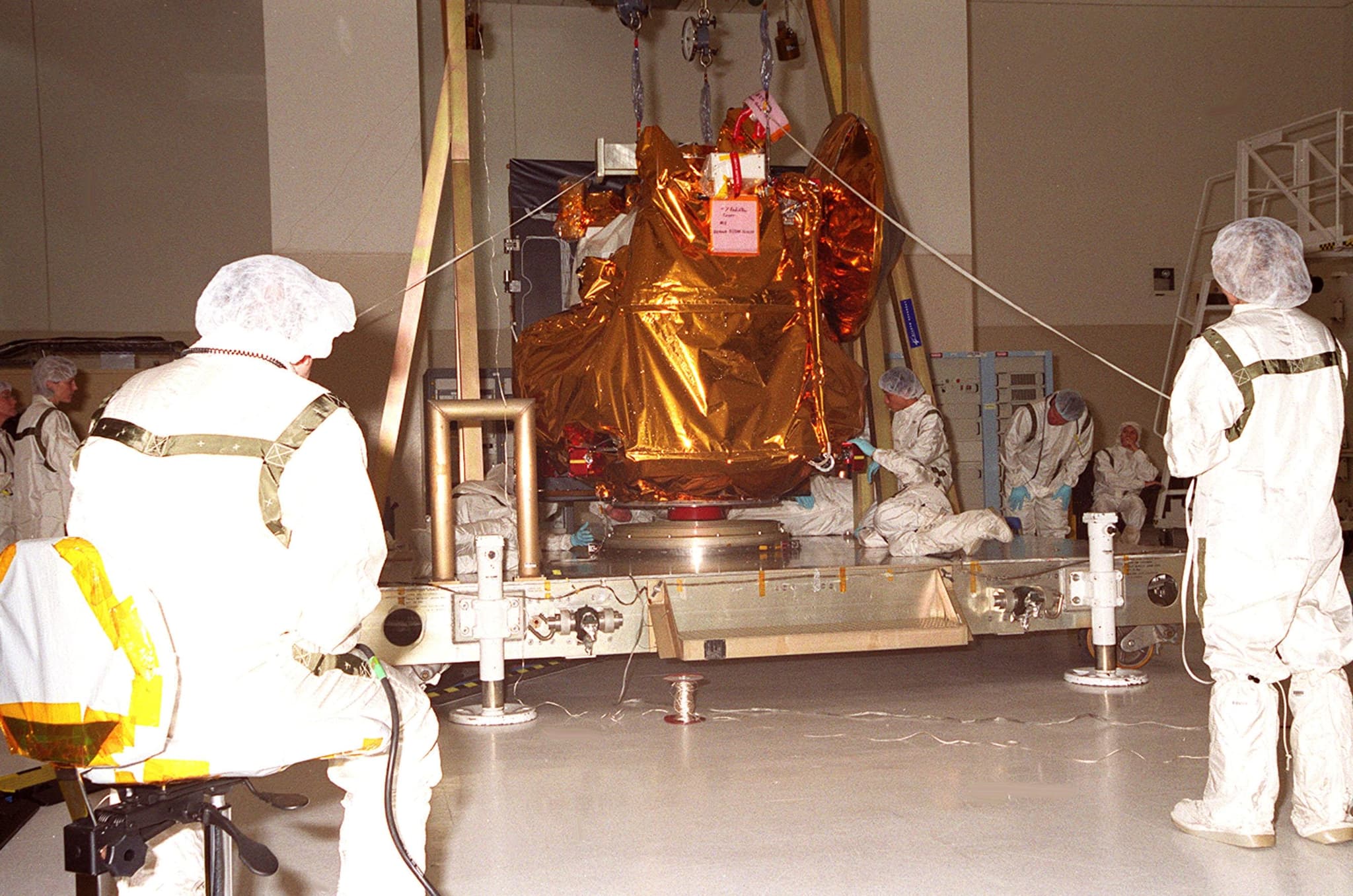
Odyssey exists because two other spacecraft did not come home. Mars Surveyor 2001 was designed as a pair, an orbiter and a lander launched separately, and when Mars Climate Orbiter burned up and Mars Polar Lander went silent in 1999 NASA tore its Mars programme apart and rebuilt it. The lander was cancelled. The orbiter survived, was renamed 2001 Mars Odyssey, and was subjected to the kind of review that failure buys: extra software testing under off-nominal conditions, additional thruster firings, suspect capacitors swapped out, an independent check of the aerobraking plan by Langley, a more conservative aerobraking profile to allow for dust storms, and an extra tracking station in Santiago to close telemetry gaps early in cruise. It launched on 7 April 2001 at 15:02:22 UT carrying three instruments and 725 kg of total mass, a small spacecraft by the standards of what it would go on to do. Arrival on 24 October 2001 went to plan: a main-engine burn into an 18.6-hour capture orbit, then eleven weeks of aerobraking through the top of the Martian atmosphere to shrink it, which ended on 11 January 2002. By 30 January the orbit was a near-circular polar loop about 400 km up with a two-hour period, and on 19 February the science started. The whole nominal mission was 917 days. It has now been flying for more than nine thousand.
The result came almost immediately, and it is still the thing Odyssey is known for. The Gamma Ray Spectrometer suite does not photograph anything. Cosmic rays hit the top metre or so of Martian soil, knock neutrons loose and excite gamma rays whose energies identify the elements present, and hydrogen announces itself by moderating neutrons far more efficiently than anything else. In three papers published in Science on 5 July 2002, the teams reported two large regions near the poles that were unmistakably rich in hydrogen, buried under a hydrogen-poor lid that thinned toward the pole, from a column density of about 150 grams per square centimetre at 42 degrees south to about 40 at 77 degrees south. Boynton's paper concluded that the host of that hydrogen was ice, at 35 plus or minus 15 percent of the layer by weight. That distinction matters and is routinely lost: the instruments found hydrogen. Reading it as water ice was an inference, argued from the fact that the hydrogen-rich ground coincided with where thermal models said ice should be stable. The proof arrived six years later, from a different spacecraft, at a site Odyssey's maps had chosen. Phoenix landed in the Martian far north on 25 May 2008, dug, and found the ice. JPL's own summary of the chain is unusually direct: the hydrogen detection prompted the Phoenix mission, which confirmed the theory.
The second career was not in the mission plan in any serious way, and it lasted longer. Odyssey carried a UHF radio for talking to landers, and from January 2004, when Spirit and Opportunity arrived, it became the default route home for data from the Martian surface. Rovers cannot afford the antennas and the power that direct-to-Earth transmission needs; an orbiter passing overhead can take the data at up to two megabits per second and forward it with a proper dish. By its hundred-thousandth orbit in June 2024, Odyssey had returned 17.2 terabits of data, 1.3 terabits of it relayed from six surface missions: Phoenix, InSight, Spirit, Opportunity, Curiosity and Perseverance. That role has now shrunk. NASA's relay page, updated on 5 June 2026, describes a four-orbiter network and puts Odyssey at two to four passes a day over the rovers with only zero to one of them actually used for relay, averaging 107.3 megabits per day between February and May 2026. ExoMars Trace Gas Orbiter averaged 2,228.1 over the same window and Mars Reconnaissance Orbiter 850.6. Anyone writing today that Odyssey is the backbone of the Mars relay network is describing 2010. It is a working spare that still carries traffic, on a network that lost MAVEN on 3 June 2026.
What nobody can tell you is how long it has left. Odyssey has no fuel gauge, and the only way to weigh what is in its two tanks is to heat them and time how fast they warm, on the principle that an empty kettle boils quicker. A measurement in summer 2021 came back at about 5 kg of hydrazine. A second in January 2022 came back at 2.8 kg, which would have meant months of life. Engineers at JPL and Lockheed Martin ruled out a leak, brought in an outside propellant specialist, and eventually found that heaters on the fuel line between the tanks had been warming them faster than the model allowed for. The corrected answer, published in March 2023, was about 4 kg, enough, NASA said, to last at least through the end of 2025. The newer public figure is in NASA's 2025 Planetary Mission Senior Review, dated 26 March 2025: 3.2 kg of usable propellant, give or take 2.0 kg, against the 1.3 kg the review says the extension through fiscal 2028 needs if no safe-mode event intervenes. The mission also nearly ended for reasons that had nothing to do with hydrazine: the White House budget request for fiscal 2026 proposed terminating it outright, and Congress restored it, funding Odyssey at $10.6 million in the minibus that passed in January 2026. So the honest status, on the evidence available today, is this. It was celebrating twenty-five years in April, relaying rover data in May, listed as active in June, and returning live vectors from Horizons in September.
Mission facts
Launch
7 April 2001, 15:02:22 UT (11:02:22 a.m. EDT), on a Delta II from Cape Canaveral Air Force Station, Florida. The launch press kit gives the vehicle as a Delta II 7925 and describes nine strap-on solid motors, a Star-48B third stage and a 9.5-foot fairing, which is the 7925-9.5 configuration; NASA's current mission page also says 7925. NSSDCA's summary field instead prints 'Delta II 7425', which does not match the hardware described anywhere else. NASA's mission page separately prints the local time as '11:02 am EST', but early April is daylight time in Florida.↗
Spacecraft
725 kg at launch: 331.8 kg of dry spacecraft, 348.7 kg of propellant and 44.5 kg of science instruments. Main structure 2.2 by 1.7 by 2.6 m, solar array 5.7 m tip to tip, producing about 1,500 W near Earth and 750 W at Mars. Built and operated by Lockheed Martin, Denver, for JPL. NSSDCA lists the mass as 376.3 kg, which is the dry spacecraft plus instruments.↗
Where it came from
Odyssey is what survived of the Mars Surveyor 2001 Project, which was to launch an orbiter and a lander separately. The lander was cancelled in the reorganisation of NASA's Mars programme that followed the loss of Mars Climate Orbiter and Mars Polar Lander in 1999. The orbiter was renamed 2001 Mars Odyssey; NSSDCA's reference list dates the naming press release to 28 September 2000.↗
Cost
$297 million total in the pre-launch accounting published in the 2001 press kit: $165 million for spacecraft development and science instruments, $53 million for the launch, $79 million for mission operations and science processing. These are then-year figures, and what they record is a plan rather than a final audit. Twenty-odd years of extended operations are not in them.↗
Instruments
Three. THEMIS, the Thermal Emission Imaging System (principal investigator Philip Christensen, Arizona State University): ten infrared bands at 100 m per pixel and five visible bands at 18 m per pixel, 11.2 kg, 17 W. The Gamma Ray Spectrometer suite (William Boynton, University of Arizona): a gamma sensor head on a 6 m boom, which the press kit planned to deploy about 100 days into the mapping orbit, plus a neutron spectrometer and HEND, the High Energy Neutron Detector, a Russian instrument from the Space Research Institute (IKI) of the Russian Academy of Sciences. And MARIE, the Martian Radiation Environment Experiment (Gautam Badhwar, NASA Johnson Space Center). The PDS mission description notes that GRS and THEMIS could not be operated at the same time, because their required operating conditions conflicted.↗
Arrival
24 October 2001. NSSDCA times the arrival at 02:26 UT and gives the main-engine burn as 19.7 minutes, putting Odyssey into an 18.6-hour capture orbit; the pre-launch plan in the press kit was for roughly 22 minutes into a 17-hour orbit. Aerobraking through the upper atmosphere then ran until 11 January 2002, when the spacecraft pulled out into a 201 by 500 km orbit.↗
Science orbit
Trimmed over the following weeks to a roughly 400 by 400 km near-polar orbit with a two-hour period, reached on 30 January 2002. First science data on 19 February 2002. NASA's relay page gives its present altitude range as 385 to 450 km. NASA describes the primary science mission as running from February 2002 through August 2004; NSSDCA puts the end of the 917-day nominal mission in July 2004. The local mean solar time of the orbit started near 4 p.m. and was later frozen by a manoeuvre at about 5 p.m.↗
The hydrogen result
Three papers in Science on 5 July 2002. Boynton and colleagues reported two regions near the poles enriched in hydrogen, arranged as a hydrogen-poor upper layer over a hydrogen-rich lower one, with the upper layer thinning from a column density of about 150 g per square centimetre at 42 degrees south to about 40 g per square centimetre at 77 degrees south. Their conclusion, quoting the abstract, is that the host of the hydrogen is ice, constituting 35 plus or minus 15 percent of the layer by weight. Feldman and colleagues published the global neutron maps, Mitrofanov and colleagues the HEND maps.↗
What it measured, and what it did not
The instruments detect hydrogen. Nothing on board detects water directly. Cosmic rays striking the top metre or so of soil produce neutrons and gamma rays whose energies fingerprint the elements present; hydrogen shows up because it moderates neutrons efficiently. Reading that hydrogen as water ice is an inference, and Boynton's team argued it by showing the hydrogen-rich regions coincide with where ice is predicted to be thermally stable. The direct confirmation came six years later and from a different spacecraft.↗
Phoenix
JPL's own account of the sequence is blunt: the 2002 detection of subsurface hydrogen, and the deduction that it was frozen water, prompted the Phoenix Mars Lander mission, which confirmed the theory in 2008. The same release records that Odyssey handled most of the data sent home by Phoenix and by the Spirit and Opportunity rovers.↗
MARIE
The radiation instrument had a difficult life and a short one. Flight controllers switched it off on 18 August 2001, during cruise, after it failed to reset following an unanswered downlink session. It was switched back on in early March 2002 once the mapping orbit was established and took data from 13 March. It was then disabled by an intense solar particle event during the Halloween storms. The PDS mission description dates that event to 29 October 2003; several secondary accounts give 28 October, and the storm sequence produced major events on both days. Before it failed the instrument showed abnormally high current draw and temperatures, and attempts to reach it through November and early December 2003 failed. Its result, as JPL summarised it in 2010, was that radiation levels around Mars from solar flares and cosmic rays run two to three times higher than around Earth.↗
The relay years
By its 100,000th orbit NASA counted 17.2 terabits of science data returned, of which 1.3 terabits was relayed from the surface, and six surface missions supported: the Phoenix and InSight landers and the Spirit, Opportunity, Curiosity and Perseverance rovers. Lockheed Martin's April 2026 feature counts eight 'landed assets', adding Beagle 2 and Schiaparelli, and gives 2.3 terabytes of science data delivered and 1.4 terabits relayed. The two counts are not in conflict: Beagle 2 and Schiaparelli both failed, and Odyssey listened for them rather than relaying from them.↗
The relay role today
Much reduced. NASA's Mars Relay Network page, updated 5 June 2026, describes the network as four orbiters: Odyssey, Mars Express, Mars Reconnaissance Orbiter and ExoMars Trace Gas Orbiter. It lists Odyssey making two to four passes a day over the rovers with zero to one of them used for relay, averaging 170.4 Mb per day through 2025 and 107.3 Mb per day from February to May 2026. Over that 2026 window TGO averaged 2,228.1 Mb per day and MRO 850.6. Odyssey is no longer the backbone; it is a spare link that still carries traffic.↗
The network lost a member in 2026
NASA declared MAVEN at an end on 3 June 2026. The spacecraft was last heard from on 6 December 2025, after an unexpected loss of signal as it emerged from behind Mars, and a review board convened in February 2026 found it unrecoverable. The remaining orbiters, Odyssey among them, absorbed its relay load.↗
Fuel
Odyssey launched with 348.7 kg of propellant, of which about 225.3 kg was hydrazine, and has no fuel gauge. A tank-heating measurement in summer 2021 suggested only about 5 kg remained; a second in January 2022 suggested 2.8 kg. Months of investigation, including an outside consultant, found that heaters on a fuel line between the tanks were warming them faster than the model assumed, making them look nearly empty. The corrected figure published in March 2023 was about 4 kg, which NASA said should last the mission at least through the end of 2025. A newer figure is in NASA's 2025 Planetary Mission Senior Review, whose final report is dated 26 March 2025: 3.2 kg of usable propellant, uncertain by plus or minus 2.0 kg at three sigma. The review says the extended mission through fiscal 2028 needs 1.3 kg if no safe-mode events intervene.↗
It was nearly cancelled in 2026
The White House budget request for fiscal year 2026 proposed terminating Odyssey; by The Planetary Society's count, termination plans were drawn up for 19 in-flight missions. Congress rejected the proposal. The minibus appropriation H.R. 6938 passed the House 397 to 28 on 8 January 2026 and the Senate 82 to 15 on 15 January, funding NASA science at $7.25 billion and Odyssey at $10.6 million. The NASA contribution to Mars Express, also proposed for termination, was funded at $0.3 million.↗
Mission timeline
- 7 Apr 2001Launch at 15:02:22 UT on a Delta II 7925 from Cape Canaveral, carrying the surviving orbiter of the cancelled Mars Surveyor 2001 pair.
- 24 Oct 2001Mars orbit insertion. The main engine burns for about twenty minutes into an 18.6-hour capture orbit, and aerobraking begins.
- 30 Jan 2002Aerobraking having ended on 11 January, the orbit is trimmed to a roughly 400 by 400 km near-polar mapping orbit with a two-hour period. First science data follows on 19 February.
- 5 Jul 2002Science publishes three papers from the gamma ray and neutron instruments. Boynton's team reports a buried hydrogen-rich layer near both poles and argues it is ice at 35 plus or minus 15 percent by weight. NSSDCA's reference list dates NASA's announcement press release, 'Odyssey finds water ice in abundance under Mars' surface', to 28 May 2002, six weeks before the papers themselves. It is the result Odyssey is remembered for.
- 29 Oct 2003An intense solar particle event during the Halloween storms disables MARIE, the radiation instrument, after about nineteen months of data. This is the date in the PDS mission description; several secondary accounts say 28 October. THEMIS and the gamma ray suite survive.
- Jan 2004Spirit and Opportunity land. Odyssey becomes their main link to Earth and, for the next two decades, the default relay for almost everything NASA puts on the Martian surface.
- 25 May 2008Phoenix lands in the Martian far north, at a site chosen because Odyssey's neutron maps said there was ice there. It digs, and the ice is there. Odyssey handles most of the lander's data.
- 15 Dec 2010At 5:55 p.m. PST Odyssey begins its 3,340th day in Mars orbit, passing Mars Global Surveyor to become the longest-serving spacecraft at the planet. It has held the record ever since.
- 9 May 2023Engineers roll the spacecraft nearly 90 degrees, a manoeuvre three months in the planning, and THEMIS shoots ten panoramas of the Martian horizon from about 400 km up. NASA calls the view an uncommon one, shot from about the altitude at which the International Space Station flies over Earth.
- 30 Jun 2024Odyssey completes its 100,000th orbit of Mars, with 1.4 million images and 17.2 terabits of data behind it.
- 15 Apr 2026Team members past and present gather at JPL to mark 25 years since launch, rolling out a global map of Mars built from THEMIS infrared imagery. Lockheed Martin's tally the previous day: 105,000 orbits, 1.4 million images, 219,000 hours of operation.
- 5 Jun 2026NASA updates its Mars Relay Network page. MAVEN, declared lost on 3 June, is gone from the active fleet. Odyssey is still listed, still passing over the rovers two to four times a day, and still averaging 107.3 Mb per day of relayed data over February to May 2026.
A filled dot marks something that physically happened. A hollow one marks an announcement, a naming or a target.
In pictures
Tap a photo to enlarge.
Sources
- NASA/JPL, 2001 Mars Odyssey Launch press kit (April 2001)
- NSSDCA Master Catalog: 2001 Mars Odyssey (2001-013A), archived 20 Jul 2025
- NASA Science: Odyssey Celebrates 25 Years (page updated 30 Apr 2026)
- NASA Science: 2001 Mars Odyssey mission page (updated 22 Jun 2026)
- NASA Science: Mars Relay Network (page updated 5 Jun 2026)
- NASA/JPL (15 Mar 2023): Engineers Keep an Eye on Fuel Supply of NASA's Oldest Mars Orbiter
- NASA Science (27 Jun 2024): Odyssey's Accomplishments at Its 100,000th Orbit
- NASA PDS Geosciences Node: 2001 Mars Odyssey mission description (mission.txt)
- NASA/JPL (15 Dec 2010): NASA's Odyssey Spacecraft Sets Exploration Record on Mars
- Lockheed Martin (14 Apr 2026): Odyssey's 25-Year Triumph
- W. V. Boynton et al., Distribution of Hydrogen in the Near Surface of Mars: Evidence for Subsurface Ice Deposits, Science 297, 81-85 (5 Jul 2002)
- W. C. Feldman et al., Global Distribution of Neutrons from Mars: Results from Mars Odyssey, Science 297, 75-78 (5 Jul 2002)
- The Planetary Society (Jan 2026): You just saved NASA's budget
- NASA, 2025 Planetary Mission Senior Review, Final Report (dated 26 Mar 2025; report package of 9 Jun 2025, PDF)
- IKI RAS (7 Apr 2021, in Russian): Нейтронный детектор ХЕНД: двадцать лет в космосе (The HEND neutron detector: twenty years in space)
Facts on this page were verified on 24 September 2026. Where sources disagree, the disagreement is stated rather than resolved silently.