Beagle 2
ESA / UK · Europe · Lander · 2003 · The long occupationFailure
Landed on Isidis Planitia on 25 December 2003, never sent a single bit, and was declared lost on 6 February 2004. HiRISE found it intact on 16 January 2015, panels only partly opened; still silent as of 23 August 2026.
TL;DR· 16 min read
Beagle 2 landed on Isidis Planitia on 25 December 2003 and never transmitted a single bit. Colin Pillinger's 33 kg British lander was spring-ejected from Mars Express on 19 December, was declared lost on 6 February 2004, and was filed as a crash for eleven years. In January 2015 HiRISE imagery found it lying intact on the surface with its solar panels only partly opened over the antenna they were meant to uncover, so ejection, entry, descent and landing had all worked.
Beagle 2 is the strangest entry in the Mars catalogue: a landing that worked and a mission that returned nothing. Colin Pillinger's 33 kg British lander was spring-ejected from Mars Express on 19 December 2003, entered the atmosphere on Christmas Day, and then said nothing at all, ever. For eleven years it was filed as a crash. In January 2015 NASA's Mars Reconnaissance Orbiter found it in Isidis Planitia, a few kilometres from where it was aimed, lying flat with its solar panels only partly unfolded.
- 11 yearsbetween the silent landing and the lander being found in orbital images
- 0bits of data ever received from Beagle 2 after it left Mars Express
- 3 of 4solar panels the 2016 reflection analysis judged most likely to have opened
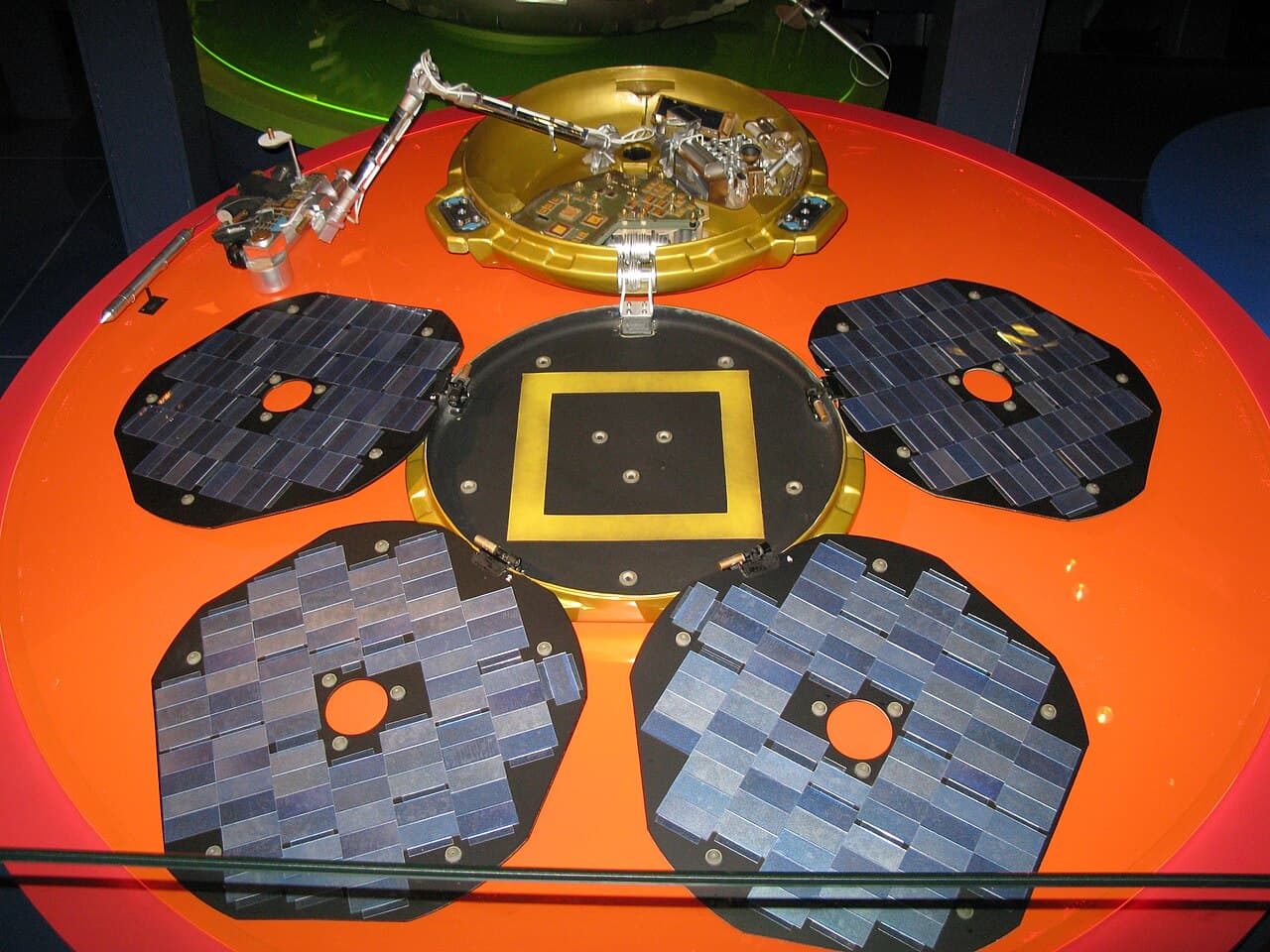
Beagle 2 was not really an ESA project. It was Colin Pillinger's project, flown on an ESA spacecraft. Pillinger, a planetary scientist at the Open University, persuaded ESA in 1997 to carry a British-built lander on Mars Express and then spent the next six years trying to pay for it. What the lander could be was brutally constrained by the ride: Mars Express could spare a slot on its top deck and a few tens of kilograms, so the thing that eventually flew massed about 33 kg on the surface and folded shut like an oversized pocket watch. What it was for was ambitious out of all proportion to that. Its Gas Analysis Package was a mass spectrometer fed by stepped-combustion ovens, built to look for organic carbon carrying the isotopic signature that life leaves, to hunt for methane in the Martian air, and if it could, to date a rock in place. Viking had asked a version of that question in 1976; Beagle 2 was Europe's attempt at it. The money never matched the ambition, and Pillinger raised profile where he could not raise cash. Damien Hirst painted the spot-pattern calibration chart the cameras and spectrometers were to photograph on arrival. Dave Rowntree and Alex James of Blur were nagged until they agreed to promote the mission and compose its call sign. Neither the painting nor the tune was ever seen or heard from Mars.
The design that made Beagle 2 possible also gave it one fatal dependency. The lander was a shallow carbon-fibre bowl 0.66 m across and 0.08 m deep, with a lid of the same diameter, and the four pentagonal solar panels, 0.57 m each, were stacked inside that lid. On the ground the lid would open, then the panels would swing out one at a time under software control, checking illumination at 130 degrees and continuing to a maximum of 160, timing out and moving to the next panel if one stuck. Only when all four were out would the UHF antenna set into the lid be exposed. Until that moment Beagle 2 could not say a word to anybody, and it had no other way of speaking. It carried no system at all to transmit during entry, descent and landing, because there was nothing to receive such a signal: Mars Express was busy inserting itself into orbit, Mars Odyssey was committed to the incoming Mars Exploration Rovers, and the Lovell Telescope at Jodrell Bank, standing in as a direct-to-Earth listening station, was not in view. So the whole descent was designed to be silent. The airbags would be inflated with ammonia rather than an organic gas that might contaminate the very samples the mission existed to analyse, the probe would bounce across Isidis Planitia and then drop clear of the airbags to the ground, and it would either open or it would not. Either way nobody on Earth would learn anything about the previous eight minutes.
Beagle 2 was spring-ejected on 19 December 2003 at 08:31 UTC and coasted for close to six days. Entry was expected at 02:51:22 UTC on Christmas Day at 5.6 km/s, with touchdown roughly eight minutes later; NSSDCA's page puts the landing at about 02:54, a few minutes' discrepancy that nobody can now resolve. The first call home was due through Mars Odyssey at 05:25 UTC. It did not come, nor on the next pass, nor the one after. The Lovell Telescope listened on 25, 26 and 27 December, the last attempt alongside the Stanford radio telescope, and heard nothing. Over four months, 24 contact attempts were made through Odyssey and Mars Express. Every one returned absolutely nothing: no carrier, no fragment, no anomaly to work with. On Friday 6 February 2004 the Beagle 2 Management Board met in London and declared the lander lost. Five days later ESA and UK Science Minister Lord Sainsbury announced a joint Commission of Inquiry under ESA Inspector General René Bonnefoy, with David Link as UK deputy chairman. It reported on 21 April and its 19 recommendations were presented at a press conference in London on 24 May 2004. No single technical failure was identified. What the Commission found instead, across those recommendations and the full report released in February 2005, was a project whose schedule was fixed by the 2003 launch window, whose money and mass budgets were tight from beginning to end, and which had been treated as a scientific instrument when it was in fact a spacecraft.
The absence of data left a decade of argument in which nothing could be ruled out. Candidate causes accumulated and never narrowed: an unusually thin atmosphere over the site that would have thrown the parachute timing, electronics failing under landing shock, a punctured gas bag, heat shield damage, a broken antenna, a collision with something unseen, the airbags tangling with the parachute during the bounces. When the full inquiry report was published in February 2005 it was harsher than the recommendations had been. ESA's peer review had approved Beagle 2 on the condition it be fully funded from the outset; the condition was never met, the lack of guaranteed early funding had hindered the orderly build-up of the engineering team, and the report concluded that a spacecraft this complex and this novel needed managing by an organisation with relevant experience, which was likely beyond a university-led group. Meanwhile the search misfired in public. In December 2005 Pillinger presented processed Mars Global Surveyor camera images of a crater inside the landing ellipse and argued that Beagle 2 might be sitting in it. When MRO's much sharper HiRISE camera photographed the same crater in February 2007, there was nothing in it that could be matched to any part of the lander. Pillinger said publicly that he was disappointed but still expected a future image to show where Beagle 2 had come to rest. He died in May 2014 without ever seeing one.
The answer arrived because two things changed. The landing ellipse had been recomputed in 2004 from the reconstructed Mars Express trajectory, shrinking from 174 by 106 km to 57 by 7.6 km, and from 2006 HiRISE was photographing that ground at 30 cm per pixel. Michael Croon, a former member of the Mars Express operations team at ESOC, noticed a gap in the coverage, asked for an image through the HiWish public targeting programme, and in November 2014 flagged something bright. Follow-up frames confirmed it: an object about 1.5 m across, multi-lobed, far brighter than the terrain around it, casting no shadow, glinting differently in every image as the sun and orbiter moved. On 16 January 2015 it was announced as Beagle 2, partially deployed, about 5 km from the centre of the expected landing area. That single find rewrote the mission's story. Ejection, entry, parachute descent, airbag landing and at least the beginning of the deployment sequence had all worked. Only the last step had not. How much of it failed remains genuinely open: 2015 said one to three panels were open, a 2016 reflection analysis said at least three, with the fourth blamed for covering the antenna, and the 2017 paper allows for all four plus antenna damage. As of 23 August 2026 Beagle 2 lies where it landed, silent, and in June 2026 the UK Space Agency announced thirteen commemorative red plaques for it across the UK.
Mission facts
What it was
A UK-led exobiology lander carried to Mars on the top deck of ESA's Mars Express and named after HMS Beagle, the ship Charles Darwin sailed on between 1831 and 1836. It was designed to look for extinct life through isotopically fractionated organic material on and roughly 2 m below the surface, to search the atmosphere for methane as a possible biomarker, and if possible to attempt in-situ potassium-argon dating of a sample.↗
Mass (sources disagree)
Every source agrees the lander itself was about 33 kg on the surface: NASA's NSSDCA gives 33.2 kg at touchdown. The probe as flown is less settled. NSSDCA puts the lander package at 69 kg at launch; the 2017 paper written by members of the Beagle 2 team gives 72.7 kg including the entry and landing systems. NSSDCA also lists a 33.2 kg headline mass. The figure it prints there is the landed mass, and it is often mistaken for the launch mass.↗
Size and shape
Per the engineers' own description: a shallow carbon-fibre-composite bowl 0.66 m across and 0.08 m deep, a lid of the same diameter and 0.03 m deep, and four pentagonal solar panels nominally 0.57 m across stacked inside the lid with their rear faces uppermost. Fully deployed the lander would have been 1.7 m across, with the panels at 20 degrees to the horizontal. NSSDCA instead describes the bowl as 0.65 m across and 0.25 m deep.↗
Payload
The Gas Analysis Package, a mass spectrometer fed by a stepped-combustion oven system; a Position Adjustable Workbench on a robotic arm carrying stereo cameras, a microscope, Mössbauer and X-ray fluorescence spectrometers, a rock corer-grinder and a lamp; environmental sensors; and PLUTO, the Planetary Undersurface Tool, a self-hammering mole on a power cable that was to crawl about 3 m from the lander at roughly 1 cm every 5 seconds and burrow for a subsurface sample.↗
Planned landing site (sources disagree)
The 2017 team paper gives the planned site as 11.60 N areocentric, 90.74 E, at -3367 m on the MOLA datum, on the flat floor of the Isidis basin. NSSDCA's page instead states the target as 10.6 N, 270 W (that is 90 E), about 70 km away. The team figure is the one used in the technical accounts of the landing ellipse.↗
Landing ellipse and the 2004 recalculation
At launch the 3-sigma ellipse was 174 by 106 km at an azimuth of 74.9 degrees, an area of about 14,500 square kilometres. In 2004 it was recomputed from the reconstructed Mars Express trajectory and Monte Carlo modelling to semi-axes of 28.5 by 3.8 km, that is 57 by 7.6 km, around a nominal point of 90.50 E, 11.53 N. That recalculation, plus HiRISE imaging the region at 30 cm per pixel from 2006, is the reason the lander was ever found.↗
No entry, descent and landing telemetry
Beagle 2 carried no system to transmit during entry, descent and landing. Nothing was positioned to receive such a signal: Mars Express was performing its own orbit insertion, Mars Odyssey was committed to Mars Exploration Rover entry operations, and the Lovell Telescope at Jodrell Bank, acting as a direct-to-Earth listening station, was not in view. So no such system was built. This single decision is why the failure went unexplained for eleven years.↗
Entry and landing times (sources disagree)
All times UTC. The team paper gives atmospheric entry at 02:51:22 on 25 December 2003, with touchdown about eight minutes later and first data expected via Mars Odyssey at 05:25. NSSDCA gives landing at about 02:54 and the first Odyssey opportunity at about 05:30. Aerodynamic deceleration was designed to start at 5.6 km/s; NSSDCA describes entry at over 20,000 km/h, which is the same speed expressed differently.↗
The silence and the search
Nothing was heard on the first Odyssey pass or any later one. The Lovell Telescope tried on 25, 26 and 27 December 2003, the last attempt jointly with the Stanford radio telescope. Over the following four months 24 contact attempts in total were made through Mars Odyssey and Mars Express. Not one produced a carrier, a fragment or any signal at all.↗
Declared lost
The Beagle 2 Management Board met in London on Friday 6 February 2004 and declared the lander lost. On 11 February 2004 UK Science Minister Lord Sainsbury and ESA announced a joint ESA/UK Commission of Inquiry, chaired by ESA Inspector General René Bonnefoy with David Link MBE as UK deputy chairman, with terms of reference covering both technical issues and programmatics.↗
What the inquiry concluded
No single technical failure or shortcoming was unambiguously identified, though a few credible causes were highlighted. The report was submitted to the UK Minister for Science and Innovation and ESA's Director General on 21 April 2004 and accepted; its 19 recommendations to the British authorities and ESA were presented at a joint ESA/BNSC press conference in London on 24 May 2004. ESA's release goes no further than saying the Board made clear that there were programmatic and organisational reasons which significantly increased the risk of failure. The specific finding that Beagle 2 had been treated as a scientific instrument rather than as a spacecraft in its own right comes from the full report published in February 2005. The 2004 recommendations do not contain it.↗
Cost, and the funding verdict
There is no audited public figure for what Beagle 2 cost. NSSDCA states the exact cost is not known and that most estimates give a range of £40 million to £50 million, roughly $65 million to $80 million at the time; the Science Museum calls it the £45 million Beagle 2 spacecraft. Other figures circulate, higher and lower, because they measure different things: early estimates, the UK government's share, build cost and total programme cost. The Commission of Inquiry's full report, published on 3 February 2005, was less concerned with the total than with the timing. ESA's peer review had approved Beagle 2 on condition that it be fully funded from the outset; that condition was never met, and the lack of guaranteed early funding is described as having seriously hindered the orderly build-up of the project engineering team. The report also concluded that Beagle 2 should have been recognised as a complex, innovative spacecraft needing management by an organisation with relevant experience, which was likely beyond the capability of a university-led group.↗
Hirst, Blur and the money problem
Unable to raise cash easily, Pillinger raised profile. He enlisted Damien Hirst to use his spot motif as the instrument calibration chart that the cameras and spectrometers would have photographed on Mars, and pressed Dave Rowntree and Alex James of Blur until they agreed to promote the mission and compose Beagle 2's call sign. Neither the painting nor the tune was ever seen or heard from the surface.↗
The 2005 false alarm
On 21 December 2005 ESA reported that the Beagle 2 team believed it had possible evidence for the lander's location in Mars Global Surveyor camera images, centred on a crater near the planned landing site; ESA's Director of Science David Southwood said it would be good news for everyone involved if it turned out to be a definitive sighting. It did not hold up. When MRO's far sharper HiRISE camera imaged the same crater in February 2007, nothing inside it could be reconciled with Beagle 2 hardware, and the object identified in 2015 is not in a crater at all.↗
Found
Announced on 16 January 2015. Michael Croon, a former member of ESA's Mars Express operations team, identified a gap in HiRISE coverage, requested an image through the HiWish public targeting programme (ESP_037145_1915, acquired 29 June 2014), and in November 2014 flagged a candidate in it. The clinching colour observation, ESP_039308_1915, was taken on 15 December 2014 at 28.2 cm per pixel from an altitude of 276.4 km, resolving objects about 85 cm across. Croon is listed on the resulting paper simply as a citizen scientist.↗
How many solar panels opened
The answer has moved. ESA's January 2015 announcement described only one, two or at most three of the four panels as open. In November 2016 a De Montfort University and University of Leicester reflection-analysis study, matching a 3D model's simulated glints against raw HiRISE frames, concluded that at least three had deployed, and attributed the silence to the fourth panel failing to unfold correctly and blocking the antenna. The 2017 paper says at least the lid and panels one to three could have deployed and possibly all of them, and adds that if all four opened then damage to the antenna system must also be part of the explanation.↗
Mission timeline
- 1997Colin Pillinger of the Open University persuades ESA to carry a British-built lander on Mars Express, then starts hunting for the money to build it, recruiting Damien Hirst for the calibration target and Dave Rowntree and Alex James of Blur to promote the mission.
- 2 Jun 2003Mars Express launches from Baikonur on a Soyuz with Beagle 2 bolted to its top deck.
- 19 Dec 200308:31 UTC: Beagle 2 is spring-ejected onto a ballistic trajectory. It has no propulsion, no attitude control and no radio it can use, and coasts for close to six days. All pre-ejection telemetry showed the probe in good health.
- 25 Dec 2003Entry is expected at 02:51:22 UTC at 5.6 km/s, with airbag-cushioned touchdown roughly eight minutes later (NSSDCA gives about 02:54). Nothing on Earth or in Mars orbit is listening, by design. The first call home, due through Mars Odyssey at 05:25 UTC, never arrives. The Lovell Telescope at Jodrell Bank listens for surface transmissions directly on 25, 26 and 27 December, the last attempt alongside the Stanford radio telescope, and hears nothing.
- 6 Feb 2004After 24 contact attempts over four months through Mars Odyssey and Mars Express, the Beagle 2 Management Board meets in London and declares the lander lost. ESA and Lord Sainsbury announce a joint Commission of Inquiry five days later.
- 24 May 2004The Commission of Inquiry's 19 recommendations are presented at a joint ESA/BNSC press conference in London, five days after ESA's release announcing them. No single technical failure is identified; the weight of the finding falls on programmatic and organisational causes.
- 3 Feb 2005The full inquiry report is published, concluding that ESA should not have confirmed Beagle 2's selection when the peer review committee's condition of guaranteed full funding had not been met.
- Dec 2005 to Feb 2007Pillinger presents processed Mars Global Surveyor camera images of a crater inside the landing ellipse and argues Beagle 2 may be in it. When MRO's far sharper HiRISE camera photographs the same crater in February 2007, nothing inside it can be reconciled with Beagle 2 hardware.
- May 2014Colin Pillinger dies in May, a decade after the landing and before any image of Beagle 2 had been found. He never learns that it made it down.
- 16 Jan 2015ESA, NASA and the UK announce that Beagle 2 has been identified in HiRISE imagery in Isidis Planitia, about 5 km from the centre of the expected landing area, partially deployed. The entry, descent and landing sequence had worked.
- Nov 2016 to Oct 2017Reflection analysis at De Montfort and Leicester concludes at least three of four panels opened, and the peer-reviewed identification paper follows in Royal Society Open Science, fixing the position at 90.43139 E, 11.52879 N and dedicating itself to the late Colin Pillinger.
- 8 Jun 2026The UK Space Agency announces 13 commemorative red plaques to be unveiled at Beagle 2 sites across the UK, from the National Space Centre in Leicester to Airbus in Stevenage, the Open University and Jodrell Bank.
A filled dot marks something that physically happened. A hollow one marks an announcement, a naming or a target.
In pictures
Tap a photo to enlarge.
Sources
- Bridges, Clemmet, Croon, Sims, Pullan, Muller, Tao, Xiong, Putri, Parker, Turner and Pillinger, 'Identification of the Beagle 2 lander on Mars', Royal Society Open Science 4:170785, 11 October 2017 (open access)
- NSSDCA Master Catalog: Beagle 2 (2003-022C), archived 24 July 2025
- HiRISE ESP_039308_1915: Finding Beagle 2 (image acquired 15 December 2014)
- ESA press release: Beagle-2 lander found on Mars, 16 January 2015
- ESA: Beagle 2, lessons learned and the way forward, 20 May 2004
- ESA: UK and ESA announce Beagle 2 inquiry, 11 February 2004
- CORDIS: Beagle 2 mission should never have got off the ground, concludes inquiry
- Phys.org: Where is Beagle 2? The search continues, 16 February 2007
- ESA: Possible evidence found for Beagle 2 location, 21 December 2005
- De Montfort University: Scientists solve mystery of Beagle 2 Mars lander, 11 November 2016
- Roger Highfield, 'Britain's Great Martian Adventure', Science Museum blog, 20 December 2018
- UK Space Agency (GOV.UK): Britain's once lost Mars lander gets its place in history with plaques at locations across the UK, 8 June 2026
Facts on this page were verified on 23 August 2026. Where sources disagree, the disagreement is stated rather than resolved silently.
90.4314 E, 11.5288 N · Isidis Planitia