Mars Express
ESA · Europe · Orbiter · 2003 · The long occupationOperating
Operating as of 24 September 2026: Europe's first mission to another planet has orbited Mars since 25 December 2003. It carried the lost Beagle 2, and its MARSIS radar found the most argued-over reflection on Mars.
TL;DR· 15 min read
Mars Express has orbited Mars since 25 December 2003, built cheaply from Rosetta spares and instruments orphaned by the loss of Mars 96, and still working after more than twenty-two years. It carried the lost Beagle 2, and its MARSIS radar produced the most argued-over measurement in modern Mars science: a bright reflection at the base of about 1.5 km of south polar ice, read in 2018 as liquid water. SHARAD sounded the same ground in November 2025 and saw only a faint return; its team says reconciling the two radars remains essential.
Mars Express was built fast and cheap out of Rosetta spares and instrument designs orphaned by the loss of Russia's Mars 96, and it was supposed to work for one Martian year. It has now worked for more than twenty-two years in orbit at Mars, through a crippled solar array, a stuck radar boom, the loss of its long-term memory and the deliberate shutdown of its gyroscopes. It also produced the single most contested measurement in modern Mars science: a patch of unusually bright radar echo under a kilometre and a half of south polar ice, which may or may not be liquid water.
- 1stEuropean spacecraft to orbit another planet, per ESA
- 25,000orbits of Mars completed on 19 October 2023
- 85.6%of Mars mapped by its stereo camera at better than 20 m per pixel by January 2024
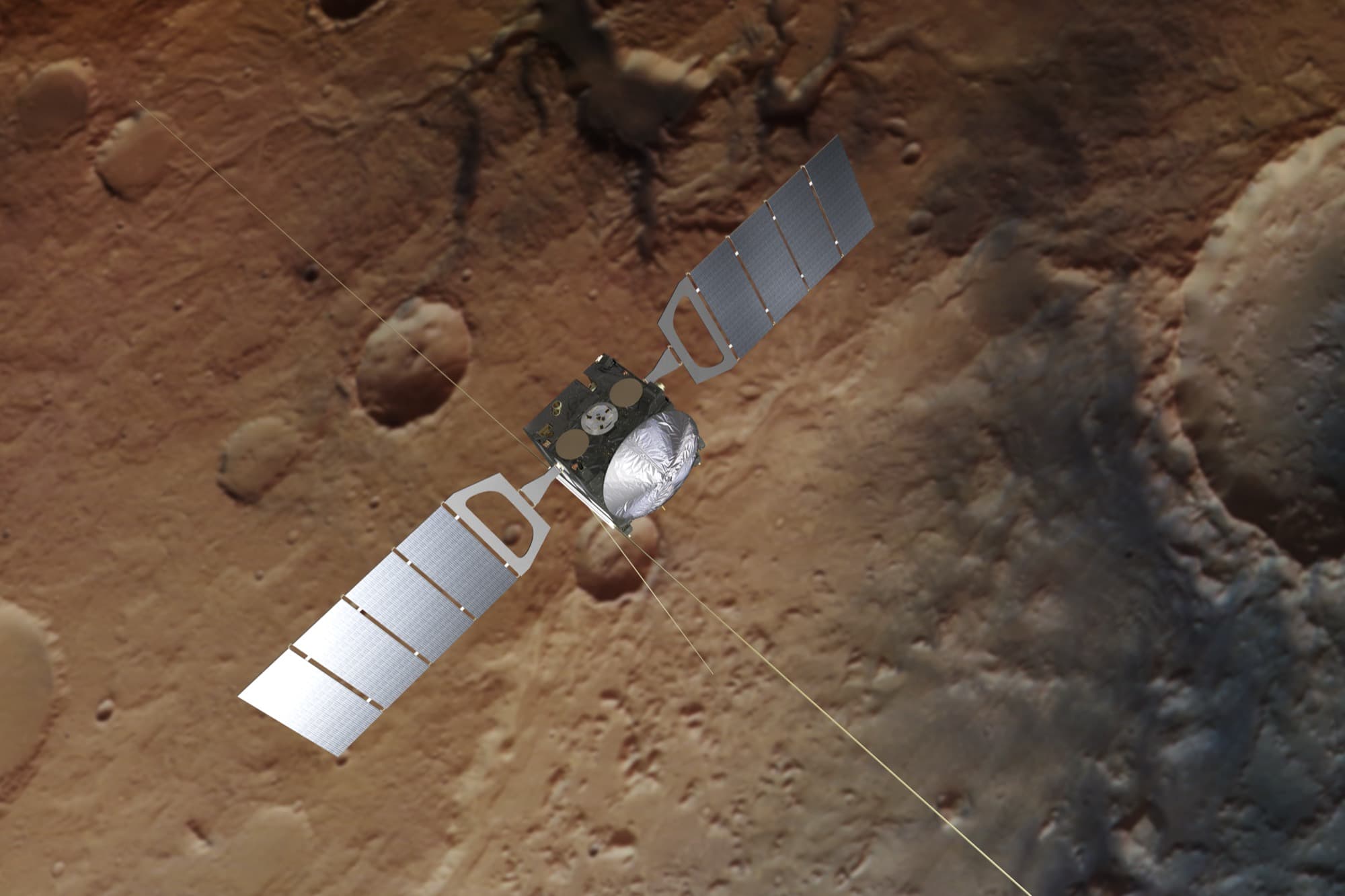
Mars Express was ESA's answer to a question nobody in Europe had answered before: could you build a serious planetary spacecraft quickly and cheaply enough that losing it would not be a catastrophe. The recipe was reuse. Equipment developed for Rosetta went into the bus, and several instruments were rebuilds of designs orphaned when Russia's Mars 96 failed to leave Earth orbit in November 1996. Astrium of Toulouse led 24 companies from 15 European countries and the United States, and NSSDCA puts the orbiter's budget at 150 million euros. It launched on 2 June 2003 on a Soyuz/Fregat, carrying eight instruments and a 60 kg British lander bolted to the top deck. Almost immediately something went wrong: a wiring fault in the solar array left about 60 percent of the expected power available, and the flight control team spent the cruise rebuilding the mission plan around the shortfall. Beagle 2 was released on 19 December and was never heard from. Six days later, on Christmas morning, the main engine burned for 37 minutes and put Mars Express into a 250 by 150,000 kilometre capture orbit. Four more burns from 30 December brought it to a 258 by 11,560 kilometre orbit, and a trim 440 days later gave a 298 by 10,107 kilometre working orbit with a 6.7-hour period. The orbit has been adjusted since, and today its period is about 7 hours. The nominal mission was one Martian year, 687 days. Everything since has been extension.
The instrument that made the mission famous nearly did not open. MARSIS sounds the subsurface with low-frequency radio waves, and to do that it needs two 20-metre dipole booms of folded glass fibre plus a 7-metre monopole. Deployment was scheduled for April 2004 and called off days beforehand, after the radar team's refined models suggested the booms might whip back further than the manufacturer's four-year-old simulations had predicted and strike the spacecraft. It took thirteen months to be sure. On 4 May 2005 boom 1 finally sprang out, and twelve of its thirteen segments locked; one, believed to be number 10, did not. The fix was to turn the 680 kg spacecraft so that the Sun heated the boom's cold side until the fibre expanded and forced the segment home. It worked, at 20:20 CET on 10 May, and controllers confirmed the lock the following morning. Boom 2 went out on 14 June and the monopole on 17 June. What that radar has done since is map the Martian polar caps in depth, find water ice above and below the surface, sound Phobos, and produce the single measurement that has occupied more argument than any other in modern Mars science.
That measurement, published in Science on 25 July 2018, was a 20-kilometre patch beneath Ultimi Scopuli where the echo from the base of about 1.5 kilometres of layered ice and dust came back brighter than the surface. Orosei's team read it as ice sitting on a body of liquid water, probably briny and sediment-laden. The counter-arguments began within three years and have not stopped: conductive ice or minerals, saline ice, hydrated clays, and, most durably, interference from thin layers of slightly different composition, which Lalich, Hayes and Poggiali showed in 2022 and again in 2024 can manufacture bright basal reflections with no water present. The water side answered with laboratory dielectric work arguing that only brines produce that contrast at the temperatures expected at the base of the cap, and with an attenuation analysis in Nature Communications. What the debate lacked was a second radar at the same spot. It got one in November 2025. NASA's Mars Reconnaissance Orbiter rolls 120 degrees to swing its own body clear of the SHARAD antenna, which boosts the radar tenfold, and at this latitude the manoeuvre can only be flown in Mars's shadow near the southern winter solstice, roughly once every two years. SHARAD reached the base. The return was faint, and Morgan's modelling fits dry, low-roughness rock better than water.
It would be wrong to file that as the end of the story, and the SHARAD team does not. Their paper says reconciling the divergent responses of the two radars remains essential, and Morgan's own line is that people need to find a solution that fits both. Meanwhile the orbiter itself keeps working, on hardware that should have failed years ago. It lost its long-term memory storage in 2011 and the team rebuilt operations around short-term memory, finding a way to fit three thousand telecommands into a queue that held 117. It dodged comet Siding Spring in 2014 by putting Mars between itself and the dust. In 2018 it became the first ESA spacecraft to fly gyroless, navigating on star cameras alone, which the operations team reckoned added about ten years of usable life. Its engineering webcam was promoted to a science instrument. Its lander relay radio has supported seven surface missions, six of them NASA's; the seventh, China's Zhurong, it could only hear through a one-way listening test in November 2021 because the two radios cannot handshake. On 15 May 2026 it coordinated with NASA's Psyche spacecraft to photograph the same craters in Noachis Terra an hour and fifty minutes apart. In June, ESA extended it again. ESA's mission page lists it as in operation, and a JPL Horizons query on 24 September 2026 still returns live Mars-centred vectors for it.
Mission facts
Launch
2 June 2003 at 17:45 UT (23:45 local time at Baikonur), on a Soyuz/Fregat supplied by Starsem. The Fregat restarted at 19:14 UT to send the spacecraft toward Mars and separated at about 19:17 UT. ESA's overview gives as one reason for the date that on 27 August 2003 Mars made what ESA calls its closest approach to Earth in 17 years.↗
Spacecraft
ESA's mission page gives the launch mass as 1120 kg; NSSDCA gives 1123 kg and breaks it down as the bus plus 113 kg of payload, the 60 kg lander and 457 kg of propellant. The body is 1.5 by 1.8 by 1.4 m with solar wings 12 m tip to tip, a 1.6 m high-gain dish (ESA's figure; NSSDCA says 1.8 m), two 20 m MARSIS dipole booms and a 7 m monopole. Prime contractor was Astrium SAS of Toulouse, leading 24 companies from 15 European countries and the United States. NSSDCA puts the budget excluding the lander at 150 million euros.↗
Why it was cheap
ESA's own explanation for the name is that the spacecraft was built and launched in record time and at much lower cost than comparable missions, achieved by reusing equipment developed for Rosetta and by flying instruments with heritage from Russia's Mars 96, which had failed to leave Earth orbit in November 1996. The experience was carried straight over into Venus Express.↗
Instruments
ESA counts eight: HRSC, the High Resolution Stereo Camera provided by DLR; OMEGA, the visible and infrared mineralogical mapper; MARSIS, the subsurface sounding radar; PFS, the Planetary Fourier Spectrometer; SPICAM, the ultraviolet and infrared atmospheric spectrometer; ASPERA, the energetic neutral atoms analyser; MaRS, the radio science experiment that uses the spacecraft's own radio link; and VMC, the Visual Monitoring Camera. NSSDCA counts seven experiments, because VMC began life as an engineering camera that watched Beagle 2 depart and was only later rehabilitated into a science instrument.↗
The power fault
A wiring problem in the solar array left the spacecraft with about 60 percent of the expected power, later worked back up to roughly 70 percent. The flight control team had the six months of the cruise to Mars to invent an entirely new mission concept around the shortfall.↗
Beagle 2
Released on 19 December 2003 at 08:31 UTC for a Christmas Day landing in Isidis Planitia. Nothing was ever heard from it. Mars Express, NASA's Mars Odyssey and ground-based telescopes all listened; the Beagle 2 Management Board declared it lost on 6 February 2004. On 16 January 2015 ESA announced that the lander had been identified in Mars Reconnaissance Orbiter images, sitting on the surface partially deployed with one, two or at most three of its four solar panels open. It had landed. The team's 2017 analysis says at least three panels, and possibly all four, may have opened; if the last one stuck, it would have covered the antenna.↗
Orbit insertion
The main engine fired for 37 minutes from 02:47 UT on 25 December 2003 into a capture orbit of roughly 250 by 150,000 km at 25 degrees inclination. Four further burns from 30 December brought it to 258 by 11,560 km at 86.3 degrees, period 7.5 hours. After 440 days the orbit was trimmed again to 298 by 10,107 km, period about 6.7 hours. The orbit has been adjusted since (NSSDCA records a change in January 2009 to maintain illumination conditions), and a JPL Horizons query on 24 September 2026 gives roughly 400 by 10,400 km with a period of about 7 hours.↗
The MARSIS booms
Deployment was due in April 2004 and was called off. New simulations by the radar team indicated the 20 m glass-fibre booms might swing back much harder than the manufacturer's four-year-old models predicted and come too close to the spacecraft. Deployment finally began on 4 May 2005; twelve of the thirteen segments of boom 1 locked, and one, thought to be number 10, did not. The team slewed the 680 kg spacecraft to let the Sun heat the boom's cold side until it expanded into place, at 20:20 CET on 10 May, and confirmed all segments locked at 04:50 CET on 11 May. Boom 2 was commanded out at 13:30 CEST on 14 June and the 7 m monopole followed on 17 June 2005.↗
The 2018 detection
Roberto Orosei and colleagues, Science, 25 July 2018. MARSIS surveyed a 200 km-wide patch of Ultimi Scopuli in the south polar layered deposits, ice and dust down to about 1.5 km, and found a 20 km-wide zone whose basal reflection was anomalously bright, brighter in places than the surface echo. Their interpretation was an interface between ice and a stable body of liquid water, possibly laden with salty saturated sediments, and at least several tens of centimetres thick for MARSIS to see it at all. ESA's release called it a pond. ESA's own MARSIS page in 2022 later described it as a suspected 20-by-30 km lake.↗
The argument since
Lauro and colleagues extended the claim to multiple bodies of water in Nature Astronomy in 2021. Against it: Bierson and colleagues in 2021 argued conductive ice or minerals could do the same job, Smith and colleagues published a solid rather than liquid interpretation the same month, and Lalich, Hayes and Poggiali showed in Nature Astronomy in 2022, and again in Science Advances in 2024, that thin layers of slightly different composition produce bright reflections through interference with no water at all. For the water side, Mattei and colleagues argued in 2022 that only brines give that dielectric contrast at such low temperatures, and Lauro's group published an attenuation analysis in Nature Communications supporting brines. The 2022 Nature Astronomy exchange ran to a formal reply in January 2023.↗
The 2025 counter-observation
Gareth Morgan and colleagues, Geophysical Research Letters, 17 November 2025. NASA's Mars Reconnaissance Orbiter rolls 120 degrees, a manoeuvre called a Very Large Roll, to get its own body out of the way of the SHARAD antenna and boost its power roughly tenfold. At this polar site the roll can only be done in Mars's shadow near the southern winter solstice, so the opportunity comes around about once every two years. SHARAD finally reached the base of the ice over the putative lake and saw only a faint return. The paper's abstract states that modelling of the radar response is not consistent with the liquid water explanation, and that a localised, low-roughness region of dry rock or dust could explain what SHARAD sees.↗
What the SHARAD team actually claims
Not that the question is closed. Morgan, quoted in the Planetary Science Institute's release, says the existence of liquid water under the south pole is compelling and exciting, but that if it is there SHARAD should also see a very bright reflectance spot, and it does not. He adds that the two radars are complementary, that there is something special about the area, and that people need to find a solution reconciling both findings. The closing line of the paper's abstract says reconciling the divergent responses of SHARAD and MARSIS remains essential.↗
Methane, the other unresolved claim
The Planetary Fourier Spectrometer reported methane in the Martian atmosphere in Science in December 2004, and in 2019 Giuranna and colleagues published in Nature Geoscience what they described as an independent confirmation of a methane spike seen by Curiosity, with a source region east of Gale crater. ExoMars Trace Gas Orbiter, built specifically to hunt for it, reported no detection in Nature in 2019 with upper limits far below the reported values. The disagreement has not been resolved.↗
What HRSC has mapped
By January 2024, DLR reports, the High Resolution Stereo Camera had covered 85.6 percent of the Martian surface at better than 20 metres per pixel and 98.9 percent at all resolutions, in stereo and colour, which is what the global topographic models of Mars are built on. Its science team is 50 co-investigators from 34 institutions in 11 countries; the principal investigator is Daniela Tirsch. The camera was still making new observations in 2026, among them the 15 May images coordinated with NASA's Psyche flyby. An image ESA released in April 2026, taken on 9 November 2024, shows volcanic ash in Utopia Planitia visibly more widespread than when Viking photographed the same ground in 1976.↗
The relay record
Mars Express has supported seven surface missions, which ESA calls a record: Spirit in 2004, in what ESA describes as the first demonstration of an interagency communications network around another planet; Opportunity in tests in early 2008; Phoenix, whose descent it tracked on 25 May 2008; Curiosity, from which it relayed science data on 6 October 2012; InSight as contingency support; the Chinese rover Zhurong, which it received one-way in the blind on 20 November 2021 because the two radios cannot handshake; and Perseverance in 2022. NASA's relay page (updated 5 June 2026, checked 24 September 2026) lists Mars Express as the network's backup orbiter, making one to three passes a day over the rovers with none currently used for relay.↗
Status and extensions in 2026
ESA's Science Programme Committee extended science operations to the end of 2026 in March 2023, and approved an indicative further extension from 1 January 2027 to 31 December 2028 specifically to support JAXA's Mars Moons eXploration mission, subject to a review in 2025 or 2026 after MMX launched and arrived. JAXA's MMX mission page, checked on 24 September 2026, gives the launch as 20 October 2026 at 04:41:03 JST. On 10 and 11 June 2026 the Committee endorsed extensions for all thirteen missions due to end their current science phase before the end of 2026, Mars Express among them; ESA's announcement did not publish new end dates. Separately, the United States budget request for fiscal 2026 proposed cancelling NASA's contribution to Mars Express; Congress funded it at $0.3 million.↗
Mission timeline
- 2 Jun 2003Launch at 17:45 UT on a Soyuz/Fregat from Baikonur. Europe's first mission to another planet leaves Earth carrying eight instruments and a British lander.
- 19 Dec 2003Beagle 2 is released at 08:31 UTC on a ballistic path to Isidis Planitia. It is never heard from again and is declared lost on 6 February 2004.
- 25 Dec 2003The main engine burns for 37 minutes from 02:47 UT and Mars Express enters a 250 by 150,000 km capture orbit. Four further burns from 30 December bring it to a 258 by 11,560 km orbit; a further trim after 440 days gives a 298 by 10,107 km working orbit, adjusted again in later years.
- 29 Apr 2004The MARSIS team advises ESA to postpone deploying the radar booms. Refined models say the 20 m glass-fibre booms could snap back into the spacecraft. The radar sits folded for another year.
- 4 May to 17 Jun 2005The booms go out. One segment of the first boom fails to lock and is freed by turning the spacecraft to sun-warm its cold side; the second 20 m boom deploys smoothly on 14 June and the 7 m monopole on 17 June. MARSIS can finally see underground.
- 29 Dec 2013Mars Express skims 45 km above Phobos, closer than any spacecraft had been, too fast and close to take pictures but close enough to weigh the moon by the tug on its radio signal. The previous record was its own 67 km pass in March 2010.
- 16 Jan 2015ESA announces that Beagle 2 has been found in Mars Reconnaissance Orbiter images, partially deployed on the surface. It landed on Christmas Day 2003 and never opened far enough to expose its antenna.
- 25 Jul 2018Orosei and colleagues publish in Science: a 20 km-wide zone of anomalously bright radar reflection under about 1.5 km of south polar ice at Ultimi Scopuli, interpreted as an interface with a stable body of liquid water. It becomes the most argued-over measurement in modern Mars science.
- 21 Jun 2022ESA announces a major software upgrade for MARSIS, developed by INAF with an on-board software engineer who notes that the original was written in a development environment based on Windows 98. It lets the radar run five times longer per pass.
- 19 Oct 2023Mars Express completes its 25,000th orbit of Mars and marks it with an HRSC view of the Tharsis volcanoes, with Phobos passing through the frame.
- 17 Nov 2025Morgan and colleagues publish SHARAD's first look at the same patch of ground, obtained by rolling Mars Reconnaissance Orbiter 120 degrees. The echo is faint, and their modelling favours dry rock or dust over liquid water. They say reconciling the two radars remains essential.
- 15 May 2026As NASA's Psyche spacecraft swings 4,500 km above Mars for a gravity assist, the Mars Express and Psyche teams coordinate their pointing weeks in advance and photograph the same craters of Noachis Terra an hour and fifty minutes apart, from 6,000 km and 41,000 km.
A filled dot marks something that physically happened. A hollow one marks an announcement, a naming or a target.
In pictures
Tap a photo to enlarge.
Sources
- NSSDCA Master Catalog: Mars Express (2003-022A), archived 24 Jul 2025
- ESA: Mars Express overview
- ESA: Mars Express, the spacecraft
- ESA: Mars Express mission page
- ESA (2 Jun 2023): Mars Express milestones, a two-year mission enters its third decade
- ESA (May 2005): First MARSIS boom successfully deployed
- ESA (Jun 2005): Smooth deployment for second MARSIS antenna boom
- ESA (25 Jul 2018): Mars Express detects liquid water hidden under planet's south pole
- R. Orosei et al., Radar evidence of subglacial liquid water on Mars, Science 361, 490-493 (2018)
- G. A. Morgan et al., High Frequency Radar Perspective of Putative Subglacial Liquid Water on Mars, Geophysical Research Letters (17 Nov 2025)
- Planetary Science Institute (25 Nov 2025): New observations suggest Mars' south pole lacks lake beneath the ice
- ESA (21 Jun 2022): Software upgrade for 19-year-old martian water-spotter
- ESA: Mars Express sets data relay record
- ESA (11 Jun 2026): ESA science missions get green light for new discoveries
- JAXA: Martian Moons eXploration mission site (news item dated 20 Aug 2026)
- Bridges, Clemmet, Croon, Sims, Pullan, Muller, Tao, Xiong, Putri, Parker, Turner and Pillinger, 'Identification of the Beagle 2 lander on Mars', Royal Society Open Science 4:170785, 11 October 2017 (open access)
- ESA (15 Apr 2026): Ash creeps across Mars
- ESA (Apr 2026): Mars Express captures dark ash covering Mars's Utopia Planitia (HRSC data of 9 Nov 2024, orbit 26327)
- NASA Science: Mars Relay Network (updated 5 Jun 2026)
- ESA (7 Mar 2023): Extended life for ESA's science missions
- The Planetary Society (15 Jan 2026): FY2026 NASA budget advocacy success
- ESA (1 Dec 2021): ESA Mars Express relays data from CNSA Zhurong rover
- S. E. Lauro et al., Using MARSIS signal attenuation to assess the presence of South Polar Layered Deposit subglacial brines, Nature Communications 13, 5686 (28 Sep 2022)
- ESA (Jun 2005): Mars Express radar ready to work
- JPL Horizons, Mars Express (-41) Mars-centred osculating elements, queried 24 September 2026
Facts on this page were verified on 24 September 2026. Where sources disagree, the disagreement is stated rather than resolved silently.