Mars Telecommunications Orbiter
NASA · United States · Orbiter · 2003 · The long occupationCancelled
Cancelled on 21 July 2005 before construction, and nothing replaced it. NASA sought proposals for a commercially built Mars Telecommunications Network on 14 May 2026, with no award announced as of 24 August 2026.
TL;DR· 14 min read
The Mars Telecommunications Orbiter was the one attempt to fund a Mars relay in its own right, and NASA cancelled it on 21 July 2005, before construction began, to pay for Hubble servicing, extended rover operations, Mars Science Laboratory and the Glory Earth science mission. Its laser terminal was designed for a continuous 1 to 100 megabit per second link from Mars. Nothing replaced it, and NASA issued a request for proposals for a commercially built Mars Telecommunications Network on 14 May 2026.
Every rover on Mars talks to Earth through a spacecraft that was funded to do something else. Odyssey was built to map chemistry, Mars Reconnaissance Orbiter to take pictures, MAVEN to study the upper atmosphere, and all three ended up carrying the traffic because they had UHF radios aboard. The Mars Telecommunications Orbiter was the one attempt to fund the relay itself: a spacecraft whose primary job was communications, carrying an optical terminal designed to send between one and a hundred megabits a second from Mars. It was cancelled on 21 July 2005 for reasons that had nothing to do with whether it worked.
- 1 to 100 Mbit/sdesign range of the laser link from Mars to Earth, depending on distance and weather
- 21 Jul 2005the date it was cancelled, before construction began
- $700mappropriated in 2025 to buy the same capability commercially
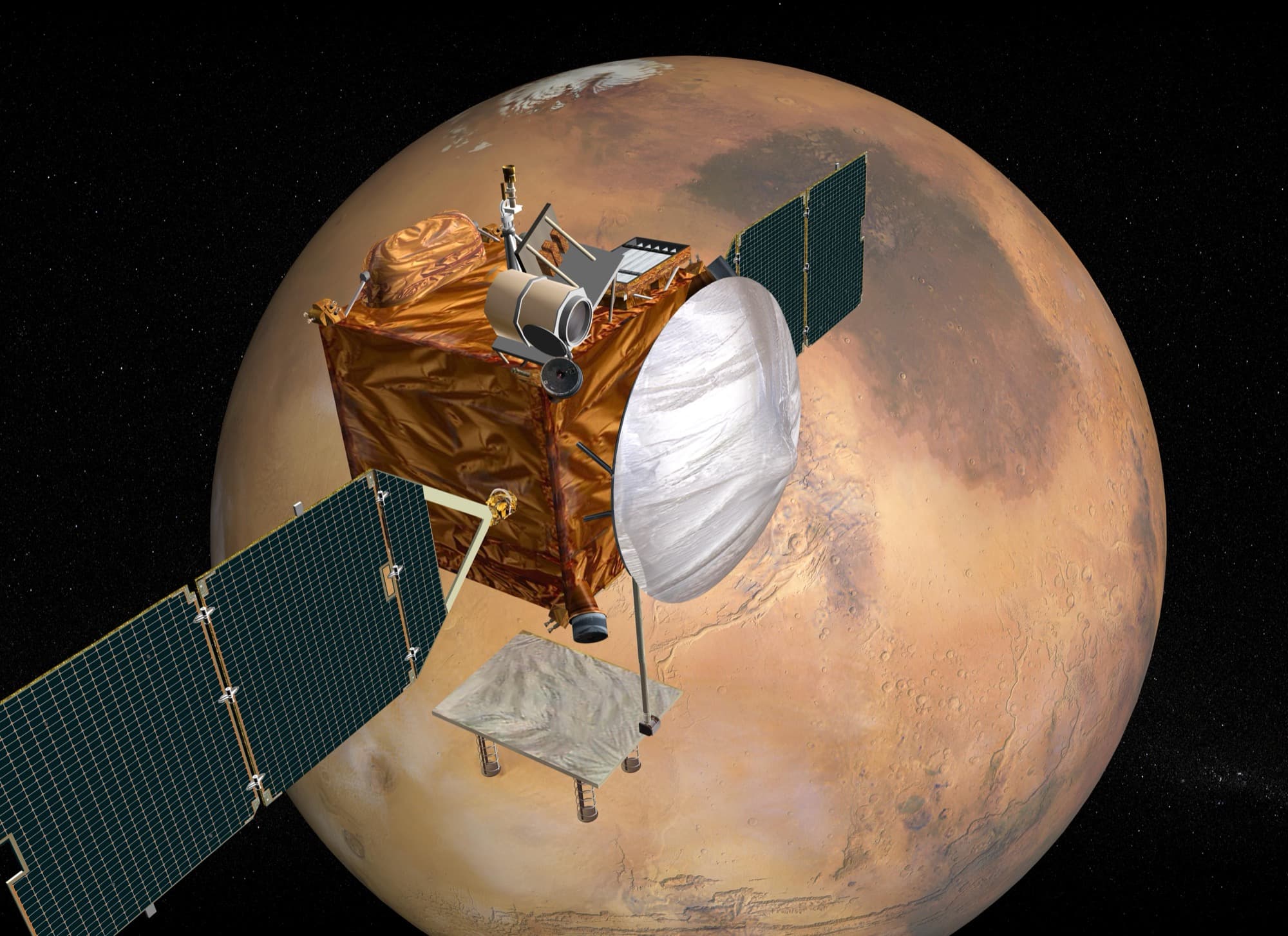
The Mars Telecommunications Orbiter was an admission that Mars had outgrown its plumbing. By the early 2000s NASA had four things happening at once at Mars, with Mars Science Laboratory coming, and every bit of data any of them produced went home through a radio that had been added to a spacecraft built for something else. MTO was to be different: a roughly 1,800 kg spacecraft based on the Mars Reconnaissance Orbiter design whose primary job was communications. It would sit in a high orbit, variously published as 5,000 km, as 180 by 4,500 km, and as about 4,800 km, some twenty times higher than the mapping orbiters, from which it would have a nearly permanent line of sight to Earth and could talk to the ground around the clock rather than in the short passes a low orbiter allows. It would carry X-band and Ka-band radio and, alongside them, an optical terminal. It was to be launched in 2009 and to work for as long as ten years. It also had a second job that mattered more than the relay in some quarters: it was to release a small target satellite the size of a football and then find and track it in orbit, which is the rehearsal for catching a sample canister fired off the Martian surface.
The optical terminal was the interesting part. The Mars Laser Communications Demonstration was run jointly by NASA Goddard, JPL and MIT Lincoln Laboratory, and its published design was a Master Oscillator Power Amplifier transmitter built around a 5 watt ytterbium-doped fibre amplifier at 1.06 micrometres, feeding a 30 cm diffraction-limited telescope, modulating with 64-ary pulse position modulation and near-capacity concatenated coding, and holding its extremely narrow beam on Earth by locking to an uplink beacon laser. The specification was a continuous link of between 1 and 100 megabits per second from Mars, depending on how far away Mars was and what the weather was doing over the receiving telescope. The team's own analysis of the hardest problem in the design is worth quoting in numbers rather than adjectives: their table of annual outages runs from 23 days at a Sun-probe-Earth angle of 2 degrees to 255 days at 20 degrees, because Mars is at its farthest from Earth at exactly the moment it is closest to the Sun in the sky. For the 2009 demonstration all the ground terminals were to be on the ground, with balloon-borne and orbiting receivers studied and set aside.
It was cancelled on 21 July 2005, before anything was built. The stated reasons had nothing to do with the spacecraft: a Hubble servicing mission, extended operations for Spirit and Opportunity, getting Mars Science Laboratory launched in 2009, and keeping the Earth science mission Glory alive. Gunter's Space Page records only that Lockheed Martin Space Systems was expected to win a contract to design and build the 500 million dollar spacecraft, and that NASA and the company were in negotiations expected to lead to an award in June 2005, a month before the axe fell. No contract was ever awarded, and we have found no NASA release naming a prime contractor. The laser demonstration, which had no other ride, was terminated with its host. What is striking in hindsight is the shape of the decision. MTO was infrastructure, and infrastructure is the easiest thing in a portfolio to defer, because deferring it costs nothing this year and the existing system keeps working. Mars kept working. Odyssey and Mars Reconnaissance Orbiter kept relaying, MAVEN joined them in 2014, ESA's Mars Express and Trace Gas Orbiter helped, and the argument for a dedicated relay got weaker every year that the old spacecraft did not break.
That argument was made explicitly. NASA studied a replacement, the Next Mars Orbiter, from 2016: about 1,900 kg, solar electric propulsion, 20 kW arrays, a 50 kg payload and a 6.5 year mission that would have combined relay, laser communications, 30 centimetre imaging and sample rendezvous, with five 400,000 dollar concept studies awarded in July 2016 to Boeing, Lockheed Martin, Northrop Grumman, Orbital ATK and Space Systems/Loral. By September 2017 a 2022 launch was out of reach, and the reasoning recorded against the relay case was that the likelihood of all the existing orbiters failing was low enough that no further investment was needed for that purpose. In March 2018 NASA extended Mars Reconnaissance Orbiter and 2001 Mars Odyssey instead and spent the money on sample return. The probability argument was reasonable and it was also a bet. On 6 December 2025 MAVEN suffered an unexpected loss of signal after passing behind Mars; a review board convened in February 2026 found it not recoverable and no longer capable of performing its science and data relay mission, and NASA ended the mission on 3 June 2026, more than eleven years after arrival.
The idea is now back, in a different form. Congress appropriated 700 million dollars for a Mars relay in the 2025 tax act, and NASA issued a Request for Proposal for a commercially built Mars Telecommunications Network on Thursday 14 May 2026, following a draft its own release dates to 2 April and an industry day at Goddard Space Flight Center, with responses due within 30 calendar days and the system to be operational no later than 2030. Washington Technology reported on 8 April 2026 that eligibility was limited to firms that had worked on the Mars Sample Return design phase and had also proposed a Mars telecom satellite, narrowing the field to Blue Origin, Lockheed Martin, Northrop Grumman, Rocket Lab and SpaceX under a firm-fixed-price contract running to 2035; English Wikipedia lists a wider set of eight companies drawn from the legislation. Europe is moving in parallel: ESA announced its LightShip tug on 21 January 2025, hosting MARCONI, a dedicated Mars communication and navigation service, with four industry consortia funded to study what could ride on it. As of 24 August 2026 we have found no announcement that the NASA contract has been awarded. The thing worth noticing is that the requirement has not changed at all since 2005. Only the funding mechanism has.
Mission facts
What it was for
To be the first spacecraft sent to another planet primarily to relay communications, rather than to carry science instruments of its own. It was to arrive in a high Mars orbit in 2010 and pass data for as long as ten years from landers, rovers and orbiters including Mars Global Surveyor, Mars Odyssey, Mars Express, Mars Reconnaissance Orbiter, Phoenix and Mars Science Laboratory.↗
Launch plan
Launch in 2009, arrival 2010. English Wikipedia's infobox records the launch vehicle as an Atlas V (401) or a Delta IV Medium from Cape Canaveral, with the specific vehicle, date and contractor never fixed. NASA never flew it, so no launch date was ever set.↗
Orbit, with a disagreement
Published figures differ and measure different things. Gunter's Space Page gives an orbital altitude of 5,000 km. English Wikipedia's infobox gives a periapsis of 180 km and an apoapsis of 4,500 km with a semi-major axis of 5,000 km. Space Today Online describes roughly 3,000 miles, about 4,800 km, and stresses that this was some twenty times higher than other Mars orbiters so that MTO would have a near-continuous line of sight to Earth. The high orbit was the whole design idea, whatever the exact numbers were to be.↗
Spacecraft
About 1,800 kg, based on the Mars Reconnaissance Orbiter design. Gunter's Space Page says Lockheed Martin Space Systems "is expected to land a NASA contract to design and build the $500 million Mars Telecommunications Orbiter," with the two sides "in negotiations expected to lead to the award of a design-and-construction contract in June 2005," one month before the cancellation. That describes an expected award. No contract was signed, and we have found no NASA press release naming a prime contractor.↗
The laser terminal
The Mars Laser Communications Demonstration, a joint project of NASA Goddard Space Flight Center, JPL and MIT Lincoln Laboratory. Its 2003 overview paper states that "the lasercom flight terminal will be flown on the Mars Telecom Orbiter (MTO) to be launched by NASA in 2009," and that the Mars terminal was "designed to provide a continuous data link of between 1 and 100 Mbits/second from Mars to Earth, depending on the instantaneous distance and atmospheric conditions."↗
How the laser worked
The strawman flight terminal was a Master Oscillator Power Amplifier transmitter built around a 5 watt ytterbium-doped fibre optical amplifier at 1.06 micrometres, a 30 cm diffraction-limited telescope, 64-ary pulse position modulation with near-capacity concatenated coding, and pointing stabilised against an uplink beacon laser from Earth. Ground reception was to use existing astronomical telescopes plus one purpose-built high-performance terminal for operations close to the Sun.↗
Solar conjunction was the hard part
The MLCD team's own table of annual communication outages runs from 23 days at a 2 degree Sun-probe-Earth angle to 255 days at 20 degrees. Mars is simultaneously at its farthest and at its smallest angle from the Sun, which is the critical design driver for an optical link. For the 2009 demonstration all Earth terminals were to be on the ground; balloon-borne and space-based receivers were studied and set aside.↗
The sample-return job
MTO was also to rehearse the hardest part of Mars Sample Return. It would have released a small target satellite, a sphere described as the size of a football, and then found and tracked it in orbit, demonstrating the ability to locate and intercept a sample canister launched from the Martian surface. A narrow-angle camera for canister detection appears in the spacecraft's payload description.↗
Cancellation
21 July 2005, before construction began. The reasons given were budgetary and external to the mission: supporting a Hubble servicing mission, extended Mars Exploration Rover operations, launching Mars Science Laboratory in 2009, and preventing the Earth science mission Glory from being cancelled.↗
What died with it
The Mars Laser Communications Demonstration had no other ride and was terminated in 2005 along with its host. The first deep-space optical link NASA actually flew came much later, on a different mission entirely.↗
The next attempt: NeMO
The Next Mars Orbiter, also called the Mars 2022 orbiter, was studied from 2016: a roughly 1,900 kg spacecraft with solar electric propulsion, 20 kW arrays, a 50 kg payload and a 6.5 year mission, combining relay, laser communications, 30 cm per pixel imaging and sample rendezvous. In July 2016 JPL awarded five concept study contracts of 400,000 dollars each to Boeing, Lockheed Martin, Northrop Grumman, Orbital ATK and Space Systems/Loral.↗
Why NeMO stopped
By September 2017 a 2022 launch was judged out of reach, and the argument was made that the likelihood of all the existing relay orbiters failing was low enough that no further investment was needed for relay alone. In March 2018 NASA chose instead to extend Mars Reconnaissance Orbiter and 2001 Mars Odyssey and put the money into sample return. The orbiter concept went on hiatus.↗
The relay fleet's age caught up with it
MAVEN, launched in 2013 and one of the relay assets NASA was relying on, suffered an unexpected loss of signal after passing behind Mars on 6 December 2025. NASA convened a review board in February 2026 which found the spacecraft "not recoverable, and is no longer capable of performing its science and data relay mission," and the mission was ended on 3 June 2026 after more than 11 years in Mars orbit.↗
Europe's answer
ESA is pursuing the same problem from the other side. Its LightShip initiative, announced on 21 January 2025, is a propulsive tug that would carry small passenger spacecraft to Mars orbit and host MARCONI, the Mars Communication and Navigation Infrastructure, as a dedicated relay service. Four consortia led by Argotec, Deimos Space, Politecnico di Milano with SITAEL, and Redwire were funded to study passenger platforms, with mission concepts to be investigated from 2026.↗
The money behind the 2026 revival
English Wikipedia records that the 2025 legislation appropriated 700 million dollars for a Mars relay orbiter, to be procured through fixed-price contracts from commercial partners already paid for Mars Sample Return design studies that included telecommunications orbiter concepts. NASA's own release names no figure, and calls the act the Working Families Tax Cut Act where Wikipedia calls the same 2025 legislation the One Big Beautiful Bill Act.↗
The 2026 revival
NASA issued a Request for Proposal for the Mars Telecommunications Network on Thursday 14 May 2026, following a draft its own release dates to 2 April 2026 and an industry day at Goddard Space Flight Center. Responses were due within 30 calendar days. The network is to use "high-performance Mars telecommunications orbiters at the Red Planet to support future surface, orbital, and human exploration" and to be operational no later than 2030. It sits within the SCaN programme's Moon to Mars strategy and is funded by Congressional direction in the Working Families Tax Cut Act.↗
Who is allowed to bid
Washington Technology reported on 8 April 2026 that NASA restricted eligibility to companies that took part in the Mars Sample Return design phase and had also proposed a separate Mars telecom satellite, narrowing the field to Blue Origin, Lockheed Martin, Northrop Grumman, Rocket Lab and SpaceX, under a firm-fixed-price award with a launch target at the end of 2028, full operation by the end of 2030 and management through 2035. That report dates the draft solicitation to 7 April with comments due 13 April, where NASA's own release dates the draft to 2 April. English Wikipedia lists eight eligible companies drawn from the legislation, adding Aerojet Rocketdyne, Quantum Space and Whittinghill Aerospace.↗
Mission timeline
- 2003The Mars Laser Communications Demonstration project, a joint effort of NASA Goddard, JPL and MIT Lincoln Laboratory, publishes its overview: an optical terminal to fly on the Mars Telecom Orbiter for launch in 2009, designed for a continuous 1 to 100 Mbit/s link from Mars to Earth.
- Jun 2005The month in which, according to Gunter's Space Page, NASA and Lockheed Martin Space Systems expected their negotiations to produce a design-and-construction contract worth about 500 million dollars. No such contract was ever awarded.
- 21 Jul 2005NASA cancels the Mars Telecommunications Orbiter before construction begins, citing the need to fund a Hubble servicing mission, extended Mars Exploration Rover operations, the 2009 Mars Science Laboratory launch, and the survival of the Earth science mission Glory. The laser demonstration is terminated with it.
- Jul 2016JPL awards five concept study contracts of 400,000 dollars each for the Next Mars Orbiter, to Boeing, Lockheed Martin, Northrop Grumman, Orbital ATK and Space Systems/Loral, aiming at a 2022 launch combining relay, laser communications, high-resolution imaging and sample rendezvous.
- Sep 2017A 2022 launch for NeMO is judged out of reach, and the case is made that the chance of every existing relay orbiter failing is low enough that no dedicated relay investment is needed.
- Mar 2018NASA decides to extend Mars Reconnaissance Orbiter and 2001 Mars Odyssey rather than build a new orbiter, and puts the money towards sample return. NeMO goes on hiatus, and Mars is left with no dedicated relay in the plan.
- 21 Jan 2025ESA announces its LightShip initiative and funds four consortia to study small Mars passenger platforms. The tug is to host MARCONI, a dedicated Mars communication and navigation relay service.
- 6 Dec 2025MAVEN suffers an unexpected loss of signal after passing behind Mars. One of the relay spacecraft the 2018 decision had counted on goes quiet.
- 2 Apr 2026NASA releases a draft solicitation for a commercially built Mars Telecommunications Network, following an industry day at Goddard Space Flight Center. Reporting elsewhere dates a draft to 7 April with comments due 13 April.
- 14 May 2026NASA issues the Request for Proposal for the Mars Telecommunications Network, responses due within 30 calendar days, the system to be operational no later than 2030, funded by Congressional direction in the Working Families Tax Cut Act.
- 3 Jun 2026NASA ends the MAVEN mission after a review board finds the spacecraft not recoverable and no longer capable of performing its science and data relay mission, six months after it fell silent and more than 11 years after it reached Mars.
- 24 Aug 2026As of this entry's research date we have found no published announcement that NASA has awarded the Mars Telecommunications Network contract. Anything you read about who won it should be checked against a NASA source dated after this line.
A filled dot marks something that physically happened. A hollow one marks an announcement, a naming or a target.
In pictures
Tap a photo to enlarge.
Sources
- B. L. Edwards, S. A. Townes, R. S. Bondurant, J. J. Scozzafava, D. M. Boroson, B. A. Parvin, A. Biswas and A. D. Pillsbury, Overview of the Mars Laser Communications Demonstration Project (2003), NASA NTRS 20030105555
- Gunter's Space Page: Mars Telecommunications Orbiter (MTO)
- Space Today Online: Mars Telecommunications Orbiter
- English Wikipedia: Mars Telecommunications Orbiter
- English Wikipedia: Next Mars Orbiter
- NASA science mission page: MAVEN
- NASA (14 May 2026): NASA Draws on Industry for Mars Telecommunications Network
- Phys.org (15 May 2026): NASA draws on industry for Mars telecommunications network
- Washington Technology (8 April 2026), Nick Wakeman: NASA seeks commercial contractor to build new Mars communications network
- ESA (21 January 2025): Towards low-cost missions to Mars
Facts on this page were verified on 24 August 2026. Where sources disagree, the disagreement is stated rather than resolved silently.