Mars gravity assists
ESA and NASA · Multinational · Flyby · 2004 · Multipolar MarsSuccess
Five spacecraft have bent their trajectories at Mars: Rosetta in 2007, Dawn in 2009, Europa Clipper and Hera in March 2025 and Psyche on 15 May 2026. Three of the five fell inside fourteen and a half months.
TL;DR· 15 min read
Five spacecraft have used Mars to bend their trajectories: Rosetta on 25 February 2007, Dawn on 17 February 2009, Europa Clipper on 1 March 2025, Hera on 12 March 2025 and Psyche on 15 May 2026. Mars is a poor place to do it, with about a ninth of Earth's mass, so the manoeuvre is used only when a mission is heading outward anyway and the geometry happens to line up. Rosetta came closest, at 250 km above the surface, and Europa Clipper used the planet as a brake, arriving at about 24.5 km/s relative to the Sun and leaving at about 22.5.
A gravity assist is theft on a planetary scale. A spacecraft falls past a moving world, takes a small share of that world's orbital momentum, and leaves on a different path at a different speed, with the planet slowed by an amount too small to measure. Mars is a poor bank for this: it has about a ninth of Earth's mass and a tenth of Venus's gravitational parameter, so a Mars swingby buys much less than an Earth or Venus one. It is used when the geometry happens to work, when a mission is going outward anyway, and when the alternative is carrying more propellant. Only five spacecraft are recorded as having done it, and the first did not fly until 2007.
- 5spacecraft that have used Mars for a gravity assist, 2007 to 2026
- 250 kmlowest published closest approach, Rosetta on 25 February 2007
- 3of the five swingbys fell between 1 March 2025 and 15 May 2026
Mars is not a good place to steal momentum. Gravity assists work by letting a spacecraft fall past a moving planet and leave along a different vector, and how much the manoeuvre buys depends on how much mass is doing the pulling and how fast the planet is travelling. Mars has roughly a ninth of Earth's mass and moves more slowly around the Sun than Earth or Venus, so a Martian swingby delivers a fraction of what an inner-planet one does. That is why the outer-planet workhorses of the twentieth century went the other way: Mariner 10 used Venus, Galileo used Venus and Earth twice, Cassini used Venus twice, then Earth, then Jupiter, and Ulysses used Jupiter. No spacecraft used Mars this way, as far as any source we consulted records, until 2007. When Mars does get used, it is almost always because the mission is heading outward anyway, the geometry happens to line up in the right month, and the alternative is a heavier propellant load or a longer cruise. ESA's flight dynamics team put it plainly before Hera flew: it is truly fortunate that Mars happens to be at the right location and at the right time. Five spacecraft have now done it, and the interesting thing about the list is how it clusters. Two swingbys in the 2000s, then a sixteen-year gap, then three inside fourteen and a half months between March 2025 and May 2026, as a generation of small-body missions all launched into the same stretch of the 2020s.
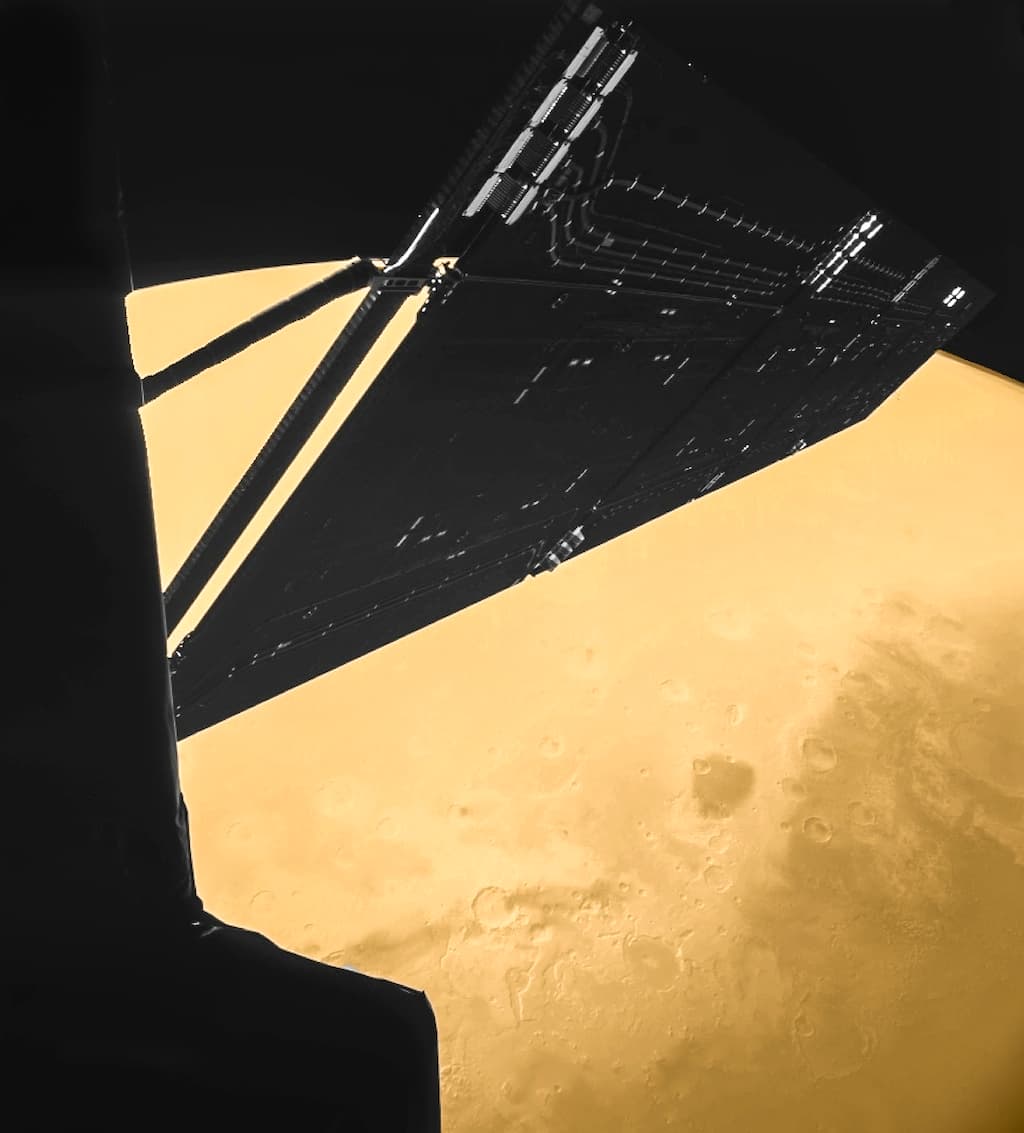
Rosetta's is still the closest and by some distance the most alarming. On 25 February 2007 it passed 250 kilometres above Mars at 36,191 kilometres per hour relative to the planet, on a trajectory that had been forced on it by launch delays. Its original design had no eclipse in it. The replanned path put the spacecraft into Mars's shadow with its solar panels useless, so ESOC spent months building a low-power configuration that would run Rosetta on batteries never intended for the job, with all but essential systems off and no way to talk to Earth. There was a planned 25 minute eclipse and a 15 minute communications blackout. Phys.org's headline two days out called it a billion-euro gamble and the phrase attached itself to the manoeuvre permanently. It worked. It also produced a widely reproduced and widely misattributed image: with the orbiter's own instruments switched off through closest approach, the Philae lander was running on its own batteries in what ESA describes as its first fully autonomous operation, and Philae's CIVA camera photographed Rosetta's solar array against the Martian disc four minutes before closest approach from about a thousand kilometres up. ESA's own record of the day is internally inconsistent about when closest approach happened: the operations release published beforehand says 02:57 CET, the image release published that morning says 03:15 CET, and we have found nothing that reconciles them.
Dawn's assist two years later is the quiet one, and it is the one where the flyby cost something. On 17 February 2009 Dawn passed less than 550 kilometres above Mars on its way to Vesta and Ceres, an assist it genuinely needed to reach the asteroid belt on ion propulsion. NASA's own status page gives that under-550 figure rather than a precise number, which is why 549 kilometres and 542 kilometres both circulate. Engineers had established in early January that the approach was accurate enough that the planned fine-tuning burn could be cancelled. The trouble came on departure. Fault-detection software responded inappropriately to an expected, temporary loss of valid star-tracker data near the planet, and put Dawn into safe mode, cancelling the bonus instrument calibrations that the team had scheduled for the outbound leg. Controllers restored the spacecraft to its normal configuration and pulled back the calibration data that had already been moved into the main computer before the safing. Nothing was lost that mattered to the asteroid mission, but it is a useful reminder of what these encounters actually are for the flight teams: a few hours in which a spacecraft designed for somewhere else is flown very fast past a bright object it was not built to look at, with its autonomy exercised in conditions no test bench reproduced.
Then came 2025, and two swingbys eleven days apart. Europa Clipper went first, on 1 March, passing 884 kilometres above the surface at 17:57 UTC. It is the clearest example of an assist that slows a spacecraft down rather than speeding it up: Clipper arrived at about 24.5 kilometres per second relative to the Sun and left at about 22.5, reshaping its solar orbit so that it will swing past Earth in December 2026 for the boost that actually throws it at Jupiter. The science return was calibration, and it was substantial. E-THEMIS took one thermal frame per second for about 18 minutes, more than a thousand images, downlinked from 5 May and assembled into a global thermal map that could be checked against twenty years of Mars Odyssey THEMIS data; the Odyssey team obligingly took their own images before, during and after. The REASON ice radar was operated as a complete system for the first time, something no clean room could accommodate because the antennas and wavelengths are simply too long. Hera followed on 12 March, closest to Mars at 12:50 GMT, and made the first scientific use of its payload beyond the Earth-Moon system while testing the autonomous surface tracking it will need at Didymos. ESA's published Mars distance for Hera moved from 6,000 km to 5,000 km to 5,700 km across three of its own releases.
Psyche closed the sequence on 15 May 2026, and very nearly did not. On 1 April 2025 the pressure in the line feeding xenon to its ion thrusters fell from 36 psi to about 26, the spacecraft shut the thrusters down as designed, and NASA deferred thrusting entirely while engineers worked. The mission design tolerated a pause until roughly mid-June before the trajectory would suffer. The team narrowed the cause to a probable valve fault in the primary line, switched to the identical backup in late May, and resumed full thrusting on 16 June 2025 with the stated purpose of protecting the Mars flyby eleven months later. It made it. Psyche passed 4,609 kilometres above the surface, a figure NASA published in July 2026 against the roughly 4,500 kilometres it had advertised the week before the encounter, and tilted its orbital plane by about a degree toward asteroid 16 Psyche. The instruments earned their keep: the magnetometer recorded its first magnetic signature of a celestial body at the Martian bow shock, the gamma-ray and neutron spectrometer saw the expected neutron enhancement and, as predicted at that range, no gamma rays, and the multispectral imager found the approaching crescent, in NASA's own wording, brighter and extended farther around the disc than anticipated, because sunlight scatters hard through Martian dust. We have found no confirmed date for a sixth Mars gravity assist. The practice stays opportunistic: it waits for the next outbound mission whose geometry happens to put Mars in the right place in the right month, which is how all five of these came about.
Mission facts
What a Mars assist is worth
Small, and worth taking anyway. ESA's Hera flight dynamics team describes the Mars leg as producing great fuel savings, with the surplus propellant then spent on advancing arrival at the target by a few months. NASA's Europa Clipper team frames it the other way: without the Mars assist in 2025 and the Earth assist in 2026, the 6,000 kg spacecraft would need extra propellant, which adds weight and cost, or would take much longer to reach Jupiter.↗
An assist does not always speed you up
Europa Clipper used Mars as a brake. NASA states it approached at about 24.5 km/s relative to the Sun and departed at about 22.5 km/s, reshaping its solar orbit so that it would return past Earth in December 2026 for the boost that actually sends it outward. Rosetta's own ESA operations release calls Mars a gravitational brake too. Psyche, by contrast, gained speed: JPL's navigation lead Don Han put the boost at 1,000 miles per hour and the shift in orbital plane at about 1 degree relative to the Sun.↗
Rosetta, 25 February 2007
The earliest Mars gravity assist in any source we consulted. ESA's pre-flyby operations release gives closest approach at 02:57 CET (01:57 UTC), a mere 250 km above the surface, at 36,191 km/h relative to the planet, with a planned 25 minute eclipse and a 15 minute communications blackout starting at 03:14 CET. ESA's own image release the same morning instead says closest approach occurred at 03:15 CET (02:15 UTC). We have found no reconciliation of the two times.↗
Why Rosetta's swingby was frightening
Rosetta's original trajectory had no eclipse in it. Launch delays forced a replan, and the new path took the spacecraft through Mars's shadow with its solar panels useless. Controllers spent months designing a low-power configuration that ran the spacecraft on batteries never designed for the job, with no possibility of communication. Phys.org's report of 23 February 2007 was headlined "Europe set for billion-euro gamble with comet-chasing probe", and the nickname stuck to the manoeuvre.↗
The picture from Philae
Rosetta's orbiter instruments were switched off through closest approach, but the Philae lander was awake on its own batteries, in what ESA calls its first totally autonomous operation. Philae's CIVA camera took the image of Rosetta's solar array against Mars four minutes before closest approach, from about 1,000 km above the surface, with Syrtis in the disc below. Philae's ROMAP magnetometer package also ran.↗
Dawn, 17 February 2009
NASA's own mission status page says Dawn passed less than 550 kilometres (340 miles) from the surface, achieving the assist it needed to reach the asteroid belt. That is the most precise figure we can trace to NASA. Sharper numbers, 549 km and 542 km, are in wide circulation without a NASA page behind them, so this entry stays with the inequality. Engineers had determined in early January 2009, not February, that the trajectory was good enough for the planned fine-tuning manoeuvre to be cancelled.↗
Dawn's safe mode
As Dawn was leaving Mars, fault-detection software put the spacecraft into safe mode and cancelled the bonus instrument calibrations. NASA traced it to an inappropriate software response to an expected temporary loss of valid data from the star tracker in the vicinity of Mars. The team recovered the spacecraft and returned the calibration data already transferred to the main computer before the safing.↗
Europa Clipper, 1 March 2025
550 miles (884 kilometres) above the surface, closest at 12:57 p.m. EST (17:57 UTC). For about 18 minutes the E-THEMIS thermal imager took one picture per second, more than a thousand frames, downlinked from 5 May 2025 and assembled into a global thermal view of Mars. Mars Odyssey, which carries the ancestor instrument THEMIS, took its own thermal images before, during and after the flyby so the two could be compared.↗
What else Clipper tested at Mars
All the components of its REASON ice-penetrating radar were operated together for the first time. The antennas and their wavelengths are too long to have been tested as a whole in a clean room before launch. NASA reported that preliminary real-time telemetry indicated the test went well. The team also transmitted through Mars's gravity field to confirm that the gravity-science technique planned for Europa would work.↗
Hera, 12 March 2025
Eleven days after Europa Clipper. ESA's flyby simulation puts closest approach to Deimos at 12:10 GMT and to Mars at 12:50 GMT. The published Mars distance is inconsistent within ESA's own material: about 5,000 km from the surface on 10 and 13 March 2025, 5,700 km in the release of 25 March 2025, and 6,000 km in the original announcement of 25 April 2024. Relative speed at Mars was 9 km/s.↗
Psyche, 15 May 2026
NASA's post-flyby blog of 17 July 2026 gives the flyby altitude as 2,864 miles (4,609 kilometres). The pre-flyby blog of 8 May 2026 had said about 4,500 km. The swingby tilted the spacecraft's orbital plane by roughly one degree to line it up with asteroid 16 Psyche, for an arrival NASA's 2025 releases put in August 2029 and its 2026 releases put in the summer of 2029. NASA's pre-flyby blog records a 12 hour thruster firing on 23 February 2026 that set up the approach.↗
What Psyche got out of it
Its magnetometer recorded its first magnetic-field signature of a celestial body, an intense uptick at the bow shock where the solar wind piles up against Mars. The gamma-ray and neutron spectrometer detected the expected count-rate enhancement in neutrons escaping Mars but, as predicted, no gamma rays at that range. NASA's image release of 19 May 2026 says the crescent Mars the multispectral imager caught on approach appeared brighter and extended farther around the planet's disc than anticipated, because sunlight scatters strongly through the dusty atmosphere.↗
The Mars fleet as ground truth
NASA's pre-flyby blog stated that Mars Reconnaissance Orbiter, Mars Odyssey, Curiosity, Perseverance, ESA's Mars Express and the ExoMars Trace Gas Orbiter would supply complementary surface and atmospheric imaging plus navigation data during Psyche's encounter, so that the visiting spacecraft's instruments could be calibrated against a planet already documented in detail. The same logic drove Europa Clipper's Odyssey thermal comparison fourteen months earlier.↗
The assist Psyche nearly lost
On 1 April 2025 Psyche detected a pressure drop in the line feeding xenon to its ion thrusters, from 36 psi to about 26 psi, and shut the thrusters down as designed. NASA said the mission could absorb a pause until at least mid-June before the trajectory suffered. The team traced it to a probable valve fault, switched to the identical backup line in late May, and resumed full thrusting on 16 June 2025, explicitly to protect the May 2026 Mars flyby.↗
Approaching from the night side
Psyche came at Mars from a high phase angle, catching up with the planet from behind. Imager instrument lead Jim Bell of Arizona State University: "We are approaching Mars at a very high phase angle, which means we are catching up with the planet from its night side with only a sliver of sunlight creating a thin crescent." Raw frames showing a starfield and a tiny Mars began appearing on the mission website from 7 May 2026, and the near-full disc came only after the spacecraft had passed.↗
Mission timeline
- Mar 2004ESA launches Rosetta on a 7.1 billion kilometre journey to rendezvous with comet 67P/Churyumov-Gerasimenko in 2014. Reaching the comet will take a series of planetary swingbys, and one of them is Mars.
- 25 Feb 2007Rosetta passes 250 km above Mars at 36,191 km/h, through a planned 25 minute eclipse and a 15 minute blackout, running on batteries with its orbiter instruments off. Philae, awake on its own power, photographs Rosetta's solar array against the planet from about 1,000 km. This is the earliest Mars gravity assist we can document.
- 17 Feb 2009Dawn passes less than 550 km from the surface on its way to Vesta and Ceres. On departure, fault-detection software mishandles an expected star-tracker dropout near Mars and safes the spacecraft, cancelling the bonus calibrations. Controllers restore the normal configuration and pull back the calibration data already moved into the main computer.
- 13 Oct 2023Psyche launches from Kennedy Space Center and begins spiralling outward on solar electric propulsion, four thrusters expelling ionised xenon. NASA's flight plan has it returning toward Mars in spring 2026 to slingshot into the main asteroid belt, and beginning to orbit asteroid 16 Psyche in 2029.
- 7 to 14 Oct 2024NASA's Europa Clipper leaves Kennedy Space Center on 14 October aboard a Falcon Heavy for a 1.8 billion mile (2.9 billion km) trip to Jupiter, on a trajectory built around assists from Mars in 2025 and Earth in 2026. ESA's Hera had gone up a week earlier, on 7 October, with a Mars swingby of its own eleven days after Clipper's.
- 1 Mar 2025Europa Clipper passes 884 km above Mars at 17:57 UTC, using the planet as a brake: in at about 24.5 km/s relative to the Sun, out at about 22.5. E-THEMIS shoots more than a thousand thermal frames in 18 minutes and the REASON radar is operated as a complete system for the first time.
- 12 Mar 2025Hera passes Mars at 12:50 GMT at a published distance of either 5,000 or 5,700 km, having already skimmed Deimos at 12:10. It is the first scientific use of Hera's payload beyond the Earth-Moon system, and the flyby also serves as a live test of the autonomous feature tracking it will need at Didymos.
- 1 Apr to 16 Jun 2025Psyche's xenon feed pressure falls from 36 psi to about 26 psi and the ion thrusters shut down. NASA defers thrusting, traces the fault to a probable valve in the primary line, switches to the identical backup in late May and resumes full-time thrusting on 16 June, explicitly to keep the May 2026 Mars flyby.
- 8 May 2026NASA publishes the flyby plan: about 4,500 km, imager calibration against a body bigger than a few pixels for the first time in flight, a satellite search around Mars as a rehearsal for hunting moonlets at the asteroid, and a look for the faint dust torus that micrometeorite strikes on Phobos and Deimos may create.
- 15 May 2026Psyche passes 4,609 km above Mars, tilting its orbital plane by about a degree toward asteroid 16 Psyche. Its magnetometer records the Martian bow shock, its neutron spectrometer sees the expected count-rate rise, and the imager captures a crescent brighter than predicted because of atmospheric dust scattering.
- 17 Jul 2026NASA releases the Psyche flyby results and a time-lapse of the encounter. Lindy Elkins-Tanton: "We didn't anticipate big discoveries, given how extensively the planet has been studied, but we did complement Mars science with the data we collected through Psyche's unique perspective."
A filled dot marks something that physically happened. A hollow one marks an announcement, a naming or a target.
In pictures
Tap a photo to enlarge.
Sources
- ESA (15 Feb 2007): Rosetta correctly lined up for critical Mars swingby
- ESA/ESOC (25 Feb 2007): Stunning view of Rosetta skimming past Mars
- NASA Psyche blog (29 Apr 2025): NASA's Psyche Mission Looking Into Propulsion System
- Phys.org (23 Feb 2007): Europe set for billion-euro gamble with comet-chasing probe, archived 25 Feb 2007
- NASA/JPL Dawn mission status, 2009 archive page
- NASA (Feb 2025): NASA's Europa Clipper Uses Mars to Go the Distance
- NASA (May 2025): NASA's Europa Clipper Captures Mars in Infrared
- ESA (13 Mar 2025): Hera asteroid mission spies Mars's Deimos moon
- ESA (25 Apr 2024): Hera asteroid mission's side-trip to Mars
- NASA Psyche blog (8 May 2026): NASA's Psyche Mission to Fly by Mars for Gravity Assist
- NASA Psyche blog (17 Jul 2026): NASA's Psyche Mission Delivers Mars Flyby Data, Time-lapse Video
- NASA Psyche blog (20 Jun 2025): NASA's Psyche Spacecraft Resumes Full-Time Propulsion
- NASA/JPL (May 2026): NASA's Psyche Mission Aces Mars Flyby, Targets Metal-Rich Asteroid
- NASA Photojournal PIA26771 (19 May 2026): NASA's Psyche Mission Images the Crescent of Mars
Facts on this page were verified on 24 August 2026. Where sources disagree, the disagreement is stated rather than resolved silently.