Opportunity (MER-B)
NASA · United States · Rover · 2004 · The long occupationEnded
Landed in Eagle crater on 25 January 2004 for a 90-sol mission and worked 5,111 sols, driving 45.16 km. A planet-encircling dust storm ended it: last signal 10 June 2018, mission complete 13 February 2019.
TL;DR· 15 min read
Opportunity landed in Eagle crater on Meridiani Planum on 25 January 2004 for a 90-sol mission, then worked 5,111 sols and drove 45.16 kilometres. Within five weeks it found jarosite, sulfates and hematite spherules in the crater wall, evidence that liquid water once flowed through the rocks. A planet-encircling dust storm blacked out its solar arrays in June 2018, the last downlink came on 10 June, and NASA declared the mission complete on 13 February 2019.
Opportunity was built to survive 90 Martian days and drive a few hundred metres. It worked for 5,111 sols and drove 45.16 kilometres, all of it on sunlight, which is also what killed it. In June 2018 a dust storm spread until it wrapped the entire planet and turned day into night over Endeavour crater. The last data came down on 10 June 2018. NASA kept calling for eight months, then stopped on 13 February 2019. Its 45.16 km was the record for driving on another world when the mission was declared complete, and on 9 October 2026 it still stood in NASA's published data, with Perseverance about 34 metres short.
- 5,111sols worked, against a design life of 90 sols
- 45.16 kmdriven, the off-Earth distance record when the mission was declared complete in 2019
- 0replies to over a thousand commands sent after the storm
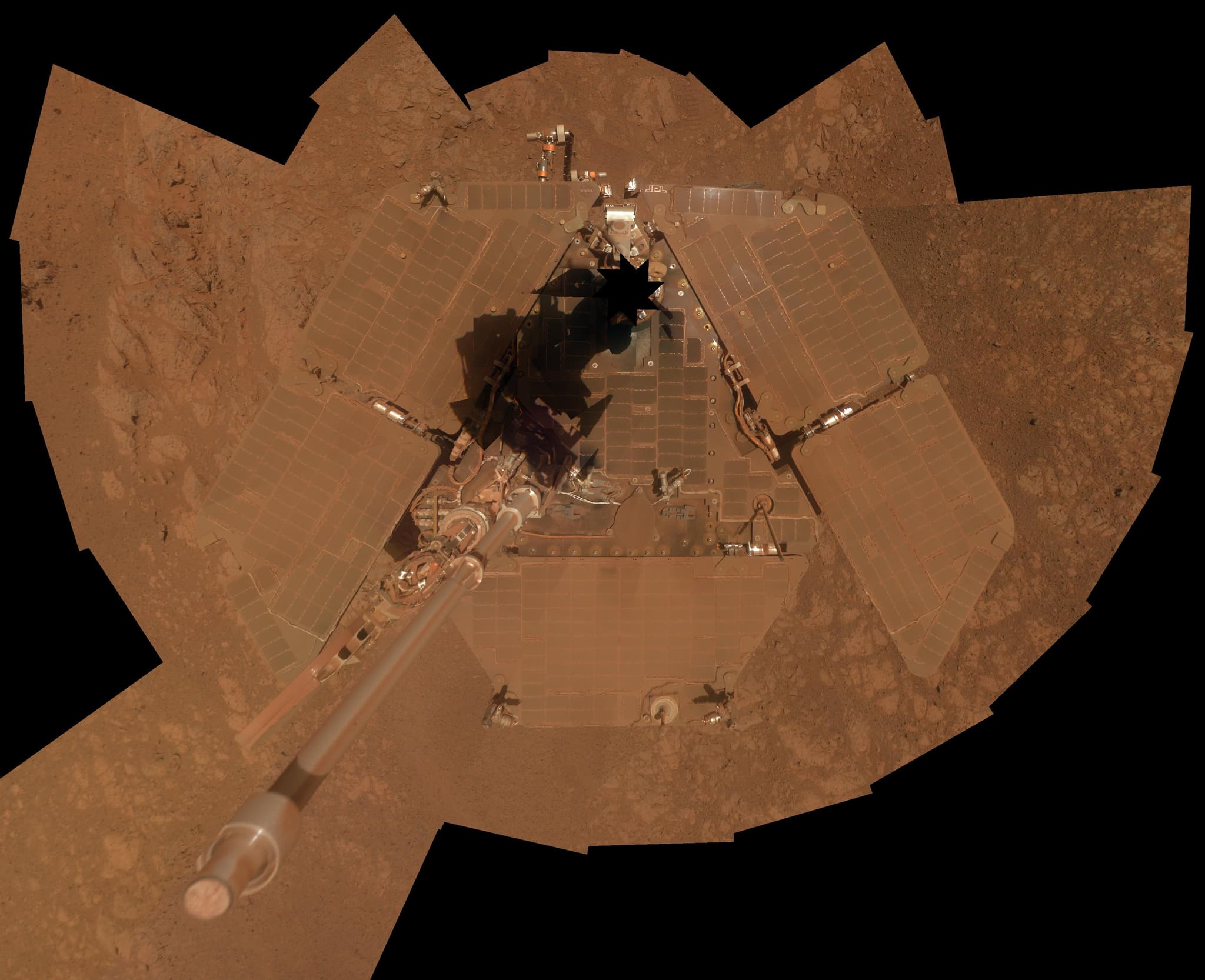
Opportunity was the second of two identical rovers, and the second to arrive. It launched on 8 July 2003 at 03:18:15 UT on a heavy Delta II from Cape Canaveral, and it was sent to do a small job: survive 90 Martian days and drive far enough to look at more than one rock. The mission's own 2003 overview paper set the bar at 600 metres of driving in that 90-sol minimum lifetime. What happened on 25 January 2004 was luck of a kind nobody could design for. The airbag bundle hit Meridiani Planum at about 50 km/h, bounced, rolled, and stopped inside a crater roughly 20 metres wide and 2 metres deep, later named Eagle, with a shelf of exposed bedrock in the wall a few metres from where the rover would stand up. Steve Squyres told the press conference that they had scored a 300-million-mile interplanetary hole in one. Five weeks later NASA announced what that outcrop contained: jarosite, a mineral that needs water and acid to form, high sulfur, cross-bedded layering, and BB-sized spherules of hematite scattered through the rock and across the ground, the things everyone ended up calling blueberries. Squyres put it plainly at the time: 'Liquid water once flowed through these rocks. It changed their texture, and it changed their chemistry.' Opportunity had answered the question it was sent to ask before its warranty ran out.
Then it kept going, and the mission changed shape. What had been a landing-site survey became a road trip between craters, each one deeper and older than the last, because on Mars a crater is a free excavation. Endurance took six months: Opportunity dipped a wheel in on sol 130, committed to the descent, read the layers in the walls, and climbed back out on sol 315. In January 2005 it stopped next to its own discarded heat shield and found a basketball-sized lump of iron and nickel, which JPL announced as the first meteorite of any type ever identified on another planet. Victoria, about 800 metres across, held it from September 2007 to August 2008; as the climb-out began, mission manager Bill Nelson noted that a rover down to five working wheels, as Spirit was, would never have got back up the slope. In between, in July 2007, the planet gave a preview of the ending. Dust cut Opportunity's daily power from around 700 watt-hours to 148, then 128, and JPL stopped talking to the rover to save the batteries. It survived that one. Later the flash memory began failing, and from December 2014 the team simply stopped using it, running the rover on volatile RAM and downlinking each sol's data before it went to sleep. The list of things that no longer worked kept growing, and the odometer kept climbing.
The long drive to Endeavour is the part of the mission that reads like endurance rather than exploration. After leaving Victoria in August 2008 the rover spent nearly three years crossing about 21 kilometres of open plain to reach a crater 22 kilometres wide, arriving on 9 August 2011 at a rim segment the team named Spirit Point for the twin that had died. What it found there was better than what it had left. In November 2011 it examined Homestake, a vein of calcium sulfate a centimetre or two wide and about half a metre long, deposited by water moving through fractures in the rock, and Squyres called it a slam dunk. On 24 March 2015, on sol 3968, a 46.5 metre drive took the total to 42.198 kilometres and past the Olympic marathon distance, eleven years and two months after landing. The driving record is more complicated than the headlines. NASA claimed it in July 2014 at 40.25 kilometres, measuring against a figure of 39 kilometres for the Soviet Lunokhod 2. But Lunokhod 2's distance has three published values: about 37 kilometres from wheel rotations, 39 kilometres as NASA used it, and roughly 42 kilometres from a Russian remapping of its tracks in Lunar Reconnaissance Orbiter imagery. Opportunity's final 45.16 kilometres beats all three, so the record is real; the date it was won is not.
The storm that killed it was first seen around 30 May 2018 by the Mars Color Imager on Mars Reconnaissance Orbiter, which is what gave the Opportunity team their warning. By 12 June it covered roughly 35 million square kilometres. Over Endeavour the atmospheric opacity, tau, was estimated at 10.8 on 10 June, against a normal figure well under 1. The rover was solar powered and had no other option. Below about 24 volts it trips a low-power fault that shuts down everything but the mission clock, which wakes the computer occasionally to ask whether there is enough charge to do anything. The last downlink arrived on 10 June 2018, sol 5,111. It was also the last day of a 354-frame panorama the rover had been assembling since sol 5,084, and a few frames at the bottom left were never finished in colour. JPL then spent eight months calling. Recovery needed tau to drop below 2 before the arrays could charge; the Deep Space Network listened during predicted wake-up windows while JPL's radio science group swept a wider band daily; three different fault states were allowed for. Nothing answered. On the evening of 12 February 2019 the last commands went out through the 70 metre Goldstone antenna, and on 13 February NASA declared the mission complete.
The numbers at the end were 45.16 kilometres, 5,111 sols against a design life of 90, more than 217,000 images, 15 full-circle colour panoramas, 52 rocks ground open with the abrasion tool and 72 more brushed clean, a single-day drive record of 220 metres set on 20 March 2005, and slopes climbed as steep as 32 degrees. On 9 October 2026 that distance had still not been beaten in NASA's published data: Perseverance's waypoints file, last modified on 15 September, ends at its sol 1980 drive with 45,126 metres, about 34 metres short. Opportunity's record for the longest-running mission on the surface of Mars is closer than it looks too. Curiosity calls its landing day sol 0 where Opportunity called it sol 1, so Curiosity draws level when it reaches its sol 5110, which azmth's sol clock puts on 21 December 2026, provided it is still working. Opportunity will probably lose both records to machines that were designed knowing it could be done. That is the actual legacy, more than any single mineral. A solar-powered rover with a 90-day warranty worked for fourteen and a half years on a planet that was trying to bury it, and in doing so it moved what a Mars surface mission is allowed to plan for.
Mission facts
Launch
8 July 2003 at 03:18:15 UT, which was 11:18:15 p.m. EDT on 7 July at the Cape, on a heavy Delta II 7925H from Cape Canaveral. NASA's mission page prints the same instant as 7 July 2003, 20:18:15 PDT, and lists the vehicle as Delta 7925H no. D299 from SLC-17B.↗
Landing
25 January 2004. NSSDCA times touchdown at 04:54:22.7 UT at Mars and 05:05:26.6 UT Earth-received, about 1:15 p.m. local solar time. Entry mass was 827 kg at 19,300 km/h; the aeroshell braked for about four minutes to 1,600 km/h, the parachute took it to roughly 300 km/h, retrorockets and airbags fired from about 100 m, and the bundle struck at around 50 km/h, bounced and rolled to a stop inside a 20 m crater. NASA's own end-of-mission release dates the landing to 24 January 2004 because it was still the 24th in Pacific time at JPL when the signal arrived.↗
Landing site
Eagle crater, Meridiani Planum, at 1.946 S and 354.473 E in IAU 2000 body-centred coordinates. NSSDCA describes the landing ellipse as centred at 2.07 S, 353.52 and roughly 119 by 17 km oriented at 88 degrees, although it prints that longitude as west, which cannot be reconciled with the east-positive touchdown figure on the same page. NASA's mission page separately says the rover came down about 9 miles (14.9 km) from its target.↗
The rover itself
Six wheels on a rocker-bogie suspension, solar arrays giving up to 140 W in full sun, 128 MB of RAM, and the Athena payload: panoramic camera, Miniature Thermal Emission Spectrometer, Alpha Particle X-Ray Spectrometer, Moessbauer spectrometer, Microscopic Imager and Rock Abrasion Tool, plus navigation and hazard cameras and a magnet array. Two rover masses circulate and both are NASA's: NSSDCA's Facts in Brief lists 185 kg, while the 2019 end-of-mission release describes a 384-pound (174-kilogram) rover. The rest of the stack is not disputed: lander platform 348 kg, backshell and parachute 209 kg, heat shield 78 kg, cruise stage 193 kg and 50 kg of propellant, which with the 185 kg rover sums to 1,063 kg off the pad. NSSDCA's own figures do not fully reconcile: those four flight components add to 820 kg against the 827 kg entry mass printed on the same page.↗
Endurance crater
JPL's overview caption records Opportunity dipping into Endurance on its 130th sol, 5 June 2004, and reaching within sight of the dunes on its floor by sol 205, 21 August 2004. The crater is described only as football-field-sized; no diameter in metres is given on that page.↗
Design life, and a disputed driving requirement
90 sols. The distance requirement is quoted two different ways by NASA itself. The mission's own 2003 overview paper says each rover 'will be capable of driving at least 600 m during its expected 90 sol minimum lifetime'; the 2019 end-of-mission release instead says the rover was 'designed to last just 90 Martian days and travel 1,100 yards (1,000 meters)'. The first is a capability floor written before flight, the second a round number written fifteen years later.↗
Total distance
28.06 miles (45.16 km), the figure NASA gives for final odometry when the mission was declared complete on 13 February 2019. The end-of-mission press release itself rounds this to 'more than 28 miles (45 kilometers)'.↗
Off-Earth driving record in 2026
Opportunity's 45.16 km still stood in NASA's published data on 9 October 2026. The Mars 2020 traverse file, last modified 15 September 2026, ends with an end-of-drive localisation on sol 1980 at 45,126.078 m, about 34 m short; NASA rounds 45.16 km to the nearest 10 m, so the real gap is between about 29 and 39 m. Every Perseverance raw image released for sols 1981 to 2001 carries the same rover motion counter as that drive, which by azmth's reading of NASA's file names means the rover had not driven since; NASA does not state this. Any statement about the record needs a date attached.↗
How the record was claimed, and the Lunokhod problem
NASA announced on 28 July 2014 that Opportunity had taken the off-world driving record the previous day at 25.01 miles (40.25 km), using 24.2 miles (39 km) for the Soviet Lunokhod 2. That 39 km is not the only published number. Emily Lakdawalla set out the alternatives for the Planetary Society on 21 June 2013, more than a year before the NASA announcement: about 37 km derived from Lunokhod 2's wheel rotations and a low-resolution route map, and about 42 km from a Russian remapping of its actual tracks in Lunar Reconnaissance Orbiter imagery. Opportunity's final 45.16 km clears every one of those figures; the 2014 announcement, measured against the highest of them, was premature.↗
Water at Meridiani
Announced 2 March 2004, five weeks after landing. The Moessbauer spectrometer found jarosite, a hydrated iron sulfate; the outcrop was rich in sulfur; it held BB-sized spherules of hematite, the objects popular coverage came to call blueberries; and it showed cross-bedding. Steve Squyres: 'Liquid water once flowed through these rocks. It changed their texture, and it changed their chemistry.'↗
First meteorite found on another planet
In January 2005, near its discarded heat shield, Opportunity found a basketball-sized iron-nickel object that JPL's release of 19 January 2005 called 'the first meteorite of any type ever identified on another planet'. Squyres: 'I never thought we would get to use our instruments on a rock from someplace other than Mars.'↗
Endeavour crater
Opportunity reached Endeavour's rim at a spot named Spirit Point on 9 August 2011, after roughly 21 km and nearly three years of driving from Victoria. The USGS Gazetteer of Planetary Nomenclature places Endeavour at 2.28 S, 354.80 E with a diameter of 21.78 km; the JPL arrival release rounds it to 14 miles (22 km). It was the oldest terrain the rover ever touched, and the last.↗
Homestake
A vein of calcium sulfate, 1 to 2 cm wide and 40 to 50 cm long, examined in November 2011 in a zone where the sulfate-rich sedimentary bedrock of the plains meets the older volcanic bedrock exposed at Endeavour's rim, and announced on 7 December 2011. JPL calls it apparently gypsum. Squyres: 'This tells a slam-dunk story that water flowed through underground fractures in the rock.'↗
The storm that ended it
Atmospheric opacity over Opportunity, tau, was estimated at 10.8 on 10 June 2018. The 2007 storm, which the rover survived, had peaked somewhere above 5.5. Below about 24 volts the rover trips a low-power fault that shuts off everything except the mission clock, which wakes the computer periodically to ask whether there is enough charge to do anything useful.↗
What the recovery campaign needed
JPL's August 2018 summary set out the conditions: tau had to drop below 2 before the arrays could recharge; the Deep Space Network listened several times a week during predicted wake-up windows while JPL's radio science group swept a wider frequency band daily; and three fault states were possible, a low-power hibernation, a mission clock fault, and an uploss fault. None of them produced a signal.↗
End of mission
The final recovery commands went out on the evening of 12 February 2019 from JPL's Space Flight Operations Facility, through the 70 m Mars Station antenna at Goldstone, and NASA declared the mission complete the next day. Two command counts circulate for the eight-month campaign. NASA's release says 'more than a thousand commands to restore contact'; the Planetary Society's account of the same effort counts over 835 commands transmitted between the June 2018 loss and 12 February 2019. Neither source states how the other was tallied.↗
Mission timeline
- 8 Jul 2003Launch at 03:18:15 UT on a heavy Delta II 7925H from Cape Canaveral, the second of the two Mars Exploration Rover launches of 2003.
- 25 Jan 2004Touchdown at 04:54:22.7 UT, Earth-received 05:05:26.6 UT. The airbag bundle bounces across Meridiani Planum and rolls to a stop inside a crater about 20 m wide, later named Eagle, with a bedrock outcrop in the wall a few metres from the wheels. Steve Squyres at the press conference: 'We have scored a 300-million-mile, interplanetary hole-in-one and we are actually inside a small impact crater!'
- 2 Mar 2004NASA announces jarosite, sulfates, hematite spherules and cross-bedding in the Eagle outcrop: the rocks were once soaked in liquid water.
- 5 Jun to 12 Dec 2004Endurance crater. NASA's farewell image caption records Opportunity climbing out on sol 315, 12 December 2004, after just over six months inside a stadium-sized hole reading the layers in its walls.
- 17 to 20 Jul 2007A rehearsal for the end. Dust drops Opportunity's daily power from about 700 watt-hours to 148 on 17 July and 128 on 18 July, and JPL suspends communications to conserve the batteries. Alan Stern, then head of NASA's Science Mission Directorate: 'We're rooting for our rovers to survive these storms, but they were never designed for conditions this intense.'
- 11 Sep 2007 to Aug 2008Victoria crater, about 800 m across and deeper than anything Opportunity had entered before. The rover drives in at Duck Bay and, eleven months later, is sent back up the slope. Rover mission manager Bill Nelson, as the climb-out began: 'If Opportunity were driving with only five wheels, like Spirit, it probably would never get out of Victoria Crater.'
- 9 Aug 2011Arrival at Endeavour's rim at Spirit Point, named for its twin, after roughly 21 km and nearly three years of open-country driving from Victoria.
- 11 Dec 2014JPL puts the rover into no-flash mode after repeated resets and amnesia events, storing each sol's data in volatile RAM and downlinking it before the rover sleeps.
- 24 Mar 2015On sol 3968 a 46.5 m drive takes the odometer to 26.221 miles (42.198 km), past the 26.219 mile Olympic marathon distance, eleven years and two months after landing.
- 30 May to 12 Jun 2018A dust storm that began around 30 May, first flagged to the Opportunity team by the Mars Color Imager on Mars Reconnaissance Orbiter, grows until by 12 June it covers 14 million square miles (35 million square kilometres), roughly a quarter of Mars.
- 10 Jun 2018Sol 5,111. The last downlink from Opportunity reaches Earth, with tau over the rover estimated at 10.8. It is also the last day of a 354-frame panorama begun on sol 5,084; a few frames in the bottom left were never filled in with the green and violet filters.
- 13 Feb 2019After a final set of commands sent the previous evening through the 70 m Goldstone antenna, NASA declares the mission complete. Project manager John Callas: 'We have made every reasonable engineering effort to try to recover Opportunity and have determined that the likelihood of receiving a signal is far too low to continue recovery efforts.'
A filled dot marks something that physically happened. A hollow one marks an announcement, a naming or a target.
Where Opportunity drove
- 45.16 kmdriven, the figure the mission reports
- 5,111sols from the first drive to the last
- 1,563stops in the published path
Path: NASA / JPL-Caltech / MER science team, via the Washington University Analyst's Notebook. Analyst's Notebook MER traverse map service, layers 1stSolPnts and merbTraverse
Ended, last position 10 June 2018. Every waypoint is on the globe, drawn where it was driven, with the sol it happened on.
Replay the driveon the globe →In pictures
Tap a photo to enlarge.
Sources
- NSSDCA Master Catalog: Opportunity (2003-032A), archived 6 Aug 2025
- NASA Science: Opportunity mission page
- NASA/JPL (13 Feb 2019): NASA's Opportunity Rover Mission on Mars Comes to End
- Crisp, Adler, Matijevic, Squyres, Arvidson and Kass (2003): Mars Exploration Rover mission, JGR Planets 108(E12), 8061
- JPL (8 Jun 2018, updated through 26 Jul 2018): Opportunity Hunkers Down During Dust Storm
- JPL (16 Aug 2018): Six Things About Opportunity's Recovery Efforts
- Jacob Margolis, LAist (16 Feb 2019)
- Snopes (18 Feb 2019): Was a Mars Rover's Final Message to NASA 'My Battery Is Low and It's Getting Dark?'
- A.J.S. Rayl, The Planetary Society (14 Feb 2019): NASA declares Opportunity and the MER mission complete
- JPL (28 Jul 2014): NASA Long-Lived Mars Opportunity Rover Sets Off-World Driving Record
- Emily Lakdawalla, The Planetary Society (21 Jun 2013): Is Opportunity near Lunokhod's distance record? Not as close as we used to think!
- NASA MMGIS Perseverance waypoints file, read 23 Aug 2026 and 9 Oct 2026
- NASA Mars 2020 raw-image feed, queried 9 Oct 2026
- USGS Gazetteer of Planetary Nomenclature: Endeavour (Mars), read 23 Aug 2026
- HiRISE ESP_056955_1775 (20 Sep 2018): Opportunity Rover in Western Endeavour Crater
- NASA MMGIS Curiosity waypoints file, read 23 Aug 2026
Facts on this page were verified on 23 August 2026. Where sources disagree, the disagreement is stated rather than resolved silently.
-5.5270 E, -1.9460 N · Eagle crater