Spirit (MER-A)
NASA · United States · Rover · 2004 · The long occupationEnded
Landed in Gusev Crater on 4 January 2004 for a 90-sol mission and worked 2,210 sols. Its last downlink came on 22 March 2010; NASA closed the recovery on 25 May 2011, and nothing had answered by 23 August 2026.
TL;DR· 19 min read
Spirit landed in Gusev Crater on 4 January 2004 for a 90-sol mission and worked 2,210 sols, driving 7,730.50 metres. A file-system bug nearly killed it on sol 18, and its right front wheel became inoperable in 2006, but the trench that dead wheel ploughed turned up soil about 90 per cent pure silica, the most important discovery of the mission. It bogged down in soft ground at a place the team named Troy and sent its last downlink on 22 March 2010. NASA closed the recovery on 25 May 2011.
Spirit was built to work for 90 Martian days and drive a few hundred metres. It nearly died on day 18, when a bug in a file-system library put it into an endless reboot loop that the engineers who fixed it later wrote might have lost the mission outright. It was rescued, and then it kept going for six years, climbed a hill, broke a wheel, and made its single most important discovery by dragging that broken wheel through the dirt. It ended embedded in soft, sulfate-rich soil at a place the team named Troy, unable to turn its panels toward a winter sun. The last signal arrived on 22 March 2010.
- 2,210sols worked, against a 90-sol design life
- 7,730.50 mdriven, the last 0.57 m of it in a year of failed escapes
- ~90%silica in the soil its dead wheel churned up
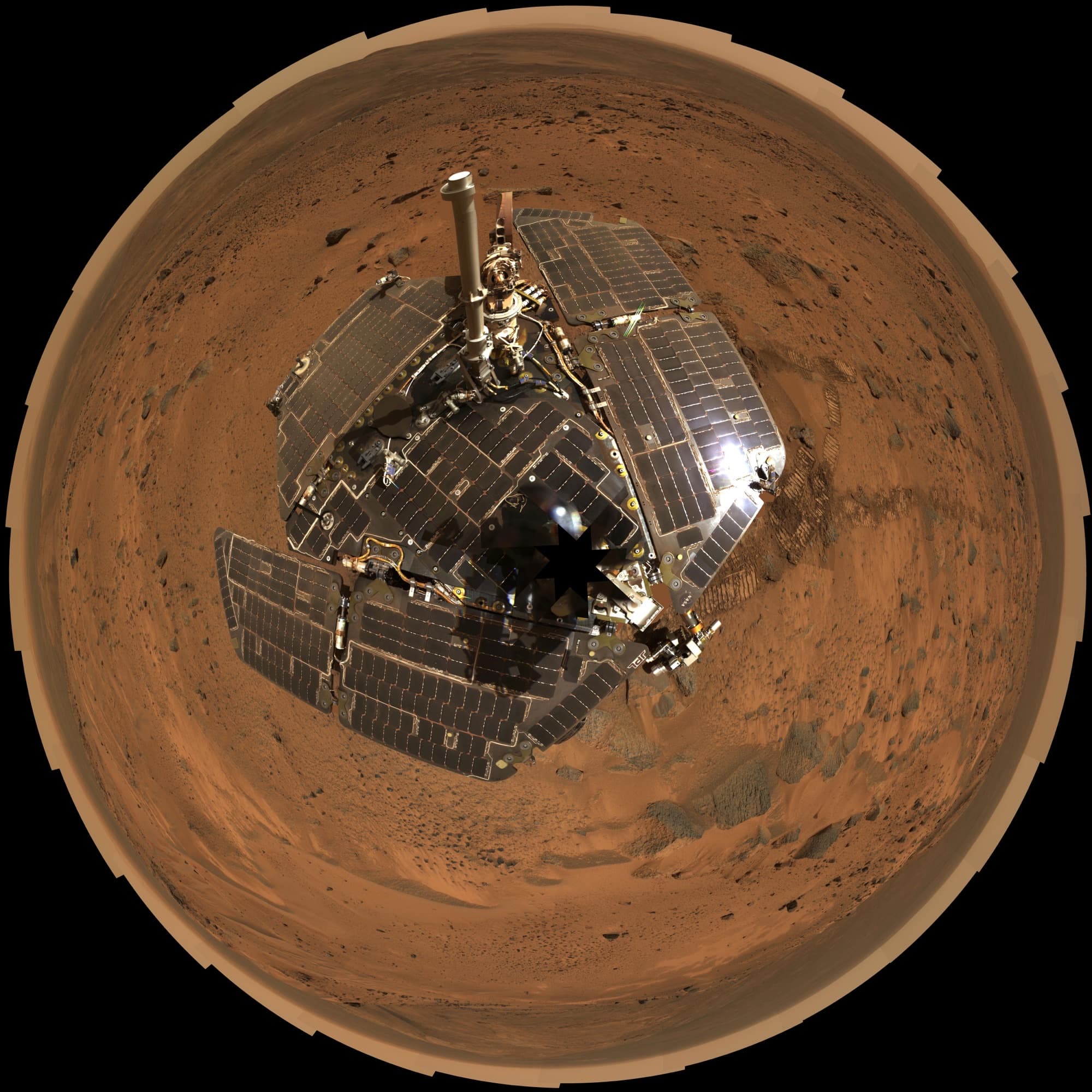
Gusev was chosen for a reason that did not survive contact with the ground. It is a crater 150 kilometres across with a 900 kilometre channel, Ma'adim Vallis, draining into it from the southern highlands, which is why NASA's landing press kit describes it as a possible former lake. Spirit came down inside it on 4 January 2004, hitting at about 14 metres per second, bouncing 28 times inside its airbags and rolling to a stop somewhere between 250 and 300 metres from the point of first impact, about 13.4 kilometres from the aim point. The lander became Columbia Memorial Station, named for the seven astronauts killed when the shuttle broke apart eleven months earlier. Then Spirit looked around and saw a plain. It cut the first hole any machine has ground into a rock on Mars, in a rock called Adirondack beside the lander, drove on to a crater called Bonneville about 370 metres away, and found no lakebed at all. NASA's own list of Spirit's discoveries puts every water result later and higher up, and the first of them is bedrock in the Columbia Hills, a range that had looked like bumps on the horizon from the landing site. The decision to drive there is the decision that made the mission. A three-month geology experiment aimed at a suspected lake floor turned into a six-year overland expedition to a range of hills nobody had planned to reach, and almost everything Spirit is remembered for happened after it arrived.
On 21 January 2004, sol 18, Spirit stopped making sense. The morning downlink began on time, went spotty, and cut out fourteen minutes early. A commanded beep came back; a scheduled communication window did not. Over the next three days the rover answered some commands and ignored others, transmitted the same telemetry packet over and over, gave one orbiter two minutes and twenty seconds of nothing but pseudo-noise code, and refused to shut down at night, draining its batteries while the project manager told reporters it had a very serious anomaly and then called its condition critical. The cause, as Glenn Reeves and Tracy Neilson of JPL later set out in detail, was a design error in a bundled DOS file-system library. Deleting a file freed the space on the flash memory but never freed the RAM used to represent it, so the memory required to mount the file system grew with the highest number of files a directory had ever held rather than the number it currently held. Two configuration parameters made it fatal. The library was allowed to expand its private memory area from free system memory with no ceiling, and when an allocation finally failed the requesting task was silently suspended instead of returning an error. A health monitor saw the suspended task and forced a reset. On reboot the file system was mounted, the memory filled, and the loop closed. The same suspended task held a semaphore the shutdown logic needed, which is why a solar-powered rover could not turn itself off at night.
The fix was a hardware command called crippled mode, one of a handful processed by the electronics rather than the software, which told the rover to initialise without touching the flash file system at all. It went up on sol 21, roughly twelve hours before Opportunity was due to land on the other side of the planet, and it worked. Over the next eleven sols the team recovered the high-gain antenna, deleted obsolete files left over from the launch software load, then erased the flash in small pieces while checking both copies of the flight software after each one, and rebuilt the file system. Spirit was normal on sol 32 and doing science on sol 33. Reeves and Neilson credit the idea for crippled mode to Mars Pathfinder and write that without it the mission may well have been lost. Then came the good years. Dust devils swept the solar arrays in March 2005 and took the panels from about 60 per cent of their clean output to 93. Spirit climbed Husband Hill, which NASA's end-of-mission release calls the first summit of a hill on another planet by a robot, and reached the top on 29 September 2005 by NASA's dating. It came down the far side to a low layered plateau the team named Home Plate, which turned out to record an explosion: coarse bulbous grains lying over finer material, the pattern of debris falling back after a volcanic blast. And on 13 March 2006, sol 779, the right front wheel became inoperable and never properly worked again.
A dead wheel on a six-wheeled rover is not a small problem. Spirit drove the other five and dragged the sixth, which meant driving backwards, avoiding slopes it could no longer climb, and ploughing a trench behind it wherever it went. The trench was the discovery. In 2006 it turned up bright sulfur-rich soil at a place called Tyrone. In the spring of 2007, in the valley beside Home Plate, it churned up something whiter. Steve Ruff of Arizona State University proposed aiming the miniature thermal emission spectrometer at the overturned soil, the spectrum showed silica, the rover was driven close enough to touch it with the alpha particle X-ray spectrometer, and the reading came back at about 90 per cent pure silica with no detectable quartz. NASA announced it on 21 May 2007. Steve Squyres said you could hear people gasp. The patch was named Gertrude Weise, after a player in the All-American Girls Professional Baseball League, and Spirit had been working within about fifty yards of it for more than eighteen months. Concentrating silica like that takes water, and NASA's release offered two routes: soil attacked by acid vapours from volcanism in the presence of water, or precipitation from hot spring fluids. Nine years later Ruff and Jack Farmer argued in Nature Communications that the nodular, finger-like shapes in the Martian silica match structures in the geyser discharge channels at El Tatio in Chile, where the equivalent forms are built partly by microbes. Abiotic origins are not ruled out. The shapes meet an a priori definition of a potential biosignature.
On 23 April 2009, driving south beside Home Plate, Spirit's wheels broke through a thin sulfate crust into loose sand. It drove again on 26, 28 and 29 April, gaining about three metres in total, and on 6 May the left middle wheel stalled. It was embedded in loose, soft ground at a place the team named Troy, at real risk of being high-centred on a small mound of rock under its belly. What followed was a year of the most careful driving in the mission's history: a soil simulant mixed in a sandbox at JPL, toe-in manoeuvres, wheel-steering frog kicks, three to four centimetres at a time. The right rear wheel stalled for the first time on 21 November 2009 and was declared troubled after diagnostics on 8 December. All of it together gained 57 centimetres. In January 2010 NASA gave up on extrication and redesignated Spirit a stationary research platform, and the last drives were spent trying to tilt the solar panels north for a winter the rover was not going to see the far side of. On 8 February 2010 it moved for the last time; very little change in tilt was achieved. The final downlink came on 22 March 2010, sol 2210: master sequence running, all systems green, 134 watt-hours a sol, electronics colder than they had ever been. NASA radiated more than 1,300 commands over the next fourteen months and closed the recovery on 25 May 2011. On 31 March 2011, while the listening was still going on, an orbiting camera happened to catch Spirit near the specular point for its flat solar panels. It was the brightest thing in the frame, which meant the panels were still not thickly dusted. Nothing has answered from Troy since, and nothing had changed when we checked again on 23 August 2026.
Mission facts
Launch
10 June 2003 at 17:58:47 UTC (10:58:47 PDT) from Space Launch Complex 17A at Cape Canaveral, Florida. NASA's mission page names the vehicle a Delta 7925-9.5 (no. D298) and gives the launch time as 17:58:47 UTC; NSSDCA calls it a standard Delta II 7925 and times it at 17:58:46.773 UT. A PAM-D upper stage performed the trans-Mars injection out of a parking orbit of about 163 by 4,762 km at 28.5 degrees. The full launch stack, cruise stage included, was 1,062 kg. Its twin Opportunity followed about a month later.↗
Where the names came from
NASA and the Lego Company, working with the Planetary Society, ran a contest to name the two rovers and took nearly 10,000 entries. The winner was announced on 8 June 2003: Sofi Collis, nine years old, of Scottsdale, Arizona, born in Siberia and adopted at the age of two. Her essay, which she read out at Kennedy Space Center, was: “I used to live in an orphanage. It was dark and cold and lonely. At night, I looked up at the sparkly sky and felt better. I dreamed I could fly there. In America, I can make all my dreams come true. Thank you for the 'Spirit' and the 'Opportunity.'”↗
The rover
185 kg, about the size of a golf cart, six wheels on a rocker-bogie suspension, solar arrays generating up to 140 W on the surface, a top speed of about 3.75 cm per second and a design tolerance of 45 degrees of tilt with a 30-degree operating limit. The science payload, called Athena, was a panoramic camera and a miniature thermal emission spectrometer on a mast, plus four tools on a robotic arm: an alpha particle X-ray spectrometer, a Mössbauer spectrometer, a microscopic imager and a rock abrasion tool.↗
Entry, descent and landing
Aeroshell braking, a parachute at roughly 6 to 7.5 km altitude on NASA's mission-page account (the pre-launch press kit instead puts parachute deployment at about 8.5 km), heat shield release, a bridle lowering the lander, then four airbags inflating and, after them, retrorockets that fired until the lander hung about 8.5 m off the ground. NASA's account has the package hitting at about 14 m/s, bouncing 28 times and rolling to a stop between 250 and 300 m from the point of first impact, at 14.5692 degrees south and 175.4729 degrees east, about 13.4 km (8 miles) from the planned target. The airbags retracted, the four petals opened, and about an hour and a half after landing the rover deployed its solar panels and began relaying through Mars Odyssey. NSSDCA gives 14.572 S, 175.478 E for the same landing, roughly 300 m away, and puts the targeted ellipse at 96 by 19 km oriented at 76 degrees and centred on 14.82 S, 175.15 E; the pre-launch press kit instead describes the target ellipse as 78 by 10.4 km near the centre of Gusev, and we have found no NASA document that reconciles the two.↗
What the landing time actually measures
NSSDCA gives the landing as 04:35 UTC on 4 January 2004 and states outright that this is Earth-received time. The one-way light time from Mars that day was 9.46 minutes, the figure NASA's landing press kit gives, so the touchdown itself happened roughly nine and a half minutes before the timestamp that is usually quoted. The same catalogue records an entry mass of 827 kg at about 19,300 km/h, and the rover driving off its lander on 15 January 2004 at 08:41 UT. In Pacific time the landing was 20:35 PST on 3 January, which is why some accounts date Spirit's arrival a day earlier than others.↗
The plan, and the price
A prime mission of 90 Martian sols, about 92 Earth days, ending around 4 April 2004. Gusev was chosen because it is a 150 km crater with a 900 km channel, Ma'adim Vallis, running into it from the southern highlands, which made it look like a former lake floor. One-way light time on landing day was 9.46 minutes. The two-rover programme cost roughly $820 million: about $645 million for spacecraft development and instruments, $100 million for the launches and $75 million for operations and science processing, in the figures published before the landings.↗
Sol 18: the flash anomaly
On 21 January 2004, sol 18, the morning downlink went spotty and cut out 14 minutes early. Over the next three days Spirit answered some commands and not others, sent the same telemetry packet repeatedly, gave one orbiter two minutes and twenty seconds of nothing but pseudo-noise code, and would not shut down at night, draining its batteries. The project manager told reporters there was a very serious anomaly, and at a later press conference called the rover's condition critical. Three flight-software resets had occurred on sol 18 alone, and by sol 20 the team knew it was in a continuous delayed-reset loop.↗
Sol 18: the root cause
A design error in a bundled DOS file-system library. Deleting a file freed its space on the flash but never freed the RAM used to represent it, so the memory needed to mount the file system grew with the highest number of files a directory had ever held. The number it currently held made no difference. Two configuration parameters compounded it: the library was permitted to expand its private memory area from free system memory with no ceiling, and when an allocation finally failed the requesting task was silently suspended rather than returning an error. A health monitor detected the suspended task and forced a reset; on reboot the file system was mounted again and the loop closed. The suspended task also held a semaphore the shutdown logic needed, which is why a solar-powered rover could not turn itself off.↗
Sol 18: the rescue
A hardware command called crippled mode, processed by the electronics rather than the flight software, told the rover to initialise without using the flash file system at all. It was sent on sol 21, about twelve hours before Opportunity was due to land on the other side of the planet, and it worked. Over the next eleven sols the team recalibrated the high-gain antenna, deleted obsolete data products left over from the launch software load, then erased the flash in small chunks while checking both copies of the flight software after each one, and rebuilt the file system. Spirit was restored to normal on sol 32 and doing science on sol 33. Reeves and Neilson credit the idea for crippled mode to Mars Pathfinder and write that without it the mission may well have been lost.↗
The right front wheel
The right front wheel became inoperable on sol 779, 13 March 2006. Spirit drove on five wheels from then on, mostly backwards, dragging the dead sixth through the soil. It stirred once more in December 2009: a resistance test on sol 2113 showed, surprisingly, normal motor continuity, and on sol 2117 the wheel revolved normally through three of four drive segments before stopping in the fourth. By then the right rear wheel had failed too, and the project had found a negative voltage on the single-point ground where none should be, suggesting an electrical short to the chassis and putting the rover's motor controller board under suspicion.↗
The 2007 dust storm
In July and August 2007 a planet-scale dust event nearly ended both rovers. Spirit's measurement of atmospheric opacity, tau, hit a record 4.738 on sol 1265, 25 July 2007, and its solar array output fell to a matching record low of 261 watt-hours a sol. Science was cut to almost nothing for weeks. Dust settling out of the clearing sky then landed on the panels, so the recovery in power lagged the recovery in the weather. On 1 October 2007 the rover entered the fifth extension of its original mission.↗
The silica
Steve Ruff of Arizona State University proposed pointing the miniature thermal emission spectrometer at soil the dragging wheel had overturned near Home Plate; the spectrum showed a high silica content, and in May 2007 Spirit was driven close enough to touch it with the alpha particle X-ray spectrometer. The reading was about 90 per cent pure silica, non-crystalline, with no detectable quartz. NASA announced it on 21 May 2007. Steve Squyres, principal investigator: “You could hear people gasp in astonishment.” The patch was named Gertrude Weise for a player in the All-American Girls Professional Baseball League. Spirit had worked within about 50 yards of it for more than 18 months without noticing.↗
What the silica might mean
NASA's 2007 release offered two routes to a deposit that concentrated: soil attacked by acid vapours from volcanic activity in the presence of water, or precipitation from hot spring fluids. In November 2016, Steven Ruff and Jack Farmer published a reanalysis in Nature Communications arguing that the nodular and millimetre-scale digitate shapes in the Martian silica closely match structures in the hot spring and geyser discharge channels at El Tatio in northern Chile, where halite-encrusted silica gives the best infrared match yet to Spirit's spectra, and where the equivalent forms are built by a combination of biological and non-biological processes. Their claim is carefully bounded: fully abiotic origins are not ruled out, but the Martian structures satisfy an a priori definition of potential biosignatures.↗
Troy
Driving south along the west side of Home Plate, Spirit's wheels broke through a thin crust into loose, bright, slippery sand. JPL's updates record drives on sols 1886, 1889, 1891 and 1892 (23, 26, 28 and 29 April 2009) totalling about three metres, and date the embedding itself to sol 1899, 6 May 2009, when the left middle wheel stalled. The rover was left in loose, soft ground with a real risk of being high-centred on a small mound of rocks under its belly, in soil that analysis showed to contain differing amounts of ferric sulfate, calcium sulfate, silica and other constituents. Extrication attempts ran from November 2009 to February 2010 and gained centimetres at a time.↗
The fourth winter and the last downlink
The last commanded movement was on sol 2169, 8 February 2010, an attempt to lift one side of the suspension for northerly tilt; very little change was achieved. The last downlink came on sol 2210, 22 March 2010: Spirit still under master sequence control, all systems green, energy production down to 134 watt-hours a sol, and the solid-state power amplifier at a record low of minus 41.5 degrees Celsius. A change in the behaviour of the battery survival heaters had been noticed a week earlier and was still being investigated. Total odometry stood at 7,730.50 metres and never moved again.↗
How it ended, and where it stands in 2026
Spirit drove 7.73 km, which JPL's end-of-mission release calls more than 12 times the goal set for the mission, returned more than 124,000 images, ground the surfaces off 15 rock targets and scoured 92 more with a brush. The same release records the climb up Husband Hill as the first summit of a hill on another planet by a robot, on slopes of up to 30 degrees, and notes that nearly a kilometre of the total was driven after the right front wheel stopped working in 2006. NASA ended operational planning and declared the mission complete on 25 May 2011. Checked again on 23 August 2026, NASA still records the mission as complete, and we found no report from any source, of any date, of a signal from Spirit since 22 March 2010.↗
Mission timeline
- 10 Jun 2003Launch at 17:58:47 UTC from Space Launch Complex 17A at Cape Canaveral on a Delta 7925-9.5 with a PAM-D upper stage, two days after NASA announced that a nine-year-old essay contest winner had named the two rovers Spirit and Opportunity.
- 4 Jan 2004Touchdown in Gusev Crater. The airbag-wrapped lander hits at about 14 m/s, bounces 28 times and rolls 250 to 300 m, coming to rest about 13.4 km from the aim point. The station is named for the crew of Columbia. The 04:35 UTC timestamp is Earth-received time; the landing itself happened about 9.5 minutes earlier.
- 21 Jan to 5 Feb 2004Sol 18 to sol 33. A file-system bug drives Spirit into a reboot loop it cannot shut down out of, and the project manager calls its condition critical. A hardware crippled-mode command on sol 21, hours before Opportunity lands, stops the loop. Eleven sols of surgery follow, the flash is erased and reformatted, and normal science resumes on sol 33.
- Mar 2005Passing dust devils sweep the solar panels clean, lifting the arrays from about 60 per cent of their clean output to 93 per cent. It is the single event that most extends the mission.
- 29 Sep 2005Spirit reaches the summit of Husband Hill, on NASA's dating, and shoots a 360-degree colour panorama from the top. NASA's end-of-mission release describes it as the first robot to summit a hill on another planet, having climbed slopes of up to 30 degrees to get there.
- 13 Mar 2006Sol 779: the right front wheel becomes inoperable. From here Spirit drives on five wheels, mostly in reverse, ploughing a trench through the soil with the sixth. It is the failure that produces the mission's biggest discovery.
- 21 May 2007NASA announces that soil churned up by the dead wheel near Home Plate is about 90 per cent pure silica, non-crystalline, with no detectable quartz. The patch is named Gertrude Weise. Spirit had been working within about fifty yards of it for more than eighteen months without noticing.
- 25 Jul 2007Sol 1265: at the height of the global dust storm, Spirit measures a record atmospheric opacity of 4.738 and its solar arrays produce a record-low 261 watt-hours. Both rovers spend weeks doing almost nothing but surviving.
- 23 Apr to 6 May 2009Spirit's wheels break through a sulfate-rich crust into soft sand beside Home Plate. Four short drives over the next week gain about three metres in total, and on sol 1899 the left middle wheel stalls. The rover never moves meaningfully again. The site is named Troy.
- Jan 2010After many failed attempts to move the rover, NASA gives up on freeing Spirit and reformulates the mission around a stationary science platform. One new goal is to track tiny wobbles in the rotation of Mars for clues to whether its core is liquid or solid. The remaining energy is spent trying to tilt the panels north. In the end the desired tilt was not achieved.
- 22 Mar 2010Sol 2210: the last downlink. Spirit is under master sequence control with all systems green, generating 134 watt-hours a sol, with its electronics at a record low of minus 41.5 C. Total odometry 7,730.50 m. Nothing is heard from it again.
- 25 May 2011After more than 1,300 commands radiated over fourteen months, NASA concludes the recovery effort and declares the mission complete. The most probable cause of the silence is given as excessive cold that made the survival heaters ineffective. Spirit had operated for six years, two months and 19 days, which NASA's mission page calls more than 25 times its intended lifetime; measured in sols, 2,210 against 90 is about 24.6 times.
A filled dot marks something that physically happened. A hollow one marks an announcement, a naming or a target.
Where Spirit drove
- 7.73 kmdriven, the figure the mission reports
- 2,208sols from the first drive to the last
- 661stops in the published path
Path: NASA / JPL-Caltech / MER science team, via the Washington University Analyst's Notebook. Analyst's Notebook MER traverse map service, layers 1stSolPnts and merATraverse
Ended, last position 21 March 2010. Every waypoint is on the globe, drawn where it was driven, with the sol it happened on. The mapped ground path is 7.08 km. NASA gives 7.73 km, which is wheel odometry and includes the months Spirit spent turning in place at Troy with a dead wheel.
Replay the driveon the globe →In pictures
Tap a photo to enlarge.
Sources
- NASA Science: Spirit mission page (page last updated 19 December 2024, retrieved 23 August 2026)
- NSSDCA Master Catalog: Spirit (2003-027A), archived 20 August 2025
- Glenn Reeves and Tracy Neilson (JPL), The Mars Rover Spirit FLASH Anomaly, IEEE Aerospace Conference 2005, paper 1426
- NASA release 07-118 (21 May 2007): Mars Rover Spirit Unearths Surprise Evidence of Wetter Past
- NASA/JPL Spirit rover status updates, 2007 (Internet Archive capture)
- NASA/JPL Spirit rover status updates, 2009 (Internet Archive capture)
- NASA/JPL Spirit rover status updates, 2010
- NASA JPL (25 May 2011): NASA's Spirit Rover Completes Mission on Mars
- NASA/JPL Mars Exploration Rover landings press kit (cover-dated January 2004)
- S. W. Ruff and J. D. Farmer, Silica deposits on Mars with features resembling hot spring biosignatures at El Tatio in Chile, Nature Communications 7:13554, 17 November 2016
- NASA/JPL (8 June 2003): Girl With Dreams Names Mars Rovers 'Spirit' and 'Opportunity' (Internet Archive capture)
- HiRISE ESP_021925_1650: Spirit, Spirit, Shining Bright (31 March 2011)
Facts on this page were verified on 23 August 2026. Where sources disagree, the disagreement is stated rather than resolved silently.
175.4729 E, -14.5692 N · Columbia Memorial Station