The place names of Mars
IAU · Multinational · Program · 2004 · The long occupationOperating
Operating as of 24 August 2026: the IAU gazetteer holds 2,052 approved names on Mars and not one is a landing site. Bradbury Landing, Wright Brothers Field and the memorial stations are agency names only.
TL;DR· 20 min read
There are two maps of Mars. The IAU has approved 2,052 feature names, the newest on 24 August 2026, and not one of them is a landing site: Bradbury Landing, Carl Sagan Memorial Station, Wright Brothers Field and the rest are agency names the gazetteer will not give official status. The rules are strict, and nobody dead less than three years may be commemorated. A mission nickname can still cross over when it fits a theme, as Yellowknife and Endeavour did.
There are two maps of Mars. One is the official gazetteer: 2,052 names voted through by an IAU working group under rules first drafted in 1919, in which large craters honour scientists and writers, small craters are named after small towns anywhere on Earth, and no feature may commemorate anyone who has been dead less than three years. The other is the map the missions actually use, full of landing sites, memorial stations, airfields and overlooks that no committee has ever approved. Almost every dedication people remember belongs to the second map. This page is the index that ties them together, because most of the places on it are already pins on this globe.
- 2,052IAU-approved feature names on Mars, the newest dated 24 August 2026
- 0landing sites or memorial stations among them
- 3 yearsa person must be dead before a name honouring them can even be proposed
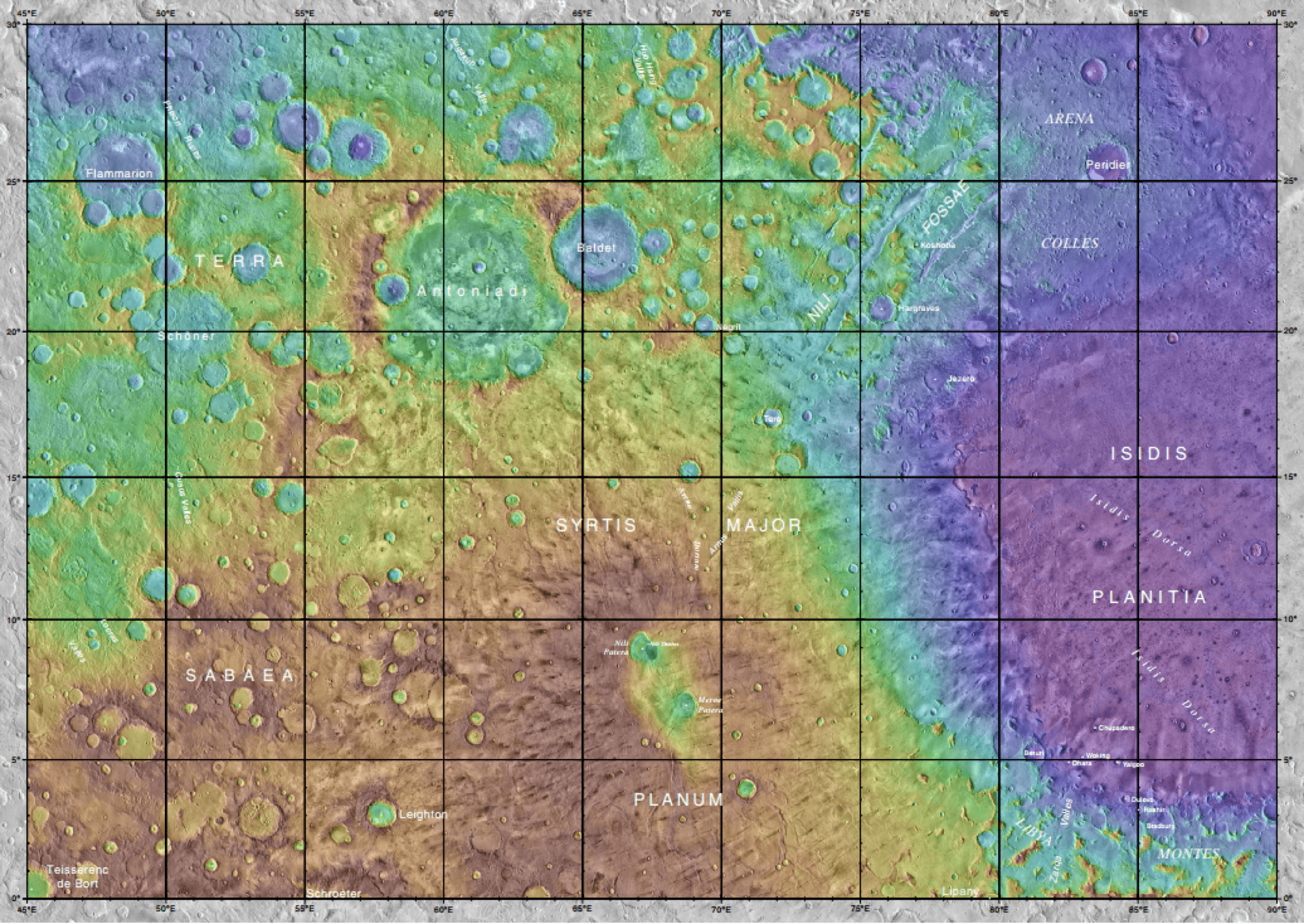
Naming anything on Mars runs through one committee. The IAU's Working Group for Planetary System Nomenclature takes proposals only from the professional science community, and only when there is a specific need to name a feature for a peer-reviewed paper or a map. The proposer supplies a scientific justification, annotated and unannotated images, the feature type, its size and its coordinates in the correct system, and an authoritative reference for the name itself, which the gazetteer notes may not be Wikipedia or Google Maps. A task group reviews it, then the working group votes, and a straightforward single name takes about a month. Fourteen numbered rules constrain what can be proposed. Nothing under 100 metres is normally named. No name may carry political, military or religious significance, except for political figures from before the nineteenth century. Commemorating a person is not supposed to be the point of a name at all, and where it happens the person must have been dead for at least three years before anyone may even submit the proposal. On top of that sit the themes, fixed per feature type and per planet. On Mars, large craters go to scientists who studied the planet and writers who added to its lore, small craters go to small towns and villages anywhere on Earth, large valles take the word for Mars in some language, small valles take rivers, and everything else inherits from the nearest classical albedo name.
The map was built in layers. The oldest is telescopic: in 1958 an IAU committee chaired by Audouin Dollfus adopted 128 albedo names from Schiaparelli's 1879 system and Antoniadi's 1929 extension of it, and those names still underlie most of the planet. Utopia, Elysium, Chryse, Hellas, Amazonis and Arcadia are 1958 names, and so is Nix Olympica, the snows of Olympus, which became Olympus Mons once Mariner 9 showed it was a volcano. The second layer is spacecraft. A Mars nomenclature working group was formed under Gerard de Vaucouleurs in 1970 to be ready for Mariner 9, and at the 1973 General Assembly in Sydney it was folded into the new Working Group for Planetary System Nomenclature. 272 Mars names were adopted in 1973, including Valles Marineris, which the gazetteer records as honouring not the spacecraft but "the scientific team of the Mariner 9 program." Then Viking: 383 names in 1976, 127 in 1979. The 1979 batch is the most quietly deliberate thing in the whole gazetteer. Around the Viking 1 lander in Chryse the small craters were named for colonial towns and ports of the age of sail, Annapolis and Charleston and Cadiz and Lisboa and Amsterdam and Okhotsk. Around the Viking 2 lander in Utopia they were named for the launch pads, tracking dishes and control rooms that had made the landing possible: Canaveral and Baykonyr and Woomera and Kourou, Goldstone and Canberra and Madrid and Jodrell, Houston and Tsukuba and Kaliningrad.
The names people actually remember are on the other map. The Viking 1 lander became the Thomas A. Mutch Memorial Station after its imaging team leader vanished in the Himalayas in October 1980, and the Viking 2 lander became the Gerald Soffen Memorial Station in July 2001 after the Viking project scientist died. Mars Pathfinder became the Carl Sagan Memorial Station on 5 July 1997, the day after it landed, announced by administrator Daniel Goldin at Planetfest '97 in Pasadena. Then came four weeks in early 2004 in which NASA named Spirit's landing site Columbia Memorial Station, dedicated three hills near it to the Apollo 1 crew on the anniversary of the pad fire, named Opportunity's landing site Challenger Memorial Station on the anniversary of that accident, and dedicated the seven hills east of Spirit to the seven people who died aboard Columbia. Curiosity's landing site became Bradbury Landing on what would have been Ray Bradbury's 92nd birthday. Ingenuity's first airfield became Wright Brothers Field. The rise Perseverance watched that flight from is Van Zyl Overlook, for a JPL director who died a month after the rover launched, and the rover's own landing point is Octavia E. Butler Landing. Every one of these is an agency name. The gazetteer is explicit: names given during active missions to landing sites, spacecraft impact sites and small surface features "will not be given official status by the IAU, except as provided for by Rules 2 and 3 above", those being the rules that let a very small feature through on scientific merit.
That does not mean the two maps never touch. A team nickname can cross over if it stops being a commemoration and starts fitting a theme. Yellowknife, where Curiosity found an ancient habitable lakebed, is now an approved crater 120 metres across, because Yellowknife is a town in the Northwest Territories and small craters are named for small towns. Opportunity's Endeavour and Victoria are approved craters too, credited in the gazetteer to a town in Canada and a town in the Seychelles rather than to the ships the rover team had in mind. The people honoured on the mission map generally get craters somewhere else entirely and years later: Mutch in 1985, Sagan in 2000, Soffen in 2006, Bradbury in 2015, each safely past the three-year rule. Whole landing regions are now named in advance, which is what the gazetteer's advice to open a nomenclature channel six to nine months before touchdown produces in practice. Twelve names went into Jezero crater in early 2020, thirteen months ahead of Perseverance, with Balkan rivers for the valles to match the Bosnian town the crater is named for. Twenty-two names went in around Zhurong in December 2021 and January 2022, all Chinese towns. And the name none of it works without is Airy-0, a 786 metre crater inside a larger crater named for George Airy, which defines zero degrees longitude and therefore fixes every coordinate on this globe.
So this page is an index of two overlapping registers, and the difference between them is worth holding onto. The official register is a working tool, added to only when someone doing science needs a word for something, deliberately impersonal, still growing at a few dozen names a year: 2,052 approved names as of 24 August 2026, the newest a 1.5 km crater called Pals, for a town in Spain. The unofficial one is a memorial wall. It holds a geologist who died on a mountain, a project scientist, an astronomer who talked a generation into caring, seventeen astronauts killed in three accidents, two bicycle makers from Dayton, two writers who imagined Mars long before anyone reached it, and a JPL manager whose people wanted his name on the spot they stood to watch the first flight on another planet. Neither register is less real than the other. Mission teams navigate by the second one daily, publish papers full of it, and put it in captions NASA distributes worldwide. But only one of them is what a future map of Mars will inherit, and it is not the one with the memorial stations in it. That is the whole reason the IAU insists on the distinction, and it is why a plaque handed to the Smithsonian in 1984 is still sitting in a museum in Washington, waiting for somebody to carry it to Chryse.
Mission facts
Who actually decides
The IAU, through its Working Group for Planetary System Nomenclature. A scientist or a student with a specific need to name a feature for a peer-reviewed paper or a map submits a justification, annotated and unannotated images, the feature type, its size and its coordinates in the right coordinate system, plus an authoritative reference for the name (the gazetteer states that Wikipedia and Google Maps are not acceptable). A task group reviews it, then the WGPSN votes. A straightforward single name takes about a month. Approved names enter the Gazetteer of Planetary Nomenclature and are listed in the Transactions of the IAU. Objections must reach the IAU General Secretary in writing within three months of publication.↗
The rules that bite
Fourteen numbered rules govern every name. The ones that shape Mars: features under 100 metres across are not normally named at all; "No names having political, military or religious significance may be used, except for names of political figures prior to the 19th century"; and commemoration "should not normally be a goal in itself, but may be employed in special circumstances and is reserved for persons of high and enduring international standing. Persons being so honored must have been deceased for at least three years, before a proposal may be submitted." There is also a quiet concession to landing: "a higher percentage of names from the country planning a landing is allowed on landing site maps." And the rule that governs everything on this page: during active missions, small features including landing sites and spacecraft impact sites are often given informal names, and "Such names will not be given official status by the IAU, except as provided for by Rules 2 and 3 above." That exception matters: Rule 2 is the one that lets a feature under 100 metres be named anyway if it has exceptional scientific interest.↗
The Mars themes
Each feature type on Mars has a fixed theme. Albedo features keep the classical mythological names Schiaparelli and Antoniadi assigned from the telescope. Large craters take "Scientists, especially those who have contributed significantly to the study of Mars; writers and others who have contributed to the lore of Mars." Small craters take "Small towns and villages of the world with populations of approximately 100,000 or less," and the gazetteer adds that "No commemoration of specific towns or villages is intended." Large valles take the word for Mars or for a star in various languages; small valles take river names. Everything else inherits from the nearest albedo feature or, failing that, the nearest named crater. The gazetteer currently puts the split between the two crater themes at approximately 50 km, though the older 60 km line is still where the data actually divides.↗
The first two layers of the map
The oldest layer is telescopic. An ad hoc IAU committee chaired by Audouin Dollfus recommended 128 albedo names in 1958, taken from the system Giovanni Schiaparelli built in 1879 and E. M. Antoniadi extended in 1929. Utopia, Elysium, Chryse, Amazonis, Hellas, Arcadia and Nix Olympica all date from that decision, and most of the planet's large features still inherit from it. The second layer is spacecraft. A Mars nomenclature working group was formed under Gerard de Vaucouleurs in 1970 to be ready for Mariner 9, and at the 1973 General Assembly in Sydney the groups were reorganised into the Working Group for Planetary System Nomenclature under Peter Millman of Canada. Counting approval dates in the gazetteer's own dataset gives 272 Mars names adopted in 1973, among them Olympus Mons and Valles Marineris, whose stated origin is not the spacecraft but the people: "General name of the system of canyons honoring the scientific team of the Mariner 9 program."↗
The two Viking landing sites got opposite themes
383 names were approved in 1976 and 127 in 1979, and the 1979 batch did something deliberate. Within 120 km of the Viking 1 lander in Chryse there are 27 craters named in 1979, every one of them a colonial town or a port of the age of sail: Annapolis, Philadelphia, Charleston, Lexington, Newport, Bristol, Cadiz, Lisboa, Bordeaux, Amsterdam, Okhotsk, Colon, Bridgetown, Kingston. Within 120 km of the Viking 2 lander in Utopia there are 18 craters named in 1979, every one of them a launch site, a tracking station or a mission control centre: Canaveral, Baykonyr, Volgograd, Woomera, Kourou, Kagoshima, Wallops, Hamaguir, Hsuanch'eng, Goldstone, Canberra, Madrid, Johannesburg, Evpatoriya, Jodrell, Houston, Tsukuba, Kaliningrad. Hsuanch'eng, entered in the gazetteer as a Chinese launch site, is the eighteenth and the one everybody leaves out. Old exploration around one lander, the machinery of the new around the other. Baikonur ends up on Mars twice, as Baykonyr near Viking 2 in 1979 and again as Tyuratam in 2013, next to the candidate Mars 3 landing site.↗
Mutch Memorial Station, and its plaque
The Viking 1 lander was renamed for Thomas A. Mutch, leader of the Viking lander imaging team, who disappeared descending in the Himalayas on 6 October 1980. The date of the renaming is not settled: NASA's NSSDCA master catalogue ("The Viking 1 Lander was named the Thomas Mutch Memorial Station in January 1981") and the National Air and Space Museum both say January 1981, while NASA's current Viking 1 mission page says January 1982. A memorial plaque was made to be fixed to the lander by whoever reaches it; the museum record quoted below is the source for its existence and its custody, and does not give its material or the year it was made. On 18 May 1984 NASA administrator James M. Beggs handed that plaque to the museum, charging it to "retain, secure, and protect" the plaque "until such time when future American Astronauts travel to Mars and affix the plaque to the Mutch Memorial Station on the Martian surface," and in the same letter transferred ownership of the lander on Mars to the museum. The plaque is still in Washington.↗
Soffen Memorial Station
The Viking 2 lander was renamed the Gerald Soffen Memorial Station in July 2001, for the Viking project scientist, who died in 2000. NASA's Viking 2 mission page carries the date and the reason. Both Viking memorial names are informal and neither appears in the IAU gazetteer. Soffen does have an official crater, 58.3 km across at 23.73 S, 140.86 E, adopted on 14 September 2006, six years after his death and so clear of the three-year rule.↗
Carl Sagan Memorial Station
Named on 5 July 1997, the day after Mars Pathfinder landed. NASA administrator Daniel S. Goldin announced it at Planetfest '97 in Pasadena, six and a half months after Sagan died on 20 December 1996. Sagan also has a crater, adopted by the IAU in 2000, four years after he died and so comfortably clear of the three-year rule. Its size is one of the few places where the gazetteer disagrees with itself: the online feature page gives 98.1 km at 10.68 N, 329.30 E, while the downloadable shapefile gives 90.3 km at 10.72 N, 329.40 E. The two names are not in the same place: the crater is about 520 km south-east of the lander.↗
Columbia Memorial Station, 6 January 2004
Three days after Spirit landed, NASA announced that "the area in the vast flatland of the Gusev Crater where Spirit landed this weekend will be called the Columbia Memorial Station." Administrator Sean O'Keefe said that "as team members gazed at Mars through Spirit's eyes, the Columbia memorial appeared in images returned to Earth, a fitting tribute to their own spirit and dedication." He meant that literally: a memorial plaque designed by JPL engineers had been mounted on the spacecraft before launch, and the rover photographed it on the surface.↗
The Apollo 1 hills, 27 January 2004
On the thirty-seventh anniversary of the launch pad fire, NASA dedicated three hills around Spirit's landing site to the Apollo 1 crew: Grissom Hill 7.5 km to the south-west, White Hill 11.2 km to the north-west and Chaffee Hill 14.3 km to the south-south-west. O'Keefe said that "Gus, Ed and Roger's contributions, as much as their sacrifice, helped make our giant leap for mankind possible." None of the three names appears in the IAU gazetteer.↗
Challenger Memorial Station, 28 January 2004
Three days after Opportunity landed and eighteen years to the day after the accident, NASA named its landing site in Meridiani Planum for the STS-51-L crew: Francis R. Scobee, Michael J. Smith, Judith A. Resnik, Ellison S. Onizuka, Ronald E. McNair, Gregory B. Jarvis and Sharon Christa McAuliffe. The small crater Opportunity actually alighted in, which the rover team called Eagle, has no official name either. There is an approved Eagle crater on Mars, 12.5 km across, but it sits at 43.81 N, 351.83 E and is named for a town in Idaho.↗
The seven hills, 2 February 2004
O'Keefe dedicated seven hills east of Spirit's landing site to the STS-107 crew: "These seven hills on Mars are named for those seven brave souls, the final crew of the Space Shuttle Columbia." The release also recorded that NASA planned to submit the names to the International Astronomical Union for official designation. Twenty-two years later there is no Columbia Hills in the gazetteer, and no Husband, McCool, Anderson, Chawla, Brown or Ramon anywhere on Mars. There is a Clark crater, but it was adopted in 1973 for the American optician Alvan Clark. The only approved Martian feature carrying the word Columbia is Columbia Valles, adopted in 2006 and credited to a river in Washington state.↗
Bradbury Landing, and Bradbury crater
NASA announced on 22 August 2012 that Curiosity's landing site would be named for Ray Bradbury, "who was born 92 years ago today and died this year." Bradbury Landing sits on Aeolis Palus, a plain the IAU had formally named on 16 May 2012, three months before the landing, alongside Aeolis Mons, the mountain NASA calls Mount Sharp. Ray Bradbury does have an official Martian crater, but nowhere near Gale: 63.2 km across at 2.58 N, 85.80 E, adopted 15 October 2015, three years and four months after his death, under the large-crater theme for writers who contributed to the lore of Mars.↗
Wright Brothers Field
Named on 19 April 2021, at the briefing that confirmed Ingenuity's first flight. NASA associate administrator Thomas Zurbuchen said that "as an homage to the two innovative bicycle makers from Dayton, this first of many airfields on other worlds will now be known as Wright Brothers Field, in recognition of the ingenuity and innovation that continue to propel exploration." The same announcement carried two registrations that are not honorary: the International Civil Aviation Organization issued Ingenuity the operator designator IGY with the call sign INGENUITY, and gave the flight location the ceremonial identifier JZRO, for Jezero Crater.↗
Van Zyl Overlook, Butler Landing, Valinor Hills
Van Zyl Overlook is the rise Perseverance parked on to watch that first flight, 211 feet (64.3 m) from the helicopter. It is named for Jakob van Zyl, who joined JPL in 1986 and was director of its Solar System Exploration Directorate, and who died unexpectedly in August 2020, about a month after Perseverance launched. The rover's own landing point had been named Octavia E. Butler Landing on 5 March 2021, for the science fiction writer, announced in JPL's release on the rover's first drive. Ingenuity's last stop was nicknamed Valinor Hills by the helicopter team, after Tolkien; NASA's accident investigation, published on 11 December 2024, found that all four rotor blades were broken in the hard landing of 18 January 2024. None of the three is an IAU name.↗
Airy-0, the crater that defines zero
Martian longitude is measured from a crater 786 metres across at 5.07 S. The gazetteer's origin field reads: "Small crater within crater Airy that defines zero degrees longitude on Mars." Airy itself, 43 km across, is named for the British astronomer George Biddell Airy and dates from the 1973 batch; Airy-0 was formalised in 2003. Every east longitude on this globe, including every landing site on this page, is counted from that one small hole in the ground.↗
Mission timeline
- 1919 to 1958The IAU is founded in Brussels and appoints a committee "to regularize the chaotic lunar and Martian nomenclatures then current." Mars waits four decades for its turn: in 1958 an ad hoc committee under Audouin Dollfus recommends 128 albedo names drawn from Schiaparelli and Antoniadi, and the classical layer of the map is fixed.
- 1973At the IAU General Assembly in Sydney the nomenclature groups are reorganised into the Working Group for Planetary System Nomenclature under Peter Millman. 272 Mars names are adopted that year on the strength of Mariner 9's global coverage, among them Olympus Mons and Valles Marineris.
- 1976 to 1979Viking floods the gazetteer: 383 names in 1976 and 127 in 1979. The 1979 batch names 27 craters around the Viking 1 site for colonial towns and old ports, and 18 around the Viking 2 site for launch pads, tracking dishes and control rooms, including Baykonyr, Goldstone, Kourou, Jodrell and Houston.
- Jan 1981The Viking 1 lander is renamed the Thomas A. Mutch Memorial Station, for the imaging team leader lost in the Himalayas in October 1980. NASA's current mission page dates the renaming to January 1982 instead. On 18 May 1984 administrator James M. Beggs hands the memorial plaque to the National Air and Space Museum, to be carried to Mars and fixed to the lander by future astronauts, and transfers ownership of the lander in the same letter.
- 5 Jul 1997NASA administrator Daniel S. Goldin names the Mars Pathfinder lander the Carl Sagan Memorial Station, at Planetfest '97 in Pasadena, the day after landing. The Viking 2 lander is renamed the Gerald Soffen Memorial Station in July 2001 on the same pattern.
- 6 Jan to 2 Feb 2004Four dedications in four weeks. 6 January: Columbia Memorial Station at Spirit's landing site. 27 January: Grissom, White and Chaffee Hills, thirty-seven years after the Apollo 1 fire. 28 January: Challenger Memorial Station at Opportunity's landing site, eighteen years to the day after that accident. 2 February: the seven hills east of Spirit dedicated to the STS-107 crew, with NASA stating it would submit the names to the IAU.
- 16 May 2012The IAU approves Aeolis Mons and Aeolis Palus in Gale crater, and Robert Sharp crater about 270 km to the west. Three months later Curiosity lands on Aeolis Palus, and NASA goes on calling Aeolis Mons Mount Sharp.
- 22 Aug 2012NASA names Curiosity's landing site Bradbury Landing on what would have been Ray Bradbury's 92nd birthday. A 120 m crater nearby, Yellowknife, becomes an official IAU name nineteen days later, because Yellowknife is a town in the Northwest Territories and small craters are named for small towns.
- 17 Jan to 26 Mar 2020Twelve names are approved in and around Jezero crater, thirteen months before Perseverance lands there: craters named for small towns from Belva in West Virginia to Ulricehamn in Sweden, four valles named for Balkan rivers to match the Bosnian town of Jezero, and Nili Planum. The gazetteer asks mission teams to open a nomenclature channel six to nine months before landing, and this is what that looks like.
- 5 Mar to 19 Apr 2021Perseverance's landing point is named Octavia E. Butler Landing on 5 March. On 19 April, after Ingenuity's first flight, the airfield becomes Wright Brothers Field and the rise the rover watched from becomes Van Zyl Overlook. ICAO issues the helicopter the operator designator IGY and the site the ceremonial identifier JZRO.
- 3 Dec 2021 to 4 Jan 2022The IAU approves 22 names within about 70 km of Zhurong's landing site in southern Utopia Planitia, all of them small Chinese towns and features named after them: Tianzhushan, Zhouzhuang, Yangliuqing, Mohe, Gutian, Lukeqin, Qidu, Wenjiashi, Xibaipo and the rest. It is the largest single landing-site naming since Viking.
- 24 Aug 2026The newest approved name on Mars: Pals, a 1.5 km crater at 43.81 N, 301.53 E, named for a town in Spain. The gazetteer now holds 2,052 approved Martian names, of which 1,240 are craters, and about 905 of those craters carry a town, village or port origin in the dataset (904 by a strict text match on the origin field).
A filled dot marks something that physically happened. A hollow one marks an announcement, a naming or a target.
In pictures
Tap a photo to enlarge.
Sources
- Gazetteer of Planetary Nomenclature: IAU Rules and Conventions
- Gazetteer of Planetary Nomenclature: Categories for Naming Features on Planets and Satellites
- JPL news release, 2 February 2004: NASA Dedicates Mars Landmarks to Columbia Crew
- Gazetteer of Planetary Nomenclature: History of Planetary Nomenclature
- Gazetteer of Planetary Nomenclature: FAQ
- Gazetteer of Planetary Nomenclature: MARS_nomenclature_center_pts
- National Air and Space Museum: Viking and the National Air and Space Museum
- NASA Science: Viking 2 mission page
- NASA Science: Viking 1 mission page
- JPL news release, 5 July 1997: NASA Renames Mars Lander in Honor of Late Carl Sagan
- JPL news release, 6 January 2004: Space Shuttle Columbia Crew Memorialized on Mars (Columbia Memorial Station)
- JPL news release, 19 April 2021: NASA's Ingenuity Mars Helicopter Succeeds in Historic First Flight
- Gazetteer of Planetary Nomenclature: Planetary Names
- HiRISE PSP_001521_2025: the Viking 1 lander imaged from orbit
- JPL news release, 5 March 2021: NASA's Perseverance Drives on Mars' Terrain for First Time
- JPL news release, 11 December 2024: NASA Performs First Aircraft Accident Investigation on Another World
- NSSDCA Master Catalog: Viking 1 Lander (1975-075C), archived August 2025
Facts on this page were verified on 24 August 2026. Where sources disagree, the disagreement is stated rather than resolved silently.
-47.9460 E, 22.2730 N · Thomas A. Mutch Memorial Station