World Trade Center Aluminium on Mars
Honeybee Robotics, with NASA JPL · United States · Artefact · 2004 · The long occupationSuccess
Still on Mars: aluminium from the World Trade Center site, machined into the rock abrasion tool cable shield on each of Spirit and Opportunity, rovers that fell silent in March 2010 and June 2018.
TL;DR· 11 min read
Aluminium recovered from the World Trade Center site was machined into the cable shield of the rock abrasion tool on each of NASA's two 2003 Mars rovers. The metal reached Honeybee Robotics in lower Manhattan on 1 December 2001 with a note saying it was debris from Tower 1 and Tower 2, and nobody involved spoke about it publicly until late 2004. Spirit photographed its shield in February 2004 and Opportunity photographed its own on the tenth anniversary of the attacks.
In September 2001 the engineers at Honeybee Robotics were finishing a pair of grinders for NASA's next two Mars rovers. Their workshop was on Elizabeth Street in lower Manhattan, less than a mile from the World Trade Center. A JPL engineer suggested that the rovers carry something to mark what had happened, and through a contact of Honeybee's chairman a parcel arrived from the New York mayor's office on 1 December 2001 containing a twisted plate of aluminium and a note. The metal was machined into a small cuff that shields a cable on each rover's rock abrasion tool. Each cuff carries an image of the American flag.
- 2cable shields, one on Spirit's rock abrasion tool and one on Opportunity's
- 1 Dec 2001the day the aluminium reached Honeybee Robotics from the New York mayor's office
- Nov 2004when the origin of the metal was first discussed publicly, ten months after the rovers landed
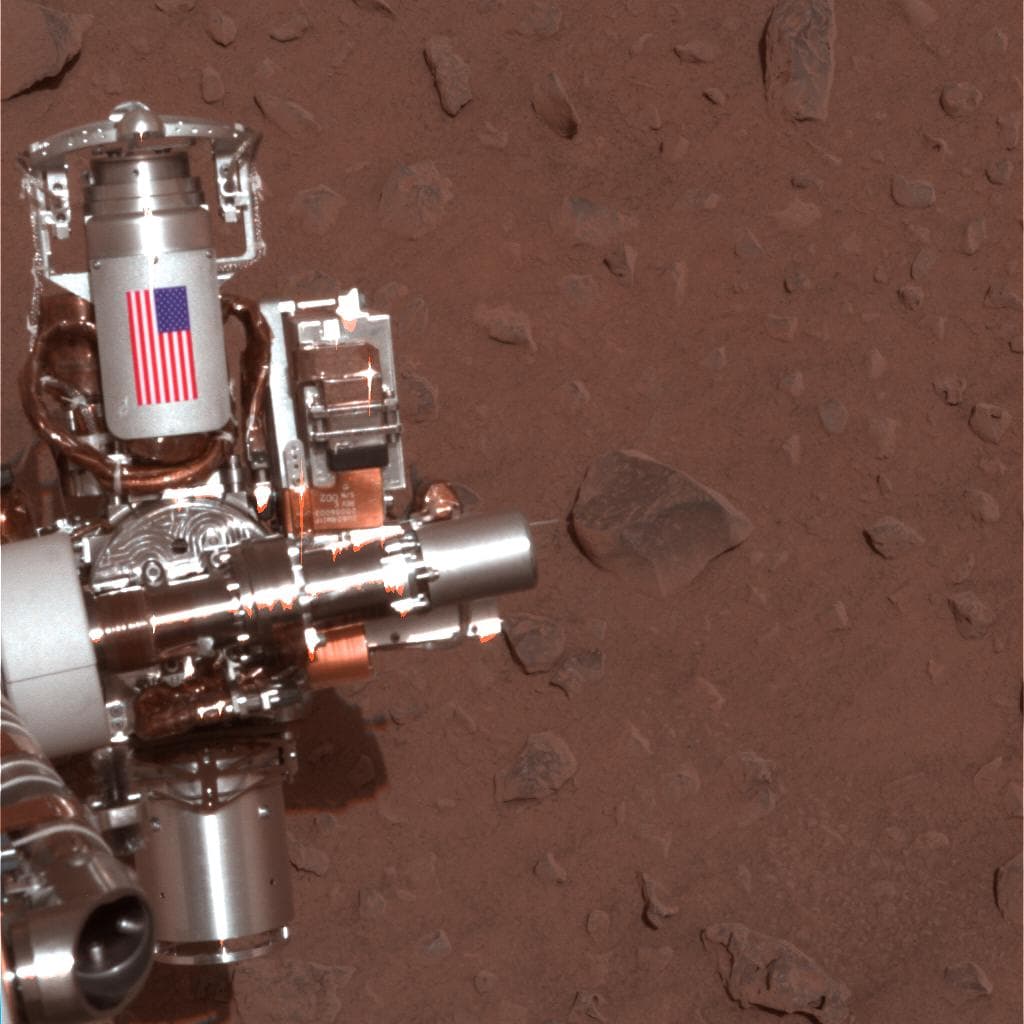
The object is small and it is not decorative. On each of NASA's two 2003 Mars rovers, the rock abrasion tool that grinds the weathered rind off a rock has a cable running to it, and that cable is protected by an aluminium cuff. Both cuffs were machined from aluminium recovered from the World Trade Center towers, and each carries an image of an American flag. The tool they belong to was built by Honeybee Robotics, a company whose workshop stood on Elizabeth Street in lower Manhattan, less than a mile from the towers. In September 2001 the company was in the middle of building the pair of tools to a schedule fixed by planetary alignments, which allowed for testing and not much else. As JPL put it later, the people building them could not spend much time helping at shelters or in other ways, and this is what they did instead. Steve Kondos, a JPL engineer working closely with the Honeybee team, suggested that the rovers carry something to mark the attacks. The difficulty was getting an appropriate piece of material. Through contacts of Honeybee's founder and chairman, Stephen Gorevan, a parcel was delivered to the company from the New York mayor's office on 1 December 2001. Inside was a twisted plate of aluminium and a note that read: Here is debris from Tower 1 and Tower 2.
Tom Myrick, an engineer at Honeybee, was the one who saw what the plate could become. The cable shields were a part the tools needed anyway, and they were small enough to be cut from what had arrived. He hand-delivered the aluminium to a machine shop in Round Rock, Texas, which was already making other components of the rock abrasion tools, and when the finished shields came back to New York he affixed the flag image to each of them. Beyond Honeybee and the mayor's office and the Texas shop, the people involved were at JPL, which was building the rovers, and at Cornell, where Steve Squyres led the rover science team. Gorevan himself had been six blocks away on the morning of 11 September, riding a bicycle to work, and his account in JPL's release is of hearing the engines of the first aircraft before the impact and then watching the rest of the day from the roof of the Honeybee building. Nothing about the shields was announced. Spirit launched on 10 June 2003 and Opportunity on 7 July, both landed in January 2004, and both completed their three-month prime missions in April that year without anyone on the team or at the company saying publicly where the metal on the cable guards had come from.
The shields have been photographed from Mars twice in a way that made the news. On 2 February 2004, sol 30 of its mission, Spirit's panoramic camera took a picture in which the flag on its own tool is clearly visible; NASA published it as PIA05221 under the title Interplanetary Memorial to Victims of Sept. 11, 2001, and noted that an identical piece was on Opportunity. Four days later Spirit used the tool for the first time, grinding about 2.85 millimetres into a rock the team had named Adirondack over roughly three hours. Every hole either rover ground after that, and there were many, was cut with this cuff in place on the cable. On 11 September 2011, the tenth anniversary, Opportunity photographed its own shield on sol 2,713, combining exposures from its navigation camera and its panoramic camera, and NASA published the result the next day as PIA14750. The public account of the metal's origin had come earlier, in November 2004, when a New York Times reporter wrote about Manhattan's part in the rover missions. JPL's release records what Gorevan told the reporter: that it had been meant to be a quiet tribute, that enough time had passed, and that they wanted the families to know.
Both shields are still on Mars and neither has moved in years. Spirit stopped talking on 22 March 2010, stuck at a place the team called Troy on the west side of the Home Plate plateau in Gusev crater, and NASA ended recovery attempts on 25 May 2011. Opportunity's last transmission reached Earth on 10 June 2018 from Perseverance Valley on the western rim of Endeavour crater, and the mission was declared complete on 13 February 2019. Neither rover has a published final coordinate more precise than the centre of the HiRISE frame that shows it, so the two shields are located to within a few hundred metres rather than to a survey fix. JPL's own assessment, written in 2011 while Opportunity was still working, is that in the cold and dry of Mars the memorials could remain in good condition for millions of years, which is longer than any part of the machines around them will be recognisable and considerably longer than the institutions that made them are likely to last. Two pieces of a building in New York are now instrument parts on a planet where nothing will disturb them. That is the whole of it, and it does not need adding to.
Mission facts
What the object is
An aluminium cuff that serves as the cable shield, also called the cable guard, on the rock abrasion tool of each Mars Exploration Rover. The tool needed that part anyway; it was not added for the memorial. The metal bears an image of an American flag.↗
Where the metal came from
Aluminium recovered from the destroyed World Trade Center towers in the weeks after their destruction. Through contacts of Honeybee Robotics chairman Stephen Gorevan, a parcel was delivered to the company from the New York mayor's office on 1 December 2001. Inside was a twisted plate of aluminium and a note reading "Here is debris from Tower 1 and Tower 2."↗
Whose idea it was
Steve Kondos, then a JPL engineer working closely with the Honeybee team, suggested including something on the rovers as an interplanetary memorial. JPL was building the rovers and managing the project.↗
Who made it
Tom Myrick, an engineer at Honeybee, saw that the aluminium could be machined into the cable shields. He hand-carried the material to the machine shop in Round Rock, Texas that was already making other parts of the tools, and when the shields came back to New York he affixed an image of the American flag to each one. The work involved Honeybee Robotics, the New York mayor's office, the Texas shop, JPL, and the rover missions' science leader Steve Squyres at Cornell.↗
Where the company was
Honeybee Robotics occupied a building on Elizabeth Street in lower Manhattan, less than a mile from the World Trade Center. Normal work stopped for days after the attacks and the smell from the collapse persisted for weeks. On the morning of 11 September 2001 Gorevan was six blocks from the towers, riding his bicycle to work.↗
Why they could not do more
JPL's account is specific about the constraint. The rock abrasion tools were on a schedule fixed by the motions of the planets and needed thorough testing before launch, so the people building them could not spend much time helping at shelters or elsewhere. The shields were what they could do.↗
The tool it is part of
The rock abrasion tool, built by Honeybee Robotics, is about 7 cm in diameter and 10 cm long, weighs 0.685 kg and draws about 30 W. A diamond-dust wheel turning at about 3,000 rpm grinds a hole 45 mm across and up to 5 mm deep into a rock face, and two brushes sweep the cuttings away so the rover's spectrometers and microscope can look at unweathered material. These figures come from English Wikipedia's article on the tool rather than from a NASA source.↗
First use
Spirit first used its rock abrasion tool on 6 February 2004 on a rock the team called Adirondack, grinding about 2.85 mm deep over roughly three hours. Every grind either rover made afterwards was done with this cuff in place on the cable.↗
The first picture
Spirit's panoramic camera photographed the shield on 2 February 2004, sol 30 of its mission. NASA published the image as PIA05221 under the title Interplanetary Memorial to Victims of Sept. 11, 2001, noting that an identical piece is on Opportunity.↗
The anniversary picture
On 11 September 2011, the tenth anniversary of the attacks, Opportunity photographed its own shield on sol 2,713 using its navigation camera and panoramic camera together. NASA published the combined view as PIA14750.↗
The silence, and the end of it
Nobody on the rover team or at Honeybee spoke publicly about the source of the aluminium until late 2004. JPL's account records Gorevan telling a New York Times reporter, for a story published in November 2004 about Manhattan's part in the rover missions, that it had been meant as a quiet tribute, that enough time had passed, and that they wanted the families to know.↗
What Gorevan said about it
In JPL's 2011 release Gorevan is quoted as saying it is gratifying to know a piece of the World Trade Center is on Mars, and that the shield contrasts the destructive nature of the attackers with the ingenuity and hopeful attitude of Americans.↗
Where the two shields are now
Each shield is on the arm of the rover it was fitted to. Spirit's last downlink reached Earth on 22 March 2010 and NASA ended recovery efforts on 25 May 2011; the rover is at a place called Troy on the west side of the Home Plate plateau in Gusev crater. Opportunity's last transmission reached Earth on 10 June 2018 and NASA declared that mission complete on 13 February 2019; the rover is in Perseverance Valley on the western rim of Endeavour crater. Neither position has a published fix better than the centre of the HiRISE frame that shows the rover.↗
How long they will last
JPL's own estimate, published in 2011, is that in the cold, dry environments where the rovers worked the memorials could remain in good condition for millions of years.↗
Not the only 9/11 material on the rovers
JPL's 2020 summary of commemorative objects on Mars rovers describes the World Trade Center metal on Spirit and Opportunity in the same paragraph as the Columbia crew memorial carried by Spirit, the Pioneer plaques and the Voyager Golden Records, and calls the practice festooning.↗
Mission timeline
- Sep 2001Honeybee Robotics, on Elizabeth Street in lower Manhattan, is building a pair of rock abrasion tools for NASA's two Mars Exploration Rovers when the World Trade Center, less than a mile away, is destroyed.
- Sep to Nov 2001Steve Kondos, a JPL engineer working with the Honeybee team, proposes that the rovers carry an interplanetary memorial. The problem becomes how to obtain a suitable piece of material from the site. JPL's account does not date the suggestion; it only places it before the material arrived on 1 December.
- 1 Dec 2001A parcel from the New York mayor's office reaches Honeybee Robotics. It contains a twisted plate of aluminium and a note: "Here is debris from Tower 1 and Tower 2."
- 1 Dec 2001 to Jun 2003Between the parcel arriving and the launches, Tom Myrick hand-carries the aluminium to the machine shop in Round Rock, Texas that is making other parts of the tools, and fits an image of the American flag to each finished shield back in New York. JPL's account gives no dates for these steps.
- 10 Jun to 7 Jul 2003Spirit and Opportunity launch from Cape Canaveral, each with one of the shields on the cable of its rock abrasion tool.
- 2 Feb 2004On sol 30 Spirit's panoramic camera photographs the flag on its own tool. NASA publishes the image as PIA05221, Interplanetary Memorial to Victims of Sept. 11, 2001.
- 6 Feb 2004Spirit makes the first grind of the mission, into a rock called Adirondack, cutting about 2.85 mm deep in roughly three hours.
- Nov 2004A New York Times story about Manhattan's part in the rover missions carries the first public account of where the metal came from. Gorevan tells the reporter it had been meant as a quiet tribute, that enough time has passed, and that they want the families to know.
- 22 Mar 2010Spirit's last downlink reaches Earth, from Troy on the west side of Home Plate in Gusev crater. NASA concludes recovery efforts on 25 May 2011. One shield stops moving.
- 11 Sep 2011On the tenth anniversary of the attacks, Opportunity photographs its own shield on sol 2,713, combining navigation camera and panoramic camera exposures. NASA publishes the result as PIA14750 the following day.
- 10 Jun 2018Opportunity's last transmission reaches Earth from Perseverance Valley as a planet-encircling dust storm blacks out its arrays. NASA declares the mission complete on 13 February 2019. The second shield stops moving.
A filled dot marks something that physically happened. A hollow one marks an announcement, a naming or a target.
In pictures
Tap a photo to enlarge.
Sources
- JPL (8 Sep 2011): Tributes to Terrorism Victims are on Mars
- NASA Photojournal PIA05221: Interplanetary Memorial to Victims of Sept. 11, 2001 (Spirit, sol 30, 2 Feb 2004)
- NASA Photojournal PIA14750: Memorial Image Taken on Mars on Sept. 11, 2011 (Opportunity, sol 2,713)
- JPL (8 Dec 2020): 5 Hidden Gems Are Riding Aboard NASA's Perseverance Rover
- English Wikipedia: Rock Abrasion Tool
- HiRISE ESP_056955_1775 (20 Sep 2018)
- HiRISE ESP_021925_1650 (31 Mar 2011)
- NASA science mission page: MER Spirit
- NASA science mission page: MER Opportunity
Facts on this page were verified on 24 August 2026. Where sources disagree, the disagreement is stated rather than resolved silently.
-5.3480 E, -2.3350 N · Perseverance Valley