Mars Reconnaissance Orbiter
NASA · United States · Orbiter · 2006 · The long occupationOperating
Operating as of 24 September 2026, in Mars orbit since 10 March 2006 and now in its twenty-first year, still relaying and still imaging. CRISM is dead; HiRISE and the Mars Climate Sounder are damaged but working.
TL;DR· 18 min read
Mars Reconnaissance Orbiter reached Mars on 10 March 2006 and is still working in its twenty-first year, relaying rover data and shooting HiRISE frames at 25 to 32 cm per pixel. That camera has photographed most of the other missions in this catalogue, including Beagle 2 lying half-open in Isidis, and it passed its 100,000th image of Mars on 7 October 2025. MRO also made the most famous water claim of the modern Mars era, in 2015, and then took most of it back with its own instruments.
Mars Reconnaissance Orbiter is the spacecraft that made Mars legible. Its HiRISE camera resolves 25 to 32 centimetres per pixel from an orbit 255 to 320 km up, sharp enough to pick a lander, a parachute or a set of rover tracks out of the desert, and in twenty years it has photographed not only the planet but most of the other missions in this catalogue: Beagle 2 lying half-open in Isidis, Schiaparelli's dark smear in Meridiani, Perseverance falling under its chute, Zhurong sitting motionless under gathering dust. MRO also made the most famous water claim of the modern Mars era and then, using its own instruments, took most of it back. As of 24 September 2026 it is still flying and still returning images.
- 25 to 32 cmper HiRISE pixel, from an orbit 255 to 320 km above Mars
- 100,000HiRISE images of Mars, the 100,000th taken on 7 October 2025
- 450+terabits of data returned, against a pre-launch plan of 26
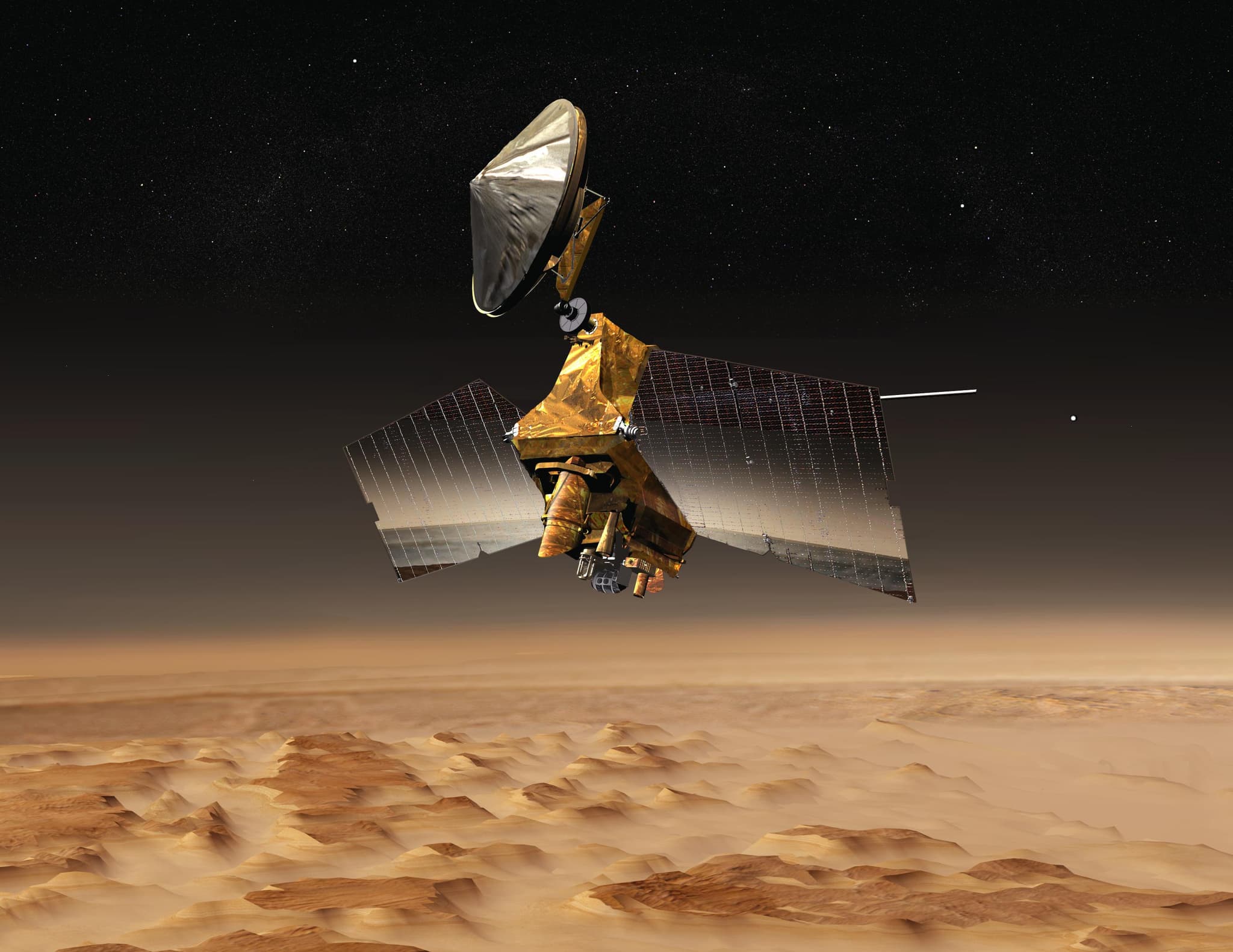
Mars Reconnaissance Orbiter left Cape Canaveral on 12 August 2005 at 11:43 UTC on an Atlas V-401, carrying 2,180 kg of which more than half, 1,149 kg, was propellant and pressurant. It reached Mars on 10 March 2006 and then spent five months doing the cheap, nervous thing: hundreds of deliberate dips into the upper atmosphere so that drag would do work a rocket engine would otherwise have to pay for. Aerobraking began on 30 March 2006, ended on 30 August when thrusters lifted periapsis clear of the atmosphere, and two further burns in September settled the spacecraft into the orbit it still flies, near-polar and sun-synchronous, planned at 255 by 320 km and achieved at about 250 by 316 km, 112 minutes a lap, about twelve laps a day. The primary science phase opened in November 2006 once solar conjunction cleared. Costs are quoted two ways: NASA's arrival press kit says about $720 million, roughly $450 million for spacecraft and instruments, $90 million for the launch and $180 million for five and a half years of operations, while Wikipedia's infobox gives $716.6 million with a $416.6 million development line and $210 million for operations. Both are prime-mission numbers and neither covers the twenty years of extensions that followed. The same press kit set expected science return at 26 terabits or more, and the HiRISE team had earlier written 34 terabits for the first Mars year. NASA was quoting more than 450 terabits by mid-2023. Dates and times on this page are UTC throughout.
HiRISE is why the mission matters to everything else in this catalogue. It is a 0.5 m telescope with a 12 m focal length and 14 CCDs, resolving 30 cm per pixel at 300 km altitude and 25 to 32 cm across the real orbit, fine enough to pick out a lander, a heat shield or a set of rover tracks. For twenty years it has been the census-taker and, when necessary, the coroner of Mars exploration. On 25 May 2008 it caught Phoenix hanging under its parachute, which NASA calls the first time one spacecraft photographed another landing on a planet; it repeated the shot for Curiosity in 2012 and for Perseverance on 18 February 2021, pitching up and rolling hard left to frame a rover 700 km away closing at about 3 km/s. In January 2015 ESA announced that Beagle 2, silent since Christmas Day 2003, had been found in HiRISE frames by Michael Croon of the former Mars Express operations team, partly deployed rather than smashed, which rewrote that mission's obituary. In October 2016 it photographed Schiaparelli's impact scar and its bright discarded parachute. Between March 2022 and February 2023 it showed Zhurong parked and unmoving under gathering dust. Two cases stay open. In April 2013 JPL published candidate Mars 3 hardware spotted by Russian enthusiasts, calling the layout a remarkable match while saying in the same release that alternative explanations could not be ruled out. And Mars Polar Lander has never been found at all: the candidate proposed from Mars Global Surveyor's camera was dismantled by better imagery in September 2005, the parachute turning out to be the sunlit slope of a small hill and the lander a single noisy pixel that vanished on re-imaging. A negative result from HiRISE is still a result.
The recurring slope lineae story is MRO's most instructive episode, because MRO is the instrument on both sides of it. In the 5 August 2011 issue of Science, McEwen and colleagues described narrow dark streaks, half a metre to five metres across, creeping down steep sun-facing slopes in late southern spring and fading in the cold season, at places where peak surface temperature ran about 250 to 300 K. On 28 September 2015 NASA held a press conference to announce that CRISM had found hydrated salts in those streaks. Lujendra Ojha, who led the Nature Geoscience paper, called it the first spectral detection that unambiguously supported the liquid-water hypothesis for RSL, and NASA's associate administrator for science, John Grunsfeld, said it appeared to confirm that water, albeit briny, was flowing on Mars today. It went round the world as proof of present-day water. It has since been taken apart. In November 2017 Dundas and colleagues showed in Nature Geoscience that the streaks stop at the angle where dry granular flows stop. In November 2018 Leask, Ehlmann and colleagues identified a CRISM processing artifact that mimics real absorptions near 1.9 and 2.1 micrometres and concluded that few to none of the published perchlorate detections remained robust. In May 2025 Bickel and Valantinas catalogued about 500,000 streaks by machine learning and found them tracking dust delivery, wind and impacts rather than water. The 2015 announcement has never been formally retracted. It has been outvoted.
The same reversal is now playing out underground, and again MRO is doing the reversing. SHARAD, the Italian-built shallow radar, spent most of the mission looking out past the spacecraft carrying it, because its antenna booms sit at the back of the bus and nadir pointing costs up to about 10 dB. Between 2023 and 2024 the team demonstrated a fix that sounds reckless: roll the whole orbiter 120 degrees, nearly inverted, so the radar looks out clean, accepting that the high-gain antenna loses Earth and the arrays lose the Sun for the duration. Three trials returned signal-to-noise gains of 9, 11 and 14 dB over near-coincident nadir passes and reached 800 m into Medusae Fossae material and 1,500 m through the ice of Ultimi Scopuli. Ultimi Scopuli is the point. In 2018 the MARSIS radar on ESA's Mars Express reported a basal reflection there brighter than the surface echo, across a patch about 20 km wide under 1.5 km of ice, and the natural reading was a subglacial lake. SHARAD, working at 15 to 25 MHz against MARSIS's 1.8 to 5 MHz, had never reached that layer. With the roll it did. Morgan and colleagues published on 17 November 2025: the basal return is faint, roughly a thousandth of SHARAD's own surface echo, with modelled permittivity reported near 4 to 4.5, which is dry rock or dust, where water should exceed 20. The two radars still disagree. The lake is much harder to defend.
Twenty years does damage, and MRO's health is now a list of specific injuries rather than a general statement. CRISM is dead, switched off on 3 April 2023, with two NASA sources giving different accounts of when it actually stopped working. HiRISE lost an edge CCD outright in 2011, costing about a tenth of its field of view, and the electronics for RED4 in the middle of the swath began failing in mid-2023; the team's own site says it has run only intermittently since, leaving gaps in the centre of some products and returning data about half the time. The Mars Climate Sounder's gimbal became unreliable in 2024, so the instrument now leans on the spacecraft's rolls to see the surface and to calibrate. The 2025 Planetary Mission Senior Review lists the live risks by name: limited remaining life on one inertial measurement unit, a failed Ka-band component in the Deep Space Transponder, the chance of losing further HiRISE memory modules, and an X-band travelling-wave tube amplifier near end of life with no backup. The project flies in an all-stellar attitude mode about 93 per cent of the time to keep the gyros switched off. None of it has stopped the spacecraft. The panel rated the seventh extended mission Excellent/Very Good, propellant reserves are high, and once MAVEN fell silent in December 2025 (NASA ended the mission on 3 June 2026) the relay load MRO carries for Curiosity and Perseverance only grew. NASA's mission page still lists MRO as an active mission, the HiRISE team posted a newly captioned image on 23 September 2026, and HiRISE frames taken as late as 30 July 2026 were in the instrument's Planetary Data System archive by 31 August 2026.
Mission facts
Launch
12 August 2005, 11:43 UTC (7:43 a.m. EDT), on a two-stage Atlas V-401 with a Centaur upper stage from Space Launch Complex 41 at Cape Canaveral Air Force Station, Florida. The launch vehicle stood 57.4 m with the payload and massed 333,000 kg fuelled.↗
Spacecraft
2,180 kg at launch, made up of 139 kg of science instruments, 892 kg of other dry mass and 1,149 kg of propellant and pressurant. 6.5 m tall including the 3 m high-gain dish, 13.6 m across the two 5.35 by 2.53 m solar wings, with 20 square metres of cells delivering about 2,000 W at Mars' greatest distance from the Sun, plus nickel-hydrogen batteries.↗
Cost
Two published figures, both covering the prime mission only. NASA's arrival press kit gives about $720 million total: roughly $450 million for the spacecraft and science instruments, $90 million for the launch, and $180 million for 5.5 years of operations, science processing and relay support. English Wikipedia's infobox gives $716.6 million, split as $416.6 million development, about $90 million launch and $210 million operations. The difference is in how development and operations are drawn, and neither figure includes the twenty years of extended missions that followed.↗
Science orbit
Near-polar and sun-synchronous, 255 by 320 km above the surface, 112 minutes a lap, about 12 orbits a day. Periapsis sits over the south pole and apoapsis over the north. The orbit was reached by aerobraking rather than by burning propellant, which is what let a spacecraft this heavy fly on an Atlas V-401.↗
Science payload
Six instruments: HiRISE (high-resolution camera), CTX (context camera, about 6 m/pixel over a 30 by 45 km frame, built and operated by Malin Space Science Systems), MARCI (daily global colour weather camera), CRISM (imaging spectrometer), MCS (Mars Climate Sounder) and SHARAD (Italian-built shallow subsurface radar). The spacecraft also carries the Electra UHF relay radio, an optical navigation camera, and gravity and atmospheric-structure investigations that use the spacecraft itself rather than a dedicated sensor.↗
HiRISE
A 0.5 m telescope with a 12 m focal length and 14 CCDs. Ground sampling is 30 cm/pixel at 300 km altitude, and 25 to 32 cm/pixel across the real 255 by 320 km orbit. The red swath is 6 km wide at 300 km, the three-colour swath 1.2 km, and the largest single observation is 20,000 by 65,000 pixels. Signal-to-noise better than 100:1, stereo topography good to about 20 cm vertically.↗
How much of Mars HiRISE actually sees
Very little, by design. The pre-flight science plan expected to cover about 1 per cent of Mars at better than 1.2 m/pixel and about 0.1 per cent at 0.3 m/pixel during the primary science phase, with roughly 10,000 observations in the first Mars year. The camera has since taken more than ten times that many images, but a current, officially published figure for HiRISE's cumulative areal coverage was not found for this entry, and much of the coverage is deliberate repeats for stereo and change detection rather than new ground.↗
100,000th HiRISE image
Acquired 7 October 2025, showing mesas and dunes in Syrtis Major about 80 km (50 miles) southeast of Jezero Crater. The target had been suggested through HiWish, the public target-request site, by a high school student; JPL does not name the student or give a date for the request. Announced by JPL on 16 December 2025, with Shane Byrne (University of Arizona) as HiRISE principal investigator and Leslie Tamppari (JPL) as MRO project scientist.↗
HiRISE damage
One RED CCD at the edge of the field failed outright in 2011, costing about 10 per cent of the field of view. The electronics for RED4, in the middle of the swath, began failing in mid-2023. The HiRISE team's own site states that since mid-2023 RED4 has operated only intermittently, creating gaps in the middle of some image products, with data returned roughly half the time. Separately the camera has a long-standing bit-flip problem in the analog-to-digital converters for some of its readout channels when the focal-plane electronics run cold, and a blurring problem traced in 2019 to the thermal control system being switched off during imaging, since fixed. Of the four problems listed here only the RED4 status is stated on the HiRISE team site cited; the 2011 CCD failure, the converter bit flips and the 2019 blurring diagnosis come from the wider HiRISE literature and were not confirmed against a single dated page for this entry.↗
CRISM, and a date that does not agree with itself
The imaging spectrometer covered 362 to 3,920 nm in 544 channels at about 18 m/pixel from 300 km. Two NASA sources give different endings. NASA's April 2023 retirement announcement says the last of CRISM's three cryogenic coolers reached the end of its operational life in 2017, after which the team worked from data already collected. The 2025 Planetary Mission Senior Review says CRISM "ended data acquisition in May 2022 after the failure of the last of its three cryocoolers". Both can be true, because CRISM's optical sensor held two detectors and only the infrared one needed cooling. English Wikipedia gives the split as a visible-near-infrared detector at 400 to 830 nm and an infrared detector at 830 to 4,050 nm, and says only the infrared one was cooled, by a radiator plate and the three cryocoolers; those sub-ranges do not tile the 362 to 3,920 nm figure quoted above, which is the instrument's overall measured range. NASA's own retirement announcement points the same way without spelling it out, saying the surviving spectrometer saw "a more limited range of minerals in visible and near-infrared light". Treat the reconciliation as strongly indicated rather than sourced outright, and the two dates as what each source actually asserts. The instrument was formally switched off on 3 April 2023.↗
Mars Climate Sounder
One visible/near-infrared and eight far-infrared channels (12 to 50 micrometres), profiling the atmosphere in about 5 km steps. Its pointing gimbal became unreliable in 2024. The instrument now depends on the spacecraft's own rolls for surface views and for calibration, which is one reason rolling has moved from a nuisance to a routine part of MRO planning.↗
Very large rolls
SHARAD's two antenna booms are mounted at the back of the bus, so in normal nadir pointing the signal has to thread past MRO's own structure, losing up to about 10 dB. Between 2023 and 2024 the team demonstrated rolling the whole spacecraft 120 degrees, nearly inverted, to give the radar a clear view. Three trial observations returned signal-to-noise gains of 9, 11 and 14 dB over near-coincident nadir passes, in line with the roughly 10 dB the antenna modelling had predicted, and reached reflectors 800 m down in Medusae Fossae material and 1,500 m through the ice of Ultimi Scopuli. During the roll the high-gain antenna loses Earth and the arrays lose the Sun, so each one is individually planned; the cadence is currently about one or two a year, and the project is working toward a standard procedure that would allow on the order of ten or twelve a year.↗
CTX and the global mosaic
The context camera images a 30 km wide strip at about 6 m/pixel alongside every HiRISE observation, which over two decades added up to near-complete coverage of the planet. Caltech's Bruce Murray Laboratory used about 110,000 CTX frames to build a 5.7 trillion pixel global mosaic at about 5 m/pixel (JPL gives the coverage as 25 square metres of surface per pixel), released on 5 April 2023 after six years of work led by image-processing scientist Jay Dickson.↗
Relay role
MRO carries the Electra UHF software-defined radio and is one of four orbiters in NASA's Mars Relay Network, with Mars Odyssey, ESA's Mars Express and ESA's ExoMars Trace Gas Orbiter. Rovers link to orbiters at up to 2 Mbps. NASA notes that MRO can point its antenna at Earth at the same time as it talks to the rovers, cutting the time to get rover data home. NASA ended the MAVEN mission on 3 June 2026 after the spacecraft went silent on 6 December 2025, and MAVEN's relay load has been redistributed among the remaining orbiters. The same page's relay table gives MRO an average of 447.5 Mb per day through 2025, rising to 850.6 Mb per day over February to May 2026, which is the most concrete published evidence that MRO was still flying and still relaying in 2026.↗
Known risks, 2025 senior review
The review names them: limited remaining operational lifetime on one inertial measurement unit; a failed Ka-band component in the Deep Space Transponder; the possibility of losing further HiRISE CCD memory modules; and an X-band travelling-wave tube amplifier near end of life that is a single-string failure point for the communications system. None were classified as high risk. The project flies an All-Stellar Mode using star trackers about 93 per cent of the time so the gyros can stay off and stop degrading. Propellant reserves are described as high and sufficient for the seventh extended mission and beyond; a January 2024 figure of 132 kg remaining, enough to about 2035, circulates via Wikipedia.↗
Data returned
Pre-flight expectations were 26 terabits or more (NASA's arrival press kit) and 34 terabits in the first Mars year in the mapping orbit (HiRISE team, 2003). Reported actual totals: 200 terabits by November 2013, from JPL; then, from the running counter on NASA's former MRO mission page as archived by the Wayback Machine, 264.8 terabits on 15 March 2016, 360.2 terabits on 9 June 2019, 456.3 terabits on 29 July 2023 (the snapshot behind the figure of more than 450 that English Wikipedia dates to that day, and that outlets covering the 100,000th image were still quoting in December 2025) and 463.6 terabits on 1 October 2023. No newer official total was found, so the real 2026 figure is higher than any published number.↗
Mission timeline
- 12 Aug 2005Launch at 11:43 UTC on an Atlas V-401 from Space Launch Complex 41, Cape Canaveral. 2,180 kg, of which 1,149 kg is propellant and pressurant.
- 10 Mar 2006Mars orbit insertion at 21:24 UTC, into a long capture orbit. Earth is 215 million km away and one-way light time is about 12 minutes.
- 30 Mar to Sep 2006Aerobraking. Hundreds of dips into the upper atmosphere shrink the orbit over 445 passes; on 30 August thrusters lift periapsis clear of the atmosphere and two further burns in September settle the near-circular science orbit, about 250 by 316 km against a planned 255 by 320 km, at 112 minutes a lap. The pre-flight plan had allowed until October. The primary science phase opens in November 2006 once solar conjunction clears.
- 25 May 2008HiRISE photographs Phoenix hanging under its parachute over the northern plains. NASA describes it as the first time one spacecraft photographed another during a landing on a planet. HiRISE repeats the trick for Curiosity in August 2012 and for Perseverance on 18 February 2021, when MRO has to pitch up and roll hard left to catch the falling rover from about 700 km away while closing at roughly 3 km/s.
- 5 Aug 2011Science publishes McEwen and colleagues on recurring slope lineae: narrow dark streaks 0.5 to 5 m wide that grow down steep sun-facing slopes in late southern spring and fade in the cold season, where peak surface temperatures run about 250 to 300 K. Found in HiRISE images.
- 16 Jan 2015ESA announces that Beagle 2, silent since Christmas Day 2003, has been found in HiRISE images of Isidis Planitia by Michael Croon, formerly of the Mars Express operations team. The lander is partly deployed rather than destroyed, with one to three of its four solar panels open and, in ESA's words, "the main parachute and what is thought to be the rear cover with its pilot/drogue parachute still attached close by", meaning entry, descent and landing had worked. A 2017 peer-reviewed paper by Bridges and colleagues is more cautious: only the lander is a confident identification, the rear cover remains a candidate, and there is no conclusive evidence for the main parachute.
- 28 Sep 2015NASA announces that CRISM has detected hydrated salts in recurring slope lineae, and frames it as confirmation that briny water flows on Mars today. Lujendra Ojha's paper appears the same day in Nature Geoscience.
- 26 Nov 2018Leask, Ehlmann and colleagues publish in Geophysical Research Letters on a CRISM processing artifact that mimics real mineral absorptions near 1.9 and 2.1 micrometres, and conclude that "few to none of the perchlorate detections reported in published literature remain robust over the 1.0- to 2.65-micrometre wavelength range".
- May 2022CRISM stops acquiring data, per the 2025 senior review, after the failure of the last of its three cryocoolers. NASA formally switches the instrument off on 3 April 2023 after 17 years, and releases two global mineral maps built from the archive.
- 19 May 2025Nature Communications publishes "Streaks on martian slopes are dry" by Bickel and Valantinas: a machine-learning catalogue of about 500,000 slope streaks across Mars, finding them correlated with wind and dust rather than water or frost, and concluding that modern Martian slopes do not commonly carry transient flows of water or brine.
- 17 Nov 2025Geophysical Research Letters publishes Morgan and colleagues: using the 120-degree rolls, SHARAD finally reaches the bright basal zone under Ultimi Scopuli that MARSIS reported in 2018 as a possible subglacial lake. The return is faint, about a thousandth of SHARAD's own surface echo, with modelled permittivity near 4 to 4.5, consistent with dry rock or dust rather than water.
- 13 Jun 2026HiRISE photographs Perseverance as a green speck near "Arbot" west of Jezero, the day before the rover passes a full marathon of driving. NASA publishes the image on 24 June 2026. MRO is in its twenty-first year at Mars and still imaging.
A filled dot marks something that physically happened. A hollow one marks an announcement, a naming or a target.
In pictures
Tap a photo to enlarge.
Sources
- NASA/JPL: Mars Reconnaissance Orbiter arrival press kit (March 2006, PDF)
- 2025 NASA Planetary Mission Senior Review, final report package, 9 June 2025 (PDF)
- NASA Science: Mars Reconnaissance Orbiter mission page
- NASA Science: Mars Relay Network
- NASA Science (24 June 2026): HiRISE Captures Perseverance Marking a Milestone on Mars
- JPL (26 June 2025): NASA Mars Orbiter Learns New Moves After Nearly 20 Years in Space
- NASA (25 April 2023): NASA Retires Mineral Mapping Instrument on Mars Orbiter
- McEwen et al., 6th International Conference on Mars (2003): HiRISE science expectations and instrument capabilities (PDF)
- McEwen et al., Science, 5 August 2011: Seasonal Flows on Warm Martian Slopes
- Leask et al., Geophysical Research Letters, 26 November 2018: Challenges in the Search for Perchlorate and Other Hydrated Minerals With 2.1-micrometre Absorptions on Mars
- Bickel and Valantinas, Nature Communications, 19 May 2025: Streaks on martian slopes are dry
- Morgan et al., Geophysical Research Letters, 17 November 2025: High Frequency Radar Perspective of Putative Subglacial Liquid Water on Mars
- Bridges et al., Identification of the Beagle 2 lander on Mars, Royal Society Open Science 4:170785 (11 Oct 2017)
- HiRISE (University of Arizona): The Descent of NASA's Perseverance Rover, ESP_068281_9024 (acquired 18 February 2021)
- NASA: former Mars Reconnaissance Orbiter mission page, data-returned counter (Wayback Machine snapshot, 1 October 2023)
- NASA: former Mars Reconnaissance Orbiter mission page, data-returned counter (Wayback Machine snapshot, 9 June 2019)
- NASA: former Mars Reconnaissance Orbiter mission page, data-returned counter (Wayback Machine snapshot, 15 March 2016)
- NBC News (March 2010): Scientists wowed by data from Mars probe
- HiRISE (University of Arizona): Crater Dunes and More, ESP_090177_2410 (caption posted 23 September 2026)
- HiRISE Planetary Data System archive: EDR orbits 93700 to 93799 (acquisitions to 30 July 2026)
Facts on this page were verified on 24 September 2026. Where sources disagree, the disagreement is stated rather than resolved silently.