Mars-500, SIRIUS and CHAPEA
Institute of Biomedical Problems, Moscow, with ESA, China and NASA · Multinational · Analogue mission · 2007 · The long occupationSuccess
Completed: six men sealed into chambers in Moscow for 520 days, 3 June 2010 to 4 November 2011. The line runs on through Russia's SIRIUS series to NASA's CHAPEA, whose second crew is due out on 31 October 2026.
TL;DR· 16 min read
Mars-500 sealed six men into pressure chambers at the Institute of Biomedical Problems in Moscow for 520 days, from 3 June 2010 to 4 November 2011, and flew a Mars mission that never left the city. It produced no hardware, only measurements: sleep rose 8.4 per cent, active wakefulness fell 7.0 per cent, four of the six developed a sleep or circadian problem, and two showed no disturbance at all. The most useful line in its literature is that conflicts with mission control were reported five times more often than conflicts inside the crew.
You cannot rehearse the radiation of a Mars transit on Earth, or the weightlessness, or the fact that there is no way home. What you can rehearse is the part that has broken more expeditions than any engine ever has: six people, one small volume, no privacy, a radio that answers forty minutes late, and an end date nobody can move. Mars-500 was the most serious attempt anyone has made at that rehearsal. It produced no pictures of Mars and no flight hardware. What it produced was a set of measurements of what happens to human beings across 520 days of confinement, and those measurements are still the reference points.
- 520 daysthe Mars-500 confinement, 3 June 2010 to 4 November 2011
- 5 to 1Mars-500 conflicts reported with mission control against conflicts inside the crew
- 0 kmdistance from Earth that any of these crews actually travelled
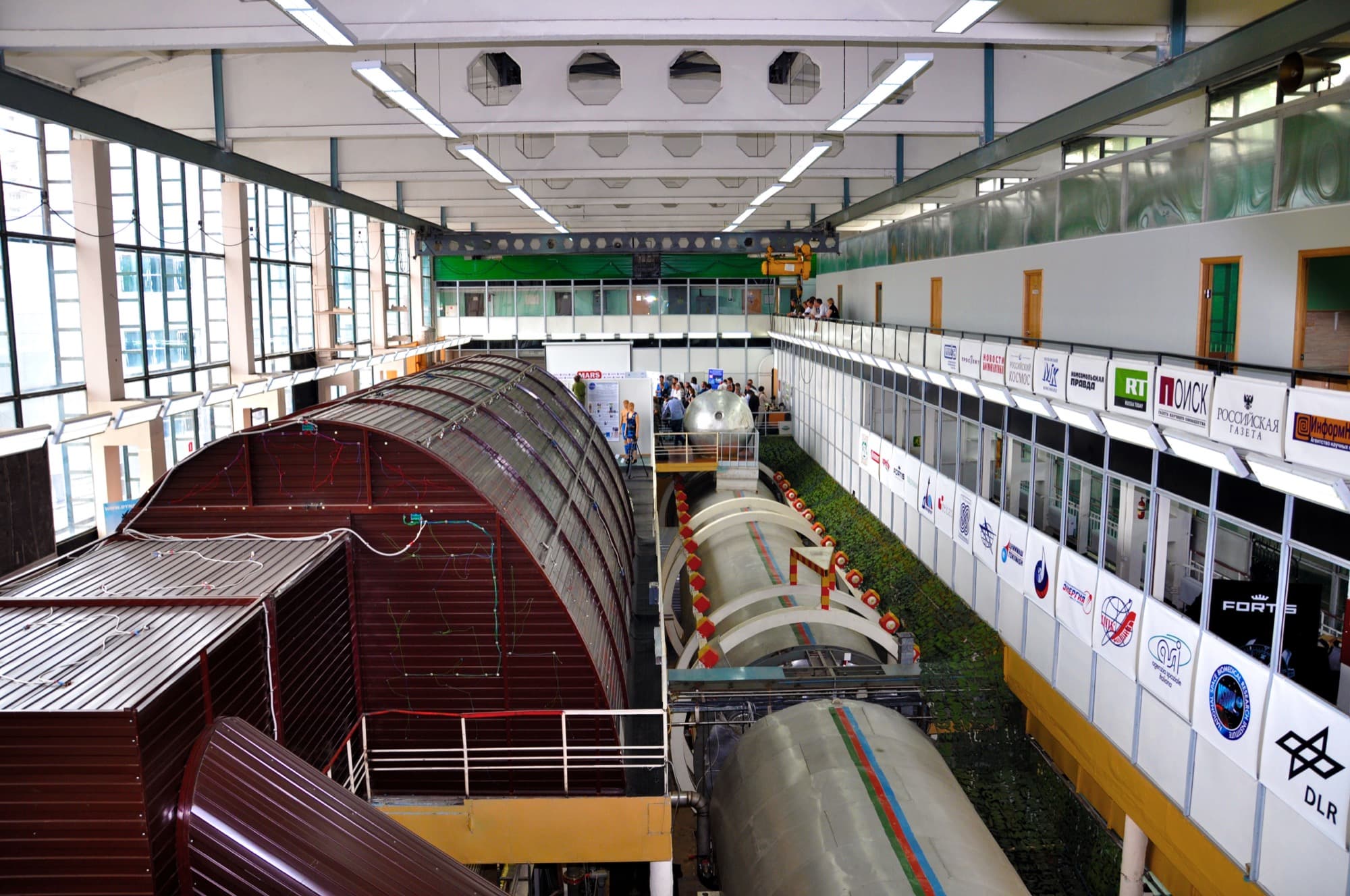
Mars-500 was the third and largest of three experiments in the same set of chambers. The Institute of Biomedical Problems in Moscow keeps a permanent ground experimental complex, the NEK, built as linked pressure modules: a 150 cubic metre habitat with individual cabins, a 100 cubic metre medical and psychological block, a 250 cubic metre store with a greenhouse and a gym, a 50 cubic metre landing module, and alongside them a hall of about 1,200 cubic metres dressed as the surface of Mars. In November 2007 six Russian volunteers spent 14 days inside to check that the modules worked and that people could stand them. From 31 March to 14 July 2009 an international crew spent 105 days. Then on 3 June 2010 the hatch closed on six men for 520 days: Alexey Sitev commanding, Sukhrob Kamolov and Alexandr Smoleevskiy, Romain Charles of France, Diego Urbina of Italy and Colombia, and Wang Yue of China. ESA, which was the main international partner and supplied a large part of the science, describes the crew as three Russian, two European and one Chinese. The sealed volume they lived in was 550 cubic metres. The one feature the chambers reproduced faithfully, and the one that turned out to matter most, was the radio: a 20 minute delay was built into every exchange with the control centre, so that a question and its answer stood up to forty minutes apart. Conversation was not possible. Correspondence was.
The flight was a fiction the crew agreed to inhabit, and they inhabited it thoroughly. They kept a schedule, maintained systems, exercised, ate stored food, and marked off a distance to a planet they were not approaching. In February 2011 the complex was reconfigured for arrival. The six split into two groups of three, the hatch between the sections was closed, and one group transferred into the 50 cubic metre landing module and then, in pressure suits, into the surface hall. Russian accounts date three simulated Marswalks to 14, 18 and 22 February 2011. The other three stayed sealed above them for the whole surface phase, which is the loneliest assignment in any Mars architecture and the one nobody volunteers for. Then the two groups rejoined and flew the return leg, which is the longer and duller half of any Mars mission, and on 4 November 2011 the outer hatch opened. What Mars-500 could not simulate is easy to list and ought to be listed. No weightlessness, no radiation, no launch, no vacuum on the far side of the wall, and above all no irreversibility: any of the six could have opened the door, and doctors were on the other side of it. That is a genuine limit on how far the findings travel. It is also, read the other way, the entire justification for the exercise, because everything it could test is a thing no amount of spacecraft engineering will fix for you.
The results are why the experiment matters, and they are more interesting than the coverage that followed it. Mathias Basner and colleagues wired the crew with wrist actigraphs for the full 520 days and reported in PNAS on 7 January 2013 that people confined like this quietly wind down. Sleep rose 8.4 per cent across the mission, about thirty-five extra minutes a day per crewmember. Active wakefulness fell 7.0 per cent, about sixty-seven fewer minutes a day. Rest, meaning awake but sedentary, rose by half. All of it statistically overwhelming, none of it dramatic from one week to the next, and the accumulated effect across seventeen months substantial. The team named it protracted hypokinesis. Four of the six developed at least one identifiable sleep problem. One had his sleep and wake periodicity break down altogether, on a cycle that varied between 24.72 and 25.06 hours, lengthened with time in mission, averaged 24.98 hours over the 520 days and slid him steadily out of phase with the other five. One accumulated chronic partial sleep deprivation and measurable lapses in alertness. Two displaced their sleep into the daytime. Two reported frequently poor sleep quality. The companion paper in PLoS One on 27 March 2014 supplied the behavioural half: one crewmember reported symptoms of depression in 93 per cent of mission weeks, and two crewmembers, the two scoring highest on stress and physical exhaustion, accounted for 85 per cent of all perceived conflicts. Two of the six went through the whole seventeen months with no behavioural disturbance and no psychological distress at all.
One line from that 2014 paper deserves to be lifted out on its own. Conflicts with mission control were reported five times more often than conflicts among crewmembers. Six men in 550 cubic metres for a year and a half did not, on the whole, turn on each other. They turned on the people at the far end of a forty minute round trip. Anyone designing a crewed Mars mission should read that twice, because mission control is the component of the architecture that looks least likely to need redesigning. The successor programme took the same chambers and internationalised the operator side too. SIRIUS, which NASA expands as Scientific International Research In a Unique terrestrial Station and Russian sources render as Научные международные исследования на уникальной наземной станции, was run jointly by IMBP and NASA's Human Research Program, and Russian Wikipedia names Oleg Orlov and Bill Paloski as its co-directors, and NASA's 2017 announcement laid out an intended ladder: 17 days, then four months, then eight, then twelve. The ladder was climbed several years late. SIRIUS-17 ran 7 to 24 November 2017 under Mark Serov, with Anna Kikina and the German Viktor Fetter in the crew. SIRIUS-19 ran 19 March to 17 July 2019 with two Americans aboard and a simulated lunar landing rather than a Martian one. SIRIUS-21 ran 4 November 2021 to 3 July 2022, eight months, jointly with NASA and the Mohammed Bin Rashid Space Centre in Dubai. SIRIUS-23 was the full year: 366 days with six volunteers, two men and four women aged 25 to 37, beginning on 14 November 2023.
NASA meanwhile built its own. CHAPEA, the Crew Health and Performance Exploration Analog, sits at Johnson Space Center in Houston in a 1,700 square foot habitat that was 3D printed rather than welded. Four crew at a time, a year at a time, under deliberate resource limits, equipment failures and heavy workloads, with simulated spacewalks next door. Its stated primary object is narrower and more honest than the Russian programme's: NASA says it is there to characterise the risk of the planned exploration food system design in relation to crew health and performance. Feeding four people for three years with no resupply ship is genuinely unsolved, and it is exactly the kind of problem a sealed room in Houston can attack. Mission 1 ran 25 June 2023 to 6 July 2024 with Kelly Haston, Anca Selariu, Ross Brockwell and Nathan Jones. Mission 2, 378 days with Ross Elder, Ellen Ellis, Matthew Montgomery and James Spicer, went in on 19 October 2025; NASA's page, last updated 14 April 2026 and read on 24 August 2026, gives 31 October 2026 as the date they come out and describes them as living and working inside; nothing later than that April stamp was found to confirm the crew is still in. Almost nineteen years after that first 14-day rehearsal in Moscow, the sum of this work is a body of numbers about ordinary people in small rooms. No agency has yet flown any of them anywhere. The numbers will outlive the chambers.
Mission facts
What Mars-500 was
A ground isolation experiment run by the Institute of Biomedical Problems of the Russian Academy of Sciences (IMBP RAN, in Russian ИМБП РАН) in Moscow, with the European Space Agency as the main international partner and Chinese participation. Six men lived in a linked set of sealed chambers and flew a Mars mission that existed only as a schedule, a script and a communications delay. ESA describes the crew as three Russian, two European and one Chinese.↗
Three stages, not one
A 14-day shakedown of the chambers in November 2007 with six Russian volunteers, to test the modules and whether people could stand them. A 105-day run from 31 March to 14 July 2009 with an international crew. Then the 520-day run from 3 June 2010 to 4 November 2011. The 520 days is the number everyone quotes, but the programme is all three, and the name Mars-500 covers the whole thing.↗
The facility
The NEK ground experimental complex at IMBP (in Russian НЭК), built as linked modules: EU-150 at 150 cubic metres as the crew habitat with individual cabins, EU-100 at 100 cubic metres for medical and psychological work, EU-250 at 250 cubic metres for stores, greenhouse, gym and waste, EU-50 at 50 cubic metres as the landing module, and alongside them a hall of about 1,200 cubic metres dressed as the surface of Mars. Russian sources date the complex's design to 1964 to 1970 and its operation to 1971. Basner and colleagues, writing in PLoS One, give the sealed volume the crew actually lived in as 550 cubic metres, which is the sum of the four numbered modules: for six men and seventeen months, roughly the interior of a large house with no window that shows anything real.↗
The 520-day crew
Alexey Sitev commanding, with Sukhrob Kamolov and Alexandr Smoleevskiy, all selected in Russia; Romain Charles of France; Diego Urbina, whom ESA lists as Italian and Colombian and who lived in Turin; and Wang Yue (王跃) of China. All six came out on 4 November 2011. Transliterations vary in the sources, so Sitev also appears as Siteyev or Sitiev and Smoleevskiy as Smoleevsky.↗
The delay
ESA states that a 20 minute delay was built into communications with the control centre to simulate an interplanetary mission. A question and its answer therefore stood up to forty minutes apart. That single design decision is what converts mission control from a conversation into correspondence, and it turns out to be the most consequential thing the chambers reproduced.↗
The simulated landing
In February 2011 the complex was reconfigured for arrival. ESA records that the crew split into two groups of three with the hatch closed between the modules, one group transferring into the landing module and then, in suits, into the surface hall. Russian sources date the three simulated Marswalks to 14, 18 and 22 February 2011.↗
ESA's science programme
ESA ran 13 scientific protocols inside the experiment: adaptation and group dynamics; psychological and cardiac functioning; physical fitness by vibration exercise on a Galileo 2000; spacecraft control training; stress and immunity; blue-enhanced lighting and circadian rhythms; group dynamics and loneliness; physical activity and the serotonergic system; omega-3 supplementation; personal values and group compatibility; retention of medical skills; microbial ecology; and cognitive and emotional adaptation.↗
What it could not simulate
No weightlessness, no radiation, no launch, no vacuum on the far side of the wall, and above all no irreversibility. Any of the six could have opened the door, and doctors were on the other side of it. Everything Mars-500 could test was behavioural, psychological and operational, plus the physiology of sleep and activity. That is a real limit on what the results mean, and it is also the point: these are the things no spacecraft design can fix for you.↗
Finding: people quietly wind down
Basner and colleagues, in PNAS on 7 January 2013, tracked the crew with wrist actigraphy throughout. Across the mission sleep rose 8.4 per cent, equivalent to 0.59 hours more sleep per crewmember per day. Active wakefulness fell 7.0 per cent, equivalent to 1.12 hours less active waking per day. Rest, meaning awake but sedentary, rose 50.4 per cent, equivalent to 0.54 hours more per day. All three at P less than 0.0001. The authors call it protracted hypokinesis.↗
Finding: four of the six had a problem
The same paper reports that a majority, four of six, experienced one or more of: disrupted sleep and wake periodicity (one crewmember), increased displacement of sleep into the diurnal period (two), performance deficits associated with chronic partial sleep deprivation (one), and frequent reductions in perceived sleep quality (two). One crewmember's sleep and wake period varied between 24.72 and 25.06 hours, increased with time in mission and averaged 24.98 hours over the whole 520 days, so that he slid steadily out of phase with the other five.↗
Finding: and two of the six had none
Basner and colleagues, in PLoS One on 27 March 2014, report the behavioural half. The crewmember with the highest average mood disturbance score reported symptoms of depression in 93 per cent of mission weeks, reaching mild to moderate levels in more than 10 per cent of them. Two crewmembers, the two with the highest ratings of stress and physical exhaustion, accounted for 85 per cent of all perceived conflicts. And two crewmembers showed neither behavioural disturbances nor reports of psychological distress across the entire 17 months. The spread between individuals is the result.↗
Finding: the fight is with the ground
The single most useful sentence in the Mars-500 literature: conflicts with mission control were reported five times more often than conflicts among crewmembers, 41 instances against 8. Six men in 550 cubic metres for a year and a half did not, on the whole, fall out with each other. They fell out with the people at the far end of a forty minute round trip.↗
What it cost
Russian Wikipedia puts the project cost at about 15 million US dollars. We could not find a primary IMBP or Roscosmos figure to check that against, so it should be read as an estimate in circulation rather than an audited number.↗
SIRIUS, the successor
Scientific International Research In a Unique terrestrial Station, which is how NASA expands it; in Russian, Научные международные исследования на уникальной наземной станции. The same NEK chambers, run jointly by IMBP and NASA's Human Research Program. Russian Wikipedia names Oleg Orlov of IMBP and Bill Paloski of NASA HRP as co-directors; the NASA announcement cited here does not name them. NASA's 2017 announcement set out an intended ladder of 17 days, then four months in 2018, eight months in 2019 and twelve months in 2020. The ladder was climbed, but several years behind that schedule.↗
The four SIRIUS runs
SIRIUS-17, 7 to 24 November 2017, six crew under Mark Serov and including Anna Kikina, Ilya Rukavishnikov, Elena Luchitskaya (Luchinskaya in some transliterations), Viktor Fetter of Germany and Natalia Lysova. SIRIUS-19, 19 March to 17 July 2019, six crew including two Americans, Allen Mirkadyrov and Reinhold Povilaitis. SIRIUS-21, 4 November 2021 to 3 July 2022, an eight-month run conducted jointly by Roscosmos, NASA and the Mohammed Bin Rashid Space Centre in Dubai. SIRIUS-23, a 366-day run with six volunteers, two men and four women aged 25 to 37; Russian Wikipedia dates its start to 14 November 2023 and we could not confirm the closing date from a source we were able to open.↗
CHAPEA, the American one
NASA's Crew Health and Performance Exploration Analog, at Johnson Space Center in Houston. Four crew at a time live in a 1,700 square foot 3D-printed habitat under environmental stressors NASA lists as resource limitations, isolation, equipment failure and significant workloads, with simulated spacewalks including virtual reality. NASA states the aim is to characterise the risk of the planned exploration food system design in relation to crew health and performance. Mission 1 ran 25 June 2023 to 6 July 2024 with Kelly Haston, Anca Selariu, Ross Brockwell and Nathan Jones. Mission 2, 378 days with Ross Elder, Ellen Ellis, Matthew Montgomery and James Spicer, began on 19 October 2025; NASA's CHAPEA page, consulted on 24 August 2026 and carrying its own last-updated stamp of 14 April 2026, gives 31 October 2026 as the end date and describes the four as living and working inside the habitat. That is an April 2026 statement read in August 2026. Nothing about it is live, so treat the crew's presence today as unconfirmed.↗
Mission timeline
- Nov 2007Six Russian volunteers spend 14 days inside the NEK chambers to prove the modules work and that people can live in them. This is the beginning of Mars-500 and it is almost never mentioned.
- 31 Mar to 14 Jul 2009The 105-day stage runs with an international crew, the dress rehearsal for the long one.
- 3 Jun 2010The hatch closes on six men for 520 days: Alexey Sitev commanding, Sukhrob Kamolov, Alexandr Smoleevskiy, Romain Charles, Diego Urbina and Wang Yue. Every message to and from the control centre now carries a 20 minute delay in each direction.
- 14 to 22 Feb 2011Simulated arrival. The crew splits into two groups of three with the hatch closed between them, one group transfers into the landing module and then in suits into the 1,200 cubic metre surface hall, and three Marswalks are conducted on 14, 18 and 22 February. The other three sit above them for the duration, which is the loneliest job in any Mars architecture.
- 4 Nov 2011The outer hatch opens after 520 days. All six walk out. ESA's account calls the venture better than expected, and the crew meet the press at RIA Novosti in Moscow on 8 November.
- 7 Jan 2013Basner and colleagues publish the actigraphy results in PNAS: sleep up 8.4 per cent, active waking down 7.0 per cent, rest up 50.4 per cent, and four of the six with an identifiable sleep or circadian problem. The companion behavioural paper follows in PLoS One on 27 March 2014.
- 7 to 24 Nov 2017SIRIUS-17, the first of the successor series, runs 17 days in the same chambers, now jointly with NASA's Human Research Program. Mark Serov commands a crew of six.
- 19 Mar to 17 Jul 2019SIRIUS-19 runs about four months with two Americans in the crew, and includes a simulated lunar landing rather than a Martian one.
- 4 Nov 2021 to 3 Jul 2022SIRIUS-21, eight months, run jointly by Roscosmos, NASA and the Mohammed Bin Rashid Space Centre in Dubai. It is the last run for which we could confirm a named NASA partnership.
- 25 Jun 2023 to 6 Jul 2024CHAPEA Mission 1 in Houston: Kelly Haston, Anca Selariu, Ross Brockwell and Nathan Jones spend a year in a 3D-printed habitat, with the exploration food system as the primary research question.
- 14 Nov 2023SIRIUS-23 begins in Moscow, a 366-day run with six volunteers, two men and four women aged 25 to 37. It is the longest of the SIRIUS series and the first to match Mars-500 in the same order of magnitude.
- 19 Oct 2025CHAPEA Mission 2 begins: Ross Elder, Ellen Ellis, Matthew Montgomery and James Spicer, 378 days, due out on 31 October 2026. NASA's page, last updated 14 April 2026 and consulted on 24 August 2026, describes them as living and working inside the habitat until that date. No source dated later than April 2026 was found to confirm they are still in.
A filled dot marks something that physically happened. A hollow one marks an announcement, a naming or a target.
In pictures
Tap a photo to enlarge.
Sources
- ESA, Mars500 study overview
- ESA, End of the Mars500 520-day isolation
- ESA, Mars500 scientific protocols
- Russian Wikipedia: Марс-500
- Russian Wikipedia: Проект SIRIUS
- Basner et al., Mars 520-d mission simulation reveals protracted crew hypokinesis and alterations of sleep duration and timing, PNAS 110(7) 2635-2640, 7 January 2013
- Basner et al., Psychological and Behavioral Changes during Confinement in a 520-Day Simulated Interplanetary Mission to Mars, PLoS One 9(3) e93298, 27 March 2014
- Elmoselhi et al., Retinal vascular changes and arterial stiffness during 8-month isolation and confinement: the SIRIUS-21 space analog mission, Frontiers in Physiology 2024
- Europe PMC record for Pashkova et al. 2025 (Research Square preprint)
- NASA, NASA is SIRIUS About Its Analog Missions
- NASA, About CHAPEA (the food-system objective, mission 1 and mission 2 dates)
- NASA, CHAPEA mission page, consulted 24 August 2026
Facts on this page were verified on 24 August 2026. Where sources disagree, the disagreement is stated rather than resolved silently.