MAX-C and the Mars Exploration Joint Initiative
NASA / ESA · Multinational · Rover · 2008 · The long occupationCancelled
Never built: NASA's caching rover concept of 2009, meant to launch in May 2018 beside Europe's ExoMars rover, was merged away in April 2011 on cost. The caching idea survived and became Perseverance.
TL;DR· 15 min read
MAX-C was NASA's caching rover, meant to drill cores and leave them where a later mission could collect them, and it never left the concept stage. It was to land in January 2019 beside Europe's ExoMars rover on a single American lander. The 2011 decadal survey made it NASA's highest-priority large mission but capped the cost at about 2.5 billion dollars against an independent estimate of 3.5 billion, and the twin-rover plan ended in April 2011. The caching idea survived and became Perseverance.
MAX-C was the rover that would have gone first. Its job was to drill cores on Mars and leave them somewhere a later mission could pick them up, splitting sample return into two jobs so that neither spacecraft had to do everything. It was to ride a NASA sky crane down in January 2019 next to Europe's drilling rover, on the same lander, in the most ambitious NASA and ESA partnership ever attempted at Mars. No metal was ever cut. A cost estimate a billion dollars over what the decadal survey would tolerate ended the twin-rover plan in April 2011, and a budget request ended the partnership ten months later. What survived is the idea itself: cache first, collect later. That is exactly what Perseverance has been doing since 2021.
- $2.5Bcost ceiling the 2011 decadal survey set for MAX-C, against a $3.5B independent estimate
- 2018launch year MAX-C and Europe's ExoMars rover were to share on one NASA lander
- 0MAX-C flight hardware ever built
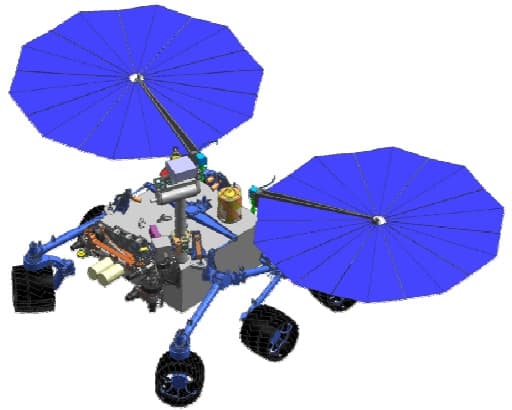
MAX-C began as an argument about sequencing rather than about hardware. Everybody wanted samples from Mars, and everybody knew a single spacecraft that landed, chose good rocks, drilled them, launched them to orbit and shipped them home would be impossibly large. In 2009 the Mars Exploration Program Analysis Group formed the Mid-Range Rover Science Analysis Group to find a mission that would do serious in-situ science and also make concrete progress toward a return. Its answer was to split the problem. One rover would land, spend a year choosing and coring rocks with better instruments than any ascent-vehicle mission could afford to carry, and leave the cores in an accessible place. A later mission would come for them. The advantages the group listed are worth reading now, because they are the argument the whole modern campaign rests on: the ascent vehicle is never put at risk until a cache already exists, sample documentation improves because the choosing is done by the better-equipped spacecraft, and the landing site no longer has to be somewhere already ground-truthed. The vehicle they described was a solar-powered rover delivered by the Curiosity sky crane, landing inside an ellipse about seven kilometres across, able to drive at least ten kilometres and survive at least an Earth year, restricted by its solar panels to latitudes between 25 north and 15 south. It would launch in May 2018 and arrive in January 2019. They called it the Mars Astrobiology Explorer-Cacher.
Europe arrived at the same window from the opposite direction, short of money. ESA's member states had pledged 850 million euros to ExoMars at their November 2008 ministerial, and it was not enough to build the rover their scientists and engineers had designed. ESA went looking for an American partner, and got one. The result was the Mars Exploration Joint Initiative, agreed in 2009, under which all Mars missions from 2016 onward would be badged as joint US-European ventures. On 12 October 2009 ESA's council approved the reshaping that followed: a trace gas orbiter and a small static lander in 2016, and the ExoMars rover slipping to 2018, with NASA providing the Atlas launcher and taking responsibility for entry, descent and landing using hardware likely to be the same as Curiosity's. The 2018 lander would carry both rovers, European and American, to the same site. It was a bigger commitment than either agency had made at Mars before, and both paid for it elsewhere. NASA's Mars Scout line of competed small missions was to end after MAVEN, and for the 2016 orbiter NASA was to supply four of the five instruments and the rocket rather than the American science orbiter it had originally wanted. In the event it supplied neither: by the time that orbiter flew in 2016 it was a European and Russian spacecraft on a Proton. Michael Meyer's summary of why was blunt: they had tried and tried and there was no way to do a full-size ExoMars lander and a decent orbiter in the same window.
The arithmetic broke it. In March 2011 the National Research Council's planetary decadal survey named MAX-C NASA's highest-priority large mission for 2013 to 2022 and called it the first step in a multipart effort to return samples, then attached a condition that functioned as a trap door. The mission should go ahead only if the cost to NASA was approximately 2.5 billion dollars, which was a billion less than the independent estimates the committee had commissioned. NASA and ESA were told to reduce the scope jointly so that both still benefited. NASA's answer was that even 2.5 billion was too much for a planetary science budget expected to decline. In early April the two agencies met in California and produced a different plan: one rover instead of two, larger than either, carrying a mix of American and European instruments, probably built in Europe, landed on NASA's MSL-derived descent stage. A joint engineering working group was set up on 6 April, ESA delegations were briefed on 7 April and gave broad support, and on 18 April Jim Green told NASA's advisory subcommittee that NASA could put in roughly 1.2 billion dollars plus the launch. From that moment MAX-C as a distinct vehicle no longer existed. Doug McCuistion described what would replace it in a sentence that has aged well: not ExoMars, not MSL, something new.
The merged rover did not survive either. On Monday 13 February 2012 NASA presented its fiscal year 2013 budget request, which called the proposed joint missions with ESA unaffordable and cut planetary science from 1.5 billion dollars to 1.2 billion. Charles Bolden said tough choices had to be made and that NASA would not be moving forward with the planned 2016 and 2018 ExoMars missions. Two weeks later, on 27 February, John Grunsfeld appointed Orlando Figueroa to lead a Mars Program Planning Group with a brief to reformulate the entire Mars Exploration Program around what money remained, and a draft framework due within three weeks. In March ESA's council met in Paris, reaffirmed both missions, and turned to Russia, which took on key roles including two launchers; the reorganisation added several hundred million euros to a programme already capped at a billion. It is worth being precise about the word withdrawal. NASA left the partnership as an equal and returned as a supplier: its December 2012 announcement lists continued participation in ESA's 2016 and 2018 missions through Electra telecommunications radios and a critical element of the premier astrobiology instrument on the 2018 rover.
What MAX-C actually produced was an idea that outlived every organisation chart it appeared on. On 4 December 2012 NASA announced a new robotic rover for launch in 2020, to be designed and built on the Mars Science Laboratory architecture that had put Curiosity down four months earlier, precisely because reusing a proven landing system kept cost and risk low. The release ties the decision to the 2011 decadal survey and to the Mars Program Planning Group's findings. That rover became Perseverance: same six-wheel chassis lineage, same aeroshell and sky crane heritage, upgraded with terrain relative navigation, and carrying the coring, encapsulation and caching system that the MRR-SAG had specified in 2010. It landed in Jezero Crater on 18 February 2021 with 43 sample tubes, and between December 2022 and January 2023 it built the Three Forks depot, an accessible cache in an accessible location, exactly as the concept had described. The mission that was to come and collect it, Mars Sample Return, was defunded in the United States appropriations act signed on 23 January 2026, and ESA member states asked for the cancellation of their Earth Return Orbiter in March 2026. So the first half of the MAX-C architecture flew and worked, and the second half has now been cancelled twice, in 2011 and again in 2026.
Mission facts
What MAX-C was
The Mars Astrobiology Explorer-Cacher, a mission concept produced by the Mid-Range Rover Science Analysis Group (MRR-SAG), which the Mars Exploration Program Analysis Group formed in 2009 to design a mission that would both do high-priority in-situ science and take concrete steps towards returning samples. The group concluded that its most definitive contribution would be to collect and cache a suite of compelling samples in an accessible location for a later mission to recover.↗
The idea inside it
Caching separates two of the essential functions of a sample return, acquiring the collection and delivering it to Mars orbit, into two different missions. The MRR-SAG report notes the advantages: the ascent vehicle is not put at risk until the cache already exists, sample documentation improves because a better-instrumented earlier mission does the choosing, and a wider range of landing sites becomes acceptable because the site does not have to be ground-truthed first.↗
The vehicle as studied
A single solar-powered rover landed by the Mars Science Laboratory sky crane, with a targeting accuracy of about 7 km on the semi-major axis of the landing ellipse, a mobility range of at least 10 km and a surface lifetime of at least one Earth year. Because it was solar powered and had to last a year, its latitude access was restricted to between 25 degrees north and 15 degrees south.↗
The flight plan that never happened
Launch in May 2018, arrival at Mars in January 2019 at solar longitude 325, northern mid-winter. The season was chosen for its favourable atmospheric pressure. Landing altitude would have been constrained not by MAX-C's own capability but by the weaker performance of the sample-return opportunities that had to follow it in the 2020s.↗
Its instrument set
Mast or body-mounted instruments to establish geologic context and pick targets, a tool to produce a flat abraded surface on rocks, arm-mounted instruments able to map visual texture, major-element geochemistry, mineralogy and organic geochemistry on those abraded surfaces to sub-centimetre scale, and a rock core acquisition, encapsulation and caching system. Every one of those functions is recognisable in Perseverance.↗
Why Europe needed a partner
ESA member states had pledged 850 million euros to ExoMars at their ministerial meeting in November 2008, a sum the BBC reported as inadequate to complete the mission as its scientists and engineers had envisaged it. That prompted ESA to seek United States participation in a joint programme at Mars, in essence to share the expense.↗
The Mars Exploration Joint Initiative
The name for the NASA and ESA agreement to run their Mars programmes together. SpaceNews, writing in August 2010, dates the agreement to 2009 and describes the intention that all Mars missions from 2016 onward would be badged as joint US-European ventures. Secondary accounts give July 2009 for the signature; we did not find a primary document confirming a day, and this entry does not assert one.↗
What the two agencies agreed to fly
At its council meeting on 12 October 2009 ESA approved a reshaping: the 2016 window would carry an orbiter to hunt the sources of Martian methane plus a small static lander, and the ExoMars rover would slip to 2018. NASA would provide the Atlas rocket and look after entry, descent and landing, with hardware likely to be the same as that being built for Curiosity. Full approval awaited a cost assessment by the end of the year.↗
What it cost NASA elsewhere
The cooperative strategy came at the price of NASA's Mars Scout line of competed small missions, which was to be discontinued after MAVEN. For the 2016 orbiter NASA was to supply four of the five instruments and the Atlas launch, at a little over 100 million dollars for the instruments, rather than the American science orbiter it had originally envisaged. None of that was delivered: after the February 2012 withdrawal the orbiter flew on a Russian Proton with a European and Russian payload.↗
The decadal survey verdict
The National Research Council's planetary decadal survey, published in March 2011, made MAX-C NASA's highest-priority large mission for 2013 to 2022 and called it the first step in a multipart effort to return samples. It attached a condition: the mission should be conducted only if the cost to NASA was approximately 2.5 billion dollars, one billion less than the independent estimates provided to the committee. NASA and ESA were told to reduce the scope together.↗
How the twin-rover plan ended
High-level NASA and ESA discussions in California produced a proposal to merge the two rovers into one larger vehicle. It was put to ESA member states on Thursday 7 April 2011 and received broad support. A joint engineering working group was established on 6 April to draft a technical solution. On 18 April Jim Green, director of NASA's Planetary Science Division, told the NASA Advisory Council's planetary science subcommittee that NASA could contribute roughly 1.2 billion dollars plus the launch, and that ESA states were expected to decide by late May.↗
What the merged rover would have been
Doug McCuistion, who headed NASA's Mars exploration programme, said NASA would provide the descent stage based on the Mars Science Laboratory, and ESA would likely develop the drill originally intended for ExoMars. He put it plainly: it would not look like ExoMars, it would not look like MSL, it would be something new. Keeping changes to the Curiosity landing architecture to a minimum was treated as an imperative for cost control.↗
NASA's withdrawal
The fiscal year 2013 budget request, presented by Administrator Charles Bolden at a news briefing on Monday 13 February 2012, called the proposed joint missions with ESA unaffordable and cut planetary science from 1.5 billion dollars to 1.2 billion. Bolden said tough choices had to be made and that NASA would not be moving forward with the planned 2016 and 2018 ExoMars missions it had been exploring with the European Space Agency.↗
What NASA did next
On 27 February 2012 John Grunsfeld, associate administrator for science, named Orlando Figueroa to lead a newly established Mars Program Planning Group tasked with reformulating the Mars Exploration Program, with a draft framework due by 15 March and an initial focus on a possible 2018 to 2020 robotic mission. The same Figueroa chaired the independent review board that reported on the later Mars Sample Return campaign in September 2023.↗
What Europe did next
At a council meeting in Paris on Thursday 15 March 2012 ESA member states reiterated support for the 2016 and 2018 missions, with Russia taking on key roles including two rockets. ESA had cost-capped ExoMars at a billion euros; the BBC reported that the American withdrawal and the resulting reorganisation would probably add several hundred million euros to the total. Member states instructed the executive to find the shortfall.↗
The heritage that survived
On 4 December 2012 NASA announced a new robotic rover for 2020, whose development and design would be based on the Mars Science Laboratory architecture that had landed Curiosity that summer, explicitly to keep cost and risk as low as possible while using a proven landing system. The release states that the mission advances the priorities of the 2011 decadal survey and responds to the findings of the Mars Program Planning Group. That rover is Perseverance.↗
Mission timeline
- Nov 2008ESA member states pledge 850 million euros to ExoMars at their triennial ministerial meeting, a sum the mission's own engineers regard as inadequate. ESA begins looking for an American partner.
- 2009The Mars Exploration Program Analysis Group forms the Mid-Range Rover Science Analysis Group to design a mission that does in-situ science and takes concrete steps toward sample return. Its answer is a caching rover named the Mars Astrobiology Explorer-Cacher.
- 12 Oct 2009ESA's council approves the reshaped plan: an orbiter and small static lander in 2016, the ExoMars rover pushed to 2018, a NASA Atlas as the launcher and NASA handling entry, descent and landing with hardware likely shared with Curiosity. All Mars missions from 2016 are to be badged as joint ventures.
- Mar 2010The MRR-SAG concept is published: a solar-powered rover landed by the MSL sky crane, launching in May 2018 and arriving in January 2019, with a 7 km landing ellipse, at least 10 km of mobility, a lifetime of at least one Earth year, and a coring, encapsulation and caching system.
- 2 Aug 2010The five instruments of the 2016 ExoMars Trace Gas Orbiter are announced, four of them American. NASA's Mars Scout line of competed small missions is to end after MAVEN as part of the cost of the partnership.
- Mar 2011The National Research Council's planetary decadal survey makes MAX-C NASA's highest-priority large mission for 2013 to 2022, but only if the cost to NASA is about 2.5 billion dollars, a billion less than the independent estimate it was given.
- 6 to 7 Apr 2011A joint NASA and ESA engineering working group is established on 6 April. On 7 April the idea of merging MAX-C and ExoMars into one larger rover is put to ESA member states and receives broad support. MAX-C as a separate vehicle is finished.
- 18 Apr 2011Jim Green tells the NASA Advisory Council's planetary science subcommittee that a merged rover is the plan, that NASA could contribute roughly 1.2 billion dollars plus the launch, and that ESA states should decide by late May. NASA would supply the MSL-derived descent stage, ESA the drill.
- 13 Feb 2012NASA's fiscal 2013 budget request calls the joint missions with ESA unaffordable and cuts planetary science from 1.5 to 1.2 billion dollars. Charles Bolden says NASA will not move forward with the planned 2016 and 2018 ExoMars missions.
- 27 Feb 2012John Grunsfeld names Orlando Figueroa to lead a new Mars Program Planning Group to reformulate the Mars Exploration Program, with a draft framework due by 15 March and an initial focus on a possible 2018 to 2020 robotic mission.
- 15 Mar 2012ESA's council in Paris reaffirms the 2016 and 2018 missions with Russia replacing the United States, including the provision of two rockets. Member states are told to find the several hundred million euros the reorganisation adds.
- 4 Dec 2012NASA announces a new rover for 2020, to be built on the Mars Science Laboratory architecture to keep cost and risk low, responding to the decadal survey and the Mars Program Planning Group. It became Perseverance, and it carries the caching function MAX-C was invented for.
A filled dot marks something that physically happened. A hollow one marks an announcement, a naming or a target.
In pictures
Tap a photo to enlarge.
Sources
- D. W. Beaty, C. C. Allen and the MEPAG Mid-Range Rover Science Analysis Group: The Proposed Mars Astrobiology Explorer-Cacher (MAX-C) Rover, First Step in a Potential Sample Return Campaign (2010)
- Wilson, Salvo, Abilleira and others: Development of a NASA 2018 Mars Landed Mission Concept (March 2010)
- BBC News, Jonathan Amos, 12 October 2009: Europe's Mars plans move forward
- SpaceNews, 6 August 2010: NASA-ESA Mars Mission is a Prelude to Future Endeavors
- SpaceNews, 8 March 2011: Report Identifies Priority Missions for Planetary Science in the Next Decade
- National Academies: Vision and Voyages for Planetary Science in the Decade 2013-2022 (2011)
- BBC News, Jonathan Amos, 7 April 2011: US and Europe mull single 2018 Mars rover
- SpaceNews, 18 April 2011: U.S., Europe Plan Single-rover Mars Mission for 2018
- CNET, William Harwood, 13 February 2012: NASA budget boosts manned space, cuts Mars exploration
- SpaceNews, 27 February 2012: NASA Official Announces Chair of New Mars Program Planning Group
- BBC News, Jonathan Amos, 15 March 2012: Europe still keen on Mars missions
- NASA release 12-420, 4 December 2012: NASA Announces Robust Multi-Year Mars Program; New Rover To Close Out Decade Of New Missions (archived)
Facts on this page were verified on 24 August 2026. Where sources disagree, the disagreement is stated rather than resolved silently.