The Mars Scout Program
NASA · United States · Program · 2000 · The long occupationEnded
Ended without a third competition: two missions were selected, Phoenix in 2003 and MAVEN in 2008, and NASA opened Discovery to Mars in 2010. Both have now finished, MAVEN declared unrecoverable on 3 June 2026.
TL;DR· 18 min read
The Mars Scout Program was NASA's competed low-cost Mars line, announced on 26 October 2000 to let any team propose a mission. It ran two competitions and selected two missions: Phoenix in 2003 under a $325 million cost cap, and MAVEN in 2008 at $485 million. A third competition was never held, because NASA opened Discovery to Mars in 2010 and committed the 2016 opportunity to a joint programme with ESA. Both Scout missions have now ended.
The Mars Scout Program was NASA's attempt to let anybody propose a Mars mission. Two flew. Phoenix dug into polar ice and MAVEN measured the atmosphere escaping into space, and between them they cost a fraction of a flagship. The programme is at least as interesting for what it did not fly: an aeroplane that had already been drop-tested over Oregon, a sample return with no lander in it, and a methane hunter that Europe eventually built instead. After nine years and two selections, NASA stopped competing Mars separately and folded it back into Discovery.
- 2missions ever selected: Phoenix in 2003 and MAVEN in 2008
- $325mtotal mission cost cap on the first Scout competition, raised to $475m for the second
- 0third Scout competitions held. Mars was folded into Discovery in 2010
A competed programme line is a standing, pre-authorised pot of money that NASA advertises rather than assigns. NASA publishes an Announcement of Opportunity with a firm total mission cost cap and a launch deadline; any team anywhere may propose; a principal investigator, usually a working scientist rather than a NASA centre, leads the proposal and owns the science; NASA funds a handful of concept studies and then picks one to fly. That is the opposite of a directed or strategic mission, where headquarters decides what it wants, assigns it to a centre, and asks Congress for a new start. Discovery, created in 1992, was the first planetary line to work this way. The point of a competed line is that Congress authorises the line once and NASA can then select repeatedly without going back for permission, and the point of the cost cap is that the price is fixed before anyone falls in love with the science. Mars sat outside Discovery for most of the 2000s because Mars had its own programme. So when Scott Hubbard rebuilt the Mars Exploration Program after the losses of Mars Climate Orbiter and Mars Polar Lander in 1999, one of the things he added was a Mars-only competed line. NASA's announcement of the new programme on 26 October 2000 put it in a sentence: a "new line of small 'Scout' missions which would be selected from proposals from the science community, and might involve airborne vehicles or small landers", with the first launch planned for 2007.
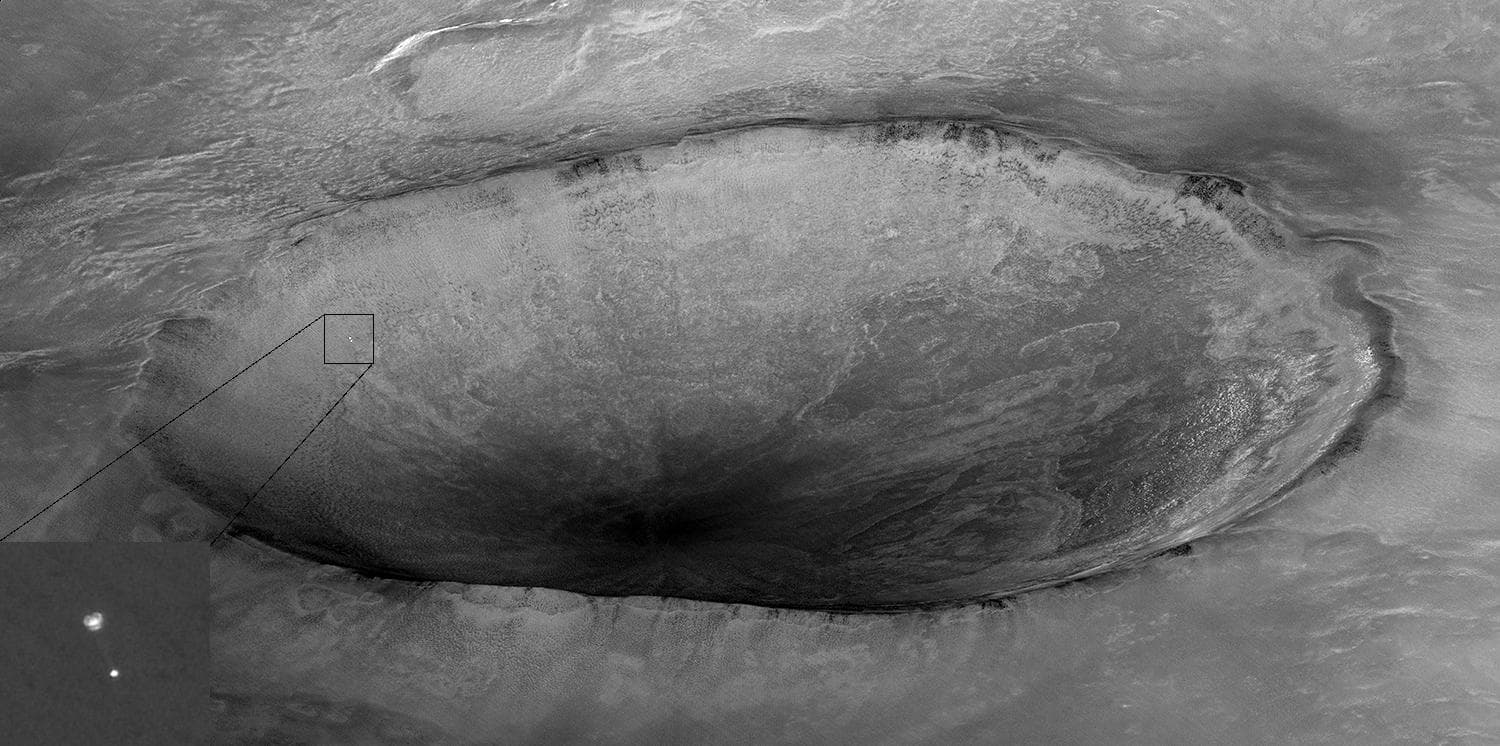
The line opened wide. In July 2001 NASA funded ten concepts out of 43 proposals, at up to $150,000 each against a $300 million cap, and the list is a fair picture of what people wanted to do at Mars when nobody was telling them what to do: SCIM to scoop dust out of the air, KittyHawk to fly three gliders along the walls of Valles Marineris, Urey to date rocks on the surface, MACO to map the atmosphere in three dimensions from a constellation of micro-satellites, Artemis to put down three small landers and micro-rovers with two of them polar, MEO to track water, dust and ice from orbit, Pascal for a network of 24 small weather stations, a Mars Scout Radar to image the shallow subsurface, The Naiades to sound for subsurface liquid water, and CryoScout to melt down into the polar cap. The formal Announcement of Opportunity followed, 25 proposals arrived in August 2002, and on 6 December 2002 NASA named four for six-month studies at up to $500,000 each, this time against a $325 million total mission cost cap. The release described what NASA was doing in a phrase worth keeping: "NASA's Mars 2007 Scout selection process is the first fully competed opportunity for scientific missions to the Red Planet." On 4 August 2003 Ed Weiler picked Phoenix, a polar lander led by Peter Smith of the University of Arizona, built around the airframe of the cancelled Mars Surveyor 2001 lander. It launched on 4 August 2007, landed on 25 May 2008 and found water ice under the arctic soil. As a bet, the first Scout competition paid.
The three that lost deserve more than a footnote. SCIM, led by Laurie Leshin at Arizona State University, would have flown through the upper Martian atmosphere without stopping, catching dust and gas in aerogel the way Stardust caught comet dust, and used a free-return trajectory to drop a capsule back at Earth: a sample return with no lander, no orbiter and no rocket on Mars. ARES, led by Joel Levine at NASA Langley, was an aeroplane. It would have arrived folded inside a Pathfinder-derived aeroshell, unfolded, and flown a rocket-powered survey about 1.5 kilometres above the ground at 140 metres per second for up to 101 minutes and 850 kilometres, carrying a magnetometer to map crustal magnetism at two-kilometre resolution, a mass spectrometer sensitive to a part per billion, a neutron spectrometer and a radiation detector, on a 6.2 metre airframe weighing 125 kilograms fuelled. A half-scale model called the ARES Eagle was dropped from a balloon at nearly nineteen miles over Tillamook, Oregon on 19 September 2002, unfolded, flew a pre-programmed course and landed undamaged. MARVEL, led by Mark Allen at JPL, was an orbiter carrying a solar occultation infrared spectrometer and a submillimetre spectrometer to hunt methane and localised water vapour, which is close to the job Europe's ExoMars Trace Gas Orbiter was eventually built to do.
The second competition went wrong in a way the first had not. Proposals arrived in August 2006, and on 8 January 2007 NASA funded two nine-month concept studies at about $2 million each against a $475 million cap for a 2011 launch: MAVEN, led by Bruce Jakosky of the University of Colorado, and The Great Escape, led by Alan Stern of the Southwest Research Institute. Both would have measured the same thing, the escape of the Martian upper atmosphere, which NASA's own release acknowledged. Stern then took the job of NASA associate administrator for science, effective 2 April 2007, stepped down as principal investigator and recused himself; Jim Burch took The Great Escape over. In November 2007, shortly after the concept study reports came in, NASA found what it would only describe as an organizational conflict of interest in one of the two teams' studies. It stopped the evaluation and rebuilt the entire review panel that produces the technical and cost analyses. On 21 December 2007 NASA announced that the roughly four-month delay had made a 2011 launch unachievable and moved the mission to 2013, because Mars windows come only every 26 months. Michael Meyer's explanation was that the panel's independence was "critical to maintaining a fair and competitive mission selection process". NASA has never published which team the conflict involved. Revised proposals came in during August 2008 and MAVEN was selected on 15 September 2008 at $485 million.
There was never a third Scout competition, and the reason is not a cancellation notice but a pair of decisions taken elsewhere. In 2009 NASA and ESA agreed the Mars Exploration Joint Initiative, which committed the Mars opportunities from 2016 onward to joint missions, so the slot a third Scout would have used was already spoken for. At the same time NASA's Science Mission Directorate opened Discovery to Mars: the Discovery Announcement of Opportunity released on 7 June 2010 states that proposed missions "may target any body in the Solar System, including Mars and Earth's Moon", and the 2010 document goes as far as setting radio rules for missions to the Martian surface. The 2011 planetary decadal survey recorded the outcome without ceremony: "NASA does not intend to continue the Mars Scout program beyond the MAVEN mission, nor do we recommend that they do so." Instead the committee recommended Discovery stay open to Mars. It worked, once. On 20 August 2012 NASA selected InSight as the twelfth Discovery mission, a lander NASA said "builds on spacecraft technology used in NASA's highly successful Phoenix lander mission". Both Scout missions are now finished: Phoenix fell silent on 2 November 2008, and NASA declared MAVEN unrecoverable on 3 June 2026.
Mission facts
What a competed programme line is
A standing, pre-authorised pot of money that NASA advertises rather than assigns. NASA issues an Announcement of Opportunity with a firm total mission cost cap and a launch deadline; any team may propose; a principal investigator, usually a working scientist rather than a NASA centre, leads the proposal and owns the science; NASA funds a handful of concept studies and then picks one to fly. The opposite is a directed or strategic mission, where NASA decides what it wants, assigns it to a centre, and asks Congress for a new start. Discovery, created in 1992, was the first planetary line run this way. Dates below are dates of record; where a clock time appears it is marked as local or UTC.↗
Creation
Announced in NASA release 00-171 on 26 October 2000, as part of the Mars Exploration Program that Scott Hubbard rebuilt after the loss of Mars Climate Orbiter and Mars Polar Lander in 1999. The wording: "NASA also proposes to create a new line of small 'Scout' missions which would be selected from proposals from the science community, and might involve airborne vehicles or small landers, as an investigation platform... The first Scout mission launch is planned for 2007."↗
The 2001 open call
On 20 July 2001 NASA funded ten concepts out of 43 proposals, at up to $150,000 each against a $300 million cost cap, chosen by Ed Weiler. They were SCIM (Laurie Leshin, Arizona State), KittyHawk (Wendy Calvin, Nevada-Reno), Urey (Jeff Plescia, USGS), MACO (Robert Kursinski, Arizona), Artemis (David Paige, UCLA), MEO (M. Janssen, JPL), Pascal (Rob Haberle, NASA Ames), Mars Scout Radar (Bruce Campbell, Smithsonian), The Naiades (Bob Grimm, Blackhawk GeoServices) and CryoScout (Frank Carsey, JPL). Hubbard's description of the exercise: "The intent of these studies was to open wide the door for fresh new ideas. There was almost no constraint given on the type of missions which could be proposed or selected for study."↗
The first Announcement of Opportunity
25 proposals arrived in August 2002. On 6 December 2002, NASA release 02-238 named four for six-month implementation feasibility studies at up to $500,000 each, against a total mission cost cap of $325 million and a launch deadline of 31 December 2007. NASA described the exercise in a phrase worth keeping: "NASA's Mars 2007 Scout selection process is the first fully competed opportunity for scientific missions to the Red Planet."↗
Phoenix wins
4 August 2003, NASA release 03-256. Ed Weiler selected Phoenix, a stationary polar lander led by Peter Smith of the University of Arizona, in partnership with JPL, Lockheed Martin and the Canadian Space Agency, built around the airframe of the cancelled Mars Surveyor 2001 lander. NASA called it "NASA's first fully competed opportunity for a dedicated science-driven mission". It launched on 4 August 2007 and landed on 25 May 2008.↗
SCIM, the sample return with no lander
Sample Collection for Investigation of Mars, led by Laurie Leshin of Arizona State University. It would have flown through the Martian upper atmosphere without landing or entering orbit, catching dust and gas in aerogel as Stardust and Genesis had done, and used a free-return trajectory to bring the capsule back to Earth. NASA's own description said such samples "could provide breakthrough understanding of the chemistry of Mars, its surface, atmosphere, interior evolution and potential biological activity". SCIM got no further than that six-month, $500,000 concept study; no SCIM hardware was built.↗
ARES, the aeroplane
Aerial Regional-scale Environmental Survey, led by Joel Levine at NASA Langley Research Center. A rocket-powered aircraft that would have been delivered in a Pathfinder-derived aeroshell by a Genesis-derived flyby spacecraft, unfolded in the atmosphere, and flown about 1.5 km above the ground at 140 m/s for up to 101 minutes and 850 km. The reference design gives the airframe at 6.2 m wingspan, 66.5 kg dry and 125 kg wet, on a Delta 2925 with a 678 kg wet launch mass. The proposed payload was a magnetometer resolving crustal magnetism at 2 km and 1 nT, a mass spectrometer good to 1 part per billion, a neutron spectrometer, an ionizing radiation detector, an atmospheric data system, and context and video cameras.↗
ARES actually flew, on Earth
A half-scale prototype called the ARES Eagle was carried by balloon from Naval Air Station Tillamook, Oregon at 10:15 local time on 19 September 2002, released at about 11:49 from close to 19 miles up with its wings and tail folded as they would have been inside the aeroshell, unfolded, transitioned from free fall to horizontal flight, flew a pre-programmed course and landed undamaged at 13:28. This is further than most losing proposals ever get.↗
MARVEL, the methane hunter
Mars Volcanic Emission and Life Scout, led by Mark Allen of JPL. An orbiter carrying two instrument types already proven looking at Earth's atmosphere from orbit: a solar occultation infrared spectrometer with very high sensitivity to methane, and a submillimetre spectrometer that could survey continuously through dust storms and polar night and was very sensitive to water vapour, to find localised places where subsurface water might be venting. That is close to the job Europe's ExoMars Trace Gas Orbiter was eventually built to do. MARVEL itself got no further than the six-month concept study.↗
The second Announcement of Opportunity
Proposals were due in August 2006 and on 8 January 2007 NASA funded two nine-month concept studies at about $2 million each, against a cap of no more than $475 million for a 2011 launch: MAVEN, principal investigator Bruce Jakosky of the University of Colorado at Boulder with project management at Goddard, and The Great Escape, principal investigator Alan Stern of the Southwest Research Institute. The same announcement funded an instrument contribution to Europe's ExoMars and two technology studies. NASA's 2007 release says 26 proposals were received in August 2006; NASA's 2008 MAVEN release says the winner was chosen from 20 mission investigation proposals submitted to the same call. The 2007 selection also covered non-mission proposals, which probably reconciles the two counts, but we found no source that says so.↗
The Great Escape
TGE would have measured the escape of the Martian upper atmosphere. NASA's own wording is that both finalists "would provide similar measurements of Mars' upper atmosphere, including its dynamics and evolution, which have been given a high priority by the scientific community". NASA's January 2007 release names Alan Stern of the Southwest Research Institute in Boulder as principal investigator, with project management at SwRI in San Antonio. Stern moved to NASA Headquarters as associate administrator for the Science Mission Directorate in April 2007 and left the proposal; by NASA's December 2007 release the principal investigator was Jim Burch of SwRI in San Antonio. Neither release states the date or the terms on which he stepped down.↗
The conflict of interest
In November 2007, shortly after the two concept study reports were received, NASA postponed the evaluation to resolve what it described only as an organizational conflict of interest in one team's Phase A concept study. It judged the conflict severe enough that its only recourse was to stop the evaluation and reconstitute the entire review panel that provides technical and cost analyses for mission selections. On 21 December 2007, in release 07-283, NASA announced that the roughly four-month delay had made a 2011 launch unachievable and moved the mission to 2013. Michael Meyer: "The panel's independent expertise and evaluation are critical to maintaining a fair and competitive mission selection process." NASA has never published which team was involved.↗
MAVEN wins
Revised proposals were due in August 2008 and NASA announced the selection on 15 September 2008: the Mars Atmosphere and Volatile EvolutioN spacecraft, $485 million, for a late 2013 launch, chosen as "the best science value and lowest implementation risk". The University of Colorado received $6 million for a year of mission planning, Goddard managed the project, and Lockheed Martin built the spacecraft on the Mars Reconnaissance Orbiter and 2001 Mars Odyssey designs. The $485 million figure is $10 million above the $475 million cap stated in the 2007 call, and we found no source explaining the difference.↗
Why there was no third competition
Two decisions taken elsewhere closed the line. NASA and ESA agreed in 2009 to run their Mars programmes together as the Mars Exploration Joint Initiative, committing the Mars launch opportunities from 2016 onward to joint missions, so the slot a third Scout would have used was already spoken for. SpaceNews, reporting the first product of that agreement in August 2010, wrote that the cooperative strategy "comes at the price of NASA's Mars Scout series of missions, which will be discontinued after the Mars Atmosphere and Volatile Evolution (MAVEN) mission". And NASA's Science Mission Directorate opened Discovery to Mars: the final Discovery Announcement of Opportunity NNH10ZDA007O, released on 7 June 2010 after a draft, NNH10ZDA003J, in December 2009, states that "The proposed missions may target any body in the Solar System, including Mars and Earth's Moon, but excluding the Earth and Sun." The 2010 announcement even sets rules for missions to the Martian surface.↗
How the end was recorded
The 2011 planetary science decadal survey, Vision and Voyages for Planetary Science in the Decade 2013-2022, states it twice: "NASA does not intend to continue the Mars Scout program beyond the MAVEN mission, and instead plans to include Mars in the Discovery Program", and "We note that NASA does not intend to continue the Mars Scout program beyond the MAVEN mission, nor do we recommend that they do so. Instead, the committee recommends that NASA continue to allow Discovery missions to be proposed to all planetary bodies, including Mars." Elsewhere the same report says of Scout that "Subsequently, the program was combined with Discovery."↗
What it became
On 20 August 2012, in release 12-288, NASA selected InSight as the twelfth Discovery mission from 28 proposals submitted to the June 2010 call, capped at $425 million in 2010 dollars excluding launch. NASA's own wording is that "InSight builds on spacecraft technology used in NASA's highly successful Phoenix lander mission". The Scout line's last descendant is therefore a mission selected under a different programme using the first Scout mission's spacecraft design.↗
Both Scout missions are over
NASA's Phoenix mission page gives the end of mission as 2 November 2008, the date of the lander's last signal. JPL's release of 24 May 2010 closed the file: a final listening campaign of 61 Mars Odyssey overflights detected nothing, and orbital images showed the lander smaller and its solar arrays apparently damaged by winter carbon-dioxide ice. MAVEN fell silent in December 2025; NASA's anomaly review board concluded the spacecraft could not be recovered, and NASA announced the end of the mission on 3 June 2026, stating that "the MAVEN spacecraft is not recoverable, and it is no longer capable of performing its science and data relay mission". The Scout line has no working hardware left at Mars. Checked 24 August 2026.↗
Mission timeline
- 26 Oct 2000NASA release 00-171 announces the rebuilt Mars Exploration Program, including "a new line of small 'Scout' missions which would be selected from proposals from the science community", with the first launch planned for 2007.
- 20 Jul 2001Ten concepts funded for study out of 43 proposals, at up to $150,000 each against a $300 million cost cap: SCIM, KittyHawk, Urey, MACO, Artemis, MEO, Pascal, Mars Scout Radar, The Naiades and CryoScout.
- 19 Sep 2002A half-scale ARES prototype is dropped from a balloon at nearly 19 miles over Tillamook, Oregon, unfolds its wings and tail, flies a pre-programmed course and lands undamaged. The proposal it belongs to will lose.
- 6 Dec 2002Four of 25 proposals go to six-month studies against a $325 million cap: SCIM, ARES, Phoenix and MARVEL. NASA calls it "the first fully competed opportunity for scientific missions to the Red Planet".
- 4 Aug 2003Phoenix is selected as the first Mars Scout mission, a polar lander led by Peter Smith of the University of Arizona built on the cancelled Mars Surveyor 2001 airframe. It will launch exactly four years later and land on 25 May 2008.
- 8 Jan 2007Two finalists funded at about $2 million each for nine-month concept studies against a $475 million cap and a 2011 launch: MAVEN under Bruce Jakosky and The Great Escape under Alan Stern. Both would measure atmospheric escape.
- Apr 2007Alan Stern, principal investigator of The Great Escape, becomes NASA associate administrator for the Science Mission Directorate and leaves the proposal. By NASA's December 2007 release Jim Burch of SwRI in San Antonio is its principal investigator.
- Nov 2007Shortly after the concept study reports arrive, NASA finds an organizational conflict of interest in one of the two teams' studies, stops the evaluation and reconstitutes the entire technical and cost review panel.
- 21 Dec 2007NASA announces that the four-month delay has made a 2011 launch unachievable and moves the second Scout mission to 2013. Revised proposals are set for August 2008 and selection for December 2008.
- 15 Sep 2008MAVEN is selected at $485 million for a late 2013 launch. It is the last Mars Scout selection ever made.
- 7 Jun 2010The Discovery 2010 Announcement of Opportunity is released, stating that proposals "may target any body in the Solar System, including Mars and Earth's Moon". No third Scout announcement is ever issued.
- 20 Aug 2012InSight is selected as the twelfth Discovery mission, capped at $425 million in 2010 dollars, and NASA notes that it "builds on spacecraft technology used in NASA's highly successful Phoenix lander mission". The competed low-cost Mars mission survives, under another programme's name.
A filled dot marks something that physically happened. A hollow one marks an announcement, a naming or a target.
In pictures
Tap a photo to enlarge.
Sources
- NASA release 00-171 (26 October 2000): NASA Outlines Mars Exploration Program for the Next Two Decades
- NASA (20 July 2001): NASA Picks Mars Scout Mission Ideas for Further Study
- NASA release 02-238 (6 December 2002): NASA Selects Four Mars Scout Mission Concepts for Study
- NASA release 03-256 (4 August 2003): NASA's First Scout Mission Selected for 2007 Mars Launch, archived NSSDC copy
- NASA/JPL (8 January 2007): NASA Selects Proposals for Future Mars Missions and Studies
- NASA release 07-283 (21 December 2007): NASA Delays Mars Scout Mission to 2013
- NASA (15 September 2008): NASA Selects 'MAVEN' Mission to Study Mars Atmosphere, archived NSSDC copy
- NASA SOMA: Discovery 2010 Announcement of Opportunity NNH10ZDA007O, released 7 June 2010
- NASA release 12-288 (20 August 2012): New NASA Mission to Take First Look Deep Inside Mars
- National Research Council, Vision and Voyages for Planetary Science in the Decade 2013-2022 (2011)
- J. S. Levine and the ARES teams, The Aerial Regional-scale Environmental Survey (ARES) Mission to Mars, Lunar and Planetary Science XXXVI (2005), abstract 1258
- StratoCat: ARES Eagle balloon drop test from Tillamook, Oregon, 19 September 2002
- NASA news release (3 June 2026): NASA Says Farewell to MAVEN Mars Mission
- NASA/JPL: Phoenix Mars Lander is Silent, New Image Shows Damage
- SpaceNews (August 2010): NASA-ESA Mars Mission is a Prelude to Future Endeavors
- NASA science mission page: Mars Phoenix
Facts on this page were verified on 24 August 2026. Where sources disagree, the disagreement is stated rather than resolved silently.