The Mars hardware with no ride
Finnish Meteorological Institute, Lavochkin, INTA, Thoth Technology, NASA/JPL · Multinational · Program · 2000 · The long occupationCancelled
Built and tested from the mid-1990s to 2020, then never launched: as of 24 August 2026 none of this hardware has left Earth. Two flight-capable MetNet landers existed by September 2013 with no rocket bought for them.
TL;DR· 14 min read
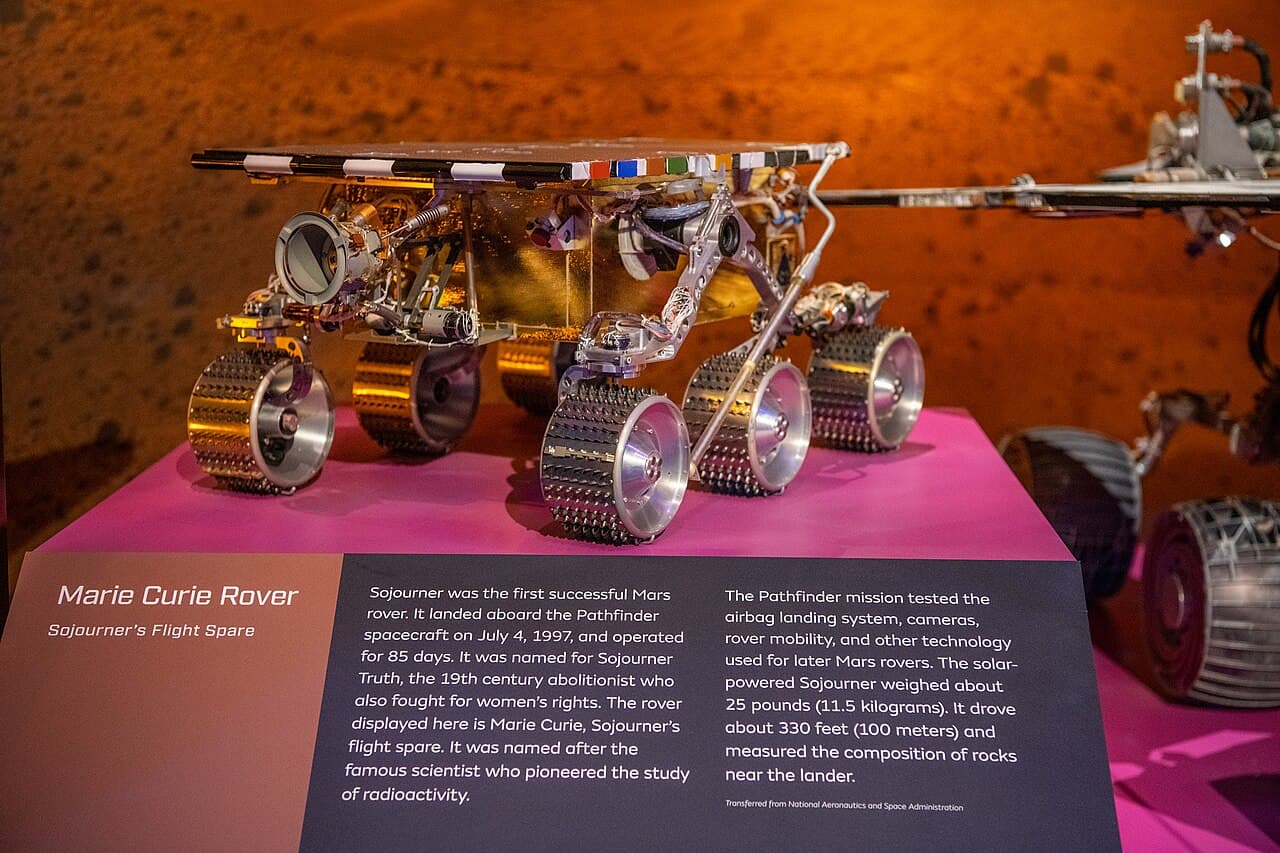
A small group of Mars vehicles were built, tested and then never launched, because the one thing their projects never bought was the ride. Finland and Russia had two flight-capable MetNet entry, descent and landing systems by September 2013 and no rocket for them. Canada's Northern Light got as far as prototypes and a crowdfunding campaign that raised $10,012 against a C$1.1 million target. Marie Curie, the complete flight spare for Sojourner, went to the Smithsonian in 2015 instead of Mars.
Most cancelled Mars missions die as paper. A smaller and stranger group dies as metal. These are the vehicles and payloads that were actually built, in some cases put through vibration, thermal and shock testing to qualification levels, and then simply parked, because the thing nobody had bought was the ride. Finland and Russia have two flight-capable landers. NASA has a complete spare Mars rover on a museum plinth. Canada has a set of prototypes and a radio telescope bought to talk to a lander that was never made. None of it has left Earth.
- 2flight-capable MetNet entry, descent and landing systems built and tested by September 2013
- $10,012raised by Northern Light's 2014 crowdfunding campaign against a C$1.1 million target
- 0of these Mars landers, rovers and payloads that has ever left Earth, as of 24 August 2026
There is a category of Mars mission that is neither a success nor a failure nor really a cancellation, and it does not have a good name. These are the vehicles that were built. Not sketched, not costed, not studied to Phase A and shelved: cut, welded, wired, shaken on a vibration table, cold-soaked in a thermal chamber, and in some cases signed off as flight-capable. And then nothing happened, because the one thing the project never had was a launch. A spacecraft is only half a mission; the other half is a rocket and a launch window, and both are bought with money that small national institutes, university consortia and privately funded teams generally do not have. What makes this group worth an entry is that it inverts the usual story of failure. Nothing here broke. No requirement was missed, no unit conversion botched, no parachute failed to open. The engineering worked and the transport did not exist. Two of these articles, the Finnish MetNet landers, are still sitting somewhere in Finland and Russia in a condition their own builders described as flight-capable. One, Marie Curie, is on a plinth in Washington. The rest are prototypes in university labs. Between them they represent perhaps twenty-five years of work by several hundred people, and a total of zero kilometres travelled toward Mars. It is a specific kind of waste, and it is common enough that it deserves to be named rather than buried inside the histories of the missions that did fly.
MetNet is the clearest case. The concept goes back to Finnish Meteorological Institute work in the late 1980s and became a development project in 2000, when the Russian Mars-NET programme began evaluating cheap ways to get instruments onto the Martian surface. The answer they picked was radical: no rigid heat shield and no parachute, but an inflatable cone that both brakes the vehicle in the upper atmosphere and cushions a semi-hard arrival, with the impact itself burying the payload container in the soil where the thermal environment is kinder to electronics. That trade buys an unusually good payload fraction: 4 kg of instruments inside a 22.2 kg entry mass, in a shell 1.8 m across when inflated. The instruments were a small weather station, pressure, humidity and temperature, plus a panoramic camera, a solar irradiance sensor with an optical wireless link, and a dust sensor, running on 0.7 to 0.8 watts of flexible solar panel, so little that the instruments had to be woken in sequence from a stored cyclogram rather than run together. The idea was never one lander. It was tens of them, scattered from 85 degrees south to 85 degrees north, measuring the same atmosphere at the same moment, which is the only way several of the outstanding questions about Martian weather can be answered at all. The division of labour was Finnish landers, Russian carrier and heritage from the Mars 96 inflatable work, Spanish optical instruments from INTA. Anatoly Zak records that the Finnish share was contracted under an arrangement settling the Soviet Union's old debt to Finland.
The hardware got further than the mission did. By September 2013 the team could write, in a conference abstract rather than a press release, that one complete entry, descent and landing flight unit had been manufactured and acceptance-tested, that a second flight-like unit had been through most of the qualification campaign and could fly after refurbishment, and that therefore two flight-capable systems existed. What never existed was a rocket. A single MetNet station had been manifested on Phobos-Grunt, and that plan was dropped around 2008, three years before Phobos-Grunt itself failed in Earth orbit. The Russian parent mission drifted from a 2016 launch to after 2021, and in August 2012 Lavochkin simply stopped listing Mars-NET among its prospective missions. The underlying descent technology had its own unhappy record: the inflatable reentry demonstrators flown between 2000 and 2005 produced one recovery and a series of vehicles that separated, inflated, transmitted and were then never found, including the Demonstrator D-2R on 7 October 2005, which sent 25 seconds of good telemetry after plasma blackout and vanished. After 2013 the published status stopped changing. The 2015 and 2016 EGU abstracts carry the same paragraphs: same qualification model in functional test, same two flight-capable units, same sentence about discussions on launch opportunities being under way. As of 24 August 2026 the FMI's dedicated MetNet pages are gone and we have found no announcement of a launch vehicle, a launch date, or a formal cancellation.
Northern Light is the other kind of story, and it is important not to confuse the two. Canada's entry was a lander and rover pursued from 2001 by a consortium of ten universities with Thoth Technology of Pembroke, Ontario as prime contractor and Ben Quine of York University as principal investigator. The design was genuinely interesting: a 35 kg lander and a 6 kg semi-autonomous rover called Beaver, with a grinder to shave a millimetre or two off rock surfaces and a photometer to look for the shades of green that mark photosynthetic microbes sheltering just under the stone, the way they do in Antarctica and the Canadian Arctic. But by the team's own account in November 2014, twelve years of work and about half a million dollars had produced prototypes of the lander and rover, plus a few instruments space-tested by flying them on Earth-orbiting satellites. The ride plan was to hitch on ExoMars or an Indian mission in 2018 and pay for the seat in kind, by relaying other agencies' Mars data through the Algonquin Radio Observatory, which Thoth had leased and repaired from the Canadian government for about a million dollars. The crowdfunding campaign that was to buy the flight hardware asked for C$1.1 million and raised $10,012. No launch followed. As of 24 August 2026 the project's domain has been turned over to an unrelated marketing blog. Northern Light never reached qualified flight hardware, and saying otherwise would flatter it.
The rest of the category is scattered across other entries in this catalogue and is worth pulling together here. Marie Curie was a complete, operational Mars rover, the flight spare that JPL drove around a sandpit in Pasadena to rehearse the commands sent to Sojourner. It was assigned to the Mars Surveyor 2001 Lander, then floated for a 2003 flight, and when both fell through it went to the Smithsonian in 2015, where it is displayed as a finished Mars rover that never went to Mars. MIP, the shoebox that would have made oxygen from Martian carbon dioxide on the same lander, reached completed flight hardware and never flew either; the idea got to Mars twenty years later as MOXIE. The pattern continued past 2020: Russia's Kazachok landing platform and Europe's Rosalind Franklin rover were both built for a launch window that came and went. The through-line is that in Mars exploration the expensive, difficult, prestigious part, building a machine that can survive entry and work on another planet, is not actually the part that most often stops a mission. Buying the ride is. Small teams can build a lander. Almost none of them can buy a Proton, a Soyuz or an Atlas, and a lander with no rocket is an exhibit.
Mission facts
What this entry covers
Mars flight hardware that was physically built and then never launched, as distinct from missions cancelled on paper. The two anchors are the Finnish-led MetNet lander and Canada's Northern Light. The Mars Surveyor 2001 Lander, the Mars network studies including NetLander, and Russia's Kazachok have their own entries in this catalogue and are cross-referenced here rather than retold.↗
MetNet, what it is
A semi-hard landing vehicle called the MetNet Lander (MNL), developed by the Finnish Meteorological Institute with Lavochkin Association, the Space Research Institute (IKI) in Moscow and Spain's Instituto Nacional de Tecnica Aeroespacial (INTA). It uses an inflatable entry and descent system in place of a rigid heat shield and parachute, so that the ratio of payload mass to total mass is far better than a conventional lander's. The impact was to bury the payload container in the soil.↗
MetNet numbers
22.2 kg entry mass per unit, 4 kg payload allocation, 1.8 m inflated diameter, all from English Wikipedia's infobox; none of the three appears in the FMI team's own EPSC 2013, EGU 2015 or EGU 2016 abstracts. Available power figures differ: the same infobox gives 0.6 W, while the FMI abstracts say the flexible solar panels provide about 0.7 to 0.8 W in daylight, too little to run all instruments at once, so they are activated in sequence from a cyclogram table.↗
MetNet payload
Pressure (MetBaro), humidity (MetHumi) and temperature (MetTemp) sensors, a panoramic camera, the MetSIS solar irradiance sensor with the OWLS optical wireless data link, and a dust sensor. A three-axis accelerometer and three-axis gyrometer would monitor the descent and transmit through an auxiliary beacon antenna from shortly after separation.↗
How the Finnish landers were paid for
Anatoly Zak's account of the Russian side records that responsibility for the landing vehicles was delegated to the Finnish Meteorological Institute, which could be contracted by the Russian government within a scheme to settle the Soviet Union's debt to Finland. Development of the parent Russian project, Mars-NET, began in August 2000 with an evaluation of five ways to put science gear on Mars reliably and cheaply.↗
How far the hardware got, in the team's own words
The FMI team's EPSC 2013 status abstract states: "One complete flight unit of the entry, descent and landing systems (EDLS) has been manufactured and tested with acceptance levels. Another flight-like EDLS has been exposed to most of the qualification tests, and hence it may be used for flight after refurbishments. Accordingly two flight-capable EDLS systems exist." A full qualification model of the landing unit with the precursor payload was in functional testing.↗
The rides MetNet lost
One MetNet station was scheduled to fly to Mars aboard Phobos-Grunt, but Zak records that the plan was dropped around 2008. The parent Mars-NET mission was scheduled for a 2016 Soyuz-2.1b launch as of 2008, then slipped to after 2021, and in August 2012 a Lavochkin presentation no longer listed Mars-NET among the company's prospective missions at all.↗
The inflatable descent system's own flight record
The inflatable reentry technology behind MetNet, IRDT, was flown repeatedly between 2000 and 2005 and never cleanly succeeded. Only one payload, Demonstrator, was successfully recovered from Earth orbit. A 2000 Fregat reentry was believed successful but the stage was never found; a 2001 solar-sail return failed; a 12 July 2002 submarine-launched test failed with the Volna rocket; and on 7 October 2005 the Demonstrator D-2R separated, inflated and transmitted through entry, then was never located.↗
MetNet's last public status
The mission status sections of the FMI team's EGU 2015 and EGU 2016 abstracts are near-identical text: the same qualification model in functional tests, the same two flight-capable EDLS units, the same sentence that "Definition of the Precursor Mission and discussions on launch opportunities are currently under way" and the same statement that baseline development funding exists for the next five years. As of 24 August 2026 the FMI's dedicated MetNet pages are gone and we found no launch vehicle or launch date ever announced.↗
Northern Light, what it was
A privately led Canadian Mars lander and rover, prime contractor Thoth Technology of Pembroke, Ontario, with York University as partner. A 35 kg lander would carry a 6 kg solar-powered rover called Beaver with a range of about 1 km, to look for photosynthetic microbes a millimetre or two below rock surfaces, the way they survive in Antarctica and the Canadian Arctic. Principal investigator Ben Quine, Thoth's technical director and a professor of space engineering at York.↗
How far Northern Light got
Prototypes only. Nothing reached flight hardware. Quine told CBC in November 2014 that he had been working on the project for twelve years and that his team had spent half a million dollars developing and testing prototypes of the lander and micro-rover, with some instruments space-tested by flying them on satellites in low Earth orbit. The Canadian Space Agency confirmed it knew of the project and had no involvement in it.↗
The plan for a ride, and the ground station
Northern Light intended to piggyback on someone else's Mars-bound spacecraft, with 2018 candidates including the Russian-European ExoMars mission and an expected Indian lander, and to barter the ride by relaying other agencies' Mars data through Canada. Thoth leased and repaired the Algonquin Radio Observatory from the federal government for about a million dollars; its 46 m dish was to be the mission's ground station and, Quine said, is the only steerable dish in Canada large enough to hear a signal from Mars.↗
The crowdfunding
An Indiegogo campaign opened on 4 November 2014 seeking C$1.1 million for flight hardware, with rewards from a $20 frisbee to naming the lander for a million dollars. It raised $10,012. As of 24 August 2026 the project's domain, marsrocks.ca, no longer carries the mission at all: it resolves to an unrelated WordPress blog publishing direct-mail-marketing articles dated 2025.↗
Marie Curie
The flight spare for Mars Pathfinder's Sojourner, a complete and operational six-wheeled rover that was used at JPL to rehearse the commands sent to its twin on Mars. It was assigned to the Mars Surveyor 2001 Lander, then proposed for a 2003 flight, and flew neither. JPL transferred it to the Smithsonian National Air and Space Museum in 2015, inventory number A20150317000, where it is on display in the Kenneth C. Griffin Exploring the Planets Gallery, 69.8 by 44.4 by 31.7 cm.↗
MIP, the oxygen box
The Mars In-situ Propellant Production Precursor, a 40 by 24 by 25 cm, 8.5 kg package built for the Mars Surveyor 2001 Lander to make oxygen from Martian carbon dioxide and to test solar cells and dust mitigation. It reached completed flight hardware and lost its ride when the lander was cancelled. Its idea reached Mars two decades later as MOXIE on Perseverance. The Mars Surveyor 2001 Lander has its own entry in this catalogue.↗
The modern cases
The pattern did not stop in 2020. Russia's Kazachok landing platform was built for a 2020 launch that slipped to 2022 and then lost its mission, and Europe's Rosalind Franklin rover was completed for the same window and is still on Earth. Both have their own entries here. The point they share with MetNet is not that the science was rejected but that the transport was never secured.↗
Mission timeline
- Mar to May 2000NASA cancels the launch of the Mars Surveyor 2001 Lander. English Wikipedia dates the cancellation to May 2000; this catalogue's own entry on the lander traces the announcement to a NASA news conference on 28 March 2000. Its rover, the complete Sojourner flight spare Marie Curie, loses its only assigned ride, as does the MIP oxygen experiment.
- Aug 2000Development of the Russian Mars-NET project begins with an evaluation of five ways to deliver science instruments to the Martian surface reliably and cheaply. The landing vehicles are assigned to the Finnish Meteorological Institute, under an arrangement tied to the Soviet Union's debt to Finland.
- 2002 to 2003The first prototype of the MetNet landing system appears in metal, and its key components go into a wind tunnel for aerodynamic testing.
- 12 Jul 2002Russia launches an inflatable descent device from a submarine. The Volna ballistic missile fails during the flight, one of a run of inflatable-reentry tests that never cleanly succeeded.
- Jun 2005NPO Lavochkin shows a full-scale prototype of the lander, by now known as MetNet, at the Paris Air and Space Show at Le Bourget.
- 7 Oct 2005At 01:30 Moscow time a Volna rocket carries the Demonstrator D-2R inflatable braking device from the Barents Sea toward Kamchatka. It separates, inflates at 238 km, survives the plasma blackout and transmits for 25 more seconds. Nothing further is heard and no debris is found.
- around 2008The plan to carry one MetNet station to Mars aboard Phobos-Grunt is dropped. It was the closest a MetNet lander ever came to a manifest.
- Aug 2012A Lavochkin presentation no longer lists Mars-NET among the company's prospective missions. The Russian carrier for the Finnish landers has quietly gone.
- 8 to 14 Sep 2013At EPSC in London the FMI team reports that one complete flight EDLS unit has been manufactured and acceptance-tested and a second flight-like unit has passed most qualification tests, so "two flight-capable EDLS systems exist." This is the high-water mark.
- 4 Nov 2014Thoth Technology opens an Indiegogo campaign for C$1.1 million to build Northern Light flight hardware, aiming to hitch a 2018 ride and to pay for it by relaying other agencies' Mars data through the Algonquin Radio Observatory. It raises $10,012.
- 2015JPL transfers Marie Curie to the Smithsonian National Air and Space Museum. A complete Mars rover enters a museum collection without ever having been to Mars.
- Apr 2016The FMI team presents MetNet at the EGU General Assembly with a mission status section that repeats the previous year's almost word for word: same qualification model, same two flight-capable units, same discussions on launch opportunities under way. We found no later public status.
A filled dot marks something that physically happened. A hollow one marks an announcement, a naming or a target.
In pictures
Tap a photo to enlarge.
Sources
- A.-M. Harri et al., Mars MetNet Precursor Mission Status, EPSC 2013 (London, 8 to 14 September 2013)
- A.-M. Harri et al., Mars MetNet Mission Status, Geophysical Research Abstracts Vol. 17, EGU2015-13336
- Mars MetNet Mission: Martian Atmospheric Observational Post Network, EGU General Assembly 2016
- RussianSpaceWeb (Anatoly Zak): The Mars-NET project
- English Wikipedia: Mars MetNet
- CBC News (4 November 2014): Northern Light Canadian Mars micro-rover and lander aim for 2018 launch
- English Wikipedia: Northern Light (spacecraft)
- Mars Rocks (marsrocks.ca), the former Northern Light project domain
- Smithsonian National Air and Space Museum: Rover, Marie Curie, Mars Pathfinder, Engineering Test Vehicle (A20150317000)
- English Wikipedia: Mars Surveyor 2001
- French Wikipedia: NetLander
- English Wikipedia: Rosalind Franklin (rover)
Facts on this page were verified on 24 August 2026. Where sources disagree, the disagreement is stated rather than resolved silently.