Mars Surveyor 2001 Lander
NASA · United States · Lander · 1994 · The losing decadeCancelled
Built and never flown: NASA said on 28 March 2000 that it was cancelled and on hold indefinitely, a near copy of Mars Polar Lander, which had crashed on 3 December 1999. Its structure reached Mars in 2008 as Phoenix.
TL;DR· 17 min read
The Mars Surveyor 2001 Lander was all but finished when it was told to stop. It was a near copy of Mars Polar Lander, and after Polar Lander crashed on 3 December 1999 the review board used this vehicle's own legs to find the fault that killed it. NASA said at its 28 March 2000 news conference that the lander was cancelled and on hold indefinitely. Its main structure reached Mars in 2008 as Phoenix, and its rover, Marie Curie, went to the Smithsonian instead.
This is the Mars lander that was all but finished and then told to stop. It was the second of the Mars Surveyor landers, a near-copy of Mars Polar Lander, and the payload bolted to it was where the programme's ambitions had piled up: a machine to make oxygen out of the atmosphere, a soil-toxicity laboratory, a descent camera, a robotic arm, and a six-wheeled rover called Marie Curie that was Sojourner's flight spare. Then Polar Lander crashed, and the fault that killed it was found on this vehicle's own landing legs. NASA cancelled it in 2000. The airframe eventually flew, as Phoenix. The rover did not, and now sits in a gallery in Washington.
- 10 Apr 2001the opening of the launch window it was built for and never used
- 2of Phoenix's instruments that NASA's press kit traces back to this lander
- 0 mdriven on Mars by its rover Marie Curie, now in the Smithsonian
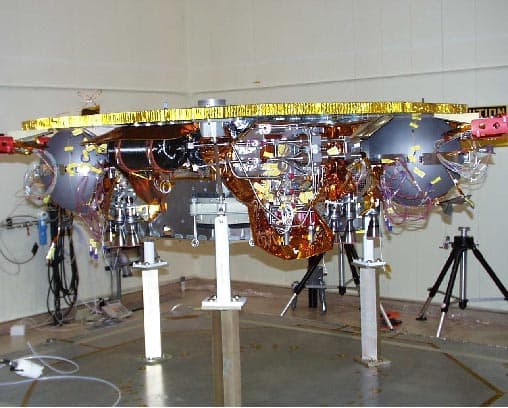
Almost everything about this vehicle exists, and almost none of it went to Mars aboard it. It was the second of the Mars Surveyor landers, closely derived from Mars Polar Lander, and its payload was where the programme's ambitions had piled up. It would have carried a descent camera, a panoramic camera and a miniature thermal emission spectrometer on a mast, a robotic arm with its own camera, a soil laboratory called MECA designed to work out whether Martian dust is toxic to humans, a sundial for the panoramic camera to photograph, a radiation monitor, and a box on the deck that would have made oxygen out of the Martian atmosphere. It would also have carried a rover. The plan was a launch window opening on 10 April 2001, a nine-month cruise inside an aeroshell, a direct entry at 7.8 kilometres per second on 22 January 2002, and a touchdown at 2.5 metres per second near 15 degrees south and 315 degrees longitude in late southern summer, for a hundred Martian days of work with perhaps fifty more after that. The vehicle would have massed 628 kilograms fuelled at launch and 328 kilograms on the ground. It was to talk to Earth through orbiters, and one of the two it was designed to relay through, Mars Climate Orbiter, was destroyed while this lander was still being built.
Then on 3 December 1999 Mars Polar Lander flew into the atmosphere and was never heard from again, and because the 2001 lander was essentially the same spacecraft, the whole Surveyor lander line stopped. What followed is unusual and worth stating carefully: this vehicle became the evidence in the investigation of its own sister ship. Polar Lander's flight legs were gone, and the engineering development unit had been deployed too many times to be representative, so the review board ran two leg deployment tests on a 2001 lander in a thermal-vacuum chamber at Martian temperatures. The first produced sensor transients of 12, 26.5 and 7.3 milliseconds on the three legs; the second produced 16, 12 and 25. The board judged that both runs would have shut the descent engines down early. The underlying software fault had already surfaced on this lander by accident, when a test engineer pressed a touchdown button too soon, released it when he realised, and was surprised when thrust termination happened anyway. That accident is what set off the failure analysis that uncovered the software fault, though the board records that a premature touchdown trigger had already been listed as a candidate failure mode before Polar Lander ever reached Mars. The report that carried those findings, published on 22 March 2000, contains a whole section of recommendations for fixing the 2001 lander, written for a vehicle that by then had already been told it would not fly.
The cancellation is usually dated to May 2000, and we could not trace that month to any NASA statement. What can be dated is a trail. On 14 March 2000 the Mars Program Independent Assessment Team wrote that it concurred with NASA's decision not to fly the Mars '01 lander in 2001 and to consider its use at a later opportunity, which means the decision already existed. On 28 March 2000, at the NASA Headquarters news conference where the failure reports were released, NASA said the lander was cancelled and on hold indefinitely; Ed Weiler's line that day was that NASA had found the boundary and was stepping back from it. By 12 May 2000 a JPL press release was referring in passing to "the canceled 2001 lander mission" as settled fact. The orbiter half of the project survived, was renamed 2001 Mars Odyssey and launched on 7 April 2001. The reason given for treating the two halves differently was never subtle and was rarely stated in a press release: the orbiter was a new design, and the lander was a near clone of the one that had just crashed.
What happened to the pieces is the reason this entry exists. The airframe was not scrapped. It went into a box in a controlled clean room at Lockheed Martin, and when NASA opened the competitively selected Mars Scout line it was offered to proposers as government property. Peter Smith's team won with Phoenix in August 2003, and on 25 May 2008 its main structure landed in the Martian arctic under a different name. NASA's press kit traces two of Phoenix's instruments back to this lander: the robotic arm camera, originally built for it, and MECA, which inherited many of its original electronic and structural components. The arm that carried that camera was a new one, based on the Mars Polar Lander design. Phoenix carried a Mars Descent Imager too, and NASA ruled before landing that it would not be used. MIP, the oxygen experiment, was finished after the cancellation on instruction, tested through to August 2000, and put into storage; it never flew, and its idea reached Mars in 2021 as MOXIE on Perseverance. The Athena payload went to the Mars Exploration Rovers. And Marie Curie, the six-wheeled rover that was Sojourner's flight spare and carried the name that came second in the 1995 naming contest, was transferred by JPL to the National Air and Space Museum in 2015. It is inventory number A20150317000, and on 27 August 2026 the museum's page still listed it on display in the Kenneth C. Griffin Exploring the Planets Gallery. It has driven no metres on Mars.
One thing about that rover deserves its own note, because catalogues disagree with themselves about it. The Smithsonian titles the object "Rover, Marie Curie, Mars Pathfinder, Engineering Test Vehicle," while the summary on the same record calls it "the flight spare for the Sojouner rover," misspelling included. Its mass is given as 13.81 kg in the descriptive text of NASA's catalogue entry for it and as 10.5 kg in the summary box on that same page, the latter being Sojourner's figure; the museum measures the physical object at 69.8 by 44.4 by 31.7 centimetres against the catalogue's 63 by 48 by 28. What is not in dispute is what it did. While Sojourner drove on Mars in 1997, engineers put Marie Curie through the same movements in a Mars-like test area at JPL, so the moves Sojourner made on Mars were made a second time in Pasadena. Then it was assigned to a mission that was cancelled, and it stayed on Earth. It is the piece of this lander's hardware that a person can walk up to and look at.
Mission facts
What it was
The lander half of the Mars Surveyor 2001 project, the third pairing of the Mars Surveyor Program after Mars Global Surveyor in 1996 and the Mars Climate Orbiter and Mars Polar Lander pair of 1998 and 1999. NASA's catalogue describes it as "based on the Mars '98 Polar Lander" and built to "study soil and atmospheric chemistry and radiation at the surface," with a rover to be deployed to study the immediate surroundings. Prime contractor Lockheed Martin Astronautics, Denver; project management at JPL.↗
Planned launch
The launch window opened 10 April 2001, on a Delta II 7425 from Cape Canaveral. That is NSSDCA's figure for the lander; NSSDCA's own page for the rover it carried gives 5 April 2001 for the same launch. Neither date can be checked against an actual launch, because there was not one.↗
Planned landing
None of the following happened. It is the descent profile NSSDCA published for a flight that was never made. Arrival was to be on 22 January 2002, entering the atmosphere directly from the approach hyperbola with the cruise stage jettisoned five minutes earlier. Entry would have been at 125 km altitude and 7.8 km/s at a 20 degree angle, the parachute deploying 226 seconds after entry at 9 to 10 km, the aeroshell releasing ten seconds later, the descent rockets lighting and the legs deploying at 1.43 km about 269 seconds after entry, the parachute and backshell releasing two seconds after ignition, and touchdown about 37 seconds after that at 2.5 m/s. Images were to be taken all the way down.↗
Where it was going
About 15 degrees south latitude and 315 degrees longitude, for a landing in late southern summer. NSSDCA does not say whether that longitude is east or west, and the same catalogue gives Mars Polar Lander's target as 76 S, 195 W, so west is the likelier reading, which would put the site near 45 degrees east in the modern east-positive convention. We could not find a source that settles it, so we do not state a hemisphere. Nominal surface life 100 Martian days with limited capability for another 50 or so, varying with the exact landing latitude. NSSDCA notes that the batteries and systems would freeze during winter, and that some might be revivable the following summer.↗
Mass and power
628 kg fully fuelled at launch, 328 kg on the ground. Power from 3 square metres of solar cells and two 12 amp-hour lithium-ion batteries, giving roughly 25 to 30 W during the day, with most activities off at night. Communications by UHF relay to the 2001 orbiter and to the Mars '98 orbiter, which is a detail worth pausing on: NSSDCA's text was written before Mars Climate Orbiter was lost, and by the time this lander was cancelled one of its two planned relay satellites no longer existed.↗
Payload
A Mars Descent Imager (MARDI), a panoramic camera (PanCam), a miniature thermal emission spectrometer (Mini-TES), the Mars Environmental Compatibility Assessment (MECA) for the toxicity of Martian soil and dust to humans, the Mars In-situ Propellant Production Precursor (MIP), a robotic arm with its own camera, a small sundial to be photographed by PanCam, a radiation monitor, and the rover. NSSDCA also lists the Mars Radiation Environment Experiment (MARIE) among the lander instruments, which is worth treating carefully: the instrument that flew under that name was carried by the 2001 orbiter, and we have found no source confirming that a separate lander unit of it existed.↗
APEX, and the rover that was swapped out
The science package was the Athena Precursor Experiment, described by Steve Squyres and colleagues in 1999 as a suite for the Mars Surveyor Program 2001 lander with four major instrument systems: a stereo colour imager with a mid-infrared spectrometer, an elemental analysis spectrometer, a mineralogy instrument for iron-bearing materials, and a magnet array. The Athena rover itself had been postponed from 2001 to a tentative 2003 launch on budget and schedule grounds, reported by Cornell on 15 July 1998, and the smaller Marie Curie was substituted. Athena's payload eventually flew on the Mars Exploration Rovers.↗
MIP, the oxygen machine
The Mars In-situ Propellant Production Precursor, principal investigator David I. Kaplan of Johnson Space Center, was a shoebox-sized package on the lander deck, 40 by 24 by 25 cm and 8.5 kg, containing five experiments: atmospheric acquisition and compression, an oxygen generator, radiator characterisation, a solar array technology test and a dust accumulation and repulsion test. It was designed to run for 300 Martian days, drawing 3 W at night and 16 W while generating oxygen. Its oxygen generator was built at the University of Arizona under contract to Johnson Space Center.↗
How far MIP got
All the way to flight hardware. Geoffrey Landis, a co-investigator, records that fabrication and qualification testing of the MIP flight hardware was completed in 1999 and delivered for qualification testing ahead of integration onto the lander in the summer of 2000; that after the cancellation the team was told to finish anyway; that a qualification unit was tested from November 1999 to August 2000; and that the flight unit was completed and put into storage to wait for a flight that never came. The oxygen generator flight unit had a mass of 1 kg and was designed to produce 0.04 grams of oxygen per hour at 131.5 mA. MOXIE, on Perseverance, made oxygen on Mars in 2021 using the same underlying technology.↗
The rover it carried
Marie Curie, a near-duplicate of Mars Pathfinder's Sojourner: six wheels on rocker-bogie suspension, 28 cm high, 63 cm long, 48 cm wide, 13 cm ground clearance, top speed 0.6 cm/s, an Intel 80C85 running at 2 MHz, three radioisotope heater units, and an alpha-proton X-ray spectrometer on the back that was a lightly modified duplicate of Pathfinder's. It was to be lifted off the lander by the robotic arm and driven up to 10 m from it, covering more than 100 m in total. NSSDCA's description gives its mass as 13.81 kg while the summary box on the same page says 10.5 kg, which is Sojourner's figure.↗
Where the rover's name came from
Second place. The Planetary Society and JPL ran a naming contest for the Pathfinder rover that drew 3,500 entries; 12-year-old Valerie Ambroise won with Sojourner Truth. JPL's release names the runner-up as Deepti Rohatgi, 18, of Rockville, Maryland, who proposed Marie Curie. The flight spare took the name that came second, and the rover that survives on Earth is the one carrying that runner-up name.↗
Where the rover is now
The National Air and Space Museum, Washington DC, inventory number A20150317000, credit line "Transferred from the Jet Propulsion Laboratory." The museum records that JPL transferred it in 2015 and that it is on display in the Kenneth C. Griffin Exploring the Planets Gallery, which the museum's page still said on 27 August 2026. Overall dimensions 69.8 by 44.4 by 31.7 cm. The catalogue titles the object an Engineering Test Vehicle while the record's own summary calls it "the flight spare for the Sojouner rover," spelling included.↗
The fault it found
The Mars Polar Lander review board could not test Polar Lander's legs, so it used this vehicle. "A 2001 lander was used for two leg deployment tests of all three legs in a thermal-vacuum chamber with temperatures representative of what they would be in the Martian environment." The first test gave transients of 12, 26.5 and 7.3 milliseconds on the three legs; the second gave 16, 12 and 25. The board assessed that both runs would have caused a premature descent engine shutdown. The software bug behind it had already been found on this lander too, by accident: a test engineer pressed a touchdown button too early, released it, and was surprised when thrust termination happened anyway.↗
The fixes written for a lander that would not fly
Section 4 of the 22 March 2000 Casani report is headed "Specific Recommendations for the Mars 2001 Lander" and lists them by subsystem: add entry, descent and landing communications; add a low-gain transmit antenna; ionisation breakdown testing of the medium-gain and UHF antennas in a landed 6-torr environment; an end-to-end UHF verification test against both the '01 and Mars Global Surveyor orbiter configurations; a list of propulsion and thermal fixes; and, under Software, "Fix known software problems" beginning with the landing leg touchdown false indication. By the time the report appeared, NASA had already said the lander would not fly.↗
When it was cancelled
The commonly printed date is May 2000, and we could not trace that to a NASA statement. What is dated: on 14 March 2000 the Mars Program Independent Assessment Team wrote that it "concurs with the NASA decision not to fly the Mars '01 Lander in 2001 and to consider its use at a later opportunity"; on 28 March 2000 CBS News reported from the NASA news conference that "the lander next year has been cancelled, it's on hold indefinitely"; and on 12 May 2000 a JPL release referred in passing to "the canceled 2001 lander mission." The Phoenix press kit and Malin Space Science Systems both say only "cancelled in 2000."↗
What became of the spacecraft
"The lander's main structure was built for the Mars Surveyor 2001 program, and then kept in a protective, controlled environment after the lander portion of that program was cancelled." NASA opened the competitively selected Mars Scout line in 2001 and offered the stored lander to proposers; Phoenix won in August 2003, launched 4 August 2007 and landed on 25 May 2008. The press kit traces two Phoenix instruments back to this lander. A team led by H. Uwe Keller and Peter Smith "originally built this camera for the Mars Surveyor 2001 Lander mission," meaning the robotic arm camera; and MECA is "based on an instrument developed for" this lander and "inherited many of the original electronic and structural components." Phoenix's robotic arm itself was not this lander's: the press kit says it "uses a design based on a similar arm flown on the 1999 Mars Polar Lander mission." Phoenix also carried a Mars Descent Imager, and NASA ruled before landing that it would not be used, the camera being sound but the risk of handling its data during final descent judged unacceptable.↗
Mission timeline
- 1994 to 1998The Mars Surveyor Program plans a lander at every launch window. The first becomes Mars Polar Lander for 1999; this vehicle is manifested as the second, for 2001, and the human exploration side of NASA buys a place on it for a technology payload.
- 15 Jul 1998Cornell reports that the Athena rover has been postponed from 2001 to a tentative 2003 launch on budget and schedule grounds, while the Athena Precursor Experiment stays on the 2001 lander. Steve Squyres: "having a somewhat delayed program that is realistic is better than having an on-schedule program that isn't going to work." Sojourner's flight spare, Marie Curie, becomes the 2001 rover instead.
- 1999Fabrication and qualification testing of the MIP flight hardware is completed, and it is delivered for qualification testing ahead of integration onto the lander, planned for the summer of 2000. A lander therefore exists at Lockheed Martin in Denver for it to be integrated onto.
- 3 Dec 1999Mars Polar Lander is lost during descent. Because the 2001 lander is essentially the same spacecraft, the Surveyor Lander programme is put on hold.
- Nov 1999 to Aug 2000The MIP team is told to finish anyway. A qualification unit is put through a rigorous test campaign, the flight unit is completed, and it is placed into storage to wait for a flight.
- Early 2000Two thermal-vacuum leg deployment tests are run on a 2001 lander for the Polar Lander review board, producing sensor transients of 12, 26.5 and 7.3 milliseconds, then 16, 12 and 25. The board assesses that both runs would have shut the descent engines down early. Separately, a test engineer on this lander presses a touchdown button too soon and uncovers the latched-indicator software fault.
- 14 Mar 2000The Mars Program Independent Assessment Team reports that it concurs with NASA's decision not to fly the Mars '01 lander in 2001 and to consider its use at a later opportunity, and with the decision to fly the '01 orbiter.
- 22 Mar 2000The Casani report on the loss of Mars Polar Lander and Deep Space 2 devotes a section to specific recommendations for this lander: entry, descent and landing communications, antenna breakdown testing, propulsion and thermal fixes, and a list of software problems to correct starting with the false touchdown indication.
- 28 Mar 2000At a NASA Headquarters news conference the reports are made public, and NASA says the 2001 lander has been cancelled and is on hold indefinitely. Ed Weiler on the two 1999 losses: "We found the boundary and we're stepping back from that boundary."
- 12 May 2000A JPL release about the 2003 options describes the Athena rover as one that "previously was considered for the canceled 2001 lander mission." The cancellation is now settled language in NASA's own press material.
- Aug 2003NASA selects Phoenix as the first Mars Scout, giving the stored lander a mission. It launches on 4 August 2007 and lands in the Martian arctic on 25 May 2008, using its main structure, the robotic arm camera built for this vehicle, and a MECA that inherited many of this lander's original components.
- 2015JPL transfers the Marie Curie rover to the Smithsonian's National Air and Space Museum, inventory A20150317000. It goes on display in a simulated Martian setting and, as of 27 August 2026, is in the Kenneth C. Griffin Exploring the Planets Gallery in Washington DC.
A filled dot marks something that physically happened. A hollow one marks an announcement, a naming or a target.
In pictures
Tap a photo to enlarge.
Sources
- NSSDCA Master Catalog: Mars Surveyor 2001 Lander (MS2001L), archived 2 December 2024
- NSSDCA Master Catalog: Mars Surveyor 2001 Rover, alternate name Marie Curie (MS2001R), archived 16 December 2024
- NSSDCA experiment record: Mars In-situ Propellant Production Precursor (MIP), MS2001L-06, archived 26 July 2024
- Geoffrey A. Landis, MIP: the First ISRU Flight Experiment, AIAA ASCEND 2020 (AIAA 2020-4234), NASA NTRS copy
- S. W. Squyres and others, The Mars 2001 Athena Precursor Experiment (APEX), Workshop on Mars 2001, NASA NTRS record
- Cornell Chronicle, 15 July 1998: Astronomer confirms Cornell's new role in 2001 Mars lander mission
- Report on the Loss of the Mars Polar Lander and Deep Space 2 Missions, JPL Special Review Board (D-18709), 22 March 2000
- CBS News, 28 March 2000: Mars Lander Reports Rip NASA
- JPL news release, 12 May 2000: NASA Identifies Two Options for 2003 Mars Missions; Decision in July
- NASA and JPL, Phoenix Landing press kit, May 2008
- Malin Space Science Systems on the Mars Surveyor 2001 Lander Mars Descent Imager
- Smithsonian National Air and Space Museum collection record A20150317000: Rover, Marie Curie, Mars Pathfinder, Engineering Test Vehicle
Facts on this page were verified on 27 August 2026. Where sources disagree, the disagreement is stated rather than resolved silently.