Mars Surveyor Program
NASA · United States · Program · 1993 · The losing decadePartial
Two of the four spacecraft flown worked, Mars Global Surveyor and the orbiter renamed 2001 Mars Odyssey; Mars Climate Orbiter and Mars Polar Lander were both lost in 1999. NASA replaced the programme on 26 October 2000.
TL;DR· 13 min read
NASA created the Mars Surveyor Program in 1994 to fly a spacecraft at every 26-month launch window, all of them built by Lockheed Martin. Four flew. Mars Global Surveyor and the orbiter renamed 2001 Mars Odyssey worked, while Mars Climate Orbiter and Mars Polar Lander were lost ten weeks apart in 1999, and the 2001 lander was cancelled. The review team judged the 1998 pair underfunded by at least thirty percent, and on 26 October 2000 NASA replaced the programme with the Mars Exploration Program.
The Mars Surveyor Program was NASA's answer to losing Mars Observer, and for six years it was the core of America's Mars effort. The idea was a spacecraft at every launch window, small, cheap, built by a single industrial partner, flown out of a single consolidated operations office. It produced Mars Global Surveyor, which mapped the planet for a decade, and the orbiter that became 2001 Mars Odyssey, which is still flying. It also produced Mars Climate Orbiter and Mars Polar Lander, lost ten weeks apart in 1999, and a 2001 lander that was cancelled before it left the clean room. The review team that examined the wreckage concluded that the 1998 pair had been underfunded by at least thirty percent.
- 2 of 4spacecraft launched under the programme that reached Mars and worked
- 30%the minimum by which the Young report judged Mars Surveyor '98 underfunded
- $235.9Mcost of the orbiter and lander lost in 1999, together, before launch vehicles
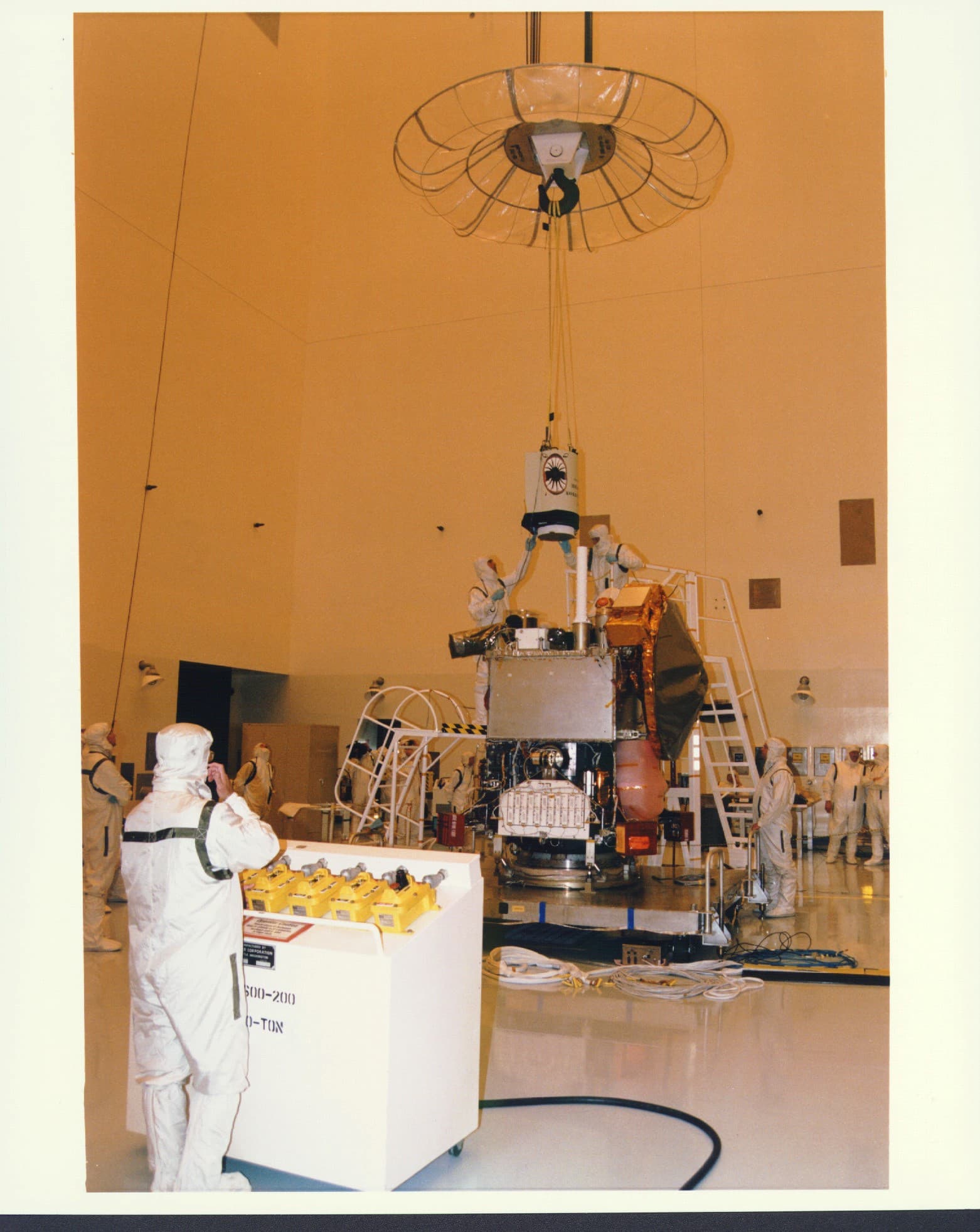
The Mars Surveyor Program was built out of a hole. On 22 August 1993, less than three days before it was due to enter orbit, Mars Observer stopped answering, and the United States lost an entire Mars science payload and, with it, the mission that was to have carried American instruments back to Mars for the first time since Viking. In 1994 NASA created a programme to fly the same science again in small pieces: a spacecraft at every launch opportunity, roughly every 26 months, for a decade. Two features defined it. The first was a single industrial partner, Lockheed Martin Astronautics of Denver, chosen to build and operate every Mars Surveyor spacecraft in order to save money. The second was the Mars Surveyor Operations Project at JPL, a standing office that would fly them all rather than a fresh operations team per mission. Both were sensible economies and both were later examined by review boards. The programme also inherited a doctrine it did not invent. Faster, Better, Cheaper came from a speech Daniel Goldin gave to JPL employees on 28 May 1992, two months into his tenure as Administrator, asking how NASA could do everything better, faster and cheaper without compromising safety. Mars Surveyor became the place where that question was answered most literally, and where the answer was tested to destruction.
For its first three years it worked. Mars Global Surveyor launched on 7 November 1996 and went on to map the planet until 2006, and it did so partly because it inherited hardware spares and software from Mars Observer, which the review team counted as a significant advantage. Then the ground shifted. In August 1996 a team announced possible fossil microbes in the meteorite ALH84001, and Mars stopped being a specialist interest. In the same year NASA Headquarters delegated programme management to the field centres, so JPL absorbed functions Headquarters had previously performed and lost its single point of contact in Washington. New requirements arrived, including robotic work tied to the long-term needs of human exploration, run by a different part of Headquarters entirely. The first architecture, drawn in the autumn of 1995, had been modest landers and orbiters on small launch vehicles with sample return somewhere over the horizon. The second, drawn in the summer of 1998, promised Martian samples on Earth by 2008. The Mars Program Independent Assessment Team later put it plainly: complexity and requirements grew, the projects were never integrated at programme level, they operated as independent entities, and oversight of them was ineffective. Meanwhile the number of flight projects at JPL had gone from two large ones to more than a dozen small ones in about three years, staffed by capable but inexperienced managers with almost no mentoring.
The 1998 window is where the arithmetic caught up. NASA's own press kit prices Mars Climate Orbiter and Mars Polar Lander together at 193.1 million dollars of spacecraft development plus 42.8 million of operations, 235.9 million for both, before launch vehicles. The review team's judgement on that number is blunt: the project attempted to deliver two spacecraft for the price of a Pathfinder, and once shared development and operations are accounted for, it was underfunded by at least thirty percent. Their diagram of the project is a box in which schedule, cost, science and launch vehicle are all fixed and the margins are inadequate, leaving risk as the only variable, which meant project management was left managing excessive risk. The orbiter was lost on 23 September 1999 because a ground file reported thruster impulse in the wrong units. The lander was lost on 3 December 1999, probably because a magnetic sensor twitched when the legs deployed and the software remembered it, and nobody can be certain because the project had decided not to spend money on descent telemetry. Ten weeks separated the two. The Mars Climate Orbiter board was still at work, and two more reviews would begin within weeks.
What came out of the reviews was not the abolition of Faster, Better, Cheaper. Having found no established definition of it, the assessment team wrote one, endorsed the concept if properly applied, and noted that none of the failures it studied had been caused by new technology. What it condemned was execution: money and staffing set below what the stated requirements needed, a programme office without the standing to balance risk across projects, and a JPL organisation in which the Mars Surveyor 2001 project office sat three levels down among 68 units of equal rank. On 28 March 2000 the reports were presented at NASA Headquarters, Ed Weiler said NASA had found the boundary and was stepping back from it, Daniel Goldin said not one employee would be fired, and NASA confirmed that the 2001 lander was cancelled and on hold indefinitely. Its orbiter went ahead, was renamed 2001 Mars Odyssey and launched on 7 April 2001. On 26 October 2000, release 00-171 announced the Mars Exploration Program with a Mars Program Director at Headquarters, twin rovers for 2003, a reconnaissance orbiter for 2005, a competitively selected Scout line, and a slogan, follow the water, that outlasted everything else. The Surveyor name went away. Its last orbiter was still working when NASA updated the mission page on 22 June 2026, and its last lander reached Mars in 2008 under a different name.
Mission facts
What it was, in NASA's own words
"In 1994, NASA created a program to send spacecraft to the planet during each launch opportunity every 26 months over the next decade. The first spacecraft under the program, Mars Global Surveyor, was launched in 1996 and is currently in orbit at the planet." That is the description NASA published in its own December 1998 press kit, shortly before Mars Climate Orbiter left Earth.↗
Why it existed
Mars Observer, launched 25 September 1992, was lost just before Mars arrival on 22 August 1993 UTC (still 21 August in Pasadena), taking its whole science payload with it. The Surveyor programme was assembled to fly that science again in pieces. The same 1998 press kit records that between them Mars Global Surveyor and Mars Climate Orbiter carried all but one instrument of the entire Mars Observer suite, and that Mars Climate Orbiter's radiometer was a copy of the Mars Observer sounder.↗
One contractor, one operations office
"In order to save costs, a single industrial partner, Lockheed Martin Astronautics, was chosen to build and operate all of the Mars Surveyor spacecraft over several years. In addition, an ongoing project office called the Mars Surveyor Operations Project was created at JPL, consolidating management of mission operations across the multi-year program." Both decisions were later examined by the review boards.↗
Faster, Better, Cheaper
The doctrine predates the programme. The Mars Program Independent Assessment Team traces it to a speech Daniel S. Goldin gave to JPL employees on 28 May 1992, about two months after he became NASA Administrator, and prints the line on a chart: "...tell us how we can implement our missions in a more cost-effective manner. How can we do everything better, faster, cheaper, without compromising safety?" The team notes that safety, in that context, means mission success.↗
Who managed it, and when that changed
JPL created a Mars Program Office in 1994, reporting directly to the Laboratory Director. In 1996 the NASA Administrator moved programme management responsibility from Headquarters to the field centres, and JPL replaced the office with a Mars Exploration Directorate. After Mars Climate Orbiter and Mars Polar Lander launched, that directorate was folded into the much larger Space and Earth Sciences Programs Directorate, where the review team found the Mars Surveyor 2001 project office sitting at the third level, alongside 68 other units of equivalent rank.↗
Three architectures in five years
Architecture 1, defined in the autumn of 1995, was a series of modest landers and orbiters on small launch vehicles, with sample return only as an out-year possibility. The announcement of possible fossils in the meteorite ALH84001 in August 1996 changed that. Architecture 2, undertaken in the summer of 1998, promised a Mars sample returned to Earth by 2008, largely through French participation. Architecture 3 was still being drafted when the review team reported in March 2000.↗
What actually flew
Four spacecraft. Mars Global Surveyor, launched 7 November 1996, which mapped Mars into 2006. Mars Climate Orbiter, launched 11 December 1998, lost at Mars orbit insertion on 23 September 1999. Mars Polar Lander, launched 3 January 1999, lost during descent on 3 December 1999. And the Mars Surveyor 2001 Orbiter, renamed 2001 Mars Odyssey before launch on 7 April 2001. A fifth spacecraft, the Mars Surveyor 2001 Lander, was built and cancelled.↗
The money
NASA's own 1998 press kit prices the two-spacecraft Mars Surveyor '98 project at 193.1 million dollars for spacecraft development and 42.8 million for mission operations, "total $235.9 million for both orbiter and lander (not including launch vehicles or Deep Space 2)." That is one figure covering an orbiter and a lander, which is why single-mission dollar figures quoted for either of them are unreliable.↗
The underfunding finding
"In effect, the Mars '98 project attempted to deliver two spacecraft for the price of a Pathfinder. If efficiencies from shared development and operations are factored in, it appears that the Mars '98 project was underfunded by at least 30 percent." The Mars Program Independent Assessment Team, 14 March 2000. Its accompanying chart compares development cost only, in 1999 dollars, excluding launch and operations, and shows Mars Climate Orbiter and Mars Polar Lander each below Mars Pathfinder's bar.↗
The overconstrained box
The review team drew Mars Surveyor '98 as a box with schedule, cost, science and launch vehicle all fixed and margins inadequate. "The only remaining variable was risk. Accordingly, project management was faced with managing excessive risk." It also found that the number of flight projects at JPL had gone from two large ones to more than a dozen small ones in about three years, filled by capable but inexperienced project managers with little mentoring.↗
Four reports
The Mars Climate Orbiter Mishap Investigation Board Phase I report, 10 November 1999. The same board's report on project management in NASA, 13 March 2000. The Mars Program Independent Assessment Team report, 14 March 2000, chaired by Thomas Young with Kurt Lindstrom as executive secretary. And the Report on the Loss of the Mars Polar Lander and Deep Space 2 Missions, chaired by John Casani, 22 March 2000. The second was released on 13 March 2000, and the last two were made public together at a NASA Headquarters news conference on 28 March 2000.↗
What the review team did NOT say
It did not condemn Faster, Better, Cheaper. Having found no established definition, it wrote one, then concluded that FBC "was reviewed extensively by the MPIAT and found to be an effective concept for guiding program implementation, if properly applied" and "should continue to be the approach utilized in the future Mars Program." It also recorded that of the missions studied, none of the failures was the result of new technology.↗
What was said out loud
At the 28 March 2000 news conference, NASA Associate Administrator Ed Weiler said of the two 1999 spacecraft: "They both failed. We found the boundary," and "We found the boundary and we're stepping back from that boundary." Administrator Daniel Goldin said "Not one employee is going to be fired." CBS News reported the same day that NASA had said the 2001 lander was cancelled and on hold indefinitely.↗
What replaced it
NASA release 00-171, 26 October 2000, announced a Mars Exploration Program developed over the preceding six months: 2001 Mars Odyssey, twin rovers in 2003, a reconnaissance orbiter in 2005, a mobile science laboratory and a first competitively selected Scout mission from 2007, and sample return launches proposed for 2014 and 2016. Scott Hubbard had been installed as Mars Program Director at NASA Headquarters, a post the reviews had demanded. Weiler's phrase in the release was "follow the water."↗
What survived it
The programme's last flown spacecraft outlived the programme by a quarter of a century. NASA's Odyssey mission page, last updated 22 June 2026, describes the orbiter as an active mission still studying clouds, fog and frost and mapping surface rocks. Its cancelled sibling, the Mars Surveyor 2001 lander, reached Mars in 2008 as Phoenix.↗
Mission timeline
- 22 Aug 1993Mars Observer, launched on 25 September 1992, is lost just before Mars arrival (21 August in California). The United States has no working Mars spacecraft and no Mars programme.
- 1994NASA creates the Mars Surveyor Program to send spacecraft at every 26-month launch opportunity for a decade, with Lockheed Martin Astronautics as sole builder. JPL creates a Mars Program Office reporting directly to the Laboratory Director.
- Autumn 1995Architecture 1 is defined: modest landers and orbiters on small launch vehicles, with sample return only as a distant possibility outside the planning horizon.
- Aug 1996The ALH84001 meteorite announcement lifts public interest in Mars sharply and brings a wave of new requirements, including robotic work tied to the long-term needs of human exploration, managed by a different part of NASA Headquarters. The same year, programme management authority moves from Headquarters to the field centres.
- 7 Nov 1996Mars Global Surveyor launches, the first spacecraft of the programme, and goes on to map Mars for a decade.
- Summer 1998Architecture 2 responds to the demand for an accelerated sample return, promising Martian samples on Earth by 2008 with substantial French participation.
- 11 Dec 1998 and 3 Jan 1999Mars Climate Orbiter and Mars Polar Lander launch three weeks apart, two spacecraft built for 235.9 million dollars together excluding launch vehicles.
- 23 Sep 1999Mars Climate Orbiter is lost at orbit insertion, after a ground software file reported thruster impulse in pound-force seconds instead of the specified newton-seconds.
- 3 Dec 1999Mars Polar Lander enters the atmosphere carrying no descent telemetry, by project decision, and is never heard from again. The probable cause is a spurious touchdown signal latched at leg deployment.
- 14 Mar 2000The Mars Program Independent Assessment Team delivers its final report to the NASA Administrator, having begun work in early January 2000 and run fact-finding trips to JPL, Lockheed Martin Astronautics in Denver and NASA Headquarters between 11 January and 9 February. It records that NASA has already decided not to fly the Mars '01 lander in 2001 and concurs.
- 28 Mar 2000The reports are presented at NASA Headquarters. Weiler says NASA found the boundary and is stepping back from it; Goldin says nobody will be fired; CBS News reports that NASA said that day the 2001 lander has been cancelled and is on hold indefinitely.
- 26 Oct 2000NASA release 00-171 announces the Mars Exploration Program: Odyssey in 2001, twin rovers in 2003, a reconnaissance orbiter in 2005, a mobile laboratory and the first Scout from 2007, sample return proposed for 2014 and 2016. The Mars Surveyor Program is over.
A filled dot marks something that physically happened. A hollow one marks an announcement, a naming or a target.
In pictures
Tap a photo to enlarge.
Sources
- NASA 1998 Mars Missions Press Kit, December 1998
- Mars Program Independent Assessment Team Report, 14 March 2000 (the Young report), NASA NTRS scan
- Mars Climate Orbiter Mishap Investigation Board Phase I Report, 10 November 1999
- Report on Project Management in NASA by the Mars Climate Orbiter Mishap Investigation Board (Phase II), 13 March 2000
- Report on the Loss of the Mars Polar Lander and Deep Space 2 Missions, JPL Special Review Board (D-18709), 22 March 2000
- NASA Release 00-171, 26 October 2000: NASA Outlines Mars Exploration Program for Next Two Decades (archived NSSDC text copy)
- JPL news page for the same 26 October 2000 announcement
- JPL news release, 12 May 2000: NASA Identifies Two Options for 2003 Mars Missions; Decision in July
- CBS News, 28 March 2000: Mars Lander Reports Rip NASA
- JPL Universe, 4 August 2000 and 18 August 2000 issues
- Keith Cowing, Astrobiology.com, 29 October 2000: A Year of Mars News
- NASA science mission page for 2001 Mars Odyssey, last updated 22 June 2026
- Mars Observer Mission Failure Investigation Board Report, Volume I (Coffey Board), December 1993
- NASA Release 00-46, 28 March 2000: Mars Program Assessment Report Outlines Route to Success (NSSDC text copy)
- NASA Release 00-37, 13 March 2000: Administrator Praises Work of Review Teams (archived KSC copy)
- NASA Note to Editors N00-9, 24 March 2000: Briefing on Report of Mars Program Independent Assessment Team Scheduled (archived KSC copy)
- NASA science mission page for Mars Global Surveyor, last updated 2 November 2024
- NSSDCA Master Catalog: 2001 Mars Odyssey (2001-013A), archived 20 July 2025
- NASA and JPL, Phoenix Landing press kit, May 2008
Facts on this page were verified on 24 September 2026. Where sources disagree, the disagreement is stated rather than resolved silently.