Mars Observer
NASA · United States · Orbiter · 1993 · The losing decadeFailure
Lost on 22 August 1993 during a planned fourteen-minute radio blackout, 68 hours short of Mars orbit insertion. The failure board found no smoking gun, and whether the spacecraft reached orbit is still unknown.
TL;DR· 14 min read
Mars Observer was America's first launch to Mars in seventeen years, and it died off the air on 22 August 1993, during a planned fourteen-minute radio blackout 68 hours short of orbit insertion. With no telemetry, the NASA failure board could only eliminate candidates: it named a rupture on the pressurisation side of the propulsion system as the most probable cause and never found a smoking gun. Whether the $813 million spacecraft reached Mars orbit is still unknown, yet almost every instrument it carried was rebuilt and flown again.
Mars Observer was America's first launch to Mars in seventeen years, and it went silent fourteen minutes before anyone would have noticed. The mission's flight rules called for the transmitter to be turned off while pyrotechnic valves pressurised the propellant tanks for orbit insertion, so when the spacecraft died on 22 August 1993 it died off the air. There is no telemetry from the failure at all. A NASA board spent four months eliminating scenarios and concluded, without proof, that nitrogen tetroxide had probably been seeping past two check valves for eleven months and met the fuel when the tanks were pressurised.
- 68 hoursfrom the last telemetry to the scheduled orbit insertion burn
- 14 minof planned radio silence that never ended
- $813mtotal mission cost, with no Mars data returned
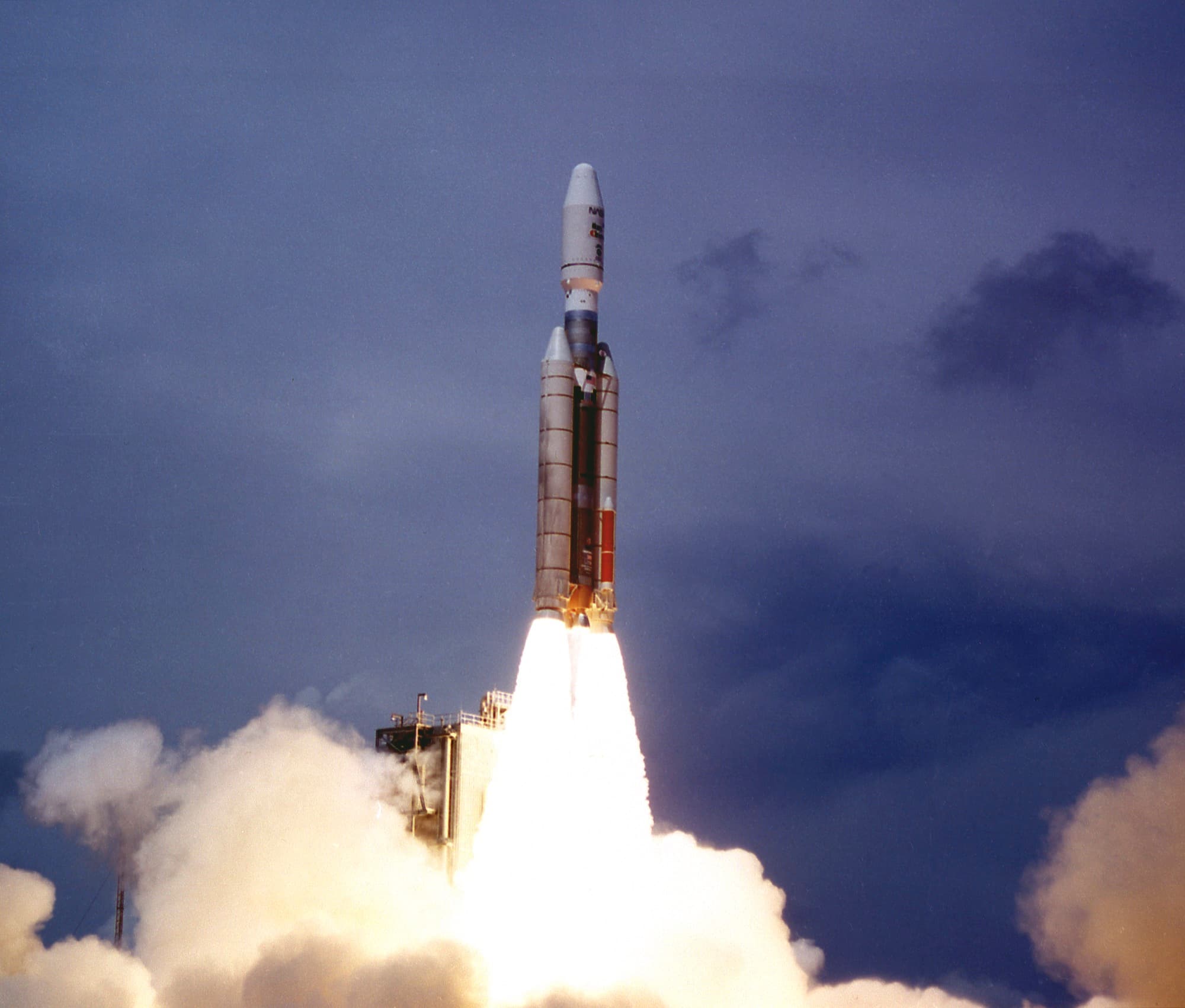
Mars Observer was supposed to be the cheap one. Between 1981 and 1983 the Solar System Exploration Committee of the NASA Advisory Council proposed it as the Mars Geoscience/Climatology Orbiter, the first of a series of planetary missions that would buy their science by adapting proven Earth-orbit satellite buses instead of designing new spacecraft from scratch. Approval came for a fiscal year 1985 start. JPL managed the project and picked a bus derived from the Defense Meteorological Satellite Program and the Satcom K commercial communications satellites, built by RCA Astro-Electronics, a company that became General Electric Astro-Space and then Martin Marietta Astro Space while the spacecraft was still being assembled. Over eight years of development the plan came apart in slow motion. Funding was cut, the payload was redefined more than once, the follow-on missions were cancelled, and the launcher moved from the Space Shuttle to a Titan III. The failure board's own summary of the net effect is blunt: the schedule stretched by two years, the launch vehicle changed, and the cost roughly doubled. NSSDCA puts the final total at $813 million. What actually flew on 25 September 1992 was still a serious machine, carrying a camera, a laser altimeter, a thermal emission spectrometer, a gamma ray spectrometer, an infrared radiometer, a magnetometer and electron reflectometer, a radio science investigation and a French-built relay meant to talk to a Russian lander. It was also the first American launch to Mars since Viking, seventeen years earlier.
The cruise was almost boring, which is the highest compliment available in deep space. Only three of the four planned trajectory correction manoeuvres were needed to hit the aim point. The one recurring problem was the inertial reference flight software, which faulted eleven times, five of them badly enough to drop the spacecraft into Contingency Mode; in every case the redundancy management software did its job, turning the solar array to the Sun and switching telemetry to the low gain antenna, and a July 1993 patch to the star identification code was expected to close the matter. On 4 August 1993 JPL began loading the Mars orbit insertion sequence, and the last parameters went up on 20 August. Insertion was a set of seven manoeuvres, the first of them on 24 August, and it started by pressurising the propellant tanks with helium admitted through two pyrotechnic valves. Because the pyro shock might damage the travelling wave tubes in the radio, the mission's flight rules called for the transmitter and power amplifier to be switched off for the ten minutes of the pressurisation block. Add four minutes for the tubes to warm back up and the plan was a fourteen minute silence, something already done several times in flight. The transmitter went off at 00:21 UTC on 22 August. Telemetry stopped on cue at 00:40 UTC. At 00:54 UTC it did not come back, and because the radio was off there is no telemetry at all from the moment the spacecraft died.
Daniel Goldin appointed Timothy Coffey of the Naval Research Laboratory to chair a failure board on 10 September 1993. Without telemetry the board could not find a fault, only eliminate candidates. It built roughly sixty failure scenarios across six subsystems and ran them through four filters: could the failure kill the downlink immediately, could it be something other than a random event (the failure had to land inside one specific fourteen minute window), could it silence the spacecraft for days rather than seconds, and could it be tied to the pressurisation sequence, which contained commands being executed for the first time in the mission. Whatever survived was then tested. The board's first principal conclusion states plainly that it never found a smoking gun. By elimination it named the most probable cause as a massive failure of the pressurisation side of the propulsion system, most probably because nitrogen tetroxide and monomethyl hydrazine mixed in the titanium pressurisation tubing. The proposed mechanism is quietly horrifying in its smallness. The oxidiser tank was isolated by two check valves in series, and for much of the cruise the plumbing beyond them was cold. JPL tests on identical valves, extrapolated across eleven months, suggested one to two grams of oxidiser could migrate through with no valve failure whatever. The board then calculated that burning less than a tenth of a gram of it against the fuel would release enough energy to melt a centimetre of the tubing.
The board's other two conclusions were about people rather than hardware. It judged the spacecraft design generally sound and the organisation that produced it not: the system had failed to react to a programme that had changed radically from the one originally envisioned, and far too much weight had been placed on heritage. Its list of specific concerns names the trap directly, calling out unjustified reliance on check valves with only Earth-orbital heritage for a job that demanded flawless leak-proof performance for eleven months in the cold and in free fall, and noting that propulsion redundancy had been removed after the switch from the Shuttle to the Titan. It also refused to eliminate three other candidates: a short circuit on the regulated power bus, a regulator failure rupturing a tank, and a NASA Standard Initiator ejected from a pyro valve like a bullet. Attempts that September to detect the Mars Balloon Relay's independent beacon with volunteered radio telescopes in the United States and Britain failed, and only while the report was being written did anyone realise the relay cannot be switched on in Safe Mode, which controllers had already commanded. So the fate of Mars Observer is genuinely unknown. Its stored sequence may have fired the engine on 24 August and placed a dead spacecraft in Mars orbit, or it may have sailed past into an orbit around the Sun. Nothing has ever been identified.
What followed was the Mars Surveyor Program: smaller spacecraft, launched at every 26-month opportunity, on cheaper rockets, with the explicit intention that no single failure could ever again cost a decade and $813 million. Mars Global Surveyor was the first of them, and it was in the most literal sense Mars Observer rebuilt. Its camera was the actual flight spare manufactured for Mars Observer. Its laser altimeter, thermal emission spectrometer and magnetometer were rebuilds of Mars Observer designs by the same principal investigators. The Gamma Ray Spectrometer went to 2001 Mars Odyssey, again under William Boynton. The infrared radiometer went to Mars Climate Orbiter, which was itself lost in 1999, and its lineage continued to the Mars Climate Sounder still flying on Mars Reconnaissance Orbiter. That is the strange afterlife of this mission. Nothing Mars Observer carried ever saw Mars, and yet almost every instrument on it eventually did, in a second copy, on someone else's spacecraft. The laser altimeter is the clearest case. Rebuilt as MOLA and flown on Mars Global Surveyor, it produced the global height model that the Mars globe on this site is displaced from, pixel by pixel. The map you are looking at exists because a mission that failed had a spare parts list.
Mission facts
Launch
25 September 1992 at 17:05:01 UTC, on a Commercial Titan III with a Transfer Orbit Stage upper stage, from Cape Canaveral Air Force Station, Florida. Both vehicles performed, although the failure board notes an unexpected transient caused by a fuel depletion shutdown of the Titan first stage.↗
Programme origin
Recommended by the Solar System Exploration Committee of the NASA Advisory Council between 1981 and 1983 as the Mars Geoscience/Climatology Orbiter, the first of a planned Observer series that would buy planetary science cheaply by adapting proven Earth-orbit satellite buses. Programme start was approved for fiscal year 1985.↗
The bus
Derived from the Defense Meteorological Satellite Program and Satcom K designs and built by RCA Astro-Electronics, which became General Electric Astro-Space and then Martin Marietta Astro Space during the spacecraft's construction. Rectangular module 2.1 by 1.5 by 1.1 m, six-panel solar array 7.0 by 3.7 m fully deployed, two 43 amp-hour nickel-cadmium batteries, 1,147 W nominal power. Only four solar panels were deployed in cruise, to limit power production near the Sun.↗
Cost
$813 million total, including development, construction, launch and ground support (NSSDCA). The failure board records that external changes to the programme stretched the schedule by two years, moved the launch from the Space Shuttle to a Titan III, and increased the cost by a factor of two.↗
Mass
Sources disagree and we went with the primary engineering document. The JPL mass summary reproduced in the failure board report gives a final launch configuration of 1,124.5 kg dry plus 1,440.5 kg of propellants and pressurants, for a total injected mass of 2,565.0 kg, against a 2,155.0 kg proposed initial figure. NSSDCA lists a bare 1,018 kg, and Wikipedia gives 1,018 kg plus 1,346 kg of propellant. Neither reconciles with the JPL table.↗
Propellant loading
About 60 days before launch the oxidiser tank was filled with 838.4 kg of nitrogen tetroxide and the fuel tank with 512.06 kg of monomethyl hydrazine, both then pressurised with helium. At launch the oxidiser tank read 250.8 psia and the fuel tank 257.9 psia. The separate monopropellant hydrazine system was loaded with 93 lb in each of its two half-system branches, about 84 kg in all.↗
Payload
156.6 kg of instruments at launch: the Mars Observer Camera (Michael Malin), Mars Observer Laser Altimeter (David E. Smith), Thermal Emission Spectrometer (Philip Christensen), Pressure Modulator Infrared Radiometer (Daniel McCleese), Gamma Ray Spectrometer (William Boynton), Magnetometer/Electron Reflectometer (Mario Acuna) and a radio science investigation (G. Leonard Tyler), plus the French-built Mars Balloon Relay (Jacques Blamont) intended to talk to the Russian Mars 94 mission.↗
Mission plan
Insertion on 24 August 1993, then roughly four months of orbit trimming to a near-circular Sun-synchronous polar mapping orbit, then one Martian year (687 days) of mapping. The five primary objectives were global elemental and mineralogical mapping, global topography and gravity, the nature of the magnetic field, the seasonal cycle of volatiles and dust, and atmospheric structure and circulation.↗
Cruise
Roughly eleven months, and almost uneventful. Only three of the four planned trajectory correction manoeuvres were needed to hit the insertion aim point. The one recurring fault was in the inertial reference flight software, which misbehaved on eleven separate occasions, five of them serious enough to put the spacecraft into Contingency Mode. In every case the redundancy management software responded correctly. A July 1993 patch to the star identification code was expected to close the problem out.↗
Why the radio was off
The insertion sequence began with a Propulsion System Pressurisation Block that fired two normally closed pyrotechnic valves to admit high pressure helium to the oxidiser and fuel tanks. The project feared the pyro shock might damage the travelling wave tube amplifiers, so the mission's published flight rules had the transponder and RF power amplifier commanded off for ten minutes, with about four minutes of tube warm-up afterwards. A fourteen minute gap in telemetry was expected and had happened several times before in flight.↗
Loss of signal
The transmitter went off at 00:21 UTC spacecraft time on 22 August 1993. Telemetry ceased on schedule at the Deep Space Network at 00:40 UTC ground receipt time and did not reappear at the scheduled 00:54 UTC. One-way light time was about 19 minutes. Within minutes the DSN reconfigured: Goldstone's 34 m antenna began spectral signal processing at about 01:10 UTC, Canberra's 70 m came on line at about 02:00 UTC. Nothing was ever heard again.↗
Most probable cause
A massive failure of the pressurisation side of the propulsion system, most probably the unintended mixing of nitrogen tetroxide and monomethyl hydrazine in the titanium pressurisation tubing, enabled by nitrogen tetroxide migrating through two series check valves during the eleven-month cruise. JPL tests on identical valves, extrapolated to eleven months, indicated one to two grams could migrate with no valve failure at all. The board calculated that burning less than a tenth of a gram of oxidiser would release enough energy to melt a centimetre of the 3/8 inch, 0.015 inch wall Ti-3Al-2.5V tubing.↗
Causes not eliminated
The board explicitly could not rule out three others: an electrical power system failure from a regulated power bus short circuit; a regulator failure over-pressurising and rupturing a propellant tank; and a NASA Standard Initiator ejected at high velocity from a pyro valve, puncturing the fuel tank or wrecking something else. British Aerospace had seen initiators strip valve body threads on similar units.↗
The beacon that could not answer
In September 1993 the board asked for attempts to switch on the small beacon transmitter inside the Mars Balloon Relay, which was electrically independent of the spacecraft's own radio. Radio astronomy groups in the United States and Britain volunteered telescopes. Nothing was detected. It emerged only while the report was being written that the relay cannot be activated when the spacecraft is in Safe Mode, and controllers had already commanded Safe Mode, so the tests proved nothing.↗
Fate
Unknown, and still unknown. The insertion sequence was already loaded and designed to run without ground contact, so the spacecraft may have put itself into Mars orbit, or may have flown past into a heliocentric orbit. No hardware has ever been identified. NSSDCA's entry says as much in plain words.↗
Where the instruments went
Every investigation was eventually rebuilt. Mars Global Surveyor carried the camera (its flight spare), a rebuilt laser altimeter, the thermal emission spectrometer, the magnetometer and electron reflectometer, radio science and a relay antenna. The Gamma Ray Spectrometer flew again on 2001 Mars Odyssey under the same principal investigator, William Boynton. The Pressure Modulator Infrared Radiometer was rebuilt for Mars Climate Orbiter, lost in 1999, and its design line continued to the Mars Climate Sounder on Mars Reconnaissance Orbiter.↗
Mission timeline
- 25 Sep 199217:05:01 UTC: Launch on a Commercial Titan III with a Transfer Orbit Stage from Cape Canaveral. The Titan first stage suffers a fuel depletion shutdown transient, but both vehicles deliver.
- 4 Aug 1993JPL begins loading the Mars orbit insertion command series into the spacecraft controls processor.
- 20 Aug 1993The last commands and final manoeuvre parameters go into the spacecraft controls processor.
- 22 Aug 199300:21 UTC spacecraft time (17:21 PDT on 21 August in Pasadena): the stored sequence switches off the transponder and RF power amplifier for ten minutes so that pyrotechnic valves can pressurise the propellant tanks without shocking the travelling wave tubes.
- 22 Aug 199300:40 UTC: telemetry stops at the Deep Space Network exactly on schedule. This is the last data ever received from Mars Observer.
- 22 Aug 199300:54 UTC: the scheduled reacquisition time passes in silence. Goldstone starts spectral signal processing at about 01:10 UTC and Canberra's 70 m dish joins at about 02:00 UTC. Commands go up every 20 minutes ordering the spacecraft onto its low gain antenna.
- 24 Aug 1993The stored sequence should have fired the main engine for the first of seven orbit insertion manoeuvres, 68 hours after pressurisation. Whether it did has never been established.
- 10 Sep 1993NASA Administrator Daniel Goldin formally appoints the Mars Observer Mission Failure Investigation Board under Timothy P. Coffey of the Naval Research Laboratory. Briefings from JPL and Martin Marietta Astro Space begin on 8 September.
- Sep 1993Attempts to raise the Mars Balloon Relay's independent beacon using radio telescopes in the United States and Britain fail. Only later does the board learn that the relay cannot be switched on in Safe Mode, which controllers had already commanded.
- 5 Jan 1994The board presents its final report to Goldin. Most probable cause: a massive failure of the pressurisation side of the propulsion system. No smoking gun.
- 7 Nov 1996Mars Global Surveyor launches carrying the Mars Observer Camera's flight spare and rebuilt copies of the laser altimeter, thermal emission spectrometer and magnetometer.
- 12 Sep 1997Mars Global Surveyor enters Mars orbit and starts doing the job Mars Observer was built for, four years late and at roughly a quarter of the cost.
A filled dot marks something that physically happened. A hollow one marks an announcement, a naming or a target.
In pictures
Tap a photo to enlarge.
Sources
- NSSDCA Master Catalog: Mars Observer (1992-063A)
- NSSDCA: launch and trajectory information for Mars Observer
- Mars Observer Mission Failure Investigation Board Report, Volume I (Coffey Board), December 1993
- NSSDCA archive: NASA and JPL statements on the loss of Mars Observer, August 1993 onward
- NSSDCA Experiment: Mars Observer Laser Altimeter (1992-063A-04)
- AIP FYI (1994): Final Report Issued on Mars Observer Loss
- JPL: Mars Observer mission page
- NSSDCA Experiment: Mars Global Surveyor Mars Orbiter Camera (1996-062A-01)
- NSSDCA Experiment: 2001 Mars Odyssey Gamma-Ray Spectrometer (2001-013A-02)
- Wikipedia: Mars Observer
Facts on this page were verified on 23 August 2026. Where sources disagree, the disagreement is stated rather than resolved silently.