The Mars networks that were never built
NASA, ESA, CNES · Multinational · Program · 1991 · The losing decadeCancelled
No network of small stations has ever landed on Mars. At least five were designed in detail between 1991 and 2004, MESUR, INTERMARSNET, NetLander, Pascal and MetNet, and every one was cancelled for money.
TL;DR· 14 min read
No network of small stations has ever been landed on Mars. Between 1991 and 2004 at least five were designed in detail: MESUR, INTERMARSNET, NetLander, Pascal and MetNet. Every one was stopped for money, and never because the science was found wanting. The cost shows in InSight, the single geophysical station that did arrive: it detected 2,769 candidate seismic events and only 42 of them could be reliably located.
Every landed Mars mission so far has been a single point. That is a problem, because several of the biggest questions about Mars, where marsquakes happen, how deep the crust is, how the atmosphere moves as a whole, cannot be answered from one point at all. The fix has been obvious since the 1970s: land several small stations at once, spread them across the planet and let them measure the same things simultaneously. Between 1991 and 2004 that idea was designed in detail at least five times, in the United States, at ESA, in France and in Finland. Every one of those designs was cancelled, and the reason was never that the science was wrong.
- 16small stations in MESUR, the 1991 proposal that set the pattern
- 4identical NetLander stations, the design that got furthest into development
- 42of 2,769 candidate seismic events InSight could reliably locate, working alone
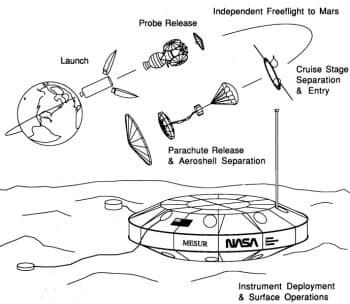
The case for a Mars network has never really been argued against. A seismometer sitting alone can hear a marsquake but has enormous difficulty saying where it happened, because locating a source normally requires the same event to be timed at three or four separate places. A single weather station tells you the weather at one spot and nothing about how the atmosphere circulates. A single heat-flow probe tells you about one patch of crust. All of these are network measurements by nature, and the idea of answering them with a swarm of cheap stations rather than one expensive lander goes back to the Viking era. The first modern version was the Mars Environmental Survey, initiated at NASA Ames Research Center with detailed design carried out at JPL from proposals dating to 1991. MESUR was to put sixteen small stations across every latitude and longitude of Mars, each with a seismometer, a full meteorology package, a soil spectrometer with a miniature rover to place it, a thermal analyser, a gas chromatograph and cameras, backed by an orbiter that would sound the atmosphere and relay the roughly 100 megabits a day each station would generate. JPL's 1993 description states the goal as establishing a global network of small science stations operating concurrently over at least one Martian year. The published schedules disagree in detail, English Wikipedia describing launches from 1996 through 2003 within a billion-dollar cap and the 2024 review describing five launches across three windows, and we have found no primary document that settles which was the real plan.
What survived of MESUR was the demonstrator. The landing system was novel enough to need proving in flight, so MESUR Pathfinder was carved off in 1993, and when Mars Observer was lost that August the network behind it was shelved and Pathfinder was moved into the Discovery programme, launching on 4 December 1996 and landing on 4 July 1997. The 2024 review of distributed instruments describes the mechanism bluntly: the complexity of a lander asked to carry every instrument at once collided with funding constraints, a single lander was approved instead, and the seismometer was dropped. That is the pattern the whole story repeats. Europe went next. ESA's Mars Exploration Study Team had already proposed a mission built around a network of small landers in its report Mission to Mars, and from 1994 to 1996 ESA carried INTERMARSNET through a Phase A study: an orbiter and four landers doing atmospheric, surface and seismic science from widely separated sites, each lander carrying an Instrument Deployment Device, in practice a small rover that walked instruments onto soil and rock. INTERMARSNET was not selected. Europe's first Mars mission was Mars Express, a single orbiter carrying a single small lander, and the lander, Beagle 2, was lost.
The design that got furthest into development was French. NetLander was four identical stations run by CNES with a consortium of France, Finland, Germany and Belgium formed in 1999, and its Phase B payload was selected in April 2000: nine instruments including a seismometer under Philippe Lognonne at the Institut de Physique du Globe de Paris, a DLR panoramic camera, a Finnish atmospheric package, ground-penetrating radar, a magnetometer and a microphone contributed by Berkeley and the Planetary Society. Each probe would enter at 66 kg and leave a 22 kg surface station on the ground with 5.2 kg of instruments, protected by a 0.9 m heat shield, a parachute derived from Huygens and airbags derived from Mars 96, opening petals that would carry its solar arrays and right it if it landed upside down. They would fly on Mars Premier, a CNES orbiter for the 2007 window whose two stated objectives were to release the four NetLanders and act as their relay, and to demonstrate the Mars Sample Return rendezvous in Martian orbit with a capture payload supplied by NASA. The programme was real enough to have a model philosophy: CNES's development plan of 15 January 2002 schedules one NetLander structural model and three mass mock-ups for orbiter structural testing, three functional models in January 2005 and cruise flight structures in May 2006.
None of it was cut. It was abandoned in pieces. Aerocapture had already been given up before that January 2002 plan was written. French accounts record that CNES dropped the PREMIER orbiter during 2002, that efforts to rehouse the four landers on NASA's Mars Telecommunications Orbiter and then on ESA's ExoMars both came to nothing, that CNES would not commit the 88 million euros the mission still needed, and that France withdrew from independent Mars missions in 2003. The Planetary Society published the formal ending on 15 June 2004, attributing it to funding difficulties within CNES. Around the same window two other networks failed in the same way. Pascal, proposed to Discovery by Robert Haberle of NASA Ames with French and American co-investigators, would have scattered 24 tiny weather stations reporting pressure, temperature and optical depth every hour for two Martian years, with an option running to ten; it was never selected. MetNet, led by the Finnish Meteorological Institute with Russian and Spanish partners, replaced rigid heat shields and parachutes with an inflatable decelerator, got two flight-capable entry systems built and tested by September 2013, and still had no launch vehicle or launch date as of 2016.
The cost of all this is measurable. InSight, the one geophysical station that did reach Mars, detected 2,769 candidate seismic events with an instrument far better than anything MESUR or NetLander would have carried, and only 42 of those events could be reliably located, because there was nothing to triangulate against. The 2023 to 2032 planetary decadal survey again asks explicitly for geophysical networks on the Moon and Mars. The nearest anyone has come to flying one remains Russia's Mars 96, which carried two small autonomous stations and two penetrators, launched on 16 November 1996 at 20:48:53 UTC, and fell back into Earth's atmosphere about five hours later when its upper stage failed. What kills network missions is not the science and not usually the engineering. It is that a network is a single programme that must buy four or sixteen of everything before it returns anything at all, which makes it expensive up front and easy to descope to one, and a network descoped to one is not a network. The 2024 review argues the arithmetic has changed, that miniaturised sensors, modern radios and better power systems have made small landers cheap enough that the old objection no longer holds. That argument has been made before.
Mission facts
The problem a network solves
A single seismometer can only locate an event by measuring arrival times and wave polarisation extremely precisely, and it mostly fails. The 2024 review by Vaquero, Nesnas and colleagues records that InSight's SEIS instrument detected 2,769 potential seismic events and that only 42 of them were reliably located. Three seismometers allow triangulation, and four are preferable.↗
MESUR
Mars Environmental Survey. Initiated at NASA Ames Research Center with the detailed design carried out at JPL, from proposals dating to 1991. The stated goal, in the words of the 1993 JPL description, was to "establish a global network of small science stations on the surface of Mars to operate concurrently over a minimum of one martian year."↗
MESUR as planned
Sixteen landers spread over all latitudes and longitudes, each carrying a seismometer, a meteorology package (pressure, wind, temperature, sky radiometer, humidity), an alpha proton X-ray spectrometer with a mini rover to place it, a thermal analyser, a gas chromatograph and a descent and surface imager, plus an orbiter for atmospheric sounding and relay. Data volume was estimated at about 100 Mbit per node per day, driven by the seismometer.↗
MESUR's schedule and cost, as published
English Wikipedia gives launches beginning 1996, four landers in 1999, four more in 2001 and the remaining eight in 2003, a ten-year programme costing about one billion dollars with annual spending capped at 150 million in FY1994 dollars. The 2024 review instead describes the network as being established over five launches and three launch windows. We have not found a primary NASA document that reconciles the two, and treat both as reported plans rather than settled fact.↗
How far MESUR got
Far enough to spawn a flight mission and no further. The landing system was radical enough to need a flight demonstration, so MESUR Pathfinder was split off; work on it formally began in 1993. After Mars Observer was lost in August 1993 the wider MESUR network was shelved and Pathfinder was moved into the Discovery programme. It launched on 4 December 1996 and landed on 4 July 1997. Nothing else in MESUR was built.↗
The descoping, in one sentence
The 2024 review puts it plainly: "given the complexity of each lander module targeting a plethora of science objectives, funding constraints led to the approval of a single lander," which that paper names Surface Lander Investigation of Mars (SLIM), after which the focus shifted to Mars Pathfinder and the seismometer was removed from the mission. We have not seen the SLIM designation in any other source.↗
Europe's first network study
ESA's Mars Exploration Study Team proposed "a mission based on a network of small landers" in its report Mission to Mars, ESA SP-1117. That report is the ancestor of everything Europe later studied for the Martian surface.↗
INTERMARSNET
Studied by ESA at Phase A level in the period 1994 to 1996. ESA's own description: it "would have consisted of an orbiter and four landers to perform atmospheric, surface science and seismic studies from a network of widely-spaced locations on Mars." Each lander carried an Instrument Deployment Device, in effect a small rover that carried instruments to soil and rocks. It was not selected, and ESA's first Mars mission was instead the single orbiter Mars Express.↗
NetLander
Four identical landers, led by CNES with a consortium of France, Finland, Germany and Belgium established in 1999. Nine instruments were selected for Phase B in April 2000: SEIS (seismometer, Philippe Lognonne, IPGP), ATMIS (atmosphere, A. M. Harri, FMI), PANCAM (camera, R. Jaumann, DLR), ARES-ELF (atmospheric electricity), NEIGE (geodesy and ionosphere), SPICE (soil properties, T. Spohn), GPR (ground-penetrating radar), MAGNET (magnetometer) and a microphone from the University of California, Berkeley and the Planetary Society.↗
NetLander hardware
Entry mass 66 kg per probe. After landing and ejection of the entry, descent and landing system, the surface module massed 22 kg, of which 5.2 kg was science. French sources describe a 58 cm diameter cylinder with a 0.9 m heat shield, a parachute derived from Huygens and airbags derived from Mars 96, with solar arrays on unfolding petals, one of which doubled as a self-righting mechanism. The surface mission was to last more than one Martian year.↗
The carrier: Mars Premier
CNES's 2007 orbiter, to launch on Ariane 5. Its stated objectives in the January 2002 development plan were "to carry and release the four NetLander probes and then support them as a telemetry relay" and "to demonstrate the Mars Sample Return rendez-vous in Martian orbit." NASA was to supply the Rendezvous Sample Capture payload, the ELECTRA UHF package and the NEIGE experiment. Aerocapture had already been abandoned by the time that document was written.↗
How far NetLander got
Into detailed design with a model philosophy and delivery dates, but not into flight hardware. The CNES plan of 15 January 2002 lists a structural and thermal orbiter model carrying one NetLander structural model plus three mass mock-ups, three NetLander functional models due January 2005, and NetLander cruise structure flight models due May 2006, against an orbiter flight model delivery in September 2007. None of that was built.↗
How NetLander died
In stages. French sources record that CNES abandoned the PREMIER orbiter in 2002, that attempts to move the landers onto NASA's Mars Telecommunications Orbiter and onto ESA's ExoMars both failed, that CNES declined to invest the 88 million euros required, and that France withdrew from independent Martian missions in 2003. The Planetary Society announced the formal end on 15 June 2004: "Due to funding difficulties within the French space agency, CNES, the Netlander mission has been officially canceled."↗
Pascal
A Discovery-class climate network proposed by Robert Haberle of NASA Ames with David Catling, Eric Chassefiere, Francois Forget, Frederic Hourdin and Conway Leovy. Twenty-four small weather stations returning hourly pressure, temperature and optical depth for two Martian years, with an extended option taking the total to ten Martian years, and a carrier spacecraft dropping into an elliptical orbit to act as relay and imaging platform. Presented at the Concepts and Approaches for Mars Exploration workshop in July 2000. Never selected.↗
MetNet
A Finnish Meteorological Institute-led network of impact landers with Russian and Spanish partners, using inflatable entry and descent systems instead of rigid heat shields and parachutes: 22.2 kg entry mass, 4 kg payload, 1.8 m inflated diameter. Two flight-capable entry, descent and landing systems had been built and tested by September 2013, but no launch vehicle or launch date had been established as of 2016. French accounts describe MetNet as NetLander's direct descendant.↗
The closest anyone came
Russia's Mars 96 carried "two small autonomous stations, landing on the surface of Mars" and "two penetrators (impact penetrating probes)" among a 550 kg science payload on a 6,825 kg spacecraft. It launched on 16 November 1996 at 20:48:53 UTC, its upper stage failed to send it towards Mars, and it re-entered Earth's atmosphere about five hours after launch. Russian sources note that the exact cause could not be established because no telemetry was taken during that phase of flight.↗
Mission timeline
- 1991The Mars Environmental Survey is proposed, initiated at NASA Ames Research Center with detailed design at JPL: sixteen small stations, all latitudes and longitudes, operating together for at least one Martian year.
- 27 Apr 1993JPL circulates a description of the MESUR Network and Pathfinder missions, stating the goal as a global network of small science stations operating concurrently over at least one Martian year. Work on the Pathfinder demonstrator has formally begun.
- Aug 1993Mars Observer is lost. The MESUR network is shelved and Pathfinder, the technology demonstrator built to prove its landing system, is transferred into the Discovery programme and survives as a single lander.
- 1994 to 1996ESA studies INTERMARSNET at Phase A: an orbiter and four landers, each with a small instrument-carrying rover. It is not selected, and Europe's first Mars mission becomes the single orbiter Mars Express.
- 16 Nov 199620:48:53 UTC: Mars 96 launches carrying two small autonomous stations and two penetrators. The upper stage fails, and the spacecraft re-enters Earth's atmosphere about five hours later.
- 1999A NetLander consortium of France, Finland, Germany and Belgium is established under CNES leadership, aiming at a 2005 launch for four identical geophysical stations.
- Apr 2000The NetLander Phase B payload is selected: nine instruments including the SEIS seismometer under Philippe Lognonne at IPGP, a DLR panoramic camera, a Finnish atmospheric package, ground-penetrating radar and a Berkeley and Planetary Society microphone.
- Jul 2000Pascal, a 24-station Mars climate network, is presented at the Concepts and Approaches for Mars Exploration workshop as a Discovery proposal. It is never selected.
- 15 Jan 2002CNES issues the Mars Premier 2007 Orbiter Preliminary Development Plan. It schedules NetLander structural, functional and flight models from January 2005 to May 2006, names NASA as supplier of the sample-capture payload and the ELECTRA relay radio, and records that aerocapture has already been abandoned.
- 2002 to 2003CNES abandons the PREMIER orbiter, efforts to rehouse the landers on NASA's Mars Telecommunications Orbiter and on ESA's ExoMars fail, CNES declines to commit the 88 million euros needed, and France steps back from independent Martian missions.
- 15 Jun 2004The Planetary Society reports NetLander officially cancelled for funding difficulties within CNES, and with it the second chance for the Mars Microphone.
- Jul 2024A review of distributed planetary instruments asks in print why no distributed instrument has ever flown on a planetary mission, and answers with the InSight numbers: 2,769 candidate seismic events detected, 42 reliably located.
A filled dot marks something that physically happened. A hollow one marks an announcement, a naming or a target.
In pictures
Tap a photo to enlarge.
Sources
- V. Vaquero, I. Nesnas and colleagues, Distributed Instruments for Planetary Surface Science: Scientific Opportunities and Technology Feasibility, arXiv:2407.01757v1 (1 July 2024)
- NASA NTRS record 20210004403: J. McNamee, The Mars Environmental Survey (MESUR) Network and Pathfinder Missions, JPL, 27 April 1993
- English Wikipedia: MESUR
- ESA: Robotics for Mars Missions
- ESA: Mars Express, International collaboration
- J. L. Counil, O. Marsal, F. Rocard, Ph. Lognonne, A. M. Harri and the NETLANDER Team, The NetLander Mission: A Geophysical Network on the Mars Surface, Concepts and Approaches for Mars Exploration (LPI, 2000), abstract 6055
- CNES, Mars Premier 2007 Orbiter Preliminary Development Plan, MARS-ON-MSRO-063-CNES, edition 1, 15 January 2002
- French Wikipedia: NetLander
- The Planetary Society (15 June 2004): Netlander Mission Cancelled
- NASA NTRS record 20010023118: R. M. Haberle, D. C. Catling, E. Chassefiere, F. Forget, F. Hourdin and C. B. Leovy, The Pascal Discovery Mission: A Mars Climate Network Mission (July 2000)
- English Wikipedia: MetNet
- Russian Wikipedia: Mars-96
Facts on this page were verified on 24 August 2026. Where sources disagree, the disagreement is stated rather than resolved silently.