Space Exploration Initiative: the Mars element
White House and NASA (United States) · United States · Program · 1989 · The losing decadeCancelled
Politically dead within eleven months of President George H. W. Bush announcing it on 20 July 1989: the House Appropriations Committee deleted every SEI budget line on 26 June 1990. No Mars hardware was ever built.
TL;DR· 17 min read
President George H. W. Bush announced the Space Exploration Initiative on 20 July 1989, and it was politically dead within eleven months. NASA answered with the 90-Day Study, which offered five reference approaches, no recommendation and no published cost total, though its internal cost work reached $541 billion for Reference Approach A. On 26 June 1990 the House Appropriations Committee deleted $329 million of SEI lines. No SEI Mars hardware was ever built.
The Space Exploration Initiative is the standing case study in how a presidential order to go to Mars dies. Bush announced it on the twentieth anniversary of Apollo 11. NASA answered with a ninety-day study that offered five ways to do the same enormous thing and no cheap way to do any of it. A cost figure escaped, Congress deleted the money within a year, and the Mars half of the initiative never got past viewgraphs.
- $541bncost of the 90-Day Study's Reference Approach A over FY1991 to 2025, per NASA's published history
- 11 monthsfrom Bush's announcement to the House deleting every SEI budget line
- 0pieces of SEI Mars flight hardware ever built
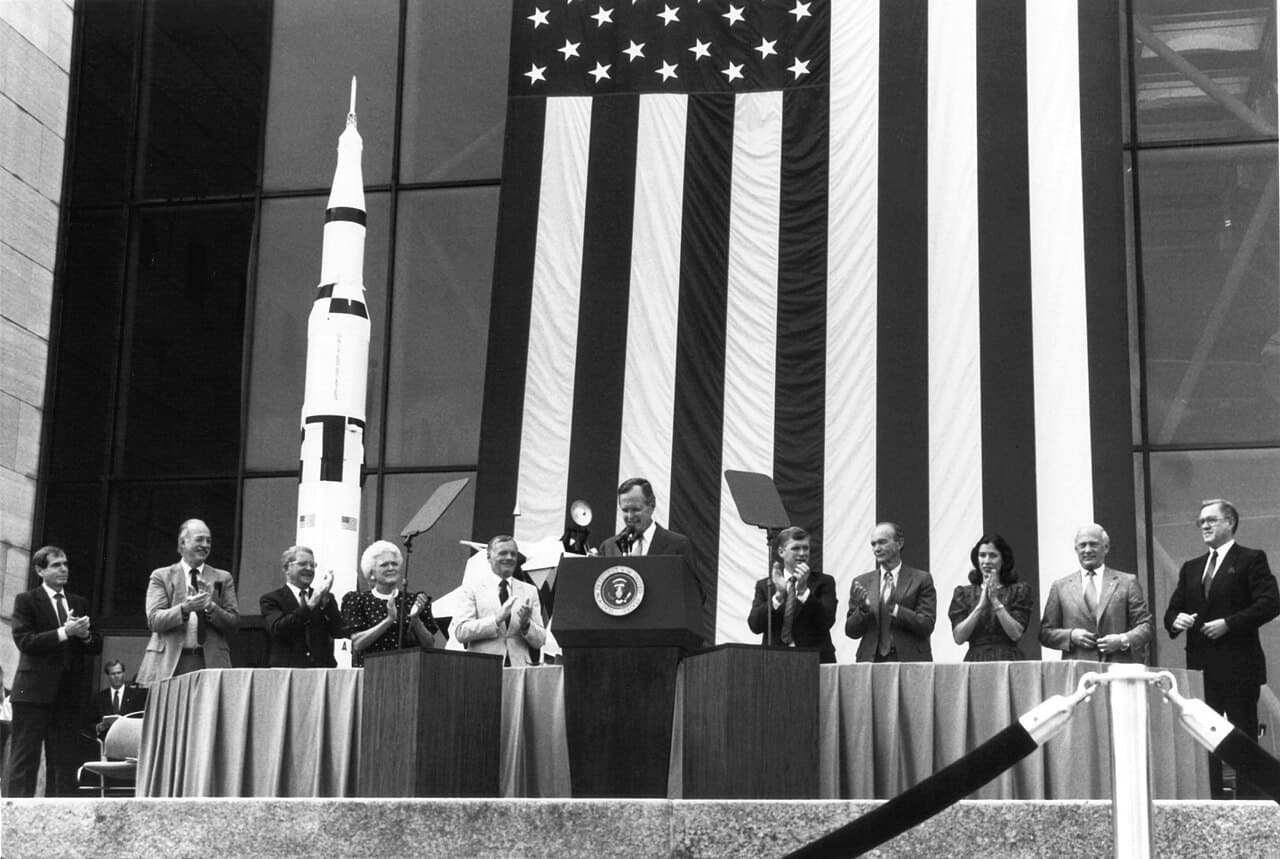
President George H. W. Bush announced the Space Exploration Initiative on the steps of the National Air and Space Museum on 20 July 1989, twenty years to the day after Apollo 11 landed, with Armstrong, Aldrin and Collins behind him. It had three parts: finish Space Station Freedom, return to the Moon, "back to the Moon; back to the future. And this time, back to stay", and then "a journey into tomorrow, a journey to another planet: a manned mission to Mars." No date for Mars was given that day. The date arrived eleven months later, on 20 June 1990 at Marshall Space Flight Center, when Bush said that "before Apollo celebrates the 50th anniversary of its landing on the Moon, the American flag should be planted on Mars", which meant 2019. Inside NASA the effort was called the Human Exploration Initiative, and the Mars half of it was never a mission in any sense a mission is normally meant. There was no project cutting metal, no contractor building a flight article, no engineering model of anything. There was a task force, five reference approaches, a set of charts and a 159-page report. Understanding that is the point of reading about SEI at all: it is a story about a study, and the study is what killed it.
Administrator Richard Truly set the study up within days of the speech and put Johnson Space Center's director, Aaron Cohen, in charge. The report that came back, Report of the 90-Day Study on Human Exploration of the Moon and Mars, is dated only "November, 1989" on its cover and is signed by Cohen in a transmittal letter to Truly. It sets out five reference approaches, all variations on one architecture: a lunar outpost first, then Mars, with crews of four riding a transfer vehicle assembled and fuelled at Space Station Freedom, aerobraking into Mars orbit, and flying either 500-day round trips with surface stays up to 100 days or 1,000-day round trips with stays of about 600 days. On the study's own charts Reference Approach A dated the first crewed Mars landing to 2016 and the first 600-day stay to 2018, Approach B pulled the landing forward to 2011, and Approach E kept 2016 but pushed a permanent outpost to 2027. None of it was ever built. What the published report does not contain is a price. A one-page NASA summary bound into the scanned document says so in two flat sentences: "The report does not contain any specific recommendations." and "The report does not contain any estimates of total mission cost." Yet a number is the only thing most people remember about the 90-Day Study, and there are at least four of them in circulation.
Those four figures measure different things. Before the speech, NASA's Ad Hoc Working Group briefed the White House on an approach costing about $400 billion over thirty years; Dwayne Day's account gives the split as $172.9 billion for the Mars element and $209.46 billion for the lunar base with a fifty per cent reserve folded in, and says the number leaked as soon as Bush finished speaking. Douglas O'Handley recalled to Thor Hogan an earlier internal range of $85 billion to $365 billion depending on how much redundancy was bought. The 90-Day Study's own cost work, which Hogan read and summarised for NASA's published history, priced Reference Approach A at $541 billion and Reference Approach E at $471 billion in constant fiscal year 1991 dollars across 1991 to 2025, with reserves accounting for nearly 55 per cent of the totals, and showed NASA's annual budget climbing from about $15 billion to $30 billion by fiscal 2000 and staying there for twenty-five years. NASA's own history page and most secondary accounts round all of it to "$400 to $500 billion" or simply "$500 billion". None of these numbers appears in the 159 pages anyone can download. The distinction matters, because the popular telling has NASA publishing a half-trillion-dollar price tag. What actually happened is that NASA declined to publish one, briefed one privately, and lost control of it anyway.
Congress did not wait for anyone's second opinion. Hearings before the House appropriations subcommittee that funded NASA, chaired by Bob Traxler of Michigan, went badly in April 1990, and on 26 June 1990 the committee's report on the fiscal 1991 bill deleted every line associated with the initiative: $154 million from the Pathfinder technology programme, $45 million from the Civil Space Technology Initiative, $40 million from the Advanced Launch System, $37 million from exploration mission studies, $20 million from Space Station advanced programmes, $15 million from Lunar Observer, $10 million from a heavy-lift vehicle, $8 million from LifeSat and the centrifuge. Total $329 million. Traxler's explanation, as Hogan records it from a contemporary newspaper report, was four words: "We didn't have the money." In November 1990 the authorisers put back $21 million for exploration mission studies, which Hogan says was the only funding the initiative ever received. The Augustine committee reported on 10 December 1990 and kept Mars alive as a long-term goal on a go-as-you-pay basis while warning it should be dropped if the budget did not grow. Thomas Stafford's Synthesis Group delivered America at the Threshold in May 1991, with four architectures landing humans on Mars in 2014 or 2016 and a recommendation for nuclear thermal propulsion as "the only prudent propulsion system for Mars transit". It contained no cost estimates at all, which became the loudest criticism of it.
After that, SEI simply stopped being something anyone worked on. Truly was pushed out, submitting his resignation on 10 February 1992 after refusing twice, and Dan Goldin was sworn in on 1 April 1992 with a mandate to make things faster, better and cheaper. Bush lost the November election. The Clinton administration disbanded the National Space Council in 1993 and put space policy under Vice President Gore. In September 1996 the White House released the first full revision of national space policy since the Cold War, and it contained no mention of human exploration beyond Earth orbit at all. Nothing had been built: no SEI Mars flight hardware, no engineering model, no qualified component. What survived was the paperwork, and it survived better than the programme did. NASA's Johnson Space Center exploration office spent the mid-1990s turning the wreckage into the Mars Design Reference Mission, published in July 1997 as NASA Special Publication 6107, whose opening summary states that its architecture "builds on previous work, principally on the work of the Synthesis Group (1991) and Zubrin's (1991) concepts for the use of propellants derived from the martian atmosphere." The line of NASA human Mars design reference architectures that followed runs back to a study written after Congress had already refused to pay for the programme that prompted it. Asked for alternatives, NASA had produced a single architecture at three speeds. Mark Albrecht, executive secretary of the National Space Council, said the report offered "one plan offered three ways; slow, moderate, and fast", and said the Space Council staff felt betrayed by it. The lesson later Mars programmes keep quoting is not that Mars is expensive. It is that a study which gives a decision-maker no genuine choices is not a study, and that a cost figure you refuse to publish will be published for you.
Mission facts
The announcement
20 July 1989, at the National Air and Space Museum in Washington, on the twentieth anniversary of the Apollo 11 landing. Bush set out three steps: Space Station Freedom, then a return to the Moon ("Back to the Moon; back to the future. And this time, back to stay."), and then "a journey into tomorrow, a journey to another planet: a manned mission to Mars." No date for Mars appears in the speech. Dates in this entry are the dates of record in Washington; where a clock time is given it is UTC and is marked as such.↗
Where 2019 came from
Not from the 1989 speech. Bush first attached a date to the Mars landing on 20 June 1990, speaking to employees at the George C. Marshall Space Flight Center in Huntsville: "Before Apollo celebrates the 50th anniversary of its landing on the Moon, the American flag should be planted on Mars." That is 2019. The Synthesis Group's 1991 report refers to it directly as "the President's goal of a landing by 2019".↗
Two names for one thing
The White House called it the Space Exploration Initiative. NASA's own documents of the period call it the Human Exploration Initiative, and the 90-Day Study is titled and written entirely in those terms. Both names refer to the same programme.↗
The 90-Day Study
Report of the 90-Day Study on Human Exploration of the Moon and Mars, 159 pages, commissioned by Administrator Richard Truly and led by Johnson Space Center director Aaron Cohen, who signed the transmittal letter to Truly. The cover carries only "November, 1989". The NASA Headquarters summary sheet bound into the scanned copy is headed "For Release: November 20, 1989", which matches the date English Wikipedia gives; the same sheet carries a Headquarters fax header dated 28 November 1989. NASA's history page dates nothing to 29 November except a briefing: "On November 29, 1989, Truly briefed the National Space Council's Blue Ribbon Panel on the resulting '90-Day Study.'" Publication and briefing are different events, and accounts giving 29 November as the publication date appear to conflate them.↗
What the released report says about cost
Nothing. A one-page NASA summary bound into the scanned report states it twice over: "The report does not contain any specific recommendations." and "The report does not contain any estimates of total mission cost." A word search of the 159-page document finds no programme dollar totals. Its Chapter 9, "Resource Assessment", is about people and facilities; it names no costs.↗
The cost figures, and what each one measures
Four numbers circulate and they are not the same number. (1) About $400 billion over thirty years: the Ad Hoc Working Group estimate briefed to Vice President Quayle in June 1989, before the speech, which Dwayne Day breaks down as $172.9 billion for the Mars element and $209.46 billion for the lunar base with a 50 per cent reserve included, and which leaked immediately after the announcement. (2) $85 billion to $365 billion: an earlier internal range recalled by Douglas O'Handley to Thor Hogan, the low end carrying a lot of risk and the high end buying redundancy. (3) $541 billion for Reference Approach A and $471 billion for Reference Approach E: the 90-Day Study's own cost work in constant FY1991 dollars across FY1991 to 2025, read and reported by Hogan in NASA's published history, with reserves at nearly 55 per cent of the totals. (4) "$400 to $500 billion" or "$500 billion": the rounded figure used by NASA's own history page and most secondary accounts. None of these appears in the document NASA released.↗
What it would have done to NASA's budget
The study's charts, as Hogan describes them, took NASA from a base of roughly $15 billion a year to $30 billion by fiscal 2000 and held it there for another twenty-five years. The Ad Hoc Working Group's pre-announcement briefing had already told the White House that the agency's budget would need to grow ten per cent a year to $25 to $30 billion, a doubling.↗
The five reference approaches
All five are variations on one architecture: a lunar outpost first, Mars second. Nothing in any of them was built, and the dates below are milestones on the study's own charts rather than events. Reference Approach A scheduled the first human Mars landing for 2016, with a 30-day surface stay and the first 600-day visit in 2018. Approach B pulled the landing forward to 2011 and the extended stay to 2014, at the price of running lunar and Mars development in parallel. Approach C advanced lunar oxygen production to 2005 but left the Mars milestones unchanged. Approach D was Approach A with every milestone delayed by two to three years. Approach E reduced the lunar outpost to human-tended operation, kept the first Mars landing in 2016, planned three expeditions with surface stays up to 90 days, and delayed a permanent Mars outpost to 2027. The study made no recommendation among them.↗
The Mars flight plan, as designed
On paper only. A Mars transfer vehicle and a Mars excursion vehicle would have been assembled, checked out and fuelled at or near Space Station Freedom. On approach the two would separate and aerobrake into Mars orbit independently, rendezvous there, and a crew of four would transfer to the excursion vehicle and land on the same aerobrake. Return would be by ascent module to the transfer vehicle, then to the vicinity of Earth. Two trajectory classes were modelled: 500-day round trips with surface stays up to 100 days for the first flights, and 1,000-day round trips with roughly 600-day stays for outpost buildup. The propulsion was to be chemical. None of this hardware was ever built.↗
The robotic Mars precursors it assumed
Two Mars Site Reconnaissance orbiters, to be launched within a 20-day period and accompanied by two telecommunications relays, were to fly a near-polar one-day repeat orbit at 299 km and image 30 to 50 per cent of the planet, with high-resolution low-Sun-angle coverage of selected regions. Then a Mars Global Network, and up to five Mars Rover missions to certify landing and outpost sites, characterise resources and survey subsurface structure. Mars Observer, then still unlaunched, was to supply the first data set. None of these precursors was ever built to this plan.↗
How Congress killed it
On 26 June 1990 the House Appropriations Committee's report on the fiscal 1991 bill removed every new line associated with the initiative: Pathfinder technology programme $154 million, Civil Space Technology Initiative $45 million, Advanced Launch System $40 million, exploration mission studies $37 million, Space Station advanced programmes $20 million, Lunar Observer $15 million, heavy-lift vehicle $10 million, LifeSat and centrifuge $8 million. Total $329 million. Subcommittee chairman Bob Traxler of Michigan explained the cut in four words that Hogan records from a contemporary newspaper report: "We didn't have the money." The Senate authorisation bill, written by Al Gore, eliminated SEI funding too.↗
The only money it ever got
In mid-November 1990 the authorising committees put back $21 million for exploration mission studies, signed as Public Law 101-611 on 16 November 1990, to "seek innovative technologies that will make possible advanced human exploration initiatives". Hogan states flatly that this "would prove to be the only funding the initiative ever received". That is his characterisation, and we have not independently audited NASA's exploration budget lines for fiscal 1992 and 1993 against it.↗
The reviews
Three panels looked at the 90-Day Study. The National Research Council reviewed it and its alternatives for the National Space Council in a 1990 report, Human Exploration of Space: A Review of NASA's 90-Day Study and Alternatives. The Advisory Committee on the Future of the U.S. Space Program under Norman Augustine reported to the Space Council on 10 December 1990, ranking space science first and recommending a "Mission from Planet Earth" with Mars as its long-term goal on a go-as-you-pay basis, while warning that without ten per cent annual budget growth both Mission to Planet Earth and SEI should be scaled back or eliminated. The Synthesis Group followed in 1991.↗
The Synthesis Group
America at the Threshold, chaired by Lieutenant General Thomas P. Stafford, transmitted with a covering letter from the Vice President dated 6 May 1991 and released publicly in June. Four architectures: Mars Exploration, Science Emphasis for the Moon and Mars, The Moon to Stay and Mars Exploration, and Space Resource Utilization. Three put the first human Mars landing in 2014 and the fourth in 2016, all with a 30 to 100 day first stay and about 600 days thereafter. Recommendation 6: "The Synthesis Group has determined the only prudent propulsion system for Mars transit is the nuclear thermal rocket." Recommendation 5 asked for a launcher lifting at least 150 tonnes, growing to 250. The report contains no cost estimates, which was the loudest criticism of it.↗
How it ended
There is no single cancellation act. Richard Truly refused two requests to resign and finally submitted his resignation on 10 February 1992 after a meeting with Bush; Dan Goldin was sworn in on 1 April 1992. Bush lost the November 1992 election. The Clinton administration disbanded the National Space Council in 1993 and moved space policy under Vice President Gore. In September 1996 the White House released the first comprehensive revision of national space policy since the Cold War, and it contains no mention of human exploration beyond Earth orbit.↗
What it became
The architecture work did not die with the programme. NASA's Mars Exploration Study Team published Human Exploration of Mars: The Reference Mission in July 1997 as NASA Special Publication 6107, and its opening summary states that "The architecture for the Mars Reference Mission builds on previous work, principally on the work of the Synthesis Group (1991) and Zubrin's (1991) concepts for the use of propellants derived from the martian atmosphere." NASA's later human Mars design reference missions and architectures are revisions of that lineage.↗
Mission timeline
- 20 Jul 1989Bush announces the initiative at the National Air and Space Museum on the twentieth anniversary of Apollo 11: Space Station Freedom, "back to the Moon; back to the future", and "a journey into tomorrow, a journey to another planet: a manned mission to Mars." No Mars date is given. Truly stands up a task force within days.
- Nov 1989The 90-Day Study is delivered to Truly under Aaron Cohen's signature. Five reference approaches, no recommendation, and no published cost total. Behind closed doors the White House reaction is described by Mark Albrecht as feeling "completely betrayed".
- 1990The National Research Council publishes Human Exploration of Space: A Review of NASA's 90-Day Study and Alternatives for the National Space Council.
- Apr 1990Two days of hearings before the House appropriations subcommittee that funds NASA. Chairman Bob Traxler works through the SEI-related technology lines one by one. Hogan's reading of the transcript is that the committee had already decided to eliminate all of them.
- Jun 1990At the fourth Case for Mars conference, Martin Marietta engineers Robert Zubrin and David Baker present Mars Direct: no Space Station assembly, no orbital rendezvous, return propellant made from the Martian atmosphere, surface stays up to 555 days, and a claimed cost of $20 billion, about a twentieth of NASA's figure.
- 20 Jun 1990At Marshall Space Flight Center, Bush finally names a date: "Before Apollo celebrates the 50th anniversary of its landing on the Moon, the American flag should be planted on Mars." Six days later Congress takes the money away.
- 26 Jun 1990The House Appropriations Committee's report on the fiscal 1991 bill deletes $329 million across eight SEI-related lines and states that any future money should go to Shuttle and Station rather than the initiative. The Senate authorisation bill follows.
- 16 Nov 1990Public Law 101-611 authorises $21 million for exploration mission studies. Hogan records this as the only funding the initiative ever received.
- 10 Dec 1990Norman Augustine presents his committee's report to the Space Council. Mars survives as a long-term goal under a "Mission from Planet Earth" heading and a go-as-you-pay funding strategy, with the explicit warning that if the budget does not grow ten per cent a year, SEI should be scaled back or eliminated.
- 6 May 1991The Synthesis Group's America at the Threshold is transmitted to the White House, and released publicly in June. Four architectures, first human Mars landing in 2014 or 2016, nuclear thermal propulsion recommended for Mars transit, and no cost estimates anywhere in its 190 pages.
- 10 Feb 1992After refusing two earlier requests, Richard Truly is summoned to the Oval Office and agrees to resign, effective 1 April. Dan Goldin is sworn in on 1 April with a mandate for faster, better, cheaper robotic exploration.
- 19 Sep 1996The White House releases a revised National Space Policy containing no mention of human exploration beyond Earth orbit. The following day Clinton says a human Mars mission is too expensive and reaffirms a commitment to robotic probes instead.
A filled dot marks something that physically happened. A hollow one marks an announcement, a naming or a target.
In pictures
Tap a photo to enlarge.
Sources
- NASA: Report of the 90-Day Study on Human Exploration of the Moon and Mars (November 1989)
- Thor Hogan, Mars Wars: The Rise and Fall of the Space Exploration Initiative (NASA SP-2007-4410)
- Synthesis Group, America at the Threshold: America's Space Exploration Initiative (transmitted 6 May 1991, chaired by Lt Gen Thomas P. Stafford), 190pp
- NASA History: Space Exploration Initiative overview page
- The American Presidency Project: Remarks on the 20th Anniversary of the Apollo 11 Moon Landing, 20 July 1989
- The American Presidency Project: Remarks to Employees of the George C. Marshall Space Flight Center, 20 June 1990
- Dwayne A. Day, The Space Review (24 October 2022): Aiming for the Moon, crashing on Earth, part 1
- Dwayne A. Day, The Space Review: Aiming for the Moon, crashing on Earth, part 2
- National Research Council, Human Exploration of Space: A Review of NASA's 90-Day Study and Alternatives (1990), NTRS record
- S. J. Hoffman and D. I. Kaplan (eds), Human Exploration of Mars: The Reference Mission of the NASA Mars Exploration Study Team, NASA SP-6107, July 1997
- The Planetary Society: What Can We Learn from a Failed Return to the Moon
- English Wikipedia: Space Exploration Initiative
Facts on this page were verified on 24 August 2026. Where sources disagree, the disagreement is stated rather than resolved silently.