Phobos 1 and 2
USSR · Soviet Union · Orbiter · 1988 · The losing decadePartial
Both spacecraft died before the landings they were built for: Phobos 1 on 31 August 1988, killed by a single missing character in an uploaded command, and Phobos 2 on 27 March 1989, after 57 days in Mars orbit.
TL;DR· 15 min read
Both Soviet Phobos spacecraft died before the close approach and the landings they were built for. Phobos 1 stopped working on 31 August 1988 after an uploaded command with one character missing switched off its attitude and stabilisation system. Phobos 2 entered Mars orbit on 29 January 1989, worked 57 days and returned 37 images of Phobos, then fell silent on 27 March, eight days before it was to drop two landers, one of them a robot that moved by hopping. Nothing has ever landed on Phobos.
The Phobos project was the most ambitious thing Soviet planetary science ever attempted: two nearly identical spacecraft that would fly to Mars, spiral inward until they were skimming 50 metres above its inner moon, shoot the surface with a laser and an ion beam to read what it is made of, and then drop two small landers onto it, one of them a battery-powered robot that moved by hopping. Neither reached that point. Phobos 1 was lost in the cruise to Mars when an operator left one letter out of a routine command upload. Phobos 2 got there, worked for 57 days in Mars orbit, and died eight days before the landing.
- 1missing character in an uploaded command, and Phobos 1 was gone
- 57days Phobos 2 worked in Mars orbit before it fell silent
- 37images of Phobos returned, at resolutions down to about 40 m
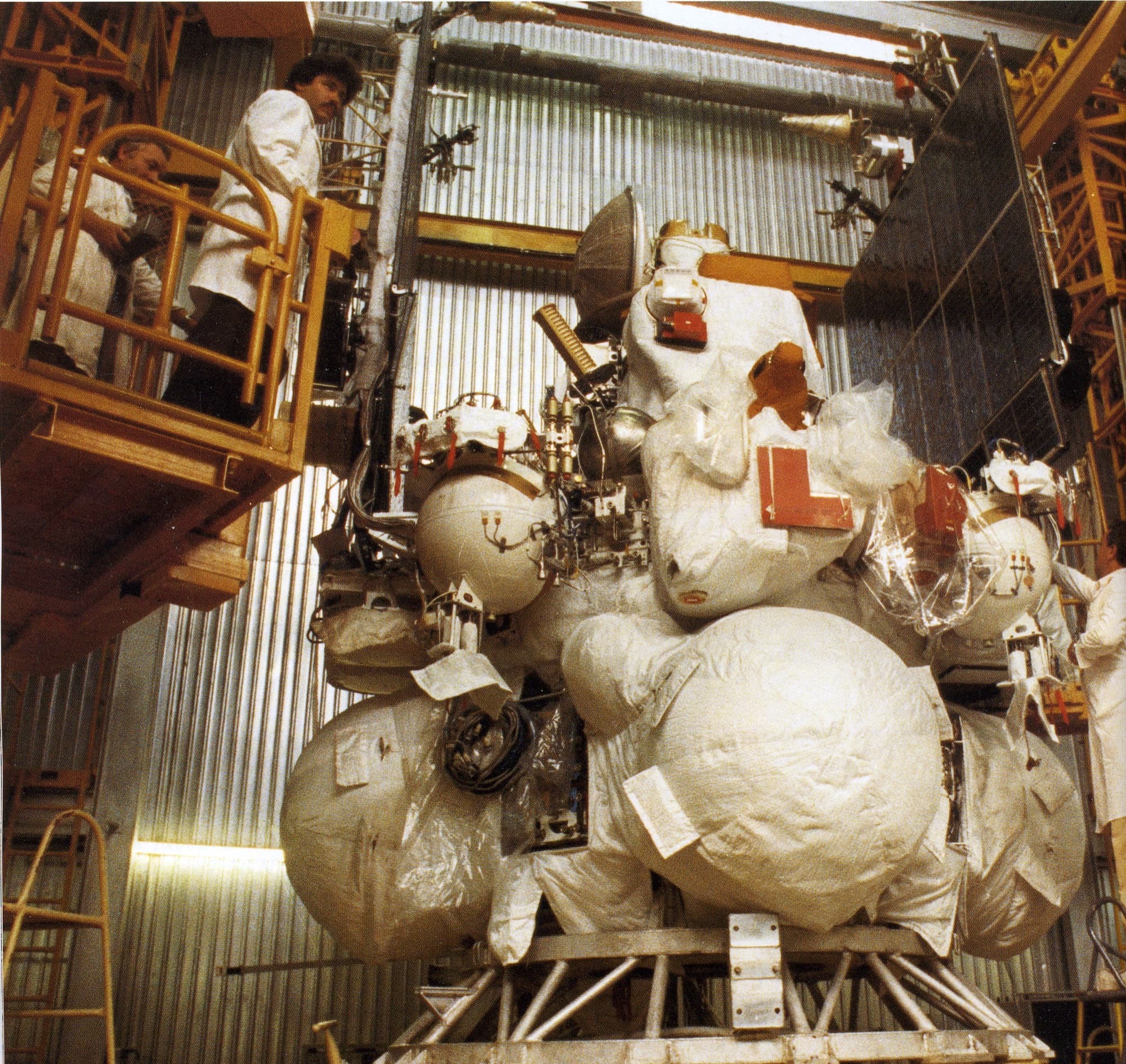
The Phobos project began as something much larger than the two spacecraft that eventually flew. A Central Committee and Council of Ministers decree of 8 May 1980 authorised an automatic complex designated 8K82K-F, and the technical specification finalised in early 1981, held today by the Russian state archive RGANTD and secret until recently, describes two 1F craft launching in 1984 to study Phobos from Mars orbit and from close range, followed in 1986 by two 2F craft that would bring pieces of the moon back to Earth on an 850-day return. The 2F half was abandoned in a 1985 revision and everything was concentrated on 1F. What survived was still extraordinary. The 1F bus was a new unified design nicknamed UMVL, for unified Mars, Venus, Luna, built around a pressurised toroidal instrument ring with a jettisonable propulsion unit slung underneath and a science bay on top. Its main engine, the S5.92, was later developed into the Fregat upper stage. The two spacecraft, 1F No. 101 and No. 102, launched five days apart in July 1988 carrying instruments from a dozen countries plus the European Space Agency: a French infrared spectrometer, a Swedish plasma analyser, an Irish particle detector, Bulgarian and East German contributions to the camera system. NASA supplied Deep Space Network tracking. The Soviet share of the bill came to 272 million roubles.
The endgame was the part nobody had tried. After months in Mars orbit the spacecraft was to be walked inward until it was flying over Phobos at a relative speed of two to five metres per second, roughly 50 metres up: not an orbit but a matched drift alongside, the spacecraft and the moon travelling together while Mars did the real gravitational work. From there two active experiments would attack the surface without touching it. LIMA-D would fire a half-joule laser pulse into a spot one millimetre across, vaporising the regolith, and catch the ions in a time-of-flight analyser. DION would inject a beam of krypton ions at two to three kiloelectronvolts and read the secondary ions knocked loose with a quadrupole. Then the landers would go down. DAS, the long-lived autonomous station, 67 kg with about 18 kg of instruments, rode on both spacecraft. On contact it would fire a harpoon penetrator into the ground to pin itself in place, because on a moon this small anything that lands can simply bounce back off, and then raise a platform on solar arrays for roughly a year of work: an alpha-backscatter and X-ray fluorescence spectrometer for surface chemistry, a television camera, a seismometer, the Razrez anchor penetrometer, and a Sun sensor named Stenopee to measure Phobos librating on its axis and finally settle when it will fall into Mars.
The other lander is the one people remember. PrOP-FP, carried only by Phobos 2, weighed 43 kg and is credited to VNIITransMash in Leningrad, the tank-research institute that had built the running gear for Lunokhod and the little skiing rover on Mars 3. It was a squat sphere that moved by hopping. Released from low altitude behind a stabiliser shaped like a shuttlecock, it would shed the stabiliser once it settled, unfold sprung whiskers to right itself support-side down, and then shove that support against the ground hard enough to throw itself perhaps 20 metres. Between hops it would measure: X-ray fluorescence for composition, a penetrometer and accelerometers for how hard the ground was, a magnetometer and a kappameter for magnetic susceptibility, a gravimeter, temperature sensors, a conductometer and a tilt sensor. It ran on batteries and was designed for up to ten hops over a few hours. It was designed thirty years before Japan's MINERVA-II rovers and the German and French MASCOT actually hopped across the asteroid Ryugu, and it never got to jump. Its engineering model sits in the museum at NPO Lavochkin. The name is transliterated inconsistently even in Russian: Lavochkin and Russian Wikipedia write PrOP-FP, other sources PrOP-F, and English catalogues usually render it PROP-F or simply 'the hopper'.
Phobos 1 died of one missing character. Yuri Markov, an engineer on the control team, wrote that on 25 August 1988 the gamma spectrometer team asked for their instrument to run about ten hours on 30 August, an entirely routine request. The operator writing the session program entered the address of a cell in the onboard timing system and left out a single letter. His supervisor checked the program and missed it. Nobody ran it against the mathematical model at the Yevpatoriya deep space centre or against Phobos-T, the engineering twin sitting powered up at the factory, because the task looked trivial. Uploaded on 29 August, the corrupted command did not turn into gibberish. It turned into a valid instruction to shut off the pneumatic attitude and stabilisation system. Roald Kremnev, who ran the Lavochkin plant, later explained to Science magazine why such a command existed at all: a steering test routine burned into read-only memory for ground checkout could not be erased without removing the computer from the spacecraft, and with launch close it had instead been sealed off in software, 'locked in a safe'. The typo found the key. The arrays drifted off the Sun, the batteries flattened, and the state commission later dated the moment the spacecraft stopped functioning to 31 August. Controllers called on the night of 1 to 2 September and heard nothing. The operator responsible found the bug himself, was not punished beyond being kept off the Phobos 2 shift teams, and the mission was formally abandoned on 3 November 1988.
Phobos 2 was already ailing when it arrived. On 1 November 1988 one of its two centimetre-band transmitters failed, and its computing complex kept shutting itself down, with one channel hanging repeatedly; Brian Harvey's history records that by Mars arrival two of the three computers were sick, which mattered because the design required two of them to agree before anything happened. It nevertheless entered orbit on 29 January 1989 at 12:55 UTC and spent 57 days working. It returned 37 images of Phobos from three passes, down to about 40 m per pixel and covering roughly 80 per cent of the moon; the Termoskan radiometer made four thermal and visible panoramas of the Martian equator at 1.8 km per pixel, the highest-resolution thermal data anyone had for Mars at the time; the French ISM spectrometer took 45,000 near-infrared spectra of the planet and 400 of Phobos; and ASPERA made the first direct measurement of ionospheric plasma escaping Mars into the solar wind, published in Nature that October. Then on 27 March, imaging on automatic with the transmitter off to save power, it failed to call home at 15:58 UTC. A weak tumbling carrier came and went between 17:51 and 18:03 UTC. The landings had been set for 4 to 5 April. Lavochkin engineers afterwards argued the approach had been too cautious and could have been made in mid-March, while the spacecraft still worked. The 1F bus flew again as Mars 96, which fell back to Earth; nothing has landed on Phobos to this day, and Fobos-Grunt, the next Russian attempt, never left Earth orbit in 2011.
Mission facts
Programme origin
Authorised by a joint Central Committee and Council of Ministers decree of 8 May 1980 (No. 379-115). The technical specification for the 8K82K-F complex was finalised in early 1981 and is held, formerly secret, by RGANTD, the Russian State Archive of Scientific and Technical Documentation. The original plan was two 1F craft in 1984 followed by two 2F sample-return craft in 1986; the 2F half was dropped in a 1985 revision.↗
Spacecraft
1F No. 101 (Phobos 1) and 1F No. 102 (Phobos 2), built by NPO imeni Lavochkina. A new unified bus, known internally as UMVL (unified Mars, Venus, Luna), built around a pressurised toroidal instrument torus with the Autonomous Propulsion Unit (ADU) below it and a cylindrical science bay above.↗
Launch, Phobos 1
7 July 1988, 17:38:04 UTC (20:38:04.306 Moscow decree time), Proton-K 8K82K with an 11S824F upper stage, Baikonur Site 200. Siddiqi's NASA chronology gives pad 39 for Phobos 1 and pad 40 for Phobos 2. The English Wikipedia infobox gives pad 40 for Phobos 1, which contradicts Siddiqi; the Phobos 2 infobox names no pad at all.↗
Launch, Phobos 2
12 July 1988, 17:01:43 UTC (20:01:43.185 Moscow decree time), same vehicle type, Baikonur Site 200. The launch time is Lantratov's, converted from Moscow decree time; the pad, 40, is Siddiqi's, as Lantratov names no pad.↗
Mass
Sources give three different figures for the same vehicle and all three are defensible. NSSDCA's project page gives 2,600 kg for the orbiter and 6,220 kg with the orbit-insertion hardware attached; Siddiqi lists 6,220 kg for both craft at launch; the archived Soviet technical specification quoted by RGANTD gives a launch mass of 5,500 kg for the 1F design. This entry uses 6,220 kg as the flown launch mass.↗
Propulsion
The Autonomous Propulsion Unit was jettisoned once the spacecraft reached its observation orbit. Its S5.92 engine was later developed into the Fregat upper stage. Attitude control used 28 thrusters (twenty-four of 50 N and four of 10 N) on four spherical hydrazine tanks, with a three-axis system pointed by Sun and star sensors.↗
International participation
Counts differ. Russian Wikipedia, citing the journal Priroda (No. 12, 1988), names twelve countries plus ESA; Siddiqi writes of 14 other nations and names twelve plus ESA. Named contributors include France (the ISM infrared spectrometer, built at IAS and DESPA with CNES support), Sweden (ASPERA, from the Swedish Institute of Space Physics), Ireland (the SLED particle detector led by Susan McKenna-Lawlor), Austria, Bulgaria, Czechoslovakia, Finland, Hungary, Poland, Switzerland, and both German states. NASA contributed Deep Space Network tracking.↗
Cost
272 million roubles to the Soviet Union and 60 million to the foreign participants, with the two 1F spacecraft themselves costing 51 million roubles. The figures come from G. M. Tamkovich in Zemlya i Vselennaya, 1989 No. 5.↗
How Phobos 1 was lost
A control program uploaded on 29 August 1988 was missing a single character. Instead of switching on the GS-14 gamma spectrometer it commanded the pneumatic attitude and stabilisation system off. The spacecraft lost Sun lock, its arrays stopped charging and the batteries drained. The 1989 state commission fixed the moment it stopped functioning at 31 August 1988; controllers only found out when the next scheduled session, on the night of 1 to 2 September, went unanswered. Attempts were formally abandoned on 3 November 1988.↗
Why the fatal command existed
Roald Kremnev, director of the Lavochkin plant, told Science magazine in September 1989 that a steering-test routine used in ground checkout had been burned into read-only memory and could not be erased without pulling the computer out of the spacecraft. With launch close, it was instead 'locked in a safe' by other software. The omitted character produced a valid instruction that unlocked it.↗
Mars orbit insertion, Phobos 2
29 January 1989 at 12:55 UTC (15:55 Moscow). First reported orbit 850 by 79,750 km, inclination 1.0 degrees, period 76.5 hours; refined afterwards to 819 by 81,214 km, inclination 1.5 degrees, period 77 hours.↗
Observation orbit
After a pericentre raise on 12 February 1989, Phobos 2 moved on 18 February to a near-circular orbit 6,280 km above Mars (a mean radius of about 9,670 km), inclination 0.5 degrees, period 8.0 hours, roughly 300 km above the orbit of Phobos itself. The Autonomous Propulsion Unit was jettisoned after this burn. Synchronising manoeuvres followed on 7, 15 and 21 March.↗
Imaging of Phobos
Three passes: 21 February 1989 from about 860 km, 28 February from about 320 km, and 25 March from about 191 km. Siddiqi dates the first pass 23 February. The VSK-Fregat team reported 37 TV images taken from ranges of 300 to 1,100 km at resolutions down to about 40 m, covering a large region west of the crater Stickney. Zemlya i Vselennaya (1989 No. 5) says 38 frames from 300 to 1,100 km, as do RGANTD and Russian Wikipedia after it; the PDS Small Bodies Node instrument catalogue says 'about 40'. Siddiqi and Brian Harvey both put the coverage at about 80 per cent of the moon.↗
The landers
DAS, the long-lived autonomous station (dolgozhivushchaya avtonomnaya stantsiya), 67 kg with about 18.1 kg of instruments, was carried on both spacecraft. PrOP-FP, the hopping mobility probe (pribor otsenki prokhodimosti, Fobos), 43 kg, was carried only on Phobos 2. It is attributed to VNIITransMash, the institute behind the Lunokhod running gear and the PrOP-M skis on Mars 3, on the strength of Russian secondary sources rather than a primary document.↗
How Phobos 2 was lost
On 27 March 1989 the spacecraft was imaging on automatic sequence with its transmitter off to save power. The signal due at 18:58 Moscow time (15:58 UTC) never came. A weak centimetre-band carrier was received from 20:51 to 21:03 Moscow (17:51 to 18:03 UTC); its character showed the spacecraft unstabilised and spinning. Recovery attempts were declared over on 14 April 1989 by Zemlya i Vselennaya and Siddiqi, and on 15 April by Lantratov and Russian Wikipedia.↗
Official cause
A state commission convened on 17 July 1989 under TsNIIMash director Yu. A. Mozzhorin, with IKI director A. A. Galeev and Lavochkin general designer V. M. Kovtunenko, found that the onboard digital computing complex halted, costing the spacecraft its orientation, but could not establish why. It listed four candidates: a fault in the onboard control complex, a brief voltage sag from the power system, brief interference on the power or control lines, and external effects (radiation, dust or meteoroid particles).↗
Mission timeline
- 7 Jul 1988Phobos 1 (1F No. 101) launches at 17:38:04 UTC on a Proton-K from Baikonur Site 200. A five-stage climb: three Proton stages, two burns of the 11S824F block, then the spacecraft's own propulsion unit finishes the job of throwing it at Mars.
- 12 Jul 1988Phobos 2 (1F No. 102) launches at 17:01:43 UTC from the neighbouring pad. It carries the extra payload its twin does not: the PrOP-FP hopper.
- 29 Aug 1988A control program is uploaded to Phobos 1 with one character missing. Rather than switching on the gamma spectrometer for a ten-hour run planned for 30 August, it shuts down the pneumatic attitude and stabilisation system. Nobody on the ground notices.
- 31 Aug 1988The date the 1989 state commission later fixed as the moment Phobos 1 stopped functioning. With no attitude control the solar arrays drifted off the Sun and the batteries ran flat.
- 1 to 2 Sep 1988Controllers open the next scheduled session overnight and get nothing back. Engineer Yuri Markov's memoir records that they only worked out what they had done the following morning.
- 3 Nov 1988After two months of calls, the Soviet Union announces that attempts to contact Phobos 1 have ended. The spacecraft coasts past Mars, where its orbit insertion had been set for 23 January 1989, and into solar orbit.
- 29 Jan 1989Phobos 2 fires its Autonomous Propulsion Unit at 12:55 UTC (15:55 Moscow) and enters Mars orbit, 819 by 81,214 km, inclination 1.5 degrees, period 77 hours.
- 18 Feb 1989A second burn drops the spacecraft into a near-circular observation orbit about 300 km above the orbit of Phobos, period 8.0 hours. The propulsion unit is jettisoned, uncovering the instruments it had been blocking.
- 21 Feb to 25 Mar 1989Three passes past Phobos, at about 860 km, 320 km and 191 km, yield 37 TV images at resolutions down to about 40 m, alongside Termoskan thermal panoramas of Mars and 45,000 near-infrared spectra from the French ISM instrument.
- 27 Mar 1989The expected signal at 15:58 UTC (18:58 Moscow) does not arrive. A weak carrier is heard from 17:51 to 18:03 UTC, tumbling and unreadable, then nothing. The landings had been set for 4 to 5 April.
- 14 Apr 1989Recovery attempts are declared over. Some Russian accounts date the announcement to 15 April.
- 17 Jul 1989A state commission under TsNIIMash director Yu. A. Mozzhorin convenes to examine the programme. It attributes Phobos 1 to operator error and Phobos 2 to an unexplained halt of the onboard computing complex, and records that the science returned was still substantial.
A filled dot marks something that physically happened. A hollow one marks an announcement, a naming or a target.
In pictures
Tap a photo to enlarge.
Sources
- NSSDCA Master Catalog: Phobos 1 (1988-058A), archived
- NSSDCA Master Catalog: Phobos 2 (1988-059A), archived
- NSSDCA: Phobos Project Information, archived
- NPO imeni Lavochkina: Kosmicheskie apparaty serii 1F (Fobos), archived (in Russian)
- RGANTD (Russian State Archive of Scientific and Technical Documentation): K yubileyu zapuskov AMS Fobos-1 i Fobos-2, by S. Kh. Shamsutdinov (in Russian)
- K. Lantratov, Na Mars!, Novosti kosmonavtiki No. 21, 1996, part II (in Russian)
- A. Pervushin, Zagadki Fobosov, Warspot, quoting Yu. Markov, Kurs na Mars (Mashinostroenie, 1989) (in Russian)
- RISKS Digest 9.24, 14 September 1989, relaying Roald Kremnev's account in Science vol. 245, 8 September 1989, p. 1045
- A. Siddiqi, Beyond Earth: A Chronicle of Deep Space Exploration 1958-2016 (NASA SP-2018-4041)
- R. Z. Sagdeev and A. V. Zakharov, Brief history of the Phobos mission, Nature 341, 581-585 (1989)
- G. A. Avanesov et al., Results of TV imaging of Phobos (experiment VSK-Fregat), Planetary and Space Science 39, 281-295 (1991)
- R. Lundin et al., First measurements of the ionospheric plasma escape from Mars, Nature 341, 609-612 (1989)
- G. A. Avanesov et al., Television observations of Phobos, Nature 341, 585-587 (1989)
- J.-P. Bibring et al., Results from the ISM experiment, Nature 341, 591-593 (1989)
- B. Harvey, Russian Planetary Exploration: History, Development, Legacy and Prospects (Springer-Praxis, 2007)
- NASA PDS Small Bodies Node: Termoskan instrument catalogue, Phobos 2
Facts on this page were verified on 23 August 2026. Where sources disagree, the disagreement is stated rather than resolved silently.