The sample returns cancelled before this one
NASA / CNES · Multinational · Sample return · 1987 · The losing decadeCancelled
Two American sample returns died before hardware. Mars Rover/Sample Return went with the Space Exploration Initiative in 1990, and the NASA and CNES project promising samples in October 2008 fell after the 1999 losses.
TL;DR· 14 min read
The United States designed a Mars sample return twice before the campaign defunded in January 2026, and put both down. Mars Rover/Sample Return was a JPL and Johnson Space Center study from 1987 that stopped when Congress stripped the Space Exploration Initiative out of NASA's budget across 1990. The second was a real NASA and CNES project, with landers in 2003 and 2005 and samples on Earth in October 2008, until Mars Climate Orbiter and Mars Polar Lander were lost. On 26 October 2000 NASA moved the first sample-return launch to 2014.
Long before the campaign that was defunded in January 2026, the United States twice designed a Mars sample return in detail and twice put it down. The first, Mars Rover/Sample Return, was a study, never a project: a tonne-class rover and a 2.7 tonne rocket to lift five kilograms of Mars off the surface, sized for the Space Exploration Initiative and killed with it. The second was real. By 1999 NASA had a Mars Sample Return Project with a French partner, two landers, two small solid rockets, an orbital rendezvous copied from Apollo, and a date: October 2008. Then two spacecraft were lost at Mars in ten weeks, and the sample return went out of the programme in a single afternoon of budget arithmetic.
- 2008year Martian samples were to reach Earth under the plan NASA held in 1999
- 2014year the first sample-return launch was pushed to, on 26 October 2000
- 0grams of Mars returned by either programme
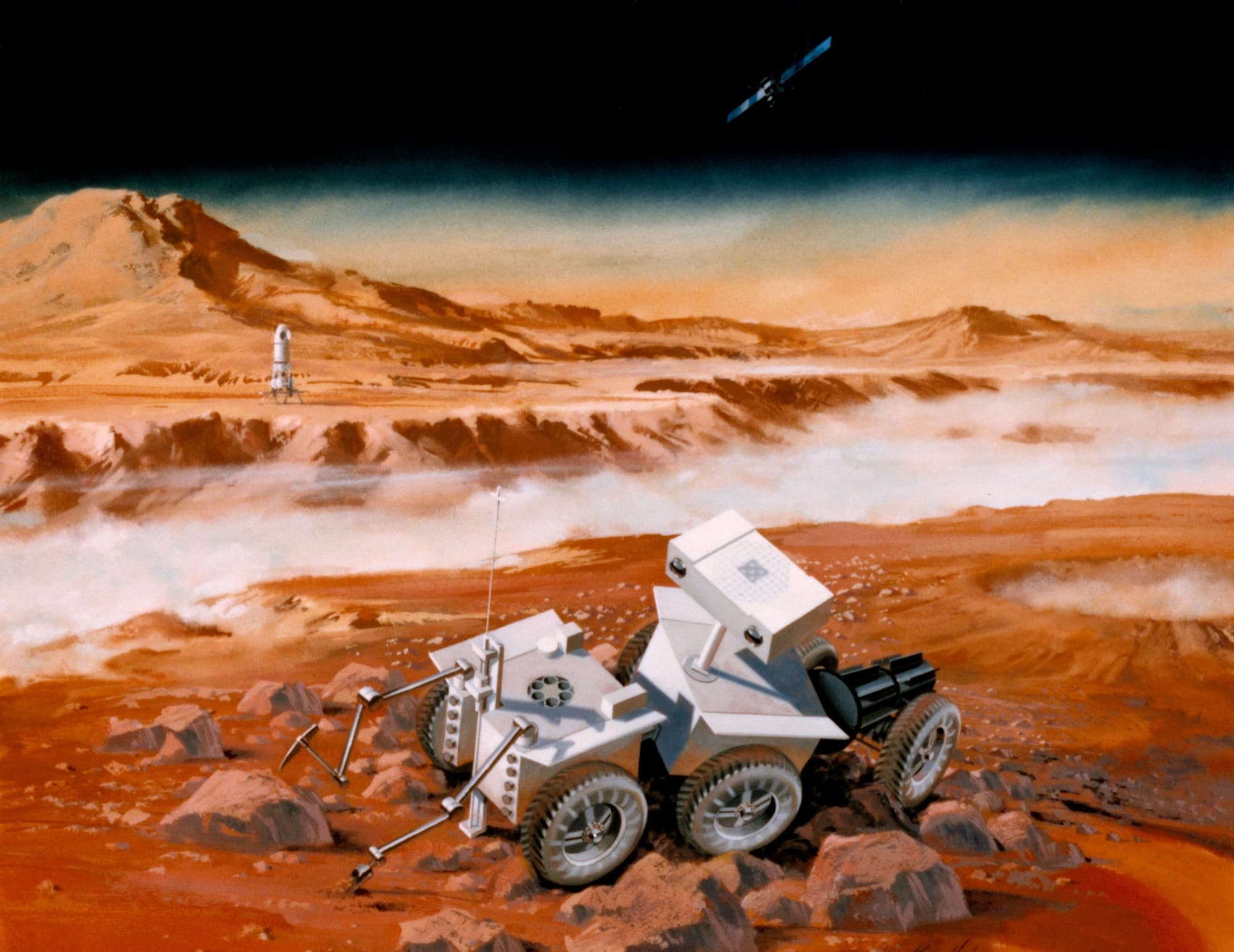
Mars Rover/Sample Return was never a mission. It was a study, and understanding that is the whole point of it. It began early in 1987, run jointly by the Jet Propulsion Laboratory and the Johnson Space Center, with a brief to find out whether a rover could be landed on Mars, drive to interesting rocks, and send them home. The answers it produced were enormous. Michael Carr's summary of the work describes vehicles built around a rover of about a tonne returning more than five kilograms of sample. One JPL option needed a single launch of a twelve-tonne stack containing a Mars orbiter and Earth-return vehicle, a 700 kg rover and a 2.7 tonne Mars ascent vehicle, delivering a 20 kg sample package with five kilograms of Martian soil inside it. Nothing remotely that heavy has ever been landed on Mars: Perseverance, the heaviest lander ever set down there, weighs 1,025 kg, and Curiosity 899 kg. In November 1989 the 90-Day Study, NASA's answer to President Bush's Space Exploration Initiative, adopted the idea and doubled it, proposing two identical sample-return flight systems each bringing back five kilograms, and called it the centrepiece of the robotic sequence that would precede humans. That was the high-water mark. The study kept generating papers into 1990, including a Phase A cost estimate in May of that year, and then it stopped.
It stopped because the thing it was attached to was deleted. In late June 1990 the House Appropriations Committee released its mark-up of NASA's budget and removed every new dollar associated with the Space Exploration Initiative. In September the Senate did the same, its report objecting that an extensive Moon and Mars planning and technology programme could not proceed without a sustainable revenue source, and citing NASA's own preliminary estimate of over 500 billion dollars for the whole enterprise. The conference report confirmed the elimination. In mid-November the authorising committees put back 21 million dollars for exploration mission studies, which Thor Hogan's NASA history records as the only money the initiative ever received. There is no cancellation memorandum for MRSR, no date, no named decision, because a study that was never approved as a project cannot be cancelled. What exists instead is a change of tense. By 1992 Carr was writing about MRSR missions that were examined in the late 1980s. The lesson NASA drew was the opposite of MRSR: small, cheap, frequent missions. Discovery and the Mars Surveyor programme followed, and in 1997 Mars Pathfinder landed a rover of roughly ten kilograms, about a hundredth of the mass MRSR had assumed for its own.
The second attempt was a real project with a real launch date, and it grew out of a meteorite. In spring 1996 a NASA team under Daniel McCleese of JPL reported that a sample return could be launched as early as 2005 within the Mars Surveyor budget of roughly 100 million dollars a year plus launch costs, provided the programme cut from two launches per opportunity to one. Then, in August 1996, NASA announced possible evidence of past life in the Martian meteorite ALH84001, and the study team refocused on the search for life. Goldin asked for three tempos. The paced option would have launched in 2005 and returned samples in 2008; the accelerated would have launched in 2003 and returned in 2006; the aggressive added a field-geologist rover in 2001 to the same 2006 return. By 1999 the resulting Mars Sample Return Project had a shape. NASA would lead and provide two nearly identical landers, each with a 60 kg six-wheeled rover and a small solid rocket. CNES was the largest international partner, supplying an Ariane 5 and the orbiter that would catch the samples; NASA would supply the Earth Entry Vehicles it carried, and Italy planned a drill. The chosen mode was Mars orbit rendezvous, which the mission designers described as analogous in concept to the lunar orbit rendezvous flown for Apollo.
The detail is what makes the loss real. An 1,800 kg lander would have left Cape Canaveral in May 2003 on an intermediate-class rocket, arrived in mid-December, and landed within ten kilometres of its target using guided hypersonic entry. Its rover would have made up to three traverses of up to a hundred metres in a 90-sol mission, carrying cores back to a canister on the lander deck. A three-stage solid Mars Ascent Vehicle of about 140 kg would then have lifted that canister into a 600 km orbit at 45 degrees, where it would have waited until early 2007. In August 2005 a second lander and a 2,700 kg French orbiter would have launched together on one Ariane 5, carrying four 60 kg Netlanders to drop off on approach, and the orbiter would have performed what would have been the first aerocapture into orbit around another planet, six minutes deep in the Martian atmosphere at a periapsis near 43 kilometres. Samples were to reach Earth in October 2008. Then Mars Climate Orbiter was lost on 23 September 1999 and Mars Polar Lander on 3 December. The Young report followed. On 28 March 2000 Weiler cancelled the 2001 lander and appointed Scott Hubbard; on 12 May the 2003 window was down to an orbiter or a rover; on 26 October the restructured programme put the first sample-return launch in 2014. The rover chosen instead became Spirit and Opportunity, and the mobile science laboratory announced the same day became Curiosity.
Mission facts
What this covers
Two American sample-return efforts that ended between 1987 and 2000: Mars Rover/Sample Return (MRSR), studied from 1987, and the NASA and CNES Mars Sample Return Project of the late 1990s, which would have used the 2003 and 2005 launch windows. The Soviet sample returns of the 1970s, 5NM and 5M, are a separate and earlier story and have their own entries.↗
Where MRSR came from
The Solar System Exploration Committee of the NASA Advisory Council had recommended that a Mars Rover/Sample Return mission be launched before the year 2000. Sally Ride's task force report of August 1987, Leadership and America's Future in Space, put a pair of Mars Rover/Sample Return missions at the end of a 1990s robotic sequence under its Humans to Mars option. A study of an MRSR mission began early in 1987.↗
Who ran it
The study was managed jointly by NASA's Jet Propulsion Laboratory and the Johnson Space Center, with contributions from multiple NASA centres. Its stated goals were to test technical feasibility, converge on two or three architectures, identify the technologies that would have to be developed, support preliminary cost estimates and sharpen the science requirements. It never advanced beyond that.↗
What MRSR would have been
Michael Carr's summary of the late-1980s work describes missions with a rover of around 1,000 kg returning over 5 kg of sample. One JPL option described by Bourke, Kwok and Friedlander used a single launch of a 12-tonne package holding a Mars orbiter and Earth-return vehicle, a 700 kg rover and a 2.7 tonne Mars ascent vehicle with pump-fed liquid propulsion, carrying a 20 kg sample package containing 5 kg of Mars soil. Alan Friedlander's mission-definition work laid out five options distinguished by launch configuration.↗
MRSR inside the Space Exploration Initiative
The 90-Day Study of November 1989, NASA's response to President Bush's July 1989 announcement, built a robotic precursor sequence: a Lunar Observer, a Mars Global Network, then a Mars Sample Return programme launching two identical flight systems to return five kilograms each of Martian rock, soil and atmosphere. Thor Hogan's NASA history calls that sample return the centrepiece of the robotic sequence. A Mars Site Reconnaissance Orbiter and up to five Mars rovers followed it.↗
How it was killed
Not by a decision about sample return. In late June 1990 the House Appropriations Committee's mark-up of the NASA budget removed the entire Space Exploration Initiative line. In early September the Senate did the same, its report objecting to an extensive planning and technology programme aimed at the Moon and Mars without a sustainable revenue source, and noting NASA's own preliminary estimate of over 500 billion dollars. The House-Senate conference confirmed the elimination. In mid-November the authorising committees restored 21 million dollars for exploration mission studies, which Hogan records as the only money the initiative ever received.↗
No cancellation notice exists
We found no document announcing the cancellation of MRSR, because there was nothing to cancel: it was a mission study and never an approved flight project. The technical literature simply stops. The Phase A cost estimation paper by Stancati and Spadoni is dated May 1990, and by the time Michael Carr wrote his chapter in 1992 he was describing missions that were examined in the late 1980s, in the past tense.↗
The 1996 revival
In spring 1996 a NASA team led by Daniel McCleese of JPL studied whether samples could be returned as early as the 2005 mission within the Mars Surveyor budget of about 100 million dollars a year plus launch costs. It reported that this was possible but that the programme would become very lean, requiring a cut from two launches per opportunity to one. After the ALH84001 meteorite announcement in August 1996, the team, called the Mars Expeditions Strategy Group, refocused on the search for life.↗
Goldin's three options
Administrator Daniel Goldin asked for paced, accelerated and aggressive variants. Paced meant a 2005 launch and a sample on Earth by 2008; accelerated meant a 2003 launch and a return by 2006; aggressive added a field-geologist rover in 2001 and still returned a sample by 2006. Each option covered three different Martian environments and would have returned a sample from each. The group's findings were presented on 30 September 1996 to NASA's Solar System Exploration Subcommittee.↗
The Mars Sample Return Project as it stood in 1999
NASA led; the French space agency CNES was the largest international partner. NASA would provide the landers, the rovers and the Mars ascent vehicles; CNES would provide an Ariane 5 launch and the Earth-return orbiter that captured the sample canisters; NASA would provide the Earth Entry Vehicles carried aboard that orbiter. Italy planned to supply a drill for subsurface samples. The baseline mode was Mars orbit rendezvous, described by the JPL mission designers as analogous in concept to the lunar orbit rendezvous used for Apollo. The project never left the design stage: we found no record of flight hardware being built for either leg.↗
The 2003 leg
An 1,800 kg lander launching in May 2003 from Cape Canaveral on an intermediate-class vehicle. O'Neil and Cazaux name a Delta III class rocket; the JPL mission-design paper says an intermediate-class launcher such as a Boeing Delta 3 or a Lockheed Martin Atlas 3A. It would take a Type 1 transfer, arrive in mid-December 2003, and land using precision approach navigation and guided hypersonic entry for a touchdown accuracy of 10 km or better, at a latitude expected to fall between 15 degrees north and south. A six-wheeled 60 kg rover would make up to three traverses of up to 100 metres in a 90-sol surface mission, bringing cores back to a canister on the lander.↗
The rocket that would have flown first
The Mars Ascent Vehicle was a three-stage solid rocket of about 140 kg mounted on the lander deck. It would have put the sample canister into a near-circular orbit about 600 km up at 45 degrees inclination, where the canister would wait to be retrieved sometime in early 2007. Had it flown in 2003, it would have been the first rocket launched from the surface of another planet.↗
The 2005 leg
A second lander and a 2,700 kg CNES orbiter departing together on one Ariane 5 in August 2005 on a Type 2 transfer, separating shortly after injection and arriving in late July 2006 between 12 and 24 hours apart. Four 60 kg CNES Netlanders were to ride piggyback on the orbiter, released one at a time in the month before arrival. The orbiter would have used aerocapture, which the mission designers noted would have been the first use of aerocapture to insert a spacecraft into orbit around another planet, targeting a 250 by 1,400 km capture orbit through about six minutes of flight at a periapsis near 43 km, saving over 2,000 m/s.↗
What ended it
Mars Climate Orbiter was lost on 23 September 1999 and Mars Polar Lander on 3 December 1999. The Mars Program Independent Assessment Team under Thomas Young began work on 7 January 2000 and delivered its report in mid-March. NASA released it on 28 March 2000, and the same day Associate Administrator for Space Science Edward Weiler announced the cancellation of the planned Mars 2001 lander pending a new Mars architecture, and appointed Scott Hubbard as Mars Program Director.↗
The 2003 window emptied
On 12 May 2000 NASA announced that the 2003 opportunity had come down to two candidates: a Mars Surveyor Orbiter recovering the lost Mars Climate Orbiter science, or a 130 kg rover based on the Athena design that had been considered for the cancelled 2001 lander, landing in a Pathfinder-style airbag system. Neither was a sample return.↗
The rover chosen instead
On 27 July 2000, in release 00-119, Weiler announced that he had chosen the rover over the orbiter, calling it an extremely difficult decision, and said NASA was evaluating the implications of sending two such rovers to two different sites in 2003, with a decision to follow in the next few weeks. Those two became Spirit and Opportunity.↗
Where sample return went
NASA's restructured Mars programme, announced on 26 October 2000, kept sample return but moved it into the second decade: current plans, the release said, called for the first sample-return mission to be launched in 2014 and a second in 2016, with options under study including launching the first as early as 2011. France and Italy were named as major contributors to sample collection and return systems. Dates and times in this entry are as published; NASA release datelines are Washington local time.↗
Mission timeline
- 1987A study of a Mars Rover/Sample Return mission begins early in the year, managed jointly by JPL and the Johnson Space Center, following a Solar System Exploration Committee recommendation that such a mission fly before 2000.
- Aug 1987Sally Ride's report Leadership and America's Future in Space recommends, under its Humans to Mars option, a 1990s robotic programme concluding with a pair of Mars Rover/Sample Return missions.
- Nov 1989The 90-Day Study makes a Mars Sample Return programme of two identical flight systems, each returning five kilograms of rock, soil and atmosphere, the centrepiece of the Space Exploration Initiative's robotic precursor sequence.
- Jun to Sep 1990The House Appropriations Committee strips every new dollar of the Space Exploration Initiative from NASA's budget in late June; the Senate does the same in early September; the conference report confirms it. MRSR loses the programme it was attached to and quietly stops.
- Aug 1996The announcement of possible evidence of past life in the Martian meteorite ALH84001 transforms the political weather. Daniel McCleese's team, already studying a 2005 sample return inside the Mars Surveyor budget, regroups as the Mars Expeditions Strategy Group around the search for life.
- 30 Sep 1996The group presents three options requested by Administrator Daniel Goldin to NASA's Solar System Exploration Subcommittee: paced (launch 2005, return 2008), accelerated (launch 2003, return 2006) and aggressive (a rover in 2001 and a return by 2006).
- 1999 to 2000The Mars Sample Return Project is under way: an 1,800 kg NASA lander in May 2003, a second lander and a 2,700 kg CNES orbiter on one Ariane 5 in August 2005, Mars orbit rendezvous, and samples arriving on Earth in October 2008.
- 23 Sep to 3 Dec 1999Mars Climate Orbiter is lost during orbit insertion, then Mars Polar Lander and the two Deep Space 2 microprobes are lost on arrival. Two spacecraft and ten weeks take the credibility of the whole Mars programme with them.
- 7 Jan 2000The Mars Program Independent Assessment Team, appointed by Administrator Daniel Goldin and chaired by Thomas Young, starts work. Its charter includes reviewing the revised Mars Surveyor Program and completing by 15 March.
- 28 Mar 2000NASA releases the Young report. The same day Edward Weiler announces the cancellation of the Mars 2001 lander pending approval of a new Mars architecture, and appoints Scott Hubbard as Mars Program Director.
- 12 May to 27 Jul 2000The 2003 launch window is reduced to two candidates, an orbiter or an Athena-derived rover in a Pathfinder airbag system. Neither returns samples. On 27 July Weiler picks the rover and says a two-rover option is being evaluated; those two became Spirit and Opportunity.
- 26 Oct 2000NASA announces its restructured Mars programme. Sample return survives on paper and moves into the second decade: the first mission launching in 2014, a second in 2016, with 2011 under study. In thirteen months the return date had gone from 2008 to somewhere past 2016.
A filled dot marks something that physically happened. A hollow one marks an announcement, a naming or a target.
In pictures
Tap a photo to enlarge.
Sources
- Michael H. Carr, MRSR: Rationale for a Mars Rover/Sample Return mission (NASA technical report, 1992)
- Cunningham, Rea, Pivirotto, Kwok and Craig, Mars rover sample return missions (October 1988)
- Bourke, Kwok and Friedlander, Mars Rover Sample Return mission (1989)
- Stancati and Spadoni, Mars Rover/Sample Return: Phase A cost estimation (May 1990)
- Thor Hogan, Mars Wars: The Rise and Fall of the Space Exploration Initiative (NASA SP-2007-4410)
- JPL Universe, 4 October 1996: Mars Program Gears Up For Sample Return Mission
- W. J. O'Neil and C. Cazaux, The Mars Sample Return Project (2000)
- Lee, D'Amario, Roncoli and Smith, Mission Design Overview for Mars 2003/2005 Sample Return Mission (2000)
- Mars Program Independent Assessment Team Report, 14 March 2000 (the Young report)
- NASA release 00-46, 28 March 2000: Mars Program Assessment Report Outlines Route To Success
- NASA release 00-81, 12 May 2000: NASA Identifies Two Options For 2003 Mars Missions (archived)
- NASA release 00-119, 27 July 2000: NASA Goes Back To The Future With Plans For A Mars Rover In 2003; Possible Second Rover Being Studied (archived)
- NASA release 00-171, 26 October 2000: NASA Outlines Mars Exploration Program For Next Two Decades
Facts on this page were verified on 24 August 2026. Where sources disagree, the disagreement is stated rather than resolved silently.