Mars Aerostat
CNES and IKI (France, USSR then Russia) · Multinational · Aircraft · 1986 · The losing decadeCancelled
Terminated in 1995 over money, with hardware built and tested on Earth. No balloon has ever been released at Mars; only its relay receiver flew, on Mars Observer in 1992 and Mars Global Surveyor in 1996.
TL;DR· 17 min read
The Mars Aerostat was a Franco-Soviet balloon that would have risen on solar heating each Martian day, drifted with the wind and settled at night onto a long instrumented guiderope designed by The Planetary Society. Studied from April 1986, it reached flight-representative hardware, Mojave field tests and high-altitude drop trials before money ended it in 1995. No balloon has ever been released at Mars. Only its relay receiver flew: Mars Observer returned nothing, and on Mars Global Surveyor it relayed rover data and never heard a balloon.
The Mars Aerostat is one of the most fully developed Mars vehicles that never left the ground. It would have unpacked from an entry capsule under a parachute, inflated a bag of six-micrometre film tens of metres long, and then spent about ten Martian days rising with the Sun, sailing hundreds of kilometres on the wind, and sinking each evening until a heavy instrumented rope took its weight and held the gondola clear of the ground. It got as far as flight-representative hardware, desert tests in the Mojave and high-altitude drop trials. It never got a launch.
- 0balloons ever released into the atmosphere of Mars
- ~1,500 kmdistance one balloon was expected to cover in about ten day-night cycles
- 1piece of it that flew: the Mars Balloon Relay, on two NASA orbiters
The idea came out of a success. In 1985 two balloons rode the Soviet Vega probes into the atmosphere of Venus and drifted there, the first balloons ever flown in the atmosphere of another planet. Ten months later, in April 1986, French and Soviet researchers began the obvious sequel. A JPL team led by Viktor Kerzhanovich, who had worked on the Vega balloons himself, later wrote that this was the first practical concept for a balloon mission in the atmosphere of Mars, and that the Vega heritage significantly influenced the Mars Aerostat approach, particularly in how the balloon was to be deployed. The division of labour was settled early and never changed: France would build the balloon, the Soviets would build the gondola and deliver the whole thing to Mars. Anatoly Zak's reconstruction of the Russian side dates the first formal appearance to May 1987, when NPO Lavochkin issued documentation for the MS-92 complex, a pair of spacecraft to launch in 1992, each carrying a 240 kg rover, a 120 kg balloon and a 55 kg penetrator. By December that year the launch had slipped to 1994, the penetrator was gone, and France had committed to what Zak describes as a giant sausage-shaped balloon of 6,000 cubic metres, carrying instruments in an aerial gondola and dragging others along the ground on a rope. That rope is the interesting part, and it is not French.
The physics of a balloon on Mars is unforgiving, and the design changed because of it. The atmosphere is thin enough that the envelope has to be enormous and the film close to nothing, and the day-night temperature swing is violent enough that a balloon cannot simply float. The first configuration was two cells: a spherical helium balloon on top, and beneath it an oval solar Montgolfiere with a dark envelope and an opening that let Martian air circulate, which was to lift the assembly once the air inside was about 55 degrees hotter than the air outside. At sunset the hot-air cell would collapse and the helium cell alone would hold the gondola clear of the ground. The design then simplified into a single translucent cylinder of six-micrometre Mylar, overpressure by day and descending at night. Its published volume is 5,500 cubic metres in the CNES simulator paper by Vargas and colleagues and 6,000 in Zak and in the French archive nirgal.net, which also gives it as 45 metres tall and 12 across, while English accounts describe a 20 metre balloon instead, because they are describing the earlier two-part design. The mass accounting is just as unsettled: 65.4 kg floating mass with a 15 kg gondola and a 13.5 kg guiderope in the CNES figures, 60 kg split evenly between balloon and payload at nirgal, 48 kg of gondola in the 1988 Soviet design and 57.5 kg in the 1989 revision.
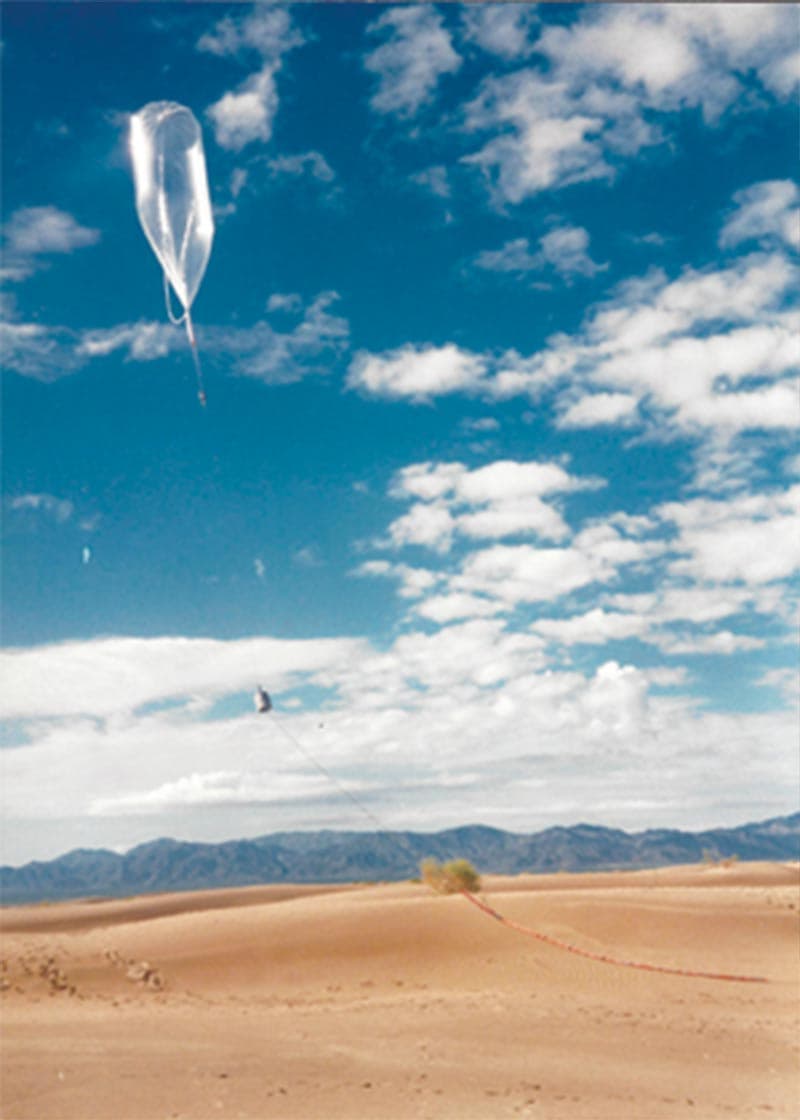
The guiderope is where The Planetary Society comes in, and it is the part of this story that a private membership organisation actually built. The problem it solves is specific. A balloon that sinks every night has to stop sinking before it hits, and it cannot do that by dropping ballast ten nights running. The answer was to hang a long, heavy, instrumented rope below the gondola, so that when it settled onto the ground its own weight would come off the balloon and the descent would halt with the gondola still in the air. Kerzhanovich's team credit the Society with developing the concept of the snake or guiderope, which enabled the balloon to tolerate diurnal descents to the surface as the balloon cooled at night and permitted a mission duration of about ten days as well as in situ surface data. Its construction was a chain of overlapping cones, which Charlene Anderson of the Society described as a nested Dixie cup design, flexible enough to work as a rope and rigid enough not to snag and to protect the instruments inside. Through the summer of 1990 it was tested in the Mojave: dragged behind a truck first, then flown under a CNES balloon over the dunes of Palen Dry Lake, the hardpan of Coyote Dry Lake and the basalt of the Pisgah lava flows, by CNES engineers, observers from the Babakin Center, scientists from the Space Research Institute, JPL volunteers, students and Society members. Her report was headlined It Works.
Then the country that was going to launch it stopped existing. Kerry Nock's JPL team, writing in 1997, dated the damage precisely: as early as 1992 the joint programme was experiencing the detrimental effects of the collapse of the Soviet Union, and the immediate impact was a slip of the launch to at least 1996. Zak records that France withdrew from the wider project over its own overspending, although CNES work on the balloon plainly continued, because by October 1993 C. Tarrieu was presenting a paper at the IAF congress in Graz titled Status of the Mars 96 Aerostat Development. By early 1995 the mission had to slip again, to 1998, and that slip carried a physical problem with it. A 1998 arrival meant the northern hemisphere in winter, with surface winds above 30 metres per second, and a balloon dragging a snake along the ground in those winds could simply be torn apart. Nock's team wrote that the programme was eventually cancelled by a combination of programmatic and related technical problems, and noted in passing that the Mars '96 aerostat had run into difficulties during two high-altitude drop-and-deploy tests that exposed key stability problems. Kerzhanovich's team put the ending more bluntly: due to budget problems the Russian-French development was terminated in 1995. Mars-96 flew on 16 November 1996 with an orbiter, two small stations and two penetrators, no balloon at all, and failed in Earth orbit.
One piece of it did reach Mars, twice. The Mars Balloon Relay was a 6.8 kg UHF package built under Jacques Blamont to talk to the balloon and the landers: it would broadcast a continuous 437 MHz beacon at the surface, listen on 401 or 405 MHz when something answered, measure the Doppler shift to work out where the balloon had drifted to, and dump everything into the memory of the Mars Observer Camera, twice a day for about eleven minutes at 2 a.m. and 2 p.m. local time. It flew on Mars Observer, launched 25 September 1992, which fell silent on 22 August 1993, less than three days short of orbit insertion and returned nothing. It was rebuilt for Mars Global Surveyor as the Mars Relay, 10.5 kg on an 86 cm helical mast, launched 7 November 1996, and there it finally worked. It never heard a balloon. What came through it, as Emily Lakdawalla recorded from the camera team's end-of-mission accounting, was 7,680 megabits of data from two rovers. The programme left one other descendant: in August 1997 JPL opened the Mars Balloon Validation Program explicitly on the back of the Russian-French Mars Aerostat Project of 1988 to 1995, with Blamont, Vargas and Evrard of CNES sharing their results, taking part in the tests and running deployment simulations.
Mission facts
What it was
A balloon (aerostat in the Russian and French usage) to be deployed and inflated during the descent of an entry capsule at Mars, then left to drift. The division of labour was fixed early: the French would supply the balloon system, the Soviets the gondola and the delivery to Mars. Neither part ever flew.↗
Where the idea came from
A JPL team led by Viktor Kerzhanovich, who had worked on the Venus balloons himself, records that the first practical concept for a balloon mission in the atmosphere of Mars was initiated in April 1986 by French and Soviet researchers, on the strength of the first planetary balloon mission, the Venus Vega balloons of 1985, and that the Vega heritage significantly influenced the Mars Aerostat approach, specifically in how the balloon was to be deployed. The French archive nirgal.net puts the Vega flight at about two days at a nearly constant altitude near 54 km, and credits the idea of a wind-borne planetary balloon principally to Jacques Blamont.↗
Programme span
Kerzhanovich's team date the effort as the Russian-French Mars Aerostat Project, 1988 to 1995. Anatoly Zak's reconstruction of the Russian side starts earlier: in May 1987 NPO Lavochkin issued documentation for the MS-92 complex (manufacturing index M1), a pair of spacecraft for 1992 each carrying a 240 kg rover, a 120 kg balloon and a 55 kg penetrator. By December 1987 the launch had slipped to 1994, the penetrator was dropped, and France had taken on what Zak describes as a giant sausage-shaped balloon of 6,000 cubic metres.↗
The first design
Two cells. A spherical helium balloon on top, able on its own to hold the gondola and guiderope off the ground, and below it an oval solar Montgolfiere with a dark envelope and an opening that let Martian air circulate. Sunlight was to heat the lower cell, and the assembly would lift once the air inside was about 55 degrees hotter than the air outside. Nirgal.net gives this configuration a total of 33 kg, of which 17 kg was envelope, 2 kg helium and 14 kg science gondola, a life of about ten days set by battery discharge, and roughly 500 km covered per day at mid-latitudes. A later refinement added valves to dump hot air so the balloon could be made to stay down or land in daylight.↗
The design it became
Kerry Nock's JPL team record that the concept eventually evolved into a 6-micron thick mylar balloon which would be overpressure during the day, descending to the surface during the night. Nirgal.net describes that version as a single translucent helium cylinder of 6,000 cubic metres, 45 m tall and 12 m across, inflated over about four minutes through special nozzles so the gas jet could not tear the film. English retellings, including Andrew LePage's and Global Aerospace Corporation's, instead describe a 20 m (66 ft) two-part Mylar balloon with helium on top and Martian air below, which is the earlier configuration.↗
The published numbers, and how far apart they sit
The volume most often quoted, 5,500 cubic metres, together with a daytime ceiling of 2 to 4 km above the reference level, a total floating mass of 65.4 kg, a 15 kg gondola and a 13.5 kg guide rope, traces to the CNES simulator paper: A. Vargas, C. Tarrieu, J.-P. Lepage, P. Mauroy and C. Sirmain, Mars balloon simulator, Acta Astronautica 26, 8-10, pp. 697-706, 1992. We verified that citation but could not read the paywalled text, so those figures are reported here at second hand. They disagree with the 6,000 cubic metres given by Zak and by nirgal.net, and with nirgal's cruise description of a late-morning climb to about 6,000 m. The masses move as much as the volume: Zak's chronology has the gondola at 48 kg in the 1988 preliminary design, 57.5 kg in the September 1989 revision and the balloon itself at 200 kg, nirgal gives 60 kg for the later cylinder split evenly between balloon and payload, and popular accounts describe a 4 kg camera package and a 4 kg snake. These are successive designs and different accountings rather than competing measurements of one object.↗
Flight profile as intended
Global Aerospace Corporation, whose staff worked on the JPL balloon studies that followed, set out the cycle: by day the sun-heated balloon would rise to between 2 and 4 km and travel hundreds of kilometres on the Martian winds while a gondola camera photographed the ground; at nightfall the balloon would sink until the guiderope reached the surface, where instruments on it would take measurements; the next morning it would rise again. About ten such cycles were expected before enough helium had leaked away to stop the balloon ascending, covering roughly 1,500 km in all. The ten-day mission length is the same figure the CNES and JPL papers give. The distance is not: that roughly 1,500 km rests on this one uncited page, and it sits awkwardly beside nirgal.net's roughly 500 km a day for the earlier two-cell design, which over ten days would be nearer 5,000 km. No primary paper we could open gives a traverse total at all.↗
The guiderope, or SNAKE
Kerzhanovich's team credit The Planetary Society with developing the concept of the snake or guiderope, which enabled the balloon to tolerate diurnal descents to the surface as the balloon cooled at night and permitted a mission duration of about 10 days as well as in situ surface data. Nock's team describe the mechanism: at night the balloon would rest on the surface on a guiderope or landing snake suspended from the gondola, and the mass of the landing snake on the surface relieved negative buoyancy so that the gondola did not touch the ground.↗
How the SNAKE was built
A chain of overlapping cones. Charlene Anderson of The Planetary Society described it as a nested Dixie cup design that gives the SNAKE the flexibility to serve as a self-ballasting guide-rope for the balloon, as well as the rigidity to avoid snagging and to protect its internal instruments. It was painted fluorescent orange for the field tests and carried instruments to measure its speed under the balloon and the friction between it and the ground. Nirgal.net describes the flight article as interconnected elements holding batteries, heaters, the data transmission system, science instruments and an antenna.↗
The Mojave tests, 1990
Through the summer and into the early autumn of 1990 the balloon and guiderope were tested in California: the SNAKE dragged behind a truck first, then flown beneath a CNES balloon over the dunes of Palen Dry Lake, with the team working out of Indio, the hardpan of Coyote Dry Lake and the basalt of the Pisgah lava flows. The team was CNES scientists and technicians, observers from the Babakin Center, scientists from the Space Research Institute of the Soviet Academy of Sciences, JPL engineers, students from Arizona, Utah State, UCLA and Caltech, and Planetary Society volunteers. Anderson's report: the balloon flew flawlessly in both heavy and light winds, and the SNAKE slithered obliviously over sand, hardpan and lava boulders.↗
What the Society then did with it
Anderson wrote that The Planetary Society has fulfilled its initial obligation: the design of a guide-rope to enable low-altitude flight over martian terrain and to carry instruments to the surface, and that the Society had transferred all of its data and designs to CNES for incorporation into the Soviet Mars '94 mission. The cover of that issue called the balloon and its SNAKE an intrinsic and official part of the Soviet Mars '94 mission.↗
The drop tests
Nock's team record that the Mars '96 Martian Aerostat system encountered difficulties during the two high altitude drop-and-deploy tests, and that the lessons learned identified key stability problems, which is why their own later design hung the balloon from the parachute and put the inflation hardware at its base, even though a top-down inflation like those of Vega and Mars '96 had been highly desired. On the Russian side a parachute system for these trials was developed and reported by R. S. Kremnev, K. M. Pichkhadze, V. M. Linkin, V. V. Kerzhanovich and colleagues, Balloon experiments in the Earth's stratosphere within the Mars-96 project, Advances in Space Research 17, 9, pp. 77-80, 1996. We verified the citation but could not read the paywalled text.↗
The relay that flew
The Mars Balloon Relay (MBR), principal investigator Jacques Blamont, was a 6.8 kg UHF package on NASA's Mars Observer drawing 12.5 W. In orbit it would transmit a continuous 437 MHz beacon at the surface; when a station or the balloon saw the signal cross a threshold it would answer on 401 or 405 MHz; the MBR would demodulate, measure the Doppler shift for localisation and balloon tracking, and pass everything into the memory buffer of the Mars Observer Camera. Two contacts a day, each about 11 minutes, at 2 a.m. and 2 p.m. local time, through a rigidly mounted quadrifilar helix with a 65 degree conical pattern.↗
What the relay was for
NASA's catalogue states that the MBR was planned to augment the return of data from the penetrators and surface stations of the Russian Mars '94 mission and from penetrators, surface stations, a rover, and a balloon from the Mars '96 mission. Mars Observer fell silent on 22 August 1993 UTC (still 21 August in Pasadena), less than three days before orbit insertion, and no data were returned. The experiment was rebuilt for Mars Global Surveyor as the Mars Relay: 10.5 kg, an 86 cm quadrifilar helix fibreglass mast, 437.1 MHz at 1.3 W down, 401.5 and 405.6 MHz up, again buffering through the camera.↗
What the relay actually carried
Not balloons. Emily Lakdawalla, reporting the Mars Orbiter Camera team's end-of-mission accounting, records that the Mars Relay wound up relaying data not from Mars balloons but instead from two rovers, and that a total of 7,680 megabits of rover data came through the Mars Relay on MOC.↗
What flew instead
Mars-96 launched on 16 November 1996 carrying an orbiter, two small autonomous surface stations and two penetrators. The Institute of Space Research project description edited by A. V. Zakharov, published in 1996, lists exactly those elements and no aerostat and no rover. The spacecraft never left Earth orbit.↗
Mission timeline
- Apr 1986French and Soviet researchers begin work on what Kerzhanovich's team call the first practical concept for a balloon mission in the atmosphere of Mars, ten months after the two Vega balloons flew in the atmosphere of Venus.
- May 1987NPO Lavochkin issues documentation for the MS-92 complex, index M1: two spacecraft to launch in 1992, each carrying a 240 kg rover, a 120 kg balloon and a 55 kg penetrating probe.
- Dec 1987The technical proposal is ready but the launch moves to 1994 and the penetrator is dropped. France takes on the balloon: 6,000 cubic metres, instruments in an aerial gondola and more instruments dragged along the surface on a rope.
- Sep 1989With the Soviet space budget being trimmed, the revised preliminary design drops the rover. The balloon survives the cut, now with a 57.5 kg gondola, alongside 20 kg meteorological landers and a 60 kg penetrator.
- Summer to autumn 1990Field tests in the Mojave. The SNAKE is dragged behind a truck, then flown under a CNES balloon over Palen Dry Lake, Coyote Dry Lake and the Pisgah lava flows by a team of French, Soviet and American engineers and Planetary Society volunteers. The Society hands its data and designs to CNES.
- 25 Sep 1992Mars Observer launches carrying the Mars Balloon Relay, the receiver built under Jacques Blamont to talk to the Russian landers and to the balloon.
- 1992Nock's team date the damage: as early as 1992 the joint programme was feeling the effects of the collapse of the Soviet Union, and the immediate impact was a slip of the launch to at least 1996. Zak dates the same damage a year earlier: with the collapse of the Soviet Union in 1991 the project lost its second spacecraft, and France withdrew from it over overspending on its own share.
- 22 Aug 1993Mars Observer falls silent less than three days before orbit insertion (21 August in California). The Mars Balloon Relay returns nothing. The instrument is later rebuilt for Mars Global Surveyor.
- Oct 1993C. Tarrieu presents a status paper at the IAF congress in Graz. Its title records where the balloon had moved to: Status of the Mars 96 Aerostat Development.
- Early 1995It becomes clear the mission must slip again, this time to 1998. That would put the balloon in the northern hemisphere in winter, with surface winds above 30 m/s, fast enough to destroy a balloon whose snake was dragging on the ground. The French continue a scaled-back development with real successes and some nagging balloon deployment failures.
- 1995The end. Kerzhanovich's team write that due to budget problems the Russian-French development was terminated in 1995. Nock's team give the cause as a combination of programmatic and related technical problems. Nirgal.net instead follows the mission slot, which moved to a Mars-98 that was itself cancelled after Mars-96 failed.
- 16 Nov 1996Mars-96 launches with an orbiter, two small stations and two penetrators, and no balloon. The Blok D-2 stage fails its second burn and the spacecraft re-enters. Nine days earlier Mars Global Surveyor had left Earth carrying the rebuilt relay, which would spend its working life listening to rovers.
A filled dot marks something that physically happened. A hollow one marks an announcement, a naming or a target.
In pictures
Tap a photo to enlarge.
Sources
- V. V. Kerzhanovich, J. Cutts et al., Mars Aerobot Validation Program, AIAA 1999 (NASA NTRS 20000058137)
- K. T. Nock et al., Mars 2001 Aerobot/Balloon System Overview, AIAA 97-1447 (Global Aerospace Corporation copy)
- Charlene M. Anderson, Wind, Sand and Mars: The 1990 Tests of the Mars Balloon and SNAKE, The Planetary Report vol. 11 no. 1, Jan/Feb 1991
- NSSDCA experiment record: Mars Balloon Relay (MBR) on Mars Observer, 1992-063A-08, PI Jacques E. Blamont (archived 19 Mar 2025)
- NSSDCA experiment record: Mars Relay Communications Experiment on Mars Global Surveyor, 1996-062A-06 (archived 11 Apr 2025)
- RussianSpaceWeb (Anatoly Zak): Mars-96
- nirgal.net (Philippe Labrot): Ballons martiens
- Institute of Space Research (IKI RAS): МАРС-96 project description, ed. A. V. Zakharov, 1996
- Global Aerospace Corporation: Mars Balloons Reference Work
- Emily Lakdawalla, The Planetary Society (2010): Buttoning up the Mars Orbiter Camera science
- A. Vargas, C. Tarrieu, J.-P. Lepage, P. Mauroy, C. Sirmain, Mars balloon simulator, Acta Astronautica 26 (8-10), 697-706, 1992
- R. S. Kremnev, K. M. Pichkhadze, V. M. Linkin, V. V. Kerzhanovich et al., Balloon experiments in the Earth's stratosphere within the Mars-96 project, Advances in Space Research 17 (9), 77-80, 1996
- Andrew LePage, Mars 1994 (EJASA, March 1990, with a 2015 postscript), Drew Ex Machina
- Mars Observer Mission Failure Investigation Board Report, Volume I (Coffey Board), December 1993
- R. Z. Sagdeev, V. M. Linkin, V. V. Kerzhanovich et al., Overview of VEGA Venus Balloon in Situ Meteorological Measurements, Science 231, 1411-1414, 1986
- NSSDCA spacecraft record: Vega 1 Balloon, 1984-125F (archived 16 Jun 2025)
- NSSDCA spacecraft record: Mars Global Surveyor, 1996-062A (archived 11 Aug 2025)
Facts on this page were verified on 24 September 2026. Where sources disagree, the disagreement is stated rather than resolved silently.