Mars 94 and Mars 98
USSR and Russia (IKI, NPO Lavochkin, VNIITransmash), with CNES and NASA · Multinational · Program · 1985 · The losing decadeCancelled
Five efforts, one launch. Vesta never became hardware, Mars 94 lost its twin in 1991 and then its 1994 launch date, and Mars 98 was closed in the spring of 1995; the surviving airframe flew as Mars 96 in November 1996.
TL;DR· 21 min read
Between 1985 and 1996 the Soviet Union and then Russia planned five large things at Mars and delivered one launch, which failed in Earth orbit. Vesta was rebaselined from Venus to Mars and never became hardware; Mars 94, approved in late 1989, flew in November 1996 as Mars 96; Mars 98, the rover and balloon reflight, was closed in the spring of 1995, twenty months before Mars 96 was lost. The Marsokhod prototypes outlived the mission, and Mars Together survived only as a Russian optical bench on Mars Climate Orbiter.
Between 1985 and 1996 the Soviet Union and then Russia planned five large things at Mars and delivered one launch, which failed in Earth orbit. This page holds all five, each with a slug of its own reserved for a future page: the Soviet-French Vesta project, the approved Mars 94 mission whose airframe became that one launch, the Mars 98 reflight that was to carry a rover and a balloon, the Marsokhod rover itself, and Mars Together, which its own report calls the first joint space science work the two governments authorised. Each of them has a date and a named cause of death, and in more than one case that cause is not the one usually given.
- 1992 to 2001how far the rover and balloon mission slipped in five years of planning, before it was closed
- 300m roublesthe late-1989 Soviet approval for Mars 94, quoted at the time as about 450 million dollars
- 1 of 5efforts on this page whose hardware reached a launch pad, as Mars 96 in November 1996
Vesta is where this story starts, and it started nowhere near Mars. The project CNES described in 1985, translated by NASA that September as Technical Memorandum TM-77669, was a Franco-Soviet double mission launching at the end of 1992 on two Proton vehicles. One Soviet craft would go to Venus, drop a descent vehicle there and continue to a small body inside the orbit of Mars. A second, built under French responsibility and independent from launch, would use a Venus-to-Earth double gravity assist and fly over three bodies in the main belt. The worked examples in that document run 4.6 and 5.3 years for total delta-v of 400 and 230 metres per second, and take in 33 Polyhymnia, comets Kopff and Gehrels in one case, 7 Iris, 4 Vesta and 286 Iclea in the other. The science payload came to 100 kg. Then, around 1985 on the only dating we can find, the whole architecture was rebaselined: Venus out, Mars in, the asteroid programme unchanged, the gravity assists now performed at Mars. Two Mars swing-bys were preferred to one because they bought about 30 per cent more spacecraft mass for 1.8 more years of flight. That version of Vesta never became hardware. The published account blames changing Franco-Soviet relations, the partial failure of the Phobos missions, money and the end of the Soviet Union, in that order and without ranking them. What outlived it was the balloon.
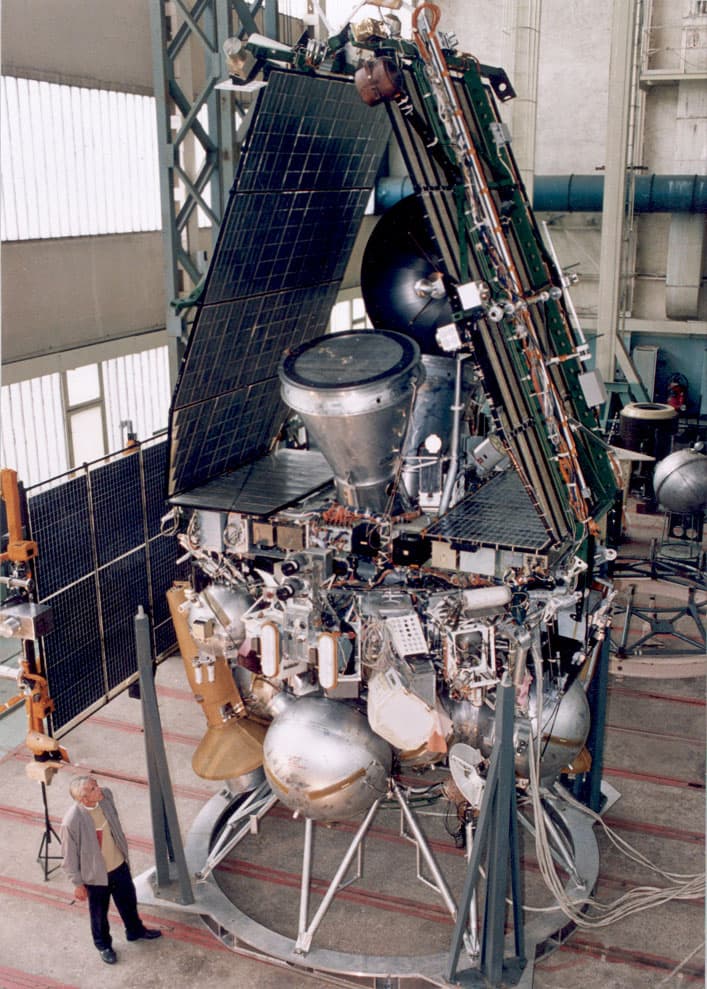
Mars 94 is the one that was genuinely approved, and it is the reason the eight-tonne ambitions of the 1980s look serious rather than aspirational. In late 1989 the Soviet government signed off a 300 million rouble programme, quoted in Western writing at the time as about 450 million dollars, though that conversion applies a meaningless exchange rate to an administered price and should be read as scale rather than cost. The plan on paper: two spacecraft of six tonnes each, on two separate Protons, in September or October 1994; eleven months of cruise; a 12 hour orbit, 300 by 18,200 kilometres; up to a gigabit of data a day. Each spacecraft would carry an orbital module, a helium balloon of about 6,000 cubic metres trailing an instrumented guiderope that lay on the ground at night, penetrators that would strike at 100 to 150 metres per second and bury themselves several metres down, small fixed meteorological stations, and, if it could be afforded, a small rover. Instruments were allocated to more than twenty countries, and Zak counts scientists from 21 countries in the project as it eventually flew. The instrument complement was frozen at the Space Research Institute in April 1990 by an International Scientific Council under academician Yuri Osipyan. NASA agreed to carry a relay package on Mars Observer to pick up data from the Martian surface; Zaitsev calls it a Soviet transceiver, though the unit that flew was the French-built Mars Balloon Relay. It is worth pausing on how much of that was already gone before the Soviet Union was: the rover had been cut from the preliminary design in September 1989, and the last Soviet decree on the subject had been signed the previous December.
What happened next is best read as a table rather than a narrative. A 1995 Novosti Kosmonavtiki review sets out the launch dates as they stood at the start of each planning year, for the two halves the programme was split into in 1992. The orbiter, small stations and penetrators: 1992, 1994, 1994, 1994, 1996, 1996. The rover and balloon: 1992, 1994, 1996, 1998, 1998, 2001. In five years of planning the second mission moved nine years further away. The names went with it, which is the most confusing thing about this period: Mars-94 became Mars-96 when the Russian Space Agency abandoned the 1994 launch in April 1994, six months before lift-off, and the rover and balloon mission that had been called Mars-96 became Mars-98. Whether that second rename followed the first or preceded it is genuinely unsettled: the Western survey treats it as a knock-on of April 1994, while the Russian review says the move to 1998 was decided first, and its table already carries 1998 for that mission at the start of 1993. A document from 1993 and a document from 1995 can use the phrase Mars 96 to mean two entirely different spacecraft. The 1994 decision is often written up as a cancellation and often as a postponement. It was both. The launch was cancelled; the airframe survived, was finished under conditions its engineers described as working without pay, and flew on 16 November 1996 as Mars 96, where a Blok D-2 upper stage left it in Earth orbit to re-enter within a day.
Marsokhod deserves to be understood as engineering rather than as a footnote. Vladimir Gromov of VNIITransmash described it in 1993: six wide wheels, part cylinder and part cone, in pairs on three axles, every wheel independently driven, the outer axles joined to the middle one by rocking balancers. Because the axles can move so far relative to each other, the step it can climb is roughly the spacing between wheels rather than the radius of a wheel, about three times better than a conventional chassis, and it can abandon rolling altogether for a wheel-walking gait: front wheels thrust forward while the others hold, spinning in place to dig in, then the middle and rear axles hauled up in turn. More than a dozen gaits existed, for descending scree, for climbing steps on a slope, for large rocks. It was to be powered by a radioisotope generator of 10 to 25 watts and to travel about 300 metres an hour. Its published mass runs from 240 kg in the 1987 design through 350 kg in 1988, then 100 kg, then 75 to 80 kg, then 35 kg for the version proposed for 1998, which is a rover being shrunk to fit a launch vehicle the programme could still afford. The prototypes travelled: Kamchatka, the Mojave in May 1992 under The Planetary Society, Toulouse in December 1994, Kilauea in February 1995 driven from NASA's Ames Research Center, and a full mission simulation at Silver Lake in the Mojave in February 1999, by which time the flight project it was built for had been dead for four years.
Mars Together is the part most worth rescuing, because it was real and it is almost entirely forgotten. It was established in Moscow on 9 April 1994, and its own October 1994 report states that this was the first time in the history of cultural relations between the two countries that US and Russian specialists had been authorized to work together on a joint space science mission. The concept, MT-98, put a US Surveyor orbiter on top of a Russian descent module carrying the balloon and the rover, launched on a Proton with a Russian upper stage, with no exchange of funds in either direction. The report was delivered on time. It was then not supported, and the Russian-language account is blunt about where the resistance was: the no-money contribution model gave Russia nothing for supplying the Proton. Work resumed in December 1994 on a version four times lighter, because the Russian Space Agency had refused to buy Protons for Mars at all and pointed the Space Research Institute at the Molniya-M, a vehicle whose last interplanetary launch, the review notes, was Venera 8 in March 1972. On that budget the lander could carry the rover or the balloon, not both, and Russia could not choose between them because the balloon was a French obligation. The proposal went to NASA at the end of March 1995 and NASA did not support it. Mars 98 was closed. What actually survived was small and real: a Russian co-investigator and a Russian optical bench on the PMIRR instrument of Mars Climate Orbiter, which the programme's own newsletter called its first fruit, and, on the 1998 lander, an additional Russian instrument that the same newsletter records only as under consideration. Mars Polar Lander did fly a Russian-provided lidar. Both spacecraft were destroyed at Mars in 1999.
Mission facts
What is on this page
Five linked efforts, filed together because they are one story and because none of them exists as a separate flown mission. Vesta, the Soviet-French deep-space project. Mars 94, the approved two-spacecraft mission. Mars 98, the rover and balloon reflight. Marsokhod, the six-wheeled rover built for it. Mars Together, the US-Russian joint study of 1994 and 1995. Each holds a reserved slug, so any of them can be promoted to its own page later.↗
Vesta, as CNES described it in 1985
A Franco-Soviet mission built around Venus, with Mars in it only as an orbital reference. The CNES project document that NASA translated in September 1985 as Technical Memorandum TM-77669 sets out a launch at the end of 1992 on two Proton vehicles: one Soviet vehicle to Venus, dropping a descent craft there and then flying over a small body inside the orbit of Mars, and one independent vehicle built under CNES responsibility using a double Venus-to-Earth gravity assist to fly over three small bodies in the main belt. Its worked example trajectories depart Earth on 18 or 27 December 1992 and run 4.6 and 5.3 years, for total delta-v of 400 and 230 metres per second. The science payload totals 100 kg.↗
The rebaselining to Mars
English Wikipedia dates the change to around 1985: Vesta became a Mars mission with the asteroid mission unchanged, using Mars gravity assists rather than Venus ones. Two Mars swing-bys were preferred over one because they raised the spacecraft mass budget by about 30 per cent, at the cost of 1.8 extra years to the belt. The published trajectory options for a 1994 launch would each have visited several asteroids and released a penetrator at 4 Vesta or 1 Ceres. Note the evidential state honestly: the article carries a one-source banner and citation-needed tags on most of these numbers, and the contemporaneous literature that would settle it is a 1987 Advances in Space Research paper whose title, The VESTA project: combined studies of Mars and small bodies of the solar system (doi 10.1016/0273-1177(87)90219-5), is itself the clearest evidence that the Mars version was real. We could not open that paper.↗
Vesta: how far it got, and why it stopped
It never advanced beyond planning. The published account attributes the failure to a combination of changing Franco-Soviet relations, the partial failure of the Phobos missions in 1988 and 1989, financial trouble and the dissolution of the Soviet Union. No spacecraft was built. What survived Vesta was the balloon: the Russian and French aerostat developed for it was carried forward into the Mars missions of the 1990s.↗
Mars 94: the approval
In late 1989 the Soviet government approved a 300 million rouble programme called Mars 1994, described in Andrew LePage's March 1990 account as about 450 million dollars. Treat that dollar figure as an order of magnitude and nothing more: it converts a 1989 Soviet administered price at an exchange rate that had no market meaning, and we have found no independent audit of it. The plan was two six-tonne spacecraft based on the Phobos design, launched on separate Proton vehicles in September 1994.↗
Mars 94: the flight plan as it stood in early 1991
Yuri Zaitsev's 1991 description, written from inside the programme, has two spacecraft launching in October 1994 on an eleven-month cruise, entering Mars orbit in September 1995 with a period of 12 hours, periapsis 300 km and apoapsis 18,200 km, returning up to 1 gigabit a day at 64 to 128 kbit/s. Each carried an orbital module, a balloon probe, two penetrators, two small fixed landing stations and possibly a small mobile station. LePage's 1990 account instead gives four penetrators per spacecraft, an inclination near 100 degrees and a periapsis of 200 to 500 km. The design was still moving. Each account is a snapshot of it at one moment, so the two do not have to agree. The same source records how the payload was settled: proposals were collected at the Space Research Institute over two years, a first international meeting was held in Moscow in February 1989, and in April 1990 the project's International Scientific Council, chaired by academician Yuri Osipyan, vice-president of the Academy of Sciences, approved the final instrument complement and the division of work between countries. Zaitsev records an agreement to install a Soviet transceiver aboard Mars Observer to relay data from the balloon and the surface stations. The relay package that actually flew on Mars Observer was the French-built Mars Balloon Relay under Jacques Blamont, which this catalogue covers on its Mars Observer and Mars aerostat pages. Mars Observer was lost on 21 August 1993.↗
The balloon
A French responsibility, and the part of the mission that captured people. Zaitsev's 1991 figures: an envelope of about 6,000 cubic metres of helium, a 15 kg instrument gondola and a 13 kg guiderope that would lie on the ground at night while the envelope stayed aloft, floating up a few kilometres by day as the Sun warmed the gas. LePage's 1990 account has a 20 metre balloon with a 4 kg camera package and a 4 kg instrumented snake supplied by The Planetary Society, good for about ten day-night cycles. Anatoly Zak's history gives 200 kg for the whole balloon in the 1988 design including a 48 kg gondola, later a 57.5 kg gondola. A 1993 to 1994 Western survey gives 65 kg total, ten days of life and up to 1,500 km of travel. All four describe the same idea at four stages of its design.↗
The descoping, 1987 to 1991
Anatoly Zak's history tracks the shrinkage. In May 1987 the M1 project called for a pair of spacecraft in 1992, each with a 240 kg rover, a 120 kg balloon and a 55 kg penetrating probe. By December 1987 the launch had moved to 1994 and the penetrator was dropped; France took on a 6,000 cubic metre balloon; within a year the rover had grown to 350 kg and the balloon to 200 kg. A decree of 30 December 1988 by the Central Committee and the Council of Ministers, the last Soviet-era government document on the subject, was followed by a September 1989 revision of the preliminary design that no longer contained a rover at all. With the collapse of the Soviet Union in 1991 the project lost its twin vehicle, and France withdrew from the balloon after overspending on its share.↗
The 1992 split, and the slip table
A 1995 Novosti Kosmonavtiki review, drawing on the Space Research Institute, records that in 1991 the double mission was moved from 1992 to 1994, and that in 1992 it was split in two: Mars-94 with the orbiter, the small autonomous stations and the penetrators, and Mars-96 with the rover and the balloon. Its Table 1 gives the launch dates as they stood at the start of each planning year. For the orbiter mission: 1992, 1994, 1994, 1994, 1996, 1996. For the rover and balloon mission: 1992, 1994, 1996, 1998, 1998, 2001. Read down the second column and you are watching a mission recede faster than time passes.↗
The end of the 1994 launch
The contemporaneous survey by Nicholas Johnson and David Rodvold records that by April 1994, six months before the planned lift-off, the Russian Space Agency decided the mission would have to be postponed to the next window in 1996, and that the two-year delay pushed the rover and balloon mission from 1996 to 1998, changing its name to Mars-98. The Russian trade press disagrees on that last point: the 1995 Novosti Kosmonavtiki review states that the decision to move the rover and balloon mission to 1998, and to rename it, was taken before the M-94 launch slipped to 1996, and its own table already carries 1998 for that mission at the start of the 1993 planning year. LePage describes the same event as a cancellation in early 1994 after the mission had already been cut to a single spacecraft. Both are true of one decision: the 1994 launch was abandoned, the airframe survived, and it flew on 16 November 1996 as Mars 96.↗
Why 1998 could not carry Mars 98
Orbital mechanics, before money. The 1995 Novosti Kosmonavtiki review states that in 1998 it was fundamentally impossible for a Proton-K to place a 1F-class spacecraft with a descent module, a rover and a balloon into Mars orbit; that 2001 was practically the same; and that only in 2003 did such launches become possible again. To fly in 1998 at all, Russia would have had to strip instruments off the orbiter, or give up either the rover or the balloon. That constraint drove everything that followed. The loss of Mars 96 came afterwards and had no part in it.↗
How Mars 98 actually ended
In the spring of 1995, twenty months before Mars 96 was lost. After the joint Proton-class version of 1994 was not supported, work resumed in December 1994 on a much cheaper design, because the Russian Space Agency had refused to buy Proton-K vehicles for the Mars missions and told the Space Research Institute to reorient onto the lighter Molniya-M. That meant a spacecraft four times lighter than the 1F bus, carrying either the rover or the balloon but not both. The proposal went to NASA at the end of March 1995 and NASA did not support it. Alexander Zakharov of the Space Research Institute is quoted in the same review saying it was by then practically obvious that Russia would have nothing in 1998, and the article states plainly that the Mars-98 project was closed and work had begun under the provisional name Mars-2001.↗
Marsokhod: the vehicle
Six wide-profile wheels, part cylinder and part cone, mounted in pairs on three axles with an independent motor in every wheel, the outer axles linked to the middle one by rocking balancers. Vladimir Gromov of VNIITransmash, writing in 1993, explains what that buys: the step height the vehicle can climb is roughly the distance between wheels rather than the wheel radius, about three times better than a conventional wheeled chassis, and the machine can move in a wheel-walking gait, thrusting the front axle forward while the others hold, then pulling the middle and rear axles up in turn. More than a dozen such gaits existed. Power and heat were to come from a radioisotope thermoelectric generator of 10 to 25 W, with heat pipes against night temperatures near minus 110 Celsius, and the driving speed was expected to be about 300 metres per hour.↗
Marsokhod: the mass figures do not agree, and that is the design history
A Western survey of 1993 and 1994, citing a specification sheet issued jointly by the Space Research Institute, the Babakin Centre and VNIITransmash, gives 75 to 80 kg, 0.95 m wide and 0.7 to 1.2 m long depending on terrain. The October 1994 US-Russian study report gives about 100 kg full mass with about 14 kg of science, the same 100 kg total that a 1993 NASA-side survey records. Zak cites one source giving 35 kg with 15 kg of instruments for the six-wheel rover of the 1998 mission. The NASA Ames field rover of the late 1990s is described as a 35 kg unloaded chassis, 100 cm wide and 150 cm long. And Zak's earlier design points are 240 kg in 1987 and 350 kg in 1988. Read in order these are not contradictions but a rover shrinking by a factor of ten as the programme lost its launch vehicle.↗
Marsokhod: the prototypes outlived the mission
On 15 December 1994 Russian and French engineers demonstrated a six-wheeled Marsokhod at CNES in Toulouse, driving ten metres, pausing about half a minute to digest what its two television cameras had seen, then continuing around obstacles; a CNES representative put the French contribution at 130 million francs, about 24 million dollars, with 25 engineers on the project. From 13 to 18 February 1995 a modified Marsokhod was run in Hawaii Volcanoes National Park with driving commands sent from NASA's Ames Research Center, in a joint programme with McDonnell Douglas Aerospace, Arizona State University and the University of Hawaii on the American side and NPO Lavochkin, the Space Research Institute and VNIITransmash on the Russian side. The week cost about 400,000 dollars. Novosti Kosmonavtiki records, citing Space News, that McDonnell Douglas had bought the rover from NPO Lavochkin about five months earlier and fitted it with an American computer and navigation system, and that the Russian side was paid in access to technology.↗
Mars Together: what it was
A joint US-Russian study established in Moscow on 9 April 1994 by delegations from NASA, the Russian Space Agency and the Russian Academy of Sciences, with an agreement to investigate cooperation in Mars exploration with emphasis on the 1998 and 2001 launch opportunities. Its own report states: "While the US and USSR had previously collaborated in human space flight and Earth application missions, this was the first time in the history of cultural relations between the two countries that US and Russian specialists had been authorized to work together on a joint space science mission." It was co-chaired by Charles Elachi of JPL and Vassili Moroz of the Space Research Institute, with Lavochkin participating under R. Kremnev, and the protocol was executed by Wesley Huntress for NASA and Yuri Milov, deputy director of the Russian Space Agency. Ground rules: strictly cooperative, no exchange of funds.↗
Mission timeline
- 1985CNES publishes its description of the Vesta project, a Franco-Soviet mission launching at the end of 1992 on two Protons, with the Soviet vehicle going to Venus and the French one using Venus and Earth gravity assists to reach the asteroid belt. NASA translates it in September as TM-77669. Mars appears in it only as an orbital reference, never as a destination.
- around 1985Vesta is rebaselined as a Mars mission with the asteroid mission unchanged, the gravity assists moving from Venus to Mars. The dating is soft: it rests on an unsourced statement in English Wikipedia, corroborated only by the title of a 1987 conference paper we could not open.
- 30 Dec 1988The Central Committee of the Communist Party and the Council of Ministers issue a decree on an artificial satellite of Mars with delivery of a landing vehicle to its surface. It is the last Soviet-era government document on the subject. The September 1989 revision of the preliminary design that follows no longer contains a rover.
- late 1989The Soviet government approves a 300 million rouble programme called Mars 1994: two six-tonne spacecraft on separate Protons in September 1994, carrying penetrators and French balloons.
- Apr 1990The project's International Scientific Council meets at the Space Research Institute in Moscow under academician Yuri Osipyan and approves the final instrument complement for the orbiter, the balloon station, the small stations and the penetrators, and the division of work between countries.
- 17 to 28 May 1992A driving mock-up of the Marsokhod is tested in the Mojave Desert at Dumont Dunes and at Mars Hill in Death Valley, organised by The Planetary Society, with Russian, American, Hungarian and French participants. Hungary supplies the onboard computer and France the panoramic and stereo cameras. Earlier tests had been run on the volcanic terrain of Kamchatka.
- 1992The double mission is split in two: Mars-94 with the orbiter, the small autonomous stations and the penetrators, and Mars-96 with the rover and the balloon. From here the two halves slip at different rates and the names stop meaning launch years.
- 9 Apr 1994Mars Together is established in Moscow by NASA, the Russian Space Agency and the Russian Academy of Sciences. The concept that emerges, MT-98, stacks a US Surveyor orbiter on a Russian descent module carrying the balloon and the rover, on a Proton with a Russian Autonomous Propulsion System.
- Apr to May 1994The Russian Space Agency abandons the 1994 launch and moves the mission to 1996. Six months of launch preparation time were left when the decision was taken. Johnson and Rodvold read the rover and balloon mission's move to 1998, and its renaming as Mars-98, as a knock-on of this decision; the Russian trade press dates that move earlier.
- 15 Dec 1994Russian and French engineers demonstrate a six-wheeled Marsokhod at CNES in Toulouse. It drives ten metres, thinks for half a minute and drives on around obstacles. CNES puts its own contribution at 130 million francs, about 24 million dollars.
- Mar to May 1995The Molniya-class redesign, four times lighter than the 1F bus and able to carry either the rover or the balloon but not both, goes to NASA at the end of March and is not supported. In late April and early May the two agencies meet in Washington and agree that a commitment to a joint 1998 mission would not be prudent. Novosti Kosmonavtiki then states plainly that the Mars-98 project is closed and work has started under the provisional name Mars-2001.
- 16 to 17 Nov 1996Mars 96, the surviving Mars 94 airframe, is stranded in Earth orbit by its Blok D-2 upper stage and re-enters. Russia attempts nothing else beyond Earth orbit until Phobos-Grunt in 2011, which also fails to leave it. The successor to Mars 98 is never built.
A filled dot marks something that physically happened. A hollow one marks an announcement, a naming or a target.
In pictures
Tap a photo to enlarge.
Sources
- Project VESTA, exploratory mission to the asteroids: scientific objectives and technical specifications (CNES, Paris, 1985), translated as NASA TM-77669, September 1985
- English Wikipedia: Vesta (spacecraft)
- RussianSpaceWeb (Anatoly Zak): Mars-96
- Yu. Zaitsev, Проект «Марс-94» (1991)
- Andrew LePage, Mars 1994 (EJASA, March 1990) with a 2015 postscript, at Drew Ex Machina
- Nicholas Johnson and David Rodvold, Europe and Asia in Space 1993-1994 (Kaman Sciences / Air Force Phillips Laboratory), Mars chapter, reproduced by GlobalSecurity.org
- Mars Together and FIRE & ICE: Report of the Joint U.S./Russian Technical Working Groups, October 1994 (NASA NTRS)
- Novosti Kosmonavtiki on «Марс-98»: items from 1994 nos. 25 and 26, 1995 no. 4 and the 1995 no. 9 review
- V. V. Gromov (VNIITransmash), «Марсоход» и его испытания в пустыне Мохаве, Земля и Вселенная 1993 no. 6 (archived)
- Roger Bourke, Mars Together: An Update, NASA Mars Pathfinder Martian Chronicle (1995)
- Roger Bourke, Mars Together Update, NASA Mars Pathfinder Martian Chronicle
- C. Stoker et al., 1999 Marsokhod Field Experiment: A Simulation of a Mars Rover Science Mission (LPSC XXX, abstract 1278)
- Report on the Loss of the Mars Polar Lander and Deep Space 2 Missions, JPL Special Review Board (JPL D-18709), 22 March 2000
Facts on this page were verified on 24 August 2026. Where sources disagree, the disagreement is stated rather than resolved silently.