ARES, the Mars airplane
NASA · United States · Aircraft · 1978 · The long occupationCancelled
Never built beyond subscale test articles. NASA Langley's rocket-powered aeroplane, designed for a single 70-minute flight over the Southern Highlands, lost Mars Scout to Phoenix in 2003 and was passed over in 2007.
TL;DR· 14 min read
ARES was a rocket-powered aeroplane with a 6.25 metre wingspan that would have been pulled out of its aeroshell at altitude, unfolded, and flown about seventy minutes and 600 km over the Southern Highlands before hitting the ground. NASA Langley proposed it to the Mars Scout programme twice, losing to Phoenix in 2003 and missing selection again in 2007. Nothing beyond subscale test articles was ever built, and a fixed-wing Mars aeroplane has still never flown.
ARES would have done all of its science in a single flight of about seventy minutes. The Aerial Regional-scale Environmental Survey was an aeroplane with a 6.25 metre wingspan, folded into an entry capsule like a paper model, that would have been dragged out of its backshell at altitude, unfolded its tail and then its wings, pulled out of a dive, lit three small rocket thrusters and flown for a little over an hour before running out of propellant and hitting the ground. Everything it was built to do, it had to do in that hour. NASA studied it twice and flew neither time.
- 6.25 mwingspan, folded to fit a 2.65 m aeroshell
- ~70 minthe entire flight, after which the aircraft would impact the surface
- 2Mars Scout competitions entered, in 2002 and 2006, without selection
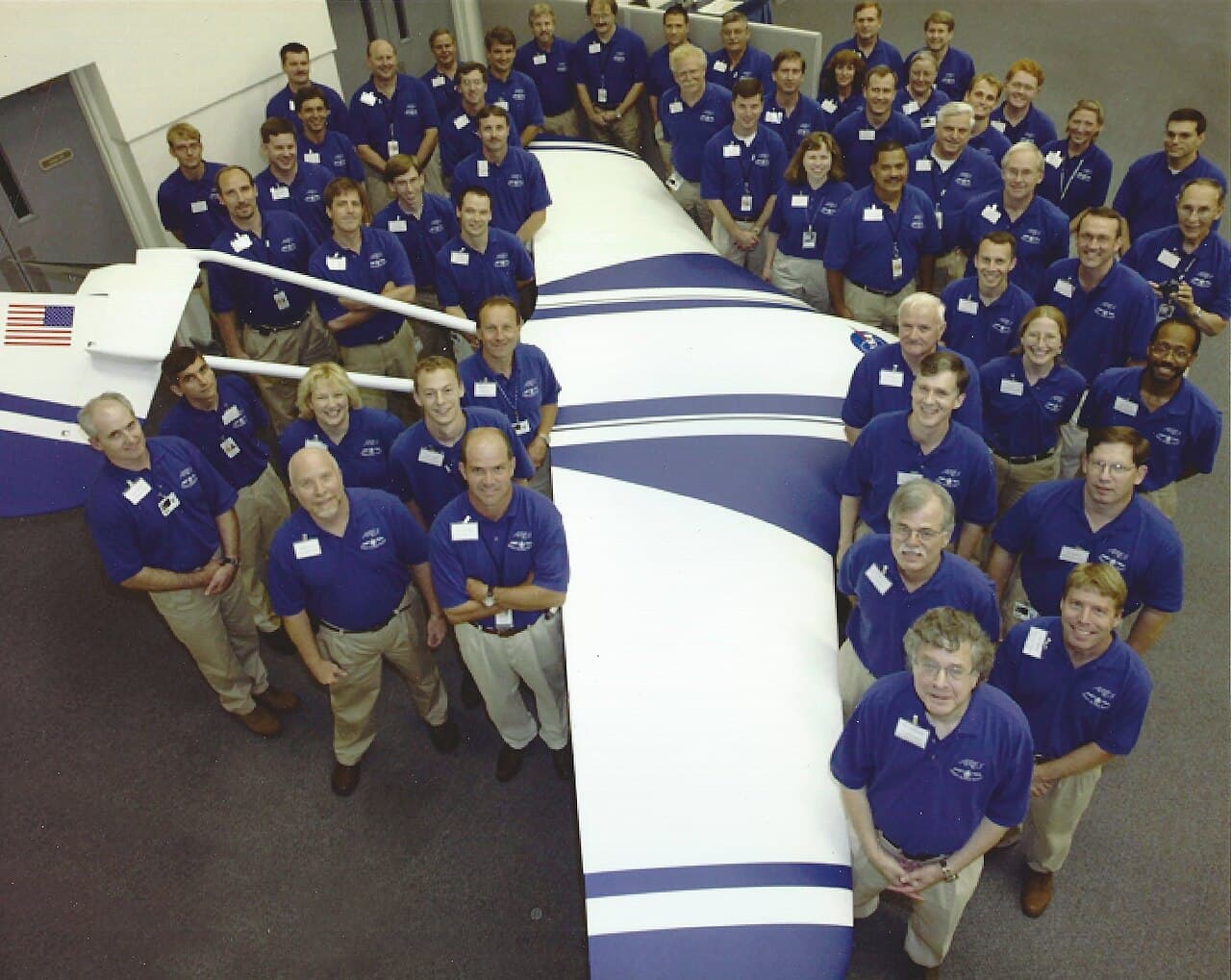
The hard part of flying on Mars is not flying. It is arriving. The atmosphere is about one percent of Earth's at the surface, so a wing has to be large and fast, and the whole aircraft has to survive launch, a ten-month cruise and a hypersonic entry folded inside an aeroshell before any of that matters. ARES was designed around that constraint from the outside in. The aeroshell was a 2.65 metre Viking-derived cone with 2.48 metres of usable internal diameter, and the airplane's shape was derived from what would fit inside it while still flying subsonically for the science. The result was a 6.25 metre span, a 4.45 metre fuselage, a 7 square metre wing and a folding scheme in which the tail came out first and then the wings. The entry sequence ran: direct entry, parachute, heatshield release, extraction of the folded aircraft from the backshell along rails, release, tail unfold, wing unfold, and a pull-up out of the resulting dive into level flight. Langley described this as the single well-defined and testable event containing most of the mission's risk, which is a fair summary and also an admission. On 19 September 2002 they tested it, dropping a half-scale ARES over Oregon from around 103,000 feet, where the air is thin enough to be Mars-relevant, and watching it unfold and fly itself.
The engine choice is where the mission's whole character was decided, and it was decided against ambition. Langley evaluated six propulsion options against a requirement to fly at least 480 km. A four-cycle internal combustion engine turning a propeller gave the best performance by a wide margin: 2,066 km and 4.1 hours on 42 kg of hydrazine. A piston expander engine gave 1,008 km. A fuel cell driving an electric motor gave 1,512 km. All of them needed a propeller that would have to fold into the aeroshell and unfold at altitude, and all of them sat at technology readiness level 4 to 5, meaning years of development. The bipropellant rocket option gave only 605 km and 1.2 hours, but it was TRL 7 to 9 with low development effort and no extra deployment. Under the Mars Scout rules, which capped cost at 325 million dollars in the first round and 475 million in the second and explicitly rewarded flight-proven hardware, the rocket won. So the aircraft that could have loitered over Mars for four hours became one that would fly for about seventy minutes on three 22-newton thrusters burning monomethyl hydrazine and nitrogen tetroxide, duty-cycled on and off to hold Mach number, and would then run dry and hit the ground.
What that hour would have bought is worth stating, because it explains why serious people kept proposing it. Flying at about 1.5 km above the surface at 145 metres per second, ARES would have made a magnetic survey of the Southern Highlands at two orders of magnitude better spatial resolution than Mars Global Surveyor achieved from orbit, good enough to resolve the structure of the sources rather than just the anomalies. Its mass spectrometer would have sampled the near-surface atmosphere in situ at parts-per-billion sensitivity, hunting for methane and other gases of possible biological or volcanic origin in the layer where orbiters cannot see and landers see only one point. A neutron spectrometer would have mapped near-surface hydrogen along the track, a context camera would have imaged a 3 km swath continuously, and an ionizing radiation detector would have measured what a human crew would face. The reference traverse drawn for the proposal began at 51.2 south, 180.0 east, ran south, and then covered two parallel 100 km legs; no part of it was ever flown. There was no orbiter to store the data: the carrier spacecraft would divert onto a flyby and relay everything live as the aircraft flew, with Mars Reconnaissance Orbiter as backup, and the 2005 plan promised science on the ground within eighteen hours.
ARES lost twice, and the second loss ended the road it was on. In the first round NASA drew 25 Mars Scout proposals in August 2002, named four for study on 6 December 2002, and on 4 August 2003 chose Phoenix, which went on to land in the northern plains in 2008 and find water ice and perchlorate. Langley kept working, funded not by the science directorate but by the aeronautics side through the Planetary Airplane Risk Reduction project: ejection dynamics tests in 2004, one-third-scale extraction demonstrations, wind tunnel campaigns in 2004 and 2006, and the airplane's outer mould line frozen in 2004. The second proposal went in on 21 July 2006 for an October 2011 launch. On 8 January 2007 NASA picked MAVEN and The Great Escape out of 26 proposals, and MAVEN won the round. There was no third Scout competition. By March 2011 the planetary decadal survey recorded that NASA did not intend to continue the Scout line beyond MAVEN and had folded Mars proposals into Discovery. The same decadal listed, among Mars missions suitable for Discovery, an in situ aerial mission to explore the part of the atmosphere not easily reached from orbit or the surface. Nothing of the kind has been selected in the fifteen years since.
It is easy to read ARES as a mission that was simply too strange, and that reading does not survive contact with the record. Nothing in the two competitions turned on the aircraft being exotic: the airframe had been frozen since 2004, the deployment had been flown at half scale in Mars-relevant air, the propulsion was off-the-shelf satellite thruster hardware chosen precisely because it was boring, and the propulsion trade study is an unusually clear document of a team deliberately picking the weaker option to lower risk. What beat it was the arithmetic of a small-mission line. Two Scout competitions produced two winners out of 51 proposals, and both winners answered questions about water and atmospheric escape that the programme had already committed to. Powered flight at Mars did eventually happen, on 19 April 2021, and it happened in the form Langley's 1999 and 2002 trade studies had shied away from, a rotorcraft, carried as a technology demonstration on a rover rather than as a mission in its own right. Ingenuity flew 72 times over nearly three years. As of August 2026 the aerial vehicles NASA has announced for Mars, the Ingenuity-class helicopters of the Skyfall payload on Space Reactor-1 Freedom, are helicopters too. The fixed-wing Mars aeroplane, studied since 1978, has still never flown.
Mission facts
What it was
A Mars exploration mission concept whose payload platform was an aeroplane rather than an orbiter, lander or rover. It would fly over the Southern Highlands at very low altitude to study crustal magnetism, the composition, chemistry and dynamics of the atmospheric boundary layer, and near-surface water. Principal investigator Joel S. Levine of NASA Langley Research Center; project lead Paul L. Moses, also at Langley.↗
Why an aeroplane
The stated case was a gap in scale. An aircraft at 1.5 km makes magnetic measurements at two orders of magnitude better spatial resolution than Mars Global Surveyor managed from orbit, takes atmospheric composition in situ where orbiters cannot reach, and covers hundreds of kilometres of terrain that no rover could drive.↗
The 2002 competition
NASA's first Mars Scout announcement of opportunity drew 25 proposals in August 2002. On 6 December 2002 NASA named four for six-month concept studies at up to 500,000 dollars each: SCIM, ARES, Phoenix and MARVEL. The eventual mission had a total cost cap of 325 million dollars and had to be ready to launch before 31 December 2007.↗
The 2002 outcome
The ARES concept study report went in at the end of April 2003, dated 30 April 2003 in one Langley citation and described as May 2003 in another Langley paper. On 4 August 2003 NASA selected Phoenix, the Peter Smith polar lander, as the first Mars Scout mission. ARES was not chosen.↗
The 2006 competition
Langley proposed ARES again for a 2011 launch. Its own papers date the proposal to 21 July 2006; NASA's announcement describes the 26 proposals it judged as having been submitted in August 2006. On 8 January 2007 NASA selected two for concept studies at about 2 million dollars each, MAVEN and The Great Escape, against a mission cost cap of 475 million dollars. ARES was not among them, and there was no third Scout competition: the decadal survey of 2011 records that NASA did not intend to continue the Scout line beyond MAVEN and had folded such missions into Discovery.↗
The aircraft
Wingspan 6.25 m, length 4.45 m, height 0.7 m, reference wing area 7.0 square metres, mean aerodynamic chord 1.25 m, cruise speed 145 m/s, composite airframe, navigation by inertial unit plus radar and air data. The outer mould line was frozen in 2004 after several design cycles and wind-tunnel and flight testing.↗
Mass figures disagree, because the design kept changing
Three published sets exist and they measure different vehicles at different dates. The 2004-05 Langley fact sheet gives 150 kg wet and 101 kg dry. The 2005 reference mission in Levine's LPSC abstract gives 66.5 kg dry with 32 percent reserve and 125 kg wet, inside a 678 kg wet spacecraft. The 2009 technical memorandum documenting the 2006 proposal gives a current best estimate dry mass of 112 kg with a 45 kg propellant load against a 185 kg airplane allocation, and its flight simulation table lists a total atmospheric flight system mass of 145 kg carrying 40 kg of propellant.↗
Propulsion, and why
Three 22-newton AMPAC-ISP bipropellant thrusters burning monomethyl hydrazine and nitrogen tetroxide with 3 percent mixed oxides of nitrogen, specific impulse about 291 seconds, fed by helium in a pressure-blowdown system and throttled by duty cycling rather than valves. Two thrusters fire to hold speed; the third comes in for climbs and turbulence.↗
The propulsion trade that decided the mission's length
Langley compared six options against a 480 km science range requirement. A four-cycle combustion engine driving a propeller offered by far the longest flight, 2,066 km and 4.1 hours, and a fuel cell offered 1,512 km, but both sat at technology readiness level 4 to 5 and required a folding propeller. The bipropellant rocket offered only 605 km and 1.2 hours but sat at TRL 7 to 9 with low development effort. Under Scout cost and risk rules, the short flight won.↗
The flight as simulated
A six-degree-of-freedom Langley simulation gave 543 km and 67.6 minutes in calm air and 536 km and 66.2 minutes in severe turbulence on a 40 kg propellant load, about 13.5 km per kilogram of propellant. On the baseline 45 kg load that scales to roughly 608 km and about 70 minutes. The reference traverse drawn in the proposal started at 51.2 S, 180.0 E, ran south, then covered two parallel 100 km north-south legs as an aeromagnetic survey. It exists only on paper.↗
Range figures disagree too
680 km on the Langley fact sheet, a maximum of 850 km over 101 minutes in the 2005 reference mission, up to 610 km on the project website in early 2007, and 608 km in the 2009 technical memorandum. These are different design iterations carrying different propellant loads, so they do not measure the same vehicle. The number tied to the actual 2006 Scout proposal is 608 km.↗
How it would have got out of the aeroshell
Direct entry, parachute, heatshield release, then extraction of the folded aircraft from the backshell, release, tail unfolding, wing unfolding and a pull-up into level flight. The airplane was to check its own altitude after the pull-out: above 2 km above ground level it would keep gliding, and at 2 km it would begin the pyrotechnic sequence that pressurised the propulsion system. Langley called airplane deployment the single well-defined and testable event holding most of the mission risk.↗
The test that proved the hardest part
On 19 September 2002 a half-scale ARES was released at high altitude over Oregon and deployed and flew autonomously in Mars-relevant atmospheric conditions. Langley's fact sheet gives the altitude as 103,000 feet and the project website as 103,500 feet. Follow-on work under the Planetary Airplane Risk Reduction project, funded from the Vehicle Systems Program in NASA's aeronautics directorate rather than from the science side, covered wind-tunnel testing, ejection dynamics tests in 2004 and one-third-scale aeroshell extraction demonstrations.↗
The payload
The candidate suite in the 2005 reference mission was a magnetometer reading the field at 2 km spatial resolution with 1 nanotesla sensitivity, a mass spectrometer measuring atmospheric constituents in situ at 1 part per billion, a neutron spectrometer for near-surface water, an ionizing radiation detector for human exploration planning, an atmospheric data system for pressure, temperature, density and wind, a context camera imaging a 3 km swath, and a video camera to record the deployment.↗
Where the data would have gone
There was no orbiter to wait for. The carrier spacecraft would have diverted onto a Mars flyby after releasing the entry system and relayed the airplane's data during the flight itself, with Mars Reconnaissance Orbiter as a redundant path for critical data. The 2005 reference mission promised science on the ground within 18 hours of the flight. No data was assumed from the airplane after impact.↗
The lineage, before and after
Mars aeroplane studies go back at least to a NASA contractor concept study of a remotely piloted vehicle for Mars exploration published in August 1978. ARES's immediate ancestor was the Mars Airplane Package of 1999, a 19 kg rocket-powered aircraft with a 1.73 m span and 20 minutes of flight, born from a challenge by administrator Dan Goldin to fly on Mars on the centenary of the Wright brothers. Powered flight at Mars eventually happened on 19 April 2021, when the 1.2 metre-rotor Ingenuity helicopter flew, and it went on to make 72 flights before its last on 18 January 2024.↗
Mission timeline
- Aug 1978NASA publishes A Concept Study of a Remotely Piloted Vehicle for Mars Exploration, contractor report CR-157942. The idea of flying an aircraft in the Martian atmosphere is already two decades old when ARES begins.
- Feb 1999NASA administrator Dan Goldin challenges the agency to fly an aircraft on Mars on the hundredth anniversary of the Wright brothers' flight. The resulting Mars Airplane Package, sized to the 0.8 m secondary payload ring of an Ariane 5, is a 19 kg rocket-powered aircraft with a 1.73 m span, 3.2 kg of fuel, 20 minutes of powered flight and a 200 km range. The Micromission programme dies before it flies.
- 2002Langley converges on ARES-1: a rigid airframe with rocket propulsion, frozen a few months after the basic concept downselect for the Mars Scout step 1 proposal.
- 19 Sep 2002A half-scale ARES is dropped from about 103,000 feet, unfolds and transitions to flight autonomously in Mars-relevant conditions. The altitude is the fact sheet's figure; the project website says 103,500 feet. The location, Oregon, comes from a figure caption in Levine's 2005 LPSC abstract; the fact sheet does not give it. It is the most complex risk-reduction test the project ever runs, and its results feed straight back into the airframe design.
- 6 Dec 2002NASA selects four of 25 Mars Scout proposals for concept studies at up to 500,000 dollars each: SCIM, ARES, Phoenix and MARVEL. The winning mission will have a 325 million dollar cost cap and must launch before the end of 2007.
- Apr to May 2003The ARES Concept Study Report is submitted, describing the refined ARES-2 configuration. Langley's own citations date it 30 April 2003 and describe it as May 2003.
- 4 Aug 2003NASA picks Phoenix as the first Mars Scout mission. ARES loses.
- 2003 to 2006Work continues under the Planetary Airplane Risk Reduction project, paid for by NASA's aeronautics directorate rather than its science directorate: ejection dynamics tests in 2004, one-third-scale aeroshell extraction demonstrations from 2003 to 2005, quarter-scale wind tunnel testing in 2004 and a further wind tunnel campaign in 2006. The airplane's outer mould line is frozen in 2004.
- 21 Jul 2006Langley submits ARES to the second Mars Scout announcement of opportunity, for an October 2011 launch on a Delta II 2925 and a 10.4 month cruise to a direct entry. NASA's own announcement instead describes the 26 proposals it received as arriving in August 2006.
- 8 Jan 2007NASA selects MAVEN and The Great Escape for concept studies out of 26 proposals, against a 475 million dollar cap. ARES is not selected, and MAVEN goes on to win the round outright.
- Mar 2011The planetary decadal survey Vision and Voyages notes that NASA does not intend to continue the Mars Scout programme beyond MAVEN and recommends folding Mars proposals into Discovery. Among the Mars missions it lists as suitable for Discovery is an in situ aerial mission to explore the part of the Martian atmosphere not easily reached from orbit or the surface. Nothing of the kind has been selected since.
- 19 Apr 2021Powered flight at Mars finally happens, and it is a helicopter rather than an aeroplane. Ingenuity, 1.2 metres across the rotors, flies for the first time and eventually makes 72 flights before its last on 18 January 2024.
A filled dot marks something that physically happened. A hollow one marks an announcement, a naming or a target.
In pictures
Tap a photo to enlarge.
Sources
- Christopher A. Kuhl, Design of a Mars Airplane Propulsion System for the ARES Mission Concept, NASA/TM-2009-215700, March 2009
- Guynn, Croom, Smith, Parks and Gelhausen, Evolution of a Mars Airplane Concept for the ARES Mars Scout Mission, AIAA 2003-6578 (NASA NTRS)
- J. S. Levine and the ARES teams, The Aerial Regional-scale Environmental Survey (ARES) Mission to Mars, Lunar and Planetary Science XXXVI (2005), abstract 1258
- NASA Langley ARES fact sheet, Robotic, Powered Airplanes for Planetary Exploration (archived, v6)
- NASA release 02-238, 6 December 2002: NASA selects four Mars Scout mission concepts for study
- NASA release 03-256, 4 August 2003: NASA's first Scout mission selected for 2007 Mars launch (Phoenix), archived
- NASA release 07-03, 8 January 2007: MAVEN and The Great Escape selected
- Spaceflight Now (8 January 2007): NASA selects proposals for future Mars missions
- ARES project website, science page (archived December 2007)
- ARES project website, reliability page (archived December 2007)
- National Research Council, Vision and Voyages (2011)
- NASA science mission page: Ingenuity Mars Helicopter
- NASA CR-157942, A Concept Study of a Remotely Piloted Vehicle for Mars Exploration, August 1978 (NTRS record)
Facts on this page were verified on 24 August 2026. Where sources disagree, the disagreement is stated rather than resolved silently.