Viking 2
NASA · United States · Lander · 1976 · The Viking yearsSuccess
Landed in Utopia Planitia on 3 September 1976, canted 8.2 degrees with one footpad on a rock, and worked 1,281 sols against a 90-day design life. Turned off on 11 April 1980 when its batteries stopped holding a charge.
TL;DR· 12 min read
Viking 2 landed in Utopia Planitia on 3 September 1976 with one footpad on a rock and the whole lander canted 8.2 degrees, and it worked 1,281 sols against a 90-day design life. It photographed water frost settling on the ground, carried the only Viking seismometer that worked, and kept a weather record long enough that a paper built entirely from it was published in 2025. Its batteries stopped holding a charge and it was turned off on 11 April 1980.
Viking 2 was the second half of a matched pair, and the half that went north into the cold. Its lander touched down in Utopia Planitia on 3 September 1976, one footpad on a rock and the whole spacecraft canted 8.2 degrees, and spent three and a half years in a place cold enough for water frost to settle on the ground every winter. It photographed that frost, carried the only Viking seismometer that worked, and kept a weather record long enough that a paper built entirely from it was published in 2025.
- 1,281sols on the surface, against a 90-day design life
- 8.2°tilt it came to rest at, one footpad on a rock
- 16,041pictures its orbiter returned in 706 orbits
Viking 2 was the spacecraft originally built as Viking A. When the first launch attempt slipped in August 1975 and the orbiter's batteries read 9 volts instead of 37, managers swapped the two vehicles rather than lose the window, so Viking A launched second, on 9 September 1975 at 18:39 UT, and NSSDCA's catalogue still lists "Viking-A Lander" among Viking 2's alternate names. It took 333 days to reach Mars and entered orbit on 7 August 1976. Its lander was aimed much further north than Viking 1's, into Utopia Planitia about 200 km west of the crater Mie, at nearly 48 degrees north: colder, closer to the seasonal ice, and chosen partly because water was likelier there. Separation on 3 September did not go entirely to plan. The bioshield base cover joining lander to orbiter was supposed to be pushed away after separation, and instead stayed attached to the orbiter for the rest of its life. The descent was textbook until the last half second, when the terminal descent radar appears to have read a rock or an unusually bright patch of ground and the engines fired one extra pulse 0.4 seconds before contact, cracking the surface and throwing up dust. The lander came to rest with one footpad on a rock, canted 8.2 degrees, at 22:37:50 UT spacecraft time. The signal reached Earth twenty and a half minutes later, at 22:58:20 UT, which is why NSSDCA's own pages give two different landing times for the same event.
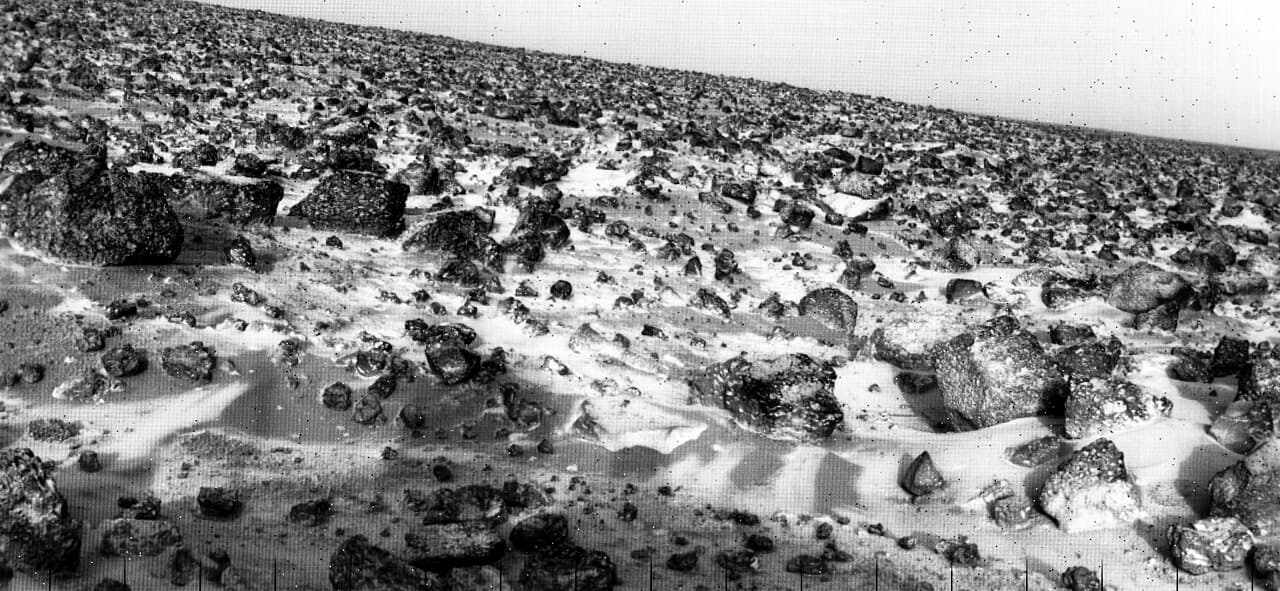
What Viking 2 was really for became clear in its second Martian autumn. On 13 September 1977, at 12:59 in the afternoon local lander time, camera 2 took a blue-filter picture looking due north and found white material banked against the bottoms of rocks, lying in a trench the sampler arm had dug, and scattered in patches across the darker soil. It was frost, and JPL called it the first clear indication of frost accumulating on the Martian surface seen by a lander camera. It came and went: laid down in the night, partly gone by the warmest part of the day, and present in some form for roughly 250 sols from late autumn into early spring. A Martian year later the cameras were pointed at the same scene and it was there again, photographed on 18 May 1979 as a thin coating of water ice on rocks and soil. The repeatability mattered more than the picture. All the while the meteorology boom was logging temperature, pressure, wind speed and wind direction, and the combination of a long calibrated weather record with in-place frost observations is rare enough that as of 2025 only two Mars missions had produced it: Viking 2 and Phoenix. Viking 2 also carried the pair's only working seismometer, since Viking 1's never uncaged. Most of what it recorded was wind, but the sol 80 event has been argued about ever since.
Viking 2 died in pieces over four years, and no two pieces died the same way. The orbiter went first. A leak in its propulsion system vented the compressed nitrogen it used to hold its attitude, and with no way to keep its solar panels on the Sun and its dish on Earth it was parked in a 302 by 33,176 km orbit and switched off after 706 orbits and 16,041 pictures. The lander outlasted it by nearly two years, but wounded. Part of its communications system had failed during the Extended Mission, leaving it with no way to talk directly to Earth at all. From then on it could only send data when Viking Orbiter 1 passed overhead, which during the Survey Mission meant roughly one relay opportunity every seven weeks. Through its first northern winter it had already been run on a survival program that kept it alive in the cold while still returning imaging, meteorology and seismology data, and it came back to full operation when the season turned. What finally stopped it was power. Its batteries stopped holding a charge, and it was turned off on 11 April 1980 after its last relay transmission, having run 1,281 sols against a 90-day design life. Both cameras were still fully functional at the end, after 2,156 separate imaging sequences.
Almost nothing about Viking 2 has stayed finished. On 21 November 2006 the HiRISE camera on Mars Reconnaissance Orbiter photographed the lander from orbit at 47.673 north, 134.300 east, confirming the identification by matching boulders, dunes and lander-derived topographic contours between the orbital frame and the lander's own panoramas, and picking out likely spots for the heat shield and backshell. In July 2001 the lander had been renamed the Gerald A. Soffen Memorial Station, for the Viking project scientist who had died the previous November. Its seismometer data, archived and then largely left alone, was rebuilt into a usable modern dataset by Ralph Lorenz in 2017 and reworked again in a 2023 paper that tested the Viking traces against what InSight had since taught us about how Mars actually shakes. And on 10 June 2025 Vincent Chevrier of the University of Arkansas published a paper in Communications Earth & Environment built entirely out of Viking 2's weather record: feed those 1970s pressure and temperature measurements into a modern Martian climate model, add the frost the cameras photographed, and calcium perchlorate at that site should form small amounts of liquid brine for roughly 30 sols at the end of winter, in films around soil grains and pockets in the surface. None of that required a new spacecraft. It required a lander that sat in one cold place long enough to build a record, and an archive that kept the record. Viking 2's fiftieth landing anniversary falls on 3 September 2026.
Mission facts
Launch
9 September 1975, 18:39:00 UT, on a Titan IIIE-Centaur from Launch Complex 41, Cape Canaveral Air Force Station. This was the vehicle originally built as Viking A; after the August launch scrubs the two spacecraft were swapped, and NSSDCA still lists "Viking-A Lander" and "Viking A" among Viking 2's alternate names.↗
Cruise and orbit insertion
333-day cruise. Mars orbit insertion on 7 August 1976 into a 1,500 x 33,000 km, 24.6-hour orbit, trimmed on 9 August to a 27.3-hour site certification orbit with a 1,499 km periapsis and 55.2 degree inclination. Landing sites were chosen from these images together with Viking Orbiter 1's.↗
Separation anomaly
The lander and aeroshell separated from the orbiter on 3 September 1976 at 19:39:59 UT. The bioshield base cover connecting the two was supposed to be ejected afterwards; because of problems with the separation it stayed attached to the orbiter for the rest of the mission.↗
Landing
3 September 1976 at 22:37:50 UT spacecraft time, 9:49:05 a.m. local Mars time. The signal reached Earth about twenty and a half minutes later at 22:58:20 UT, which is the figure NSSDCA prints on the lander page while its orbiter page prints the spacecraft event time. No source states the split in so many words, but the 20 minute 30 second gap between the two published figures is exactly the Earth-Mars one-way light time on 3 September 1976, and NSSDCA prints the 9:49:05 a.m. local Mars time alongside 22:58:20 rather than alongside the touchdown instant it belongs to.↗
Landing site
Utopia Planitia, 47.6673 N, 134.2809 E planetocentric, about 200 km west of the crater Mie and roughly 6,400 km (about 4,000 miles) from the Viking 1 site. Published planetographic equivalents are 47.967 to 47.968 N, 225.71 to 225.74 W.↗
Landing anomaly
The terminal descent radar appears to have misread a rock or a highly reflective patch of ground, so the descent engines fired one extra pulse 0.4 seconds before contact, cracking the surface and raising dust. The lander settled with one leg on a rock, tilted at 8.2 degrees, with about 22 kg of propellant unused. The cameras began imaging immediately.↗
Frost
On 13 September 1977, at 12:59 p.m. local lander time, a blue-filter image looking due north captured what JPL describes as the first clear indication of frost accumulating on the Martian surface seen by a lander camera: white material around the bases of rocks, in a sampler trench and in patches on darker soil. It formed at night and partly vanished by day. A high-resolution colour image on 18 May 1979 showed the same thin water-ice coating a Martian year later.↗
Seismometer
Viking 2 carried the only seismometer that worked on either lander; Viking 1's failed to uncage. It returned the only seismic data from the Martian surface until NASA's InSight in 2018. Most of the signal is wind, but the sol 80 event has been argued about since Anderson and colleagues flagged it in 1977, and reanalysis against InSight data has revived the case for sol 80 and sol 53 being genuine quakes.↗
Lost direct link to Earth
Part of the lander's communications system failed during the Extended Mission, leaving it with no direct downlink to Earth. From then on it could only return data when Viking Orbiter 1 flew a relay pass overhead, which during the Survey Mission meant roughly one opportunity every seven weeks.↗
Winter operations
Through its first Martian winter the lander was run on an automatic program designed simply to survive the cold while still returning imaging, meteorology and seismology data, then brought back to full operation once winter passed. Viking 1, nearer the equator, needed no such measure.↗
Orbiter end of mission
A leak in the propulsion system vented the compressed nitrogen used for attitude control. The orbiter was placed in a 302 x 33,176 km orbit and turned off after 706.1 orbits and 16,041 pictures. NSSDCA, the PDS lander archive and NASA's Viking project page give 25 July 1978, and so does the Viking facts table in Appendix H of JPL Publication 82-107, which states the end of orbiter operations outright. A JPL news release of 9 July 1980 and some NASA mission summaries give 24 July 1978 instead. The same JPL publication credits the orbiter with 1,049.52 days from an 18:39 UT launch, which independently works out to the morning of 25 July 1978.↗
Lander end of mission
Turned off on 11 April 1980 after its last relay transmission, when its batteries could no longer hold a charge, having operated 1,281 Mars days (about 1,316 Earth days). Both cameras were still fully working, after 2,156 camera events across three and a half years.↗
Renaming
Renamed the Gerald A. Soffen Memorial Station in July 2001, for the Viking project scientist, who died in November 2000.↗
Found from orbit
Photographed by the HiRISE camera on Mars Reconnaissance Orbiter on 21 November 2006 at 47.673 N, 134.300 E. The identification was confirmed by matching boulders, dunes and lander-derived topographic contours between the orbital image and the lander's own panoramas, and likely positions were found for the heat shield and backshell.↗
Still producing science
Vincent Chevrier of the University of Arkansas published a paper in Communications Earth & Environment on 10 June 2025 built from Viking 2's meteorology data and frost images, concluding that calcium perchlorate at the site could form small amounts of liquid brine for about 30 sols at the end of winter as the frost sublimates. The paper describes Viking 2 as one of only two missions, with Phoenix, to have observed water frost forming in place on Mars.↗
Cost and design life
Part of a Viking project costing about 1.06 billion US dollars in then-year money. Both orbiters and both landers were specified to operate for approximately 90 days after landing. Viking 2's lander beat that by a factor of about fourteen, its orbiter by a factor of about seven.↗
Mission timeline
- 9 Sep 1975Launch at 18:39:00 UT from Launch Complex 41 at Cape Canaveral, three weeks after its twin and on the vehicle originally designated Viking A
- 7 Aug 1976Mars orbit insertion after a 333-day cruise, into a 1,500 x 33,000 km, 24.6-hour orbit
- 3 Sep 1976Touchdown in Utopia Planitia at 22:37:50 UT after an extra engine pulse 0.4 seconds before contact; the lander settles with one footpad on a rock at 8.2 degrees and starts imaging at once
- 30 Sep 1976The orbiter's inclination is raised to 75 degrees to open up the high northern latitudes for mapping
- 8 Nov 1976The orbiter's primary mission ends at the start of solar conjunction; the extended mission resumes on 14 December
- 13 Sep 197712:59 p.m. local lander time: a blue-filter image looking north records the first clear indication of frost accumulating on the Martian surface seen by a lander camera
- 23 Oct 1977After close approaches to Deimos earlier in the month, the orbiter's periapsis is lowered to 300 km and its period set to 24 hours
- 25 Jul 1978The orbiter, leaking attitude control gas from its propulsion system, is parked in a 302 x 33,176 km orbit and switched off after 706 orbits and 16,041 pictures
- 18 May 1979A high-resolution colour image shows the same thin water-ice frost on rocks and soil a full Martian year after the first sighting
- 11 Apr 1980The lander is turned off after its last relay transmission, its batteries no longer able to hold a charge, after 1,281 sols and 2,156 camera events
- 21 Nov 2006The HiRISE camera on Mars Reconnaissance Orbiter photographs the lander at 47.673 N, 134.300 E, matching boulders and dunes to the lander's own panoramas
- 10 Jun 2025Communications Earth & Environment publishes Vincent Chevrier's analysis of Viking 2's weather and frost data, arguing that calcium perchlorate brines could form at the site for about 30 sols at the end of winter
A filled dot marks something that physically happened. A hollow one marks an announcement, a naming or a target.
In pictures
Tap a photo to enlarge.
Sources
- NSSDCA Master Catalog: Viking 2 Lander (1975-083C), archived
- NSSDCA Master Catalog: Viking 2 Orbiter (1975-083A), archived
- Guinness, E. A., Archive of Viking Lander 1 and 2 EDR Images, NASA Planetary Data System
- Mudgway, D. J., Telecommunications and Data Acquisition Systems Support for the Viking 1975 Mission to Mars, JPL Publication 82-107 (1983)
- HiRISE PSP_001501_2280: Viking Lander 2 (Gerald Soffen Memorial Station) imaged from orbit, 21 November 2006
- NASA Science: Viking 2 mission summary
- JPL PIA00530: Frost on Utopia Planitia, 13 September 1977
- JPL news release, 9 July 1980: Viking Orbiter 1 Approaches Its Mission End
- Chevrier, V. F., Perchlorate brine formation from frost at the Viking 2 landing site, Communications Earth & Environment 6, 447 (10 June 2025)
- Lazarewicz, A. R., Viking Marsquakes 1976, Seismic Archaeology, J. Geophys. Res. Planets 128(7) (2023)
- Lorenz, R. D., Viking-2 Seismometer Measurements on Mars: PDS Data Archive and Meteorological Applications, Earth and Space Science (2017)
- NASA History: 45 Years Ago, Viking 1 and 2 off to Mars
Facts on this page were verified on 23 August 2026. Where sources disagree, the disagreement is stated rather than resolved silently.
134.2809 E, 47.6673 N · Utopia Planitia